Showing posts sorted by relevance for query "Norman Graham". Sort by date Show all posts

Sunday, June 19, 2016

Norman Graham

Following the recent celebration of Alan Knott on his seventieth birthday, some readers have requested more on Kent players of the golden era. I will take Brian Carpenter’s suggestion of Norman Graham first, partly because Graham was a favourite then but rather forgotten since, and partly because Brian is responsible for my name being mentioned (and kindly at that) in the 2016 Wisden, in his review of cricket blogs.

From time to time I have set about compiling an XI of players of the past who would would have no place in the modern game, not from lack of ability, but because they would not meet contemporary fitness standards. But this is a hard call. What are the criteria for selection?

For example, some would put Colin Cowdrey at the top of the list. A cheer would rise around St Lawrence when he chased the ball to the boundary every couple of years or so. Yet Cowdrey was a talented sportsman and superb slip who, in a later era would have romped around the field like his sons Chris and Graham, both of whom were excellent fielders. So he doesn’t qualify.

In my piece on Derek Underwood I suggested that many a modern coach would have taken one look at a 17-year-old bowler with round shoulders, cigarette on, and the acceleration of a Morris Marina and pointed towards the gate with no need for further discussion. But while Underwood never quite shook off giving the impression that whenever he ran, it was through an invisible trough of treacle, he became a highly dependable fielder capable of the occasional remarkable catch: one at Gloucester in the Sunday League in 1979 sticks in the mind, running back from mid on to stretch out a hand to dismiss Jim Foat when most of us hadn’t thought it a chance.

So not Underwood either.

In fact there are only two players who I would have as stone-cold certainties for this team (the Bradman and Hobbs of the lumbering, if you will). One was playing at the Wagon Works Ground that day and was, to nobody’s surprise, run out: David Shepherd, later one of the great umpires, then a spherical Gloucestershire batsman.

The other: Norman Graham.

Graham opened the bowling for Kent for a decade, one that encompassed almost all of the glory years. He contended with Tony Greig for the title of tallest first-class cricketer of the time, being six foot seven or thereabouts. But before we consider what Norman Graham was, let us address what he wasn’t: he was neither a batsman nor a fielder.

Every team used to have one. Some had two, or even three: a No 11 batsman who was never absolutely certain if he was a right or left-hander. They have disappeared almost completely. I watched a one-day game from Taunton on TV last week. Somerset wanted 60 when the last man, Tim Groenewald, came in. He proceeded to knock them off while doing a passable imitation of Walter Hammond.

Norman Graham wasn’t the worst batsman I have seen; Kevin Jarvis was comfortably that. When the two batted together Graham was at No 10, as he was when he and John Dye were both in the team. One shot sticks in the mind when many by real batsmen have disappeared, because it was such a surprise. St Lawrence, August 1972: Graham plonks the long left leg well down the pitch and drives Johnny Gleeson of the Australians over mid off and to the boundary, two bounces. There was a gasp, then a cheer as loud as for anything in the match.

Another thing that has gone from first-class cricket is third man. Until quite recently, there was invariably a third man from the start of the innings, but these days it seems that no matter how often the ball finds its way there, captains will no more deploy a fielder in that area than they would in a minefield (even though it takes only a couple of cover boundaries for them to install a sweeper for the duration; I sense my inner Fred Trueman emerging).

One reason for this may be that third man is no longer required to fill the role for arthritic fielders that country parishes did for the stupid sons of the aristocracy: to be somewhere for them to hide.

Norman Graham spent much of his time at third man. If the ball came straight to him, all would be well, provided that he had enough notice to get the bending down organised. He had a powerful and accurate throw.

If a pursuit were needed, it would start like a farm tractor on a frosty morning. When the ball beat him he would throw back his head and smile in surprise, as if that were only the second time that season that one had eluded him, rather than the third time that over, as was more probably the case. On the odd occasion when the ball was intercepted, its progress would be allayed by a large boot, and would then rest awhile while it waited for Graham to return from the distant point where he had managed to stop and turn.

There was obviously no question of him diving. Had he done so, it would have required the equipment and expertise necessary to right a felled giraffe to have restored him to the vertical.

What Norman Graham did so very well, was to bowl. Go to 23:30 here to see him in action in the Benson & Hedges Final of 1973. At first glance he does not look much at all: a 12-pace amble to the crease a prelude to a delivery action that Richie Benaud fairly describes as “ungainly”. Yet he took 614 first-class wickets, and a further 172 in one-day cricket.

His height meant that the ball reached the batsman at a steeper angle than his pace suggested, a sort of bargain basement Glenn McGrath. Like the great Australian, Graham bowled with a proofreader’s accuracy, searching out whatever assistance the pitch had to offer.

He established himself as a regular in 1967, when he finished third in the national averages with 104 wickets at 13.9. At Bradford early that season, Geoff Boycott bagged the only pair of his career, bowled Graham in the first innings, caught Knott bowled Graham in the second.

Let’s look again at that 55-over trophy win in ‘73. In seven matches he took 11 for 206, conceded at just under three an over. Remember that then the opening bowlers were usually the death bowlers too. Norman Graham was as important as Derek Underwood in that one-day attack. He played in three Lord’s finals and Kent won them all (it is often forgotten that he pulled out of the ‘71 Gillette final on the morning of the game; in his absence the partnership of Hughes and Simmons at the end of Lancashire’s innings made all the difference).

The public showed its appreciation during his benefit year in 1976, when it was said that he visited every pub in Kent. Perhaps not absolutely true, but within the margin of error. He was rewarded with a declared return of £70,000 (the average house price in England in 1976 was £13,000). It was rumoured that the actual figure was somewhat higher, but camouflaged so as not to provoke Her Majesty’s tax inspectors into a review of the tax-free status of cricketers’ benefits. This was an appreciation of Norman Graham’s skill, and of his whole-hearted effort. More than that, it acknowledged that here was a cricketer who set out to enjoy the game and was proud to play it.

If it is the case that cricket would not have room for a Norman Graham these days, the game is the worse for it.


Tuesday, November 1, 2011

In Search of the Crabble

Kent v Essex, County Championship, the Crabble Ground, Dover, 30 and 31 August 1967


I first went to the Crabble Ground in Dover 44 years ago, for the second (and, as it turned out, final) day of the Championship match between Kent and Essex. It was the first time I had watched cricket anywhere other than at the St Lawrence Ground.

Kent wrapped up a victory that took them to the top of the table, though everybody knew that it was too late; Yorkshire were in a strong position in a game in progress and had another fixture to come, wheras Kent's programme was now concluded, and Yorkshire duly became champions the next week. By that time, Kent held the Gillette Cup having defeated Somerset in the final on the Saturday following this game.

I still have the autograph book in which I collected signatures after the game had ended. Among compliant signers that day were Peter West, for four decades the face of BBC TV's cricket coverage but reporting for The Times that day, and Kent's match winner Norman Graham.

1967 was Graham's breakthrough season. A fringe player up to that point, his pinpoint medium-fast bowling, making full use of his six feet seven inches, took him to third place in the national bowling averages (Derek Underwood was top) with 104 wickets at 13.90. He remained a key member of the Kent attack for a further decade, his accuracy and extra bounce contributing significantly to the one-day glory years, even if his batting and fielding did not; he challenges Kevin Jarvis for the title of worst batsman that I have seen, but Jarvis takes it out.

Norman Graham was hugely popular with Kent supporters and was richly rewarded in his benefit season. Benefits have fallen into deserved disrepute now that county cricketers are well paid, but in the seventies they were justified reward for long-serving professionals. Graham, who was said to have visited a thousand pubs during his year, earned enough to buy several houses and, I hope, a nice car. He left the Crabble that day folded into a Triumph Herald, adopting a driving position not usually seen outside a dodgem track, but he had taken 12 for 80, so was smiling.

Of course, the Crabble pitch was not so much helpful to Graham and his colleagues as enslaved to them. There have not been too many unabbreviated matches which one team has one won comfortably having scored fewer than 200, as was the case in 1967. Pitch quality remained an issue there. Things came to a head in 1976 when Charles Rowe, batsman and occasional off spinner, took 11 for 71 against Derbyshire, almost a fifth of his total career haul for Kent. That was that. It was the last time county cricket was played at the ground, a shame because it was the most attractive of all the Kent grounds, though supporters of the Nevill at Tunbridge Wells will disagree.

Accompanied by my Blean correspondent, I went back there last week (I am in the old country for a month). The ground was hard to find, though this was more because of navigational issues than anything to do with the ground itself. I am always confused as to where the sun is when I change hemispheres and, except when I resume duties as his chauffeur, my correspondent relies on public transport to get him where he wants to go, so is untroubled by such concerns. We hit upon the idea of following a bus, as my correspondent had passed the ground while on such a conveyance at some unspecified point in the past. I recommend this as an aid to navigation, though we added the refinement of establishing where the bus was going later than we might have done. But Dover is on the coast, so we reasoned that we could only explore half the compass, and came upon the ground well before nightfall, a success by our own standards.
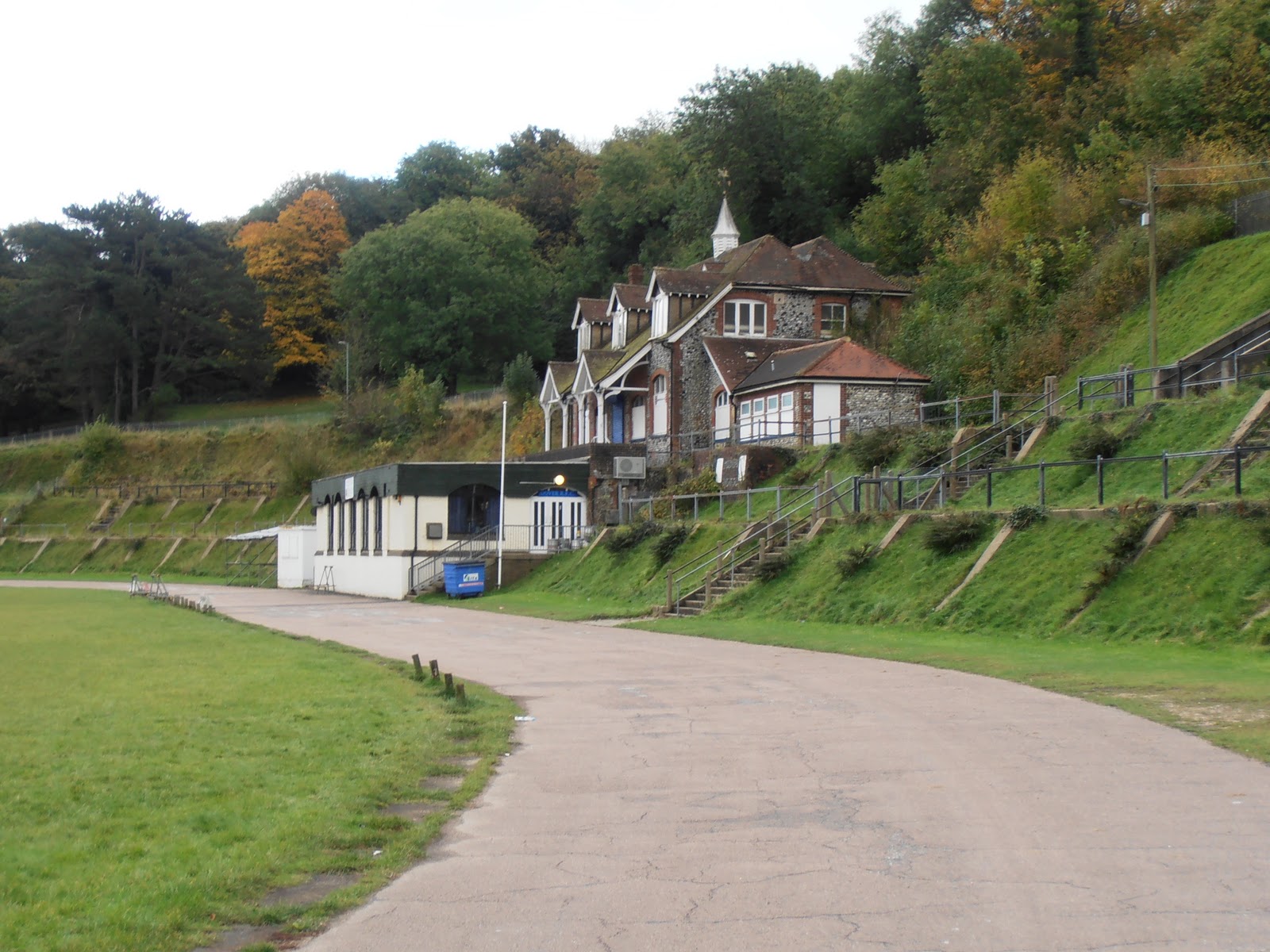
We were pleased with what we found. The Crabble is no longer a cricket ground, but has escaped the developers' grasp. It is home to Dover Rugby Club and instantly recognisable as the splendid venue it once was.

 It is situated in a valley at River (not all Kentish names are imaginative), with tall trees marking the extremity of the ground on three sides. Cut into the hill is a series of terraces, which used to accommodate seating, covered on the higher levels, with more trees above them. This is slightly reminiscent of the majestic Pukekura Park in New Plymouth, though on a much smaller scale. In the middle is the stone pavilion, run down and boarded up now, but stately in its day, brightly painted and decorated with flower baskets.
I have watched cricket from few better places than the higher terraces at the Crabble. It is to hoped that cricket can return to the ground one day; there is room enough, despite the floodlights around one of the two rugby pitches. New Zealand expertise in using the same piece of turf for a rugby pitch and cricket square would be useful.

We took a couple of turns around the ground and thought of the players who had batted and bowled with grace and style to match the surroundings. Ames and Leyland scored double hundreds here; Ames seven more centuries, Woolley the same number. Sobers scored a quickfire, match-winning hundred in 1968 described with awe by those who saw it, and he'd taken seven for 69 earlier in the same game. Yorkshiremen liked bowling here. Illingworth took 14 in a game in 1964, Verity nine in an innings in 1933, Trueman eight for 28 in 1954. And Kent's Freeman took seven or more on ten occasions.

The rustling of the trees is leftover applause for them all.

Sunday, September 17, 2017

Gillette Cup Final, Kent v Somerset, Lord’s, 2 September 1967


The Second World War was still a point of reference for most things in 1967. I see now that what was a distant event for an eight-year-old was so recent and defining for those that had lived through it that everything that happened would be measured in relation to it. So the scramble for Gillette Cup final tickets in Kent was compared to rationing. Tickets were the oranges of our time, such was the demand generated by Kent’s run in the Cup and the Championship. 

It was fortunate then, that a speculative enquiry at the East Kent Bus Co offices secured the last two seats on the bus to Lord’s and the match tickets that went with them. So with daylight breaking over the pier, my father and I made our way along Herne Bay sea front to the bus stop, he carrying the provisions, me a string bag containing the three books pictured at the top of this page.

The recent debate about the redevelopment of Lord’s has made reference to the “prison wall” at the Regent’s Park end of the ground. This was pretty much my first impression of the ground as the bus deposited us beside it. We found seats on the bottom level of the grandstand, at wide third man when a right-hander was facing bowling from the pavilion end. The pavilion apart, the whole ground has been rebuilt since then, but would still be unmistakably the same place. The Tavern Stand was under construction, though the noise that had spoiled John Woodcock’s day early in the season was silenced for finals day. I don’t recall a space around the boundary; perhaps some temporary seats were installed in front of the building site.

The arrangements were more informal than is the case for big games now. Some spectators sat on the grass behind the boundary. A group of Somerset supporters dressed as stereotypical yokels pushed a haycart around the boundary all day, dispensing cider as they went and waving pitchforks in the air when Somerset took a wicket.   

Seats were unallocated, so a spectator with a ground admission ticket had a wide choice. This was the first of 28 one-day finals that I attended at Lord’s, and this was the case for all those until 1985, when I found that my allocated seat at the Nursery End was perfect other than being directly behind the sightscreen, a discovery that led to my watching a few overs of the afternoon session from the assistant secretary’s office next to the pavilion as I offered him the benefit of my experience on this issue.

Kent’s XI was as it had been for the semi-final, except that Norman Graham was fit and replaced David Sayer. Brian Luckhurst played for the first time since having his hand broken by Fred Trueman at Canterbury a month before. Colin Cowdrey won the toss and chose to bat. 

It would be untrue to claim that I remember the detail of the game, but the ebb and flow of the three sessions remains with me. Easy until lunch; collapse and a good start by Somerset up to tea; a gradual relieving of tension after that. Kent were most comfortable during the opening partnership of 78 between Denness and Luckhurst. Denness played the “one innings of genuine quality”, according to Woodcock. Shepherd was at No 3, and with Luckhurst (who was out of touch but determined) put on 60 for the second wicket. 

The last nine Kent wickets fell for 55, all attempts at late order acceleration to no avail. Dixon and Brown were both promoted, but got one between them. Knott and Ealham’s partnership of 27 for the seventh wicket was vital; as so often, Ealham’s contribution was worth much more in context than the face value—17 in this case—suggested.

Bill Alley did most to slow Kent down, with three for 22 from 12 overs. Alley was 48 years old by 1967. Once said to be the best welterweight in Australia, he brought the fighter’s instinct and temperament to the field. He came to England having missed out on selection for the 1948 Invincibles, playing in the leagues until 1957 when he joined Somerset. He bowled assorted slow-medium that was as close as you could get in 1967 to modern limited-overs death bowling. He later became a fine umpire; nobody got away with anything as he knew every underhand ruse and had been the originator of some of them. 

Graham Burgess bowled six tidy overs for 17. Burgess bookends Kent’s glory years, there at Lord’s as they began and the only member of the Somerset XI still playing when they ended at Taunton in the Gillette Cup quarter-final of 1979, when Kent were routed for 60. Indeed, it was his doughty unbeaten 50 that day that gave Garner and Botham the space in which to wreak havoc.

In 1967 the grammar of one-day cricket was largely unwritten, so we didn’t really know how challenging a target 194 was. Not enough, it seemed as the 50 partnership for the first wicket between Roy Virgin and Peter Robinson was registered. A few balls later Virgin mistimed an on drive off Alan Dixon and the ball went in a high parabola towards mid on. Kent eyes swivelled to see who was there; a gasp followed the collective discovery that it was Norman Graham, who was to high catches what Robert Maxwell was to pensions. No matter. Graham held on. From that point on no Somerset partnership became properly established—only two got into the twenties—and the balance of the game shifted each time a wicket fell.

The Kent bowling was consistently tight. Graham took one for 26 in 12, Shepherd two for 27. Woodcock makes the point that by the 41st over, Underwood, making the first of ten appearances in Lord’s finals, still had nine to bowl. He finished off the innings with three for 41. 

It was tense rather than exciting. Looking back, I am reminded of the 1983 World Cup final, when it seemed impossible that India’s 183 would be enough to hold off the West Indies, but the wickets kept falling, so it was.

The Playfair Cricket Annual 1968 described the game as the best Gillette final of them all, which is a bit of a stretch; Playfair editor Gordon Ross also handled the PR for the competition. John Woodcock was closer to it with his judgment that it was the closest final, but “from the cricketing point of view, the most ordinary”. The best cricket in a Gillette final had—astonishing as it may now seem—been provided by Geoff Boycott (“forcing shots all round the wicket” said Wisden), who took the Surrey attack apart in 1965 like one of those plants that blooms only every 20 years. 

So the first of 11 titles in 12 seasons went to the hop county (the tradition of garlanding the Lord’s dressing room balcony with hops began that day too).

Sunday, June 12, 2022

A Sunday League catastrophe

Kent v Middlesex, 11 June 1972, Folkestone, 40 overs

The 2022 season has been a wretched one for Kent. In each of the county’s first five Championship games, the opposition made more than 500. The Sri Lankan Development XI did the same in an additional first-class fixture. The sequence may be a record. The dismissal of Northamptonshire for a mere 430 in the sixth Championship match was, no doubt, greeted by dancing in the streets of Tunbridge Wells.

If we expected Kent’s status as champions to give us solace in the T20, we were to be disappointed. Despite the recent win at Taunton, they remain ninth of nine in the southern group. Being able to watch the live streams of county cricket here in New Zealand is a wonderful thing, but breakfast watching has been a Groundhog Day of Kentish defeats.

My Blean Correspondent and I have been wondering whether 2022 displaces 1980 as the annus horribilis of our times. In that wet summer, Kent were kept off the bottom of the Championship only by a win over Warwickshire off the penultimate possible ball of Canterbury Week. There were exits at the earliest possible opportunity in both knockout competitions, and Sundays were spent adrift in the bottom half of the league.

Allen Hunt and George Murrell always maintained that the fifties were universally grim. One day, I mentioned that in 1951 Kent had a run of 20 Championship games without a win. George just said “Ah yes” as if remembering a summer spent in a foxhole and preferring not to talk about it.

So it is tempting to take refuge in the past, to return to the seventies when the sun shone every day on a never-ending series of Kentish victories, except when it didn’t.

Exactly half-a-century ago today as I write, Kent played Middlesex in the Sunday League at Folkestone. I loved the Sunday League, but it is in the nature of the shorter forms that many of its matches have not stuck in the mind. I look at scorecards knowing that I must have been there, but struggle to excavate corroboration from the memory.

Not this one. Kent v Middlesex at Folkestone in 1972 is a contest that I have thought about more than any other that I have watched. It was again in my mind just last week as I willed New Zealand to take some wickets even as England were within a couple of shots away from victory at Lord’s. Remember Folkestone ‘72, I thought as I invariably do as cricket matches reach their conclusion with one team well ahead, either from caution or hope, depending on whether it is my team that is winning or losing.

For this was a game in which Kent snatched defeat not just from the jaws of victory, but from its lower intestine, almost fully digested.

It was a top-of-the-table fixture. Kent had won four from five thus far in 1972, Middlesex were unbeaten. The first Ashes test was taking place at Old Trafford so Kent were without Luckhurst and Knott. Middlesex had no international absentees, through Price and Parfitt were both to feature later in the series. The Times sent Peter Marson along. His report supplements my memories and is reproduced below.

Kent won the toss and put Middlesex in. We can’t deduce anything about the pitch from this; it was what usually happened on Sundays in 1972. The visitors struggled from the start. It is unusual to write about a Middlesex one-day match in the seventies and eighties without mentioning a match-winning innings of nudging and nurdling from Clive Radley, but here he was run out for three. With MJ Smith and Parfitt also going for single-figures, Middlesex were 15 for three.

Norman “Smokey” Featherstone and Mike Brearley started a cautious rebuild, but both were out with the total at 40. Brearley was in the second of twelve seasons as Middlesex captain, and had not yet attained the mythical status with which he was later to be invested, but his apprenticeship with the Jedi was well under way and may have been behind the mysterious turn that events were to take.

That Middlesex reached 127 was down to a partnership of 54 in nine overs between former England keeper JT Murray, and Keith Jones, who was from Central Casting’s plentiful stock of bits-and-pieces seaming all-rounders.

Derek Underwood, incomprehensibly omitted from the test team for Norman Gifford, took two for 28, but it was John Shepherd who was the meanest of the Kent attack that day with just 12 runs from his eight overs.

Norman Graham took two for 29, getting Smith and Murray both caught behind, no doubt from balls that did just enough, and bounced a little more than expected off the most inconvenient line and length. As I have written before, Graham probably wouldn’t pass the two-skills athlete test to be a cricketer these days, and the game is poorer for it.

Bernard Julien took three wickets, Parfitt early and Titmus and Price to finish the innings. On the basis that he was West Indian, a left-arm bowler who mixed a little wrist-spin in with the quicker stuff, and had unquestioned talent, Julien was lumbered with the worst of all labels: the new Sobers. Ridiculous as that was, he was potentially a high-quality player who never quite achieved what he promised. It didn’t help that for Kent he, the maker of two test hundreds, was a perennial No 9.

As ever, we should remember that 127 was, in 1972, not quite the cinch that it would be now. But it wasn’t far off. For the greatest part of the chase, Kent made it look easy. Dave Nicholls opened the batting at the ground where, nine years before, he had made 211 against Derbyshire, one of only two double hundreds in the County Championship that year. He was bracketed with Luckhurst and Denness as the future of Kent’s batting in the annual report. But it was eight years until he made his only other first-class hundred. He might have drifted out of the game had it not been for Kent’s lack of a deputy for Alan Knott when the great keeper began his England career in 1967. It was a role that Nicholls filled most capably for a decade. In 1972 he made regular appearances as a batter even when Knott was available. In this game he opened, put on 51 for the first wicket with Graham Johnson and was sixth out, for 54, going for the run that would have levelled the scores. No doubt he returned to the pavilion thinking that a good job had been done.

Denness and Cowdrey were both out for five, and Asif Iqbal was unable to bat at his usual place as he was ill. As so often, it was Alan Ealham who moved things along, with 24 of a fourth-wicket partnership of 33 with Nicholls. Only 19 were needed when Ealham was out, only ten when Shepherd’s was the fifth wicket to fall.

Neither Woolmer’s duck two runs later, nor Nicholls’ departure caused us any worries. People round the ground were packing up their picnic baskets, folding their chairs and making for car park or railway station. Some of them may have gone to their graves ignorant of the catastrophe that unfolded as they left the ground.

Only when Julien edged Selvey behind for the second of five noughts on the scorecard did it sudden occur to us that the victory that had seemed captive since the opening overs was tunnelling beneath our feet and had almost reached the perimeter fence. But still it was only two runs to win, one for the tie.

The next sight offered no reassurance. Peter Marson reported that Asif, who now walked down the pavilion steps, was unwell and running a high temperature. The story that went round at the time was that he had malaria, and had gone into quick decline shortly after the toss. He had left the field not long into the Middlesex innings. Now, this most swift footed of cricketers appeared to be using his bat as a walking stick as he made his way to the middle.

The simple act of scoring a run now seemed akin to splitting the atom or running a four-minute mile. Asif appeared incapable of lifting the bat with sufficient purpose to play a shot, nor of getting down the other end if he had, when normally he would have been there and back in an instant. Twice he watched the ball go by before the desperate attempted slog against Mike Selvey that resulted in the loss of a stump.

It was telling that, so ill as he obviously was, Asif was still considered a better bet to win the game than a perfectly well Norman Graham, in whose hand a bat was as effective as a bow and arrow when charging machine guns. I am not sure if Norman received a ball when he replaced Asif. Marson makes it clear that Underwood was faced the last over, bowled by Sam Black. The “dire alarms” sounded by the first two balls of the over were wild swipes as the collective hysteria that overtook the Kent lower order spread to the usually phlegmatic Underwood.

Frankly, the leg before decision given to the third ball was a relief as much as anything, so unbearable was the tension, so improbable the scoring of even a single run. There was an awful silence as the ground emptied, as spectators tried to work out what they had just seen.

Four wickets fell for no runs when only two were needed for a win. If ever you need to cling onto hope a little longer as your side nears defeat, or if you want to guard against complacency when victory seems certain, say to yourself as I do, “Folkestone ’72”. 


Saturday, January 26, 2019

The Lord’s Finals: 1973 & 1976 (and a little of 1974)


I went to Lord’s for 24 domestic finals (plus the first three World Cup finals). With the 50-over final moving to Trent Bridge from 2020, there will be no more. Every one of the 24 was played before a full house, even when there were two a year. Were that still the case, the question of moving it would not arise, but over-pricing, the prevalence of international cricket, the devaluing of the county game and the short attention spans of the marketing folk have conspired to devalue what were some of summer’s highest days.

To mark their passing, I hereby announce a series of posts on those 24 finals. This will involve a bit of “curating” (the name young people give to re-sorting and sticking a different label on old stuff). Just as those who played at the MCG in March 1877 were oblivious to taking part in the first test match, so these old posts turn out to be early episodes of this series.


I’ll mix the cricket reportage with a little of what was happening in the world and as much autobiography as the reader might be able to tolerate.

But anybody anticipating an eyewitness account of the 1974 Gillette Cup final between Kent and Lancashire will be disappointed. I was there on the Saturday, sitting in the sunshine to hear that there would be no play that day, thanks to heavy rain two days before and a sharp shower at 9 am.

People who hanker for the old days of cricket-watching should remember how much of the time we spent watching grass dry. Now, play would probably have started on time.

The game was played on Monday, a school day, hence my absence. Why not Sunday? Because Kent had a Sunday League game scheduled at Worcester. What’s more, the XI that played at New Road was exactly the same as turned out back at Lord’s on the Monday. Rotation then was merely a means of crop management.

I’m sorry to have missed the match—the only one of Kent’s first twelve Lord’s finals from which I was absent—not only because Kent won, but also because it was such a curiosity. Lancashire, having won the toss, lost their tenth wicket to the final ball of the 60th over to be all out for…118. That is to say, a fraction under two an over.

In The Times, John Woodcock described the pitch as “churlish…of uneven bounce and no pace”, but observed that “there was less good batting than one would have thought possible from so many distinguished players”. The Lancashire team contained some of the best one-day batsmen of the era—Lloyd C (& D), Wood, Pilling, Engineer—and those fine tonkers of a cricket ball Hughes and Simmons. Nobody in Kent’s innings made as many as 20, surely a record for a winning team in a final.

Kent’s bowling was apparently splendid: “Rarely did any Kent bowler drop short of a difficult length” reported Wisden. This included James Graham-Brown (his name a pleasing compendium of two other Kent bowlers of the era), who finished with 12–5–15–2. Graham-Brown was a medium-pace bowler with bouncy run up. By a lengthy street, this was the best day of his cricket career. He made only occasional appearances in 1975 and 1976 and then had a couple of years with Derbyshire (as good a euphemism as any for career failure: “Mrs May, we have arranged for you to have a couple of years with Derbyshire”). He was a headteacher for 20 years and now writes plays, including one about Colin Milburn, under the name Dougie Blaxland.

It was Kent’s fielding that won the cup that Monday. There were three run outs, including, crucially, Clive Lloyd, beaten by a 50-yard throw by Alan Ealham after slipping mid-pitch. John Shepherd was responsible for the other two, leading Woodcock to compare him to Learie Constantine.

Kent were coasting at 52 for one, but collapsed to 89 for six before being seen home by Knott and Woolmer (then batting at No 8; within a year he was scoring an Ashes century).

Those not around then would find it hard to credit how difficult it was to find out what was happening in the closing stages for those of us not at Lord’s. BBC schedules were not sufficiently flexible to take account of the delay. Radio coverage was restricted to hourly sports desks, and midweek county games had to give way to the Open University on BBC 2 from about 5 pm, so programmes on Games (sic) Theory and Pure Mathematics filled the screen as Knott and Woolmer eked their way to the target. The tension was in wondering how much tension there was. Nor could time be found to show any highlights, which is presumably so there are none on YouTube.


55-over final 1973


No two Lord’s finals were more alike than the 55-over finals of 1973 and 1976. Both were between Kent and Worcestershire. Kent batted first both times, making a good, but not insurmountable score. Worcestershire slipped behind, were given hope by D’Oliveira, but ultimately fell 40 runs or so short. I watched these games from the top deck of the Warner Stand, a largely Kent area on both days.

Kent’s glory years were now well under way, the trophies coming as easily as bonuses to bankers. This was the third of ten in the seventies. Seven of the team were test players, two of them—Knott and Underwood, obviously—in or near the World XI of the time. Woolmer had already played ODIs and was to be a test player two years later. The other three—Johnson, Graham and Ealham—were fine county players, and the former two might have been capped had the selectors actually been as biased towards Kent as supporters of other counties supposed they were.

Worcestershire had three current test players. Norman Gifford, unaccountably (to us in Kent, and many others) selected in preference to Underwood for the first two tests against New Zealand, where he had bowled to Glenn Turner, who was opening the batting here with Ron Headley, who would open for the West Indies in the first test later that week.

The loss of Johnson and Denness with the score on 23 forced Luckhurst and Asif Iqbal onto the defensive, so much so that after 20 overs the total was only 34. But they knew that if no more wickets were lost the runs would come, and so they did, in a partnership of 116.

They were a contrasting pair, the craftsman and the showman. Looking at the recording (posted by Luckhurst’s son), Brian Luckhurst reminds me a bit of Kane Williamson, so correct, and with a practical answer to every bowler’s questions. He was the least stylish of the Kent batsmen, a short backlift turning most shots into punches, but perhaps the most effective. This was a beautifully paced innings, and it turned the game Kent’s way.

Tony Greig said that Asif was the quickest runner between wickets he ever saw. There is plenty of evidence on the recording to support this contention. See how, as Luckhurst is halfway down the pitch completing his third run to pass 50, Asif is already at the other end, scoping a fourth.

Asif’s fleetness did for Luckhurst in the end, beaten by a howitzer of a throw from D’Oliveira from the general direction of Regent’s Park.

These days they call a batsman coming in for the final ten overs or so a “closer”. Kent’s unlikely closer that day was Colin Cowdrey, whose appearance was greeted with a certain amount of derision by Worcestershire folk, who spoke of blocking and maiden overs. What followed was a short masterclass of placement and timing, enough weight taken off the shot to get two even with seven boundary fielders (no fielding restrictions yet, of course). He was puffed by the end mind, particularly when joined by Alan Knott, perhaps the only Kent player who could challenge Asif in a short sprint. Who would blame Cowdrey for turning down a second from the last ball of the innings, given that would have placed him 22 yards further away from the pavilion, to which he was by then so keen to return? Cowdrey refuted another misconception—that he was a liability away from slip—early in the Worcestershire innings when he threw down the stumps from side on.

Kent’s opening bowlers were Norman Graham and Asif Iqbal. Like Jasprit Bumrah’s now, Norman Graham’s run up was no more than an administrative necessity, but batsmen were unused to seeing the ball from the angle that his six foot seven frame delivered it from. The effect was of a bowler faster than he actually was. Asif’s handling of the new ball was a surprise in that he had bowled only three overs in the competition thus far that season, and did not bowl at all in the first nine games of the Sunday League season. But then Bernard Julien headed off to join the West Indies touring team and somebody remembered that Asif had first emerged as in international cricket as an opening bowler. He did the job very well, with a slingly action and busy arms that looked as if they wanted to dispatch the ball long before reaching the bowling crease.

Worcestershire were going along quite well at 57 for one when Ted Hemsley made a mistake that many had made before and many would after: he took a single to the little dumpy guy at mid on. He was a yard short when the ball hit the base of the middle stump, as it tended to when thrown by Alan Ealham.

A couple more wickets fell quickly. Worcestershire were behind the clock and mesmerised by Underwood. It was a surprise to see the captain, Norman Gifford coming in at six, promoting himself above D’Oliveira and Yardley. This may have had something to do with the fashionable theory that Underwood was less effective against left-handers.

D’Oliveira soon joined him and they came close to turning the game, with a partnership of 70 in 12 overs, massive productivity in the year of the three-day week. Gifford slogged effectively, but some of D’Oliveira’s shots were sublime. All the political business that his name evokes can get in the way of remembering what a fine cricketer he was; a man Peter Oborne reckoned would have toured England in 1951, but for apartheid. As we will see, he wasn’t done with Lord’s finals yet.

The rest of the Worcestershire order folded, leaving them 39 runs short with 20 balls spare. Asif had four wickets to add to his half-century and was named man of the match by Sir Leonard Hutton (“I saw Hutton past his prime…”).

The highlights package on YouTube was posted by Tim Luckhurst, Brian’s son. No highlights package is shown in the schedules for that day on BBC Genome, so it would seem to be a piece of individual enterprise for which we nostalgists are grateful.

How shining white their kit is in those pictures; they look like angels descended from heaven, but your childhood heroes always do, I suppose.


55-over final 1976


For those of us of a certain age, the summer of ’76 will never be beaten. Lazy, hazy, crazy days, the sun relentless and dazzling, the West Indies cricket team the same. Viv Richards announced his greatness with two double hundreds. I was at the Oval for some of Mikey Holding’s 14 wickets on a pitch so flat it would be an exaggeration to call it three-dimensional.

Zaheer Abbas with a double hundred and a hundred at Canterbury…a helicopter landing at Mote Park as Kent won the Sunday League…Cowdrey’s last game…and another Lord’s cup final win.

Kent’s XI for the 1976 final had three changes from that of three years before. Cowdrey had retired (but was to reappear once during Canterbury Week); Luckhurst and Graham had already had their seasons ended by injury, and were both to retire that year (prematurely in Luckhurst’s case). Leading the attack was Kevin Jarvis, like Graham a fine county bowler unlucky not to get a few England caps along the way. When the two played together Graham was promoted to the No 10 position, a promotion that the introduction of no player I have seen other Jarvis could have achieved.  

Cowdrey and Luckhurst were replaced by Charles Rowe and Richard Hills. Here was a straw in the wind, though we didn’t recognise it as such at the time: two players of proven international quality succeeded by two decent county pros. Rowe was embarking on the unenviable sequence of three Lord’s finals in successive years in which he would not score a run, bowl a ball or take a catch.

Only five returned from Worcestershire’s 1973 XI: Turner, D’Oliveira, Gifford, Ormrod and Hemsley. There was plenty of talent among the replacements, most of whom would become well-known county names: Phil Neale, Gordon Willcock, Paul Pridgeon and John Inchmore. The least familiar is all-rounder Cedric Boyns, who had made his way from the Drones Club specially.

And there was Imran Khan, now in the final year of a spasmodic six-season career at New Road. Worcestershire folk chanted his name to the tune of the chorus of You’ll Never Walk Alone (“Imran” for “walk on”) as he opened the bowling, but the volume diminished as the Kent openers Johnson and Woolmer saw off the new ball.

In 1973 Woolmer had been a bowling all-rounder. Three years later, he was an England batsman, his 61 here part of the reason he was promoted to open in the fourth test later that week as the selectors hit upon the notion that it would be a good idea to have openers with a combined age lower than 84, as it had been when Close and Edrich opened in the third test, at Old Trafford.

It was always more fun when a county pro who never experienced international glory turned in the key performance at a Lord’s final. Here, it was Graham Johnson’s day, the high day of a 20-year career (though I’ve written before about the scandal that was Geoff Miller playing 34 tests while Johnson played none). With Woolmer, he put on 110, the first century opening partnership in a Lord’s final. “Watching Johnson and Woolmer…no one would know that English cricket is in the doldrums” reported Woodcock.

Kent didn’t build the big total that might have followed this fine start. There were no boundaries between the 36th to 52nd overs. Woodcock described Gifford’s field settings as “as much like rounders as cricket” and suggested that there might be an inner ring containing a specified number of fielders, as has become standard. But there was also some good tight bowling, notably by Gifford himself, but also from Boyns, who had to step up to a full 11-over contribution after D’Oliveira limped off having torn his 44-year-old hamstring. That Kent got as many as 236 was largely thanks again to Asif’s scampering in the last ten overs.

Worcestershire started well enough, with Turner and Ormrod putting on 40 in 12 overs, but Shepherd had the New Zealander caught behind. He dismissed Neale soon after and a tourniquet was applied first by Woolmer, whose first seven overs cost only four runs, then Underwood playing the fifth of his ten finals.

The difficulty that Underwood presented can be judged by the fact that three batsmen in a row were caught by Johnson at deep square leg as they desperately sought to escape the Alcatraz that Underwood built on the line of leg stump.

There is a curiosity around the first of these catches, to dismiss Ormrod. Johnson took the catch inside the rope, but clearly continued across it. For a few years in that era, that constituted a fair catch. That clearly had not been the case in 1968, when Roger Davis caught the fifth of Sobers’ six sixes at Swansea, only to fall over the boundary for the catch to be overruled. The variation to the law that did not last long, or the gymnastic displays that are now a regular feature of boundary fielding would not be necessary.

When D’Oliveira limped in, accompanied by Turner as runner, Worcestershire were 90 for four and well behind the clock, as good as done if all they had to offer was an elderly disabled man and his carer. D’Oliveira proceeded to play what I still regard as the finest one-legged innings I have seen, rivalled perhaps by Chris Gayle’s equally futile effort in the World Cup quarter-final of 2015 (when he was not allowed a runner). With mobility unavailable, he relied on eye and power, one that of an eagle, the other what would get a small town through an afternoon.

“With short-arm jabs, D’Oliveira struck four after four and he straight drove Hills to the pavilion seats for six” reports Wisden. He never quite caught Worcestershire up with the required rate—all those fielders on the boundary saw to that—but he certainly had us worried. Only when he was out for 50 in the 47th over did we relax, after we had stood to see him on his slow way back to the pavilion. There has never been a cricketer who has attracted such universal goodwill as Basil D’Oliveira.

Kevin Jarvis cleaned up the tail, giving him four wickets on his Lord’s final debut. The 43-run victory margin was a touch flattering to Kent. Graham Johnson won the gold award by Sir Garry Sobers.

Except for certain members of the committee, none of the Kent people at Lord’s that day would have believed that Mike Denness was in the final couple of months of his Kent career. Nobody would have thought that when we returned a year later our world would have been turned upside down by Kerry Packer (or rather the establishment’s blimpish reaction to him). In a way, that happy day was the last of our childhood, the only time in our lives that we had a full hand of illusions, none yet shattered.

The golden summer of ’76.

A feast of 50 over finals at the Basin Reserve

  Men’s eliminator final, Wellington v Central Districts Women’s final, Wellington v Northern Districts Men’s final, Canterbury v Centra...