Showing posts with label Colin Cowdrey. Show all posts

Saturday, July 5, 2025

28 June – 4 July: Woolmer’s week

Bob Woolmer had been a Kent regular for seven years by 1975. For most of that time he had batted at No 8 and been a useful purveyor of swing at an amiable pace, most notably in the Canterbury Week of 1972 when he took 17 wickets. These days he would probably have shifted to another county with more space at the top of the order. Now he was showing what he could do when batting was his main purpose. His unbeaten 71 (with a break for injury mid-innings) was valuable support for Cowdrey in Kent’s win over the tourists. For MCC against the same opposition he made 56 and 85 with a hat-trick thrown in taken on the day of the funeral of the last man to take a hat-trick against the Australians in England, HS Enthoven for Middlesex in 1934. International selection was just a few weeks away.

The two other Kent players at Lord’s did not do so well. Colin Cowdrey, leading MCC, bagged a pair, ending sentimental speculation that he would play again for England. Graham Johnson made two and one at No 3 and was not to catch the eye of the selectors again.

Graham Gooch’s first innings 75 attracted considerable praise and resulted in his notorious England debut the following week. Both Arlott and Woodcock focus on Gooch’s build, which led to comparison with Colin Milburn. The daily runs from ground to hotel were still a thing of the future apparently.

I was at Maidstone on Sunday to watch Kent beat Lancashire by 24 runs in a (by the standards of the day) high-scoring game. Luckhurst, Johnson and Cowdrey all made fifties, but the one memory I have of the game is of Clive Lloyd smiting a six over Mote Park’s mock-Tudor pavilion, a mighty blow.

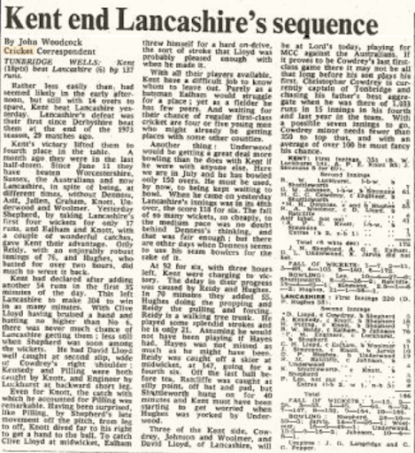
Kent also won the Championship game against the same opposition at Tunbridge Wells. John Woodcock was there for The Times. Most readers will know about Knott’s greatness, as will anybody who has made the mistake of engaging me in conversation at the Basin Reserve. Alan Ealham’s fielding prowess will be less well-known. Being somewhat dumpy in stature, nobody would have picked him as the gun fielder. New overseas players were often caught out in this way, the middle stump flying out of its ground while they were still a couple of yards short of completing what they had thought a safe single. What Woodcock has to say about the Kent team and the captaincy of Denness (of which he was not a fan) is interesting.


 In the 55-over semi-finals Middlesex beat Warwickshire and Leicestershire defeated Hampshire, against form in both cases.  In the latter case it was despite a century by Gordon Greenidge and a storming Andy Roberts, as described by Gerry Harrison in The Times.

With Roberts roaring in from the car park end…Steele, Balderstone and Davison were not sure whether it was Shrove Tuesday or Sheffield Wednesday.

Harrison was, for many years, Anglia TV’s football commentator. His Yorkshire TV counterpart, Keith Macklin, also reported cricket for The Times in 1975.

Middlesex’s win was largely down to a century by Clive Radley, whose batting style was captured by Alan Gibson:

Radley…was, as usual, a mixture of the classical, the baroque and the Old Kent Road.

Radley’s name often comes up as the scorer of key runs at crucial times, and continued to do so for another decade or more. It seems wrong that his England career was so short.

This was the second week of Wimbledon, which was exciting, firstly for the tennis itself, but also because it meant that Clive James would be reviewing the tournament’s TV coverage in The Observer, an annual treat in this era.

In 2025 the BBC lists 39 commentators for the TV coverage, which continues for 12 hours a day and ranges across all 18 courts. Fifty years ago it was limited to Centre and No 1. Harry Carpenter presented coverage that lasted under six hours plus a highlights package in the evening. The commentary team comprised no more than six led by Dan Maskell and Peter West (Peter Walker filled in at the cricket during the fortnight). On the radio Peter Jones presented three hours of commentary by Max Robertson and Maurice Edelston, with expertise provided by Fred Perry and Bob Howe.

It has always seemed a pity that Clive James was the only Australian with no interest in cricket. I only came across him writing about the game once, when he referred to the Chappel [sic] brothers. Cricket broadcasters may have been relieved.


Saturday, June 21, 2025

14-20 June 1975: Swing it like Happy Gilmour


Public interest in the World Cup was increasing as it moved towards its climax. Its success was clear. On Saturday New Zealand beat India to take what would become our traditional semi-final spot. India’s respectable 230 was passed with an over to spare thanks to Glenn Turner’s unbeaten 114, his second century of the tournament.

East Africa continued with their strategy of making the (sparse) crowd regret that they had paid good money to go to the cricket. They took 53 overs to make 92 in answer to England’s 290. John Snow took four for 11.

Sri Lanka weren’t much different: 138 in 51 overs chasing (or not) Pakistan’s 330.

Even though it meant nothing in terms of qualification, the game of the day was Australia v West Indies at the Oval, with immense interest in how the Caribbean batters would face up to the sensation that was Lillee and Thomson. The prospect was sufficiently intriguing to tempt Hugh McIlvanney into a rare visit to the cricket. His report in The Observer demonstrated an insight beyond that of most regular cricket correspondents and shows why he was widely regarded as the best sports writer of his era.


It was the West Indian quicks rather than the Australians who won the day. Kent’s Bernard Julien—I’d forgotten what an striking loping run he had—, Keith Boyce and Andy Roberts reduced Australia to 61 for five, with the help of a brilliant run out of Walters by Greenidge at mid-wicket. When an RAF flypast connected with the Trooping the Colour ceremony was seen at about this point Richie Benaud said that it was to mark the first Australian boundary.

Edwards and Marsh put on 99 before the second batch of five wickets fell for 32, leaving the West Indians with an obviously inadequate target of 193. After losing Greenidge early, Fredericks and Kallicharran put on 124 for the second wicket. The Warwickshire left-hander carried his fine county form into the World Cup and took it to Lillee in particular, with four fours in one over, leaving the great fast bowler with one for 66 off ten overs.

Anybody younger than 40 would not understand how difficult it was to keep up with this game. Because of the pageantry at Horseguards there was no live coverage for the first hour or so. Thereafter, the Oval game had to share space with the England match, racing from Bath and show jumping from Hickstead. There was sparse radio commentary, and it was pre-teletext, so basically a live-scores Stone Age.

Their defeat meant that Australia faced England at Headingley while the West Indies played New Zealand at the Oval.

For the Australians, it was a return to Headingley where they had been defeated in three days on a fusarium infested pitch perfect for DL Underwood to run through them, which is exactly what he did. To this day, mention Headingley ’72 to any Australian and they will slam their glass on the table and allege conspiracy and chicanery. It must be on the Australian schools curriculum in the Wrongs Done to Us section given roughly equal weight with the Japanese bombing of Darwin. What unfolded that Wednesday was seen as payback, as the Leeds gloom provided perfect conditions for Gary Gilmour’s left-arm swing.

Gilmour’s career consisted of dramatic entrances that created expectations that he did not come close to living up to. A century on debut for New South Wales; 52 and four for 75 on Test debut against New Zealand. Then the World Cup semi-final at Headingley. A late selection to replace Ashley Mallett when the Australians saw how grassy the pitch was, he took six for 14 as England were rolled for 93, then shared a partnership of 55 with Doug Walters to take Australia from 39 for six to a four-wicket victory. As we will see, Gilmour had another good day at Lord’s in the final, but there was hardly any more. Not quite a one-match wonder in the manner of Bob Massie, but not that far off. Unfulfilled promise for a player who the great left-armer Alan Davidson thought was a better player than he had been early in their careers. Gideon Haigh's profile of Gilmour for CricInfo suggests that a "light-hearted" approach to training did not help.

It could have been even worse for England on one of those Leeds days when the grey Yorkshire skies allowed the ball to go in any direction bar straight; they subsided to 37 for seven. Skipper Mike Denness top scored with 27, sporting a resemblance to the captain of the Titanic stoically on deck after iceberg Gilmour had holed his craft with irrevocable consequences. Only Arnold joined him in double figures. When Australia lost four wickets for seven runs the home side briefly became unlikely favourites, but Walters and Gilmour saw them home, helped by the first sight of the sun that day.

The other semi-final was much more prosaic. New Zealand’s 158 was about a hundred short of what was needed against the confident West Indian batting. Julien was agin in form with four for 27. A second-wicket partnership of 165 between Greenidge and Kallicharran settled it.

On the Sunday of that week I was at St Lawrence for the 40-over game against Worcestershire, one of the better examples of the genre. The visitors made what by the standards of the time was a massive 231 for four, Alan Ormrod batting through the innings for an unbeaten 110. How we missed the restraint that Derek Underwood imposed. Kent were 184 for one (Luckhurst 53, Johnson 88) but had fallen behind the clock. Four wickets fell quickly and things seemed hopeless when Colin Cowdrey, greeted as a hero after the announcement of his retirement, came in at No 6. Cowdrey was nobody’s choice for the improvised slogging that appeared to be Kent’s only hope, yet when John Inchmore dug one in Cowdrey swivelled inside the line and casually flicked the ball among the benches by the white scoreboard. A repeat and the game was Kent’s but Cowdrey was bowled by Inchmore and Worcestershire won by two runs.

The Sunday game interrupted a Championship match at Maidstone against Sussex, which Kent won on the third morning thanks to one of the greatest all-round performances by a Kent player. John Shepherd bowled unchanged through the first innings, finishing with eight for 93. He then made 52 in a sixth-wicket partnership of 122 with Dave Nicholls before taking seven for 54 to finish with 15 for 147. It seems that only a late change stopped him from becoming the first Kent bowler to bowl unchanged through both innings since the First World War. It was the first time since Dave Halfyard in 1959 that a Kent man had taken 15 in a match, Only Mohammad Sami and Martin McCague have done it since.

It was timely that Henry Blofeld interviewed Shepherd for The Guardian after this game.


One curiosity of that match was that it featured Norman Graham and Kevin Jarvis in the same Kent XI. Cricket scholars have long debated the question of which of these two was the worse batter. Their respective final career averages were 3.88 and 3.59. Graham’s seniority promoted him to the unexplored heights of No 10.

Gregory Armstrong, another young Caribbean fast bowler referred to in the Shepherd interview, was taking plenty of wickets, and creating a fair amount of mayhem, for Glamorgan. Surrey won the game at Cardiff but captain John Edrich (the “He” quoted in the following report) was not happy.


Wilf Wooller could always be relied upon for a pointed or splenetic quote. There are many stories associated with him. One of my favourites was his response to Jim Swanton’s letter requesting information about a young Glamorgan player. Swanton, often accused of focusing too much on the south-eastern counties, enclosed a stamped-addressed envelope for the reply. When it was returned a few days later it was found to contain only a copy of the London to Cardiff train timetable.

At the end of the week Hampshire remained on top of the County Championship while Clive Lloyd and Derek Underwood led the first-class averages.


There was a century by David Steele of Northamptonshire, an innings that was of much greater significance that anybody could have imagined.

The Second XI scores record nineties by T Chappell of Lancashire and Gower of Leicestershire.


At the end of the week your writer is preparing to go to Lord’s for the World Cup final. It was to be the biggest week of his cricket-watching life, and remains that to this day.

Daily updates on Twitter/X at @kentccc1975 and Bluesky at @kentkiwi.bsky.social

Wednesday, January 31, 2024

The Cricketer. December 1973 and January 1974

These days there is cricket everywhere you look. A few days ago here in New Zealand we could watch great finishes to simultaneous test matches overlapping with the finals of the domestic T20s (we are spared coverage of the franchise competitions in South Africa and UAE). 


It was not always thus. The Cricketer for December 1973 has virtually no cricket on which to report. The only account of a match is Alan Gibson’s on the final of the inter-diocesan Church Times Cup (triumph for the Gloucester diocese), though John Edrich files from South Africa on the tour of DH Robins’s [sic] XI of which he was a member. This report is notable for the absence of the word “apartheid”, a triumph of omission as striking as Basil Fawlty’s failure to mention the war, or the sabbatical taken by “sandpaper” during the recent canonisation of David Warner as he ended his test career, 


The magazine struggles to fill its 32 pages, and the grainy photo of Keith Fletcher is well below the usual standard for covers. The contents page contains promise, but this rarely translates into anything memorable. I was naturally  interested in Colin Cowdrey’s piece on Kent’s season, with wins in the 40 and 55-over competitions, but it was no more than an efficient summary that arranged the obvious into a cogent order. 


Much the same applies to Gordon Ross’s look at 11 seasons of the Gillette Cup, in which the first person singular shoulders far too much of the burden. 


There is a note from Australia on the waiting lists for membership at the MCG and the SCG, respectively 55,000 and 15,000 at that time. Those numbers have increased in the intervening half century; more than 200,000 now await their MCG member’s pass. A friend of mine had an application form for Melbourne Cricket Club membership filled in on his behalf as an infant, as so many Victorians do. Years passed. When he was 18 his mother rang him, distraught. She had found the application form, unposted, in a draw. This is the saddest story I know. 


There is poignancy aplenty in this edition. Jack Iverson’s death would feature in David Frith’s chronicling of cricketing suicides, but Frith does not mention cause in his obituary of the ultimate mystery spinner here. Sir Leonard Hutton contributes a coda in which he does not overwhelm Iverson with praise. The key, according to Hutton, was to play Iverson as an off spinner. He says that “most of our batsmen found themselves over-positioned to cope with this type of bowling” so does not appear to have shared this insight with teammates. 


David Frith interviews Colin Milburn, who had returned to county cricket in 1973, four years after the car crash that cost him an eye. The tone is optimistic, but there are enough portents that there would be no happy endings to the story of Milburn’s cricket, or his life. 


Back in the Northamptonshire middle order, there were a series of 30s and 40s, but not until the final game of the season did Milburn pass 50 for the first time, scraping an average of 20, which was double what he managed in 1974. He told Frith that batting at No 6 made things difficult and that he did better when opening because the shiny new ball was easier to see. In Perth when interviewed, Milburn hoped that the bright Western Australian light would have the same benefit and had hopes of playing in the Sheffield Shield, a fanciful notion even in a place where he was as much a hero as he was in Northampton.


Milburn was part of the BBC TV commentary team in 1969, when he must have still been in some sort of trauma following the accident, but was not asked back (though he was an occasional summariser on BBC Radio in the late 80s). At the time of the interview he was recently engaged, but that came to nothing. The considerable sum for 1973 of £19,000 from his testimonial was in trust: “on his own admission it would have been ‘chaotic’ to have given him the lump sum”, another sign of future troubles. 


In 1988, when I worked occasionally for Cricketcall (I had turned down the Gloucestershire contract, but that’s another story) one of my colleagues had recently worked with Milburn and reported that he gave the impression of having slept rough. He died in a pub car park in 1990, having inspired a love of cricket in so many so saw him play.


The January edition has tributes to Howard Marshall from EW Swanton and Alan Gibson, following a three-paragraph obituary in December. As Gibson says, had Marshall died in 1938 “there would have been a headline about him on the main page of every newspaper”. Marshall was then one of the BBC’s best-known voices, and was the leading commentator on cricket, rugby and ceremonial occasions. He was the first to give extended ball-by-ball commentary, famously on Verity’s match at Lord’s in 1934. 


Marshall devised the grammar of cricket commentary, and did the same for radio news reporting as the head of the BBC’s war reporting unit. He reported from the Normandy beaches on D-Day. But after the Victory Tests of 1945, and the occasional ceremonial commentary, he gave up broadcasting in favour of a career in commerce. He might have continued for another 25 years. 


Howard Marshall deserves a biography; he is important enough as a broadcaster and led an interesting private life. He left his first wife for the film critic Nerina Shute, who later deserted him with their French maid. 


The January edition is richer in content than its predecessor, and includes a couple of interesting investigations into cricket history. Gerald Brodribb, whose niche was the evolution of six hitting, questions the veracity of what the Guinness Book of Records and Wisden long accepted as the longest hit with a cricket bat, Walter Fellows’ 175-yard smite during practice at the Christ Church Ground in Oxford in 1856. Brodribb looks for evidence that the hit was measured properly and verified, and finds none.


David Frith’s ability to find sad stories in cricket’s past is further illustrated. Here, his subject is Billy Bates of Yorkshire and England. Bates toured Australia with great success. At Melbourne in January 1883 he made 55 at No 9, then took seven wickets in each innings as Australia followed on, taking the first English test hat-trick in the process. His name appears  on the Ashes urn, presented to the England captain, Hon Ivo Bligh, after on the tour. 


Bates’ first four tours of Australia were all successful. It was on the fifth that his life went suddenly wrong. He was hit in the eye in the nets, an injury that ended his career at the top level. There are parallels with Milburn here. The rest of Bates’ life was a struggle. He died at 44. 


On Scorecards, we have often talked about the Rest of the World series in England and Australia in this era. The January edition reminds us of a third, consisting of two matches in Pakistan to raise funds after devastating flooding. The World XI was a mix of English and West Indian players, topped up by a couple of locals. The Caribbean contingent were mostly world-class, or something near it, but has an unexpected opening partnership of Mike Brearley and Harry Pilling. Keeping was Keith Goodwin, then Farokh Engineer’s deputy at Lancashire.  


There were centuries for Brearley, Kallicharran, and Asif Iqbal, and two for Zaheer Abbas, as well as attractive innings from Clive Lloyd, Rohan Kanhai and Colin Cowdrey, though the fact that Cowdrey’s rarely seen leg breaks nabbed two victims suggests that the level of competitiveness waxed and waned. Pakistan won both games.


Friday, July 14, 2023

Early adventures in autograph hunting

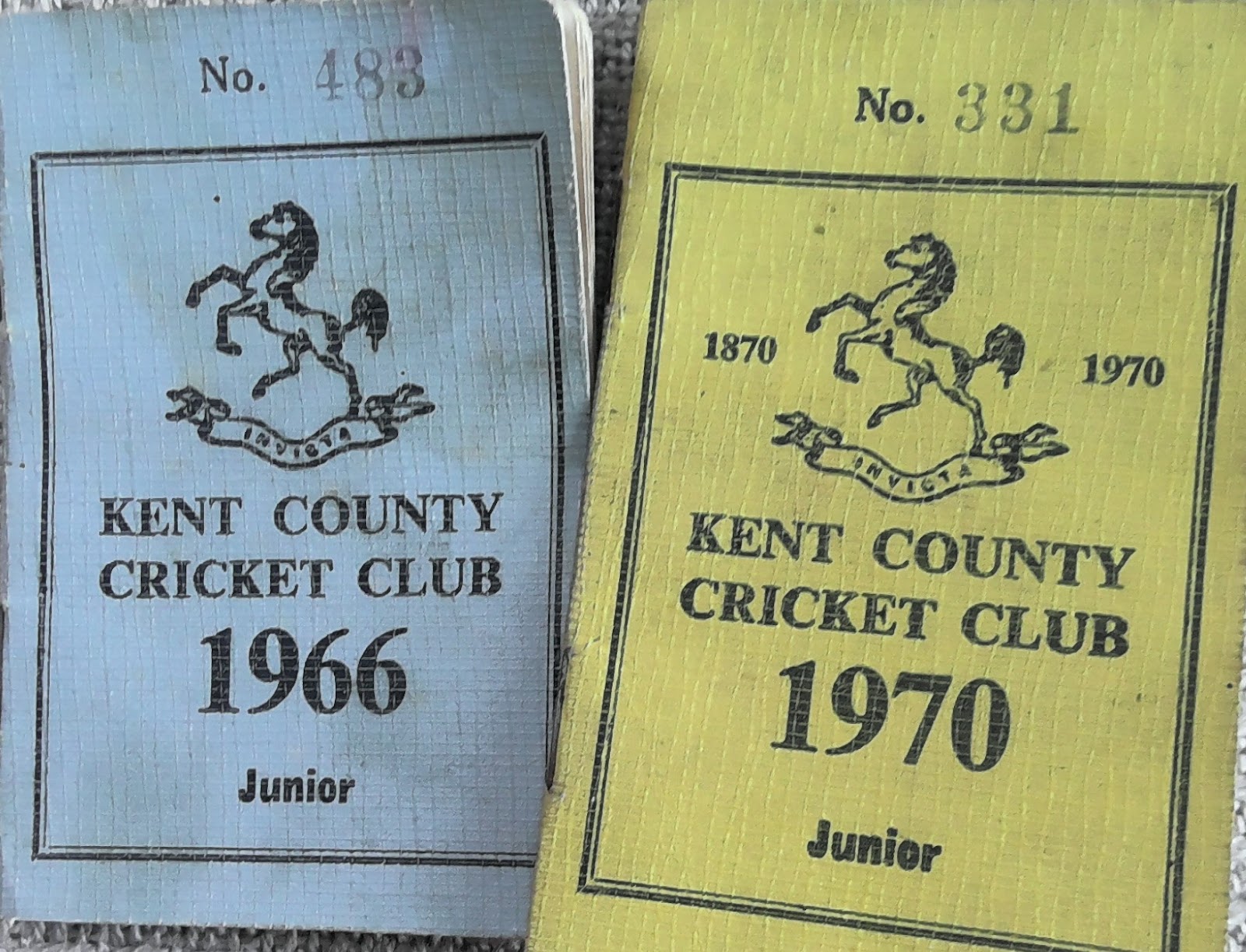
The two Kent junior membership passes pictured both cost a guinea, or a pound and a shilling, or one pound five pence, for which the keen young cricket fan got entry and a seat in the stand at all Kent’s home games bar tourist and Gillette Cup matches, for which ground admission had to be paid. The 1966 pass was my first.


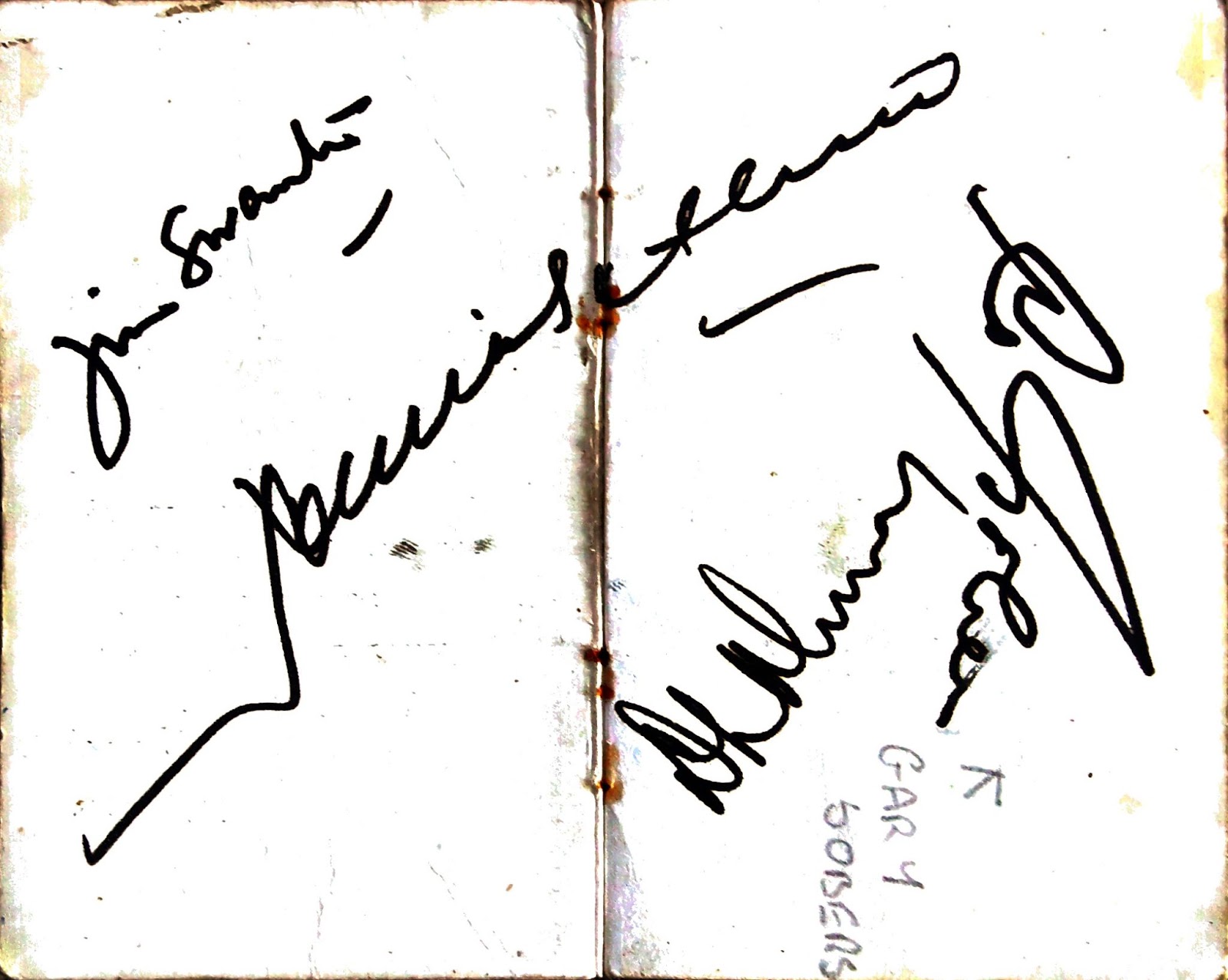
They could also be used as impromptu autograph books. Below are the back two pages of the 1966 edition. Clockwise from the left are the signatures of Colin Cowdrey, Garry Sobers, Alan Knott and David Nicholls. 


The first two were collected on Monday 11 July, the second day of the match between Kent and the West Indians. I was there on a school day because I was recuperating from the measles, which dates me pretty effectively. It was a cautious first expedition outside home for a few hours in the afternoon. 


It was the match in which Sobers took his career-best figures of nine for 49, in slow left-arm mode. One of these was late on that second day, so I assume that I saw a small part of the great man’s best bowling, but I have no memory of doing so. An amnesiac reaction to Sobers will become a theme of this piece, as you will see.


The West Indian captain’s signature must have been secured after the close of play, given that he would have been on the field throughout the afternoon (there was no racing on the TV—I checked). My memory is that Cowdrey signed earlier, on the spot where the Cowdrey Stand was built two decades later. Cowdrey was England captain at that time, having replaced MJK Smith after the first test before handing over to Brian Close for the fifth.


Of these four names, David Nicholls is the only one that will require introduction to the general reader. Three years previously, as a nineteen-year-old, he had made a double century, a rare thing in the three-day era. But there had not been much since then, and he had become a fringe player. 


I assume that Nicholls also signed earlier in the day. If it was at the close it says much for his well-known affability, as he got his second duck of the game shortly before. The following year, he found the role in which he served the county well for the next decade; that of stand-in keeper when Alan Knott was playing for England, which gave him a place in the team for half the season.


I see from the TV listings that England played Uruguay in the opening game of the World Cup that evening. It was a dull nil-nil draw that could not compare watching the West Indians play cricket.


Knott’s autograph was added a few weeks later, on August Bank Holiday Monday. It was a wet day, as public holidays invariably seemed to be when we were young. Kent were hosting Nottinghamshire at St Lawrence. An on-off, interrupted day ended just before tea, by which time most of the spectators had drifted away. My mother and I went to the back of the pavilion to collect a few autographs as we waited for my father to pick us up. 


Cowdrey came out. Thank you, but I had his autograph (membership card proffered as supporting evidence). Was there anyone else I was waiting for to sign? Alan Knott. Wait there.


Cowdrey returned to the dressing room and a minute later a beaming Alan Knott appeared, as if there was nothing he wanted to do more than leave the warmth of the pavilion to stand in the rain signing a raggedy card. Cowdrey was a flawed individual in some ways (see the D’Oliveira affair), and he lumbered us with the ridiculous Spirit of Cricket in the laws but his kindness that day made a big impression on a seven-year-old. It presented cricket as a game with a heart, as a place of safety where you would be looked after. 


The 1970 signatures were all secured at the Oval on the second day of the fifth and final match in the series between England and the Rest of the World, a replacement for the cancelled tour by white South Africa. In my last piece I bemoaned that the series was retrospectively stripped of test status when the cricket was of a quality rarely equalled and never surpassed in my time. 


Not that it was all brilliant. On the first day, 115 overs had been bowled, almost a session more than the sedentary over rates of the 21st century. But look at the score: 229 for five—a fraction under two runs scored in each of those extra overs. In The Times, John Woodcock blamed the Kent captain: “What had promised to be a classical innings by Cowdrey was beset by apprehension”. 


Things went a little more quickly when we were there on Friday, as they tended to when Alan Knott was making a half-century. But a slow pitch meant that, until tea, great players—Barry Richards, Eddie Barlow, Rohan Kanhai—struggled to be more than mundane. 


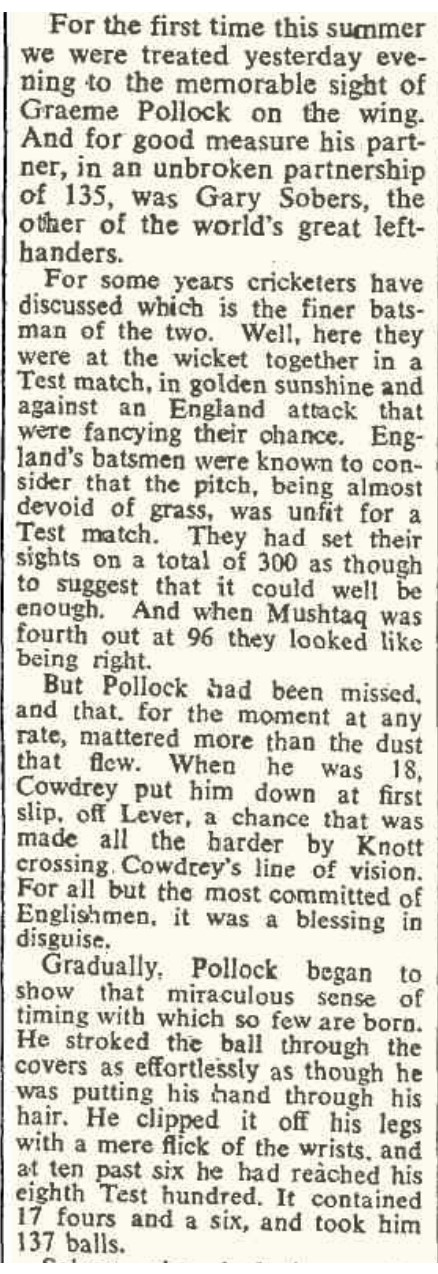
Then, something special happened, as Woodcock reports:


Here were the two great left-handers of the age together and at their best, since equalled, but not surpassed, only by Lara and Sangakkara. More than that, it was a partnership between two men who could not have shared the same railway carriage or used the same bathroom in the homeland of one of them. How Vorster must have choked on his breakfast biltong as he read the reports on the South African papers the following morning. 


This should surely make the top ten of my personal cricket-watching list. Trouble is, I can’t remember any of it. I was certainly there, as the autographs in the member’s card testify. It must have been Friday, as that was my mother’s day off from the china-and-glass department. We would not have left before the end. I recall sitting in the Vauxhall Stand, and certain details, such as Don Wilson’s return catch to dismiss Kanhai. But nothing of two great players nearing perfection. 


Though too young to provide analysis or useful insight, I have impressions of everything significant that I had watched up to that point—Cowdrey in the 67 Gillette semi-final; the whole course of the  final that year; Denness’s painful debut innings against New Zealand. Much that was insignificant too, like slow-left-armer Andy Hooper’s first five overs in first-class cricket being maidens in 1966. So why not this? Maybe Kent players not being involved? 


I do remember waiting at the back of the Oval pavilion to collect the autographs shown above. Garry Sobers (my annotation is badly spelt) shows consistency of signature over the years. Deryck Murray uses his initials, as befits a Cambridge man. Dennis Amiss was that year’s victim of Oval-test syndrome, where the selectors based their selection of fringe players for the winter tour just on performance in that match. In the second innings he made 35, but Fletcher scored 63, so got the place on the plane to Australia.


I intercepted EW Swanton as he left the pavilion having delivered his summary of the day’s play on Test Match Special (for those too young to have experienced Swanton’s daily address, it was like the Queen’s Christmas message, but in the summer). Given the fun I have at Swanton’s expense in the monthly cricket magazine pieces, I should report that he was charm itself, saying “happy to oblige a Kent man” with a beaming smile as he returned the card. 


Sunday, May 29, 2022

The Cricketer, May 1972


Continuing the new series looking at The Cricketer from 50 years ago.

The cover of The Cricketer was usually graced by a photo from Patrick Eager, cricket’s greatest photographer. In what was still a largely monochrome era, the action shot on the cover of this edition was something of a novelty. It is described simply as “Richard Hutton bowls watched by Alan Knott”. It was almost certainly taken at Scarborough the previous September, when Yorkshire played Kent in the Fenner Trophy, a four-county knockout played over three days as part of the Festival. The uncredited batter is Derek Underwood.

EW Swanton returned to the editorial page. For those unfamiliar with the Great Pontificator’s style, the opening couple of sentences offer a primer.

Ian Chappell, we notice, remarks from Adelaide that he considers that in the advance notices his team has been underrated. In the Australian vernacular ‘Good on him’ for that.

Swanton was not afraid of the regal plural.

One aspect of the selection disturbs us; the over-weighting of the attack in favour of fastish bowling at the expense of spin.

Despite sympathising with Chappell, he does not dissent from the general view that this is an underwhelming Australian selection.

The green caps have the same magic about them, even if for the moment they do not inspire quite the old dread.

The visitors proved to have plenty of quality. After the moribund 1964 series and the damp, dull contest of 1968, the ‘72 Ashes were outstanding, a two-all draw full of memorable, top-draw cricket.

On the same page, Tony Pawson welcomes the Benson and Hedges Cup, the 55-over competition with the midsummer final that was to be become a favourite of the fixture list for the next three decades.

Does it remind you of anything? There was no great demand for it, but the marketing people at Lord’s thought that it would be a new source of revenue. It cut into the County Championship programme. In 1968, before the introduction of the Sunday League, each county played 28 three-day matches. In 1972, this was cut to 20, which adds up to only four more potential playing days than the 14 four-day contests of 2022.

But unlike the Hundred, the shorter form then took the early weeks of the season (which were the last week of April and May, rather than the tail end of Christmas as is now the case) leaving high summer to the Championship. Whether it was the different climate patterns, or that the cricket fields of that time were the least porous materials known to science is unclear, but only one of the ten games in the south group finished on the first of the scheduled three days.

I saw no games in the new competition that year. Kent played their two home group games at Blackheath and Tunbridge Wells and did not make the knockout phase.

There was a cracker at Lord’s. Colin Cowdrey, batting at No 3, made an unbeaten 107. Wisden said

Cowdrey batted with all his old mastery, grafting on to his vintage ability the urgency needed in limited-overs cricket.

He hit three sixes, and with Asif Iqbal but on 70 in 30 minutes. I have written before that when Cowdrey escaped the prim prison of his background and character and batted like a free man­­--a cricketing Brigadoon in its own way--it was a grand day to be at the cricket.

In that era, 234 would usually have been enough to secure a comfortable victory, but here a well-measured reply, led by MJ Smith’s 73, took Middlesex home with eight balls to spare.

Leicestershire won that inaugural competition. Yorkshire prised free 136 from 55 overs (no blaming Boycott, who was injured) and Leicestershire took 47 overs to get them. It was the worst of the B&H finals, with the possible exception of that of 1984 when Lancashire took 43 overs to chase 139 and Peter May gave the man-of-the-match award to John Abrahams, who made a duck and did not bowl. It was Leicestershire’s first trophy, one of four that Illingworth would lead them too.

The most interesting article in the May 1972 edition was a piece of journalism/stalking by David Frith. Presenting himself as an autograph hunter with a few books for signing, Frith drove 200 miles, to see a man, who he describes thus:

Jack Gregory, First AIF, New South Wales and Australia fast bowler who made even Walter Hammond blanch, scorer of the fastest-ever Test century, arguably the greatest of slip fieldsmen, was not discernibly pleased to see me.

Gregory played in all of Warwick Armstrong’s eight successive wins over England in the consecutive Ashes series of 1920-21. With Ted McDonald he formed the first of Australia’s great fast-bowling partnerships.

Frith managed to get to Gregory’s kitchen table, but his description of the great bowler as “Garbo-like” indicates that he didn’t get any revelations out of him, though it is interesting to learn that Gregory bowled off just 12 paces, and did not share the contempt that most of his generation of cricketers had for one-day cricket.

“By jove, I like that 50-overs stuff…They have to get on with it. I liked to hit hard myself, because I love the game and I tried to amuse the public. They like to see bright cricket.”

I bought a recent edition of The Cricketer the other day. David Frith had two pieces (both obituaries) in it. Only Swanton  has had a longer association with the magazine, though as founder of the Wisden Cricket Monthly, a good deal of the interim was spent with Frith in competition with it.


Saturday, January 26, 2019

The Lord’s Finals: 1973 & 1976 (and a little of 1974)


I went to Lord’s for 24 domestic finals (plus the first three World Cup finals). With the 50-over final moving to Trent Bridge from 2020, there will be no more. Every one of the 24 was played before a full house, even when there were two a year. Were that still the case, the question of moving it would not arise, but over-pricing, the prevalence of international cricket, the devaluing of the county game and the short attention spans of the marketing folk have conspired to devalue what were some of summer’s highest days.

To mark their passing, I hereby announce a series of posts on those 24 finals. This will involve a bit of “curating” (the name young people give to re-sorting and sticking a different label on old stuff). Just as those who played at the MCG in March 1877 were oblivious to taking part in the first test match, so these old posts turn out to be early episodes of this series.


I’ll mix the cricket reportage with a little of what was happening in the world and as much autobiography as the reader might be able to tolerate.

But anybody anticipating an eyewitness account of the 1974 Gillette Cup final between Kent and Lancashire will be disappointed. I was there on the Saturday, sitting in the sunshine to hear that there would be no play that day, thanks to heavy rain two days before and a sharp shower at 9 am.

People who hanker for the old days of cricket-watching should remember how much of the time we spent watching grass dry. Now, play would probably have started on time.

The game was played on Monday, a school day, hence my absence. Why not Sunday? Because Kent had a Sunday League game scheduled at Worcester. What’s more, the XI that played at New Road was exactly the same as turned out back at Lord’s on the Monday. Rotation then was merely a means of crop management.

I’m sorry to have missed the match—the only one of Kent’s first twelve Lord’s finals from which I was absent—not only because Kent won, but also because it was such a curiosity. Lancashire, having won the toss, lost their tenth wicket to the final ball of the 60th over to be all out for…118. That is to say, a fraction under two an over.

In The Times, John Woodcock described the pitch as “churlish…of uneven bounce and no pace”, but observed that “there was less good batting than one would have thought possible from so many distinguished players”. The Lancashire team contained some of the best one-day batsmen of the era—Lloyd C (& D), Wood, Pilling, Engineer—and those fine tonkers of a cricket ball Hughes and Simmons. Nobody in Kent’s innings made as many as 20, surely a record for a winning team in a final.

Kent’s bowling was apparently splendid: “Rarely did any Kent bowler drop short of a difficult length” reported Wisden. This included James Graham-Brown (his name a pleasing compendium of two other Kent bowlers of the era), who finished with 12–5–15–2. Graham-Brown was a medium-pace bowler with bouncy run up. By a lengthy street, this was the best day of his cricket career. He made only occasional appearances in 1975 and 1976 and then had a couple of years with Derbyshire (as good a euphemism as any for career failure: “Mrs May, we have arranged for you to have a couple of years with Derbyshire”). He was a headteacher for 20 years and now writes plays, including one about Colin Milburn, under the name Dougie Blaxland.

It was Kent’s fielding that won the cup that Monday. There were three run outs, including, crucially, Clive Lloyd, beaten by a 50-yard throw by Alan Ealham after slipping mid-pitch. John Shepherd was responsible for the other two, leading Woodcock to compare him to Learie Constantine.

Kent were coasting at 52 for one, but collapsed to 89 for six before being seen home by Knott and Woolmer (then batting at No 8; within a year he was scoring an Ashes century).

Those not around then would find it hard to credit how difficult it was to find out what was happening in the closing stages for those of us not at Lord’s. BBC schedules were not sufficiently flexible to take account of the delay. Radio coverage was restricted to hourly sports desks, and midweek county games had to give way to the Open University on BBC 2 from about 5 pm, so programmes on Games (sic) Theory and Pure Mathematics filled the screen as Knott and Woolmer eked their way to the target. The tension was in wondering how much tension there was. Nor could time be found to show any highlights, which is presumably so there are none on YouTube.


55-over final 1973


No two Lord’s finals were more alike than the 55-over finals of 1973 and 1976. Both were between Kent and Worcestershire. Kent batted first both times, making a good, but not insurmountable score. Worcestershire slipped behind, were given hope by D’Oliveira, but ultimately fell 40 runs or so short. I watched these games from the top deck of the Warner Stand, a largely Kent area on both days.

Kent’s glory years were now well under way, the trophies coming as easily as bonuses to bankers. This was the third of ten in the seventies. Seven of the team were test players, two of them—Knott and Underwood, obviously—in or near the World XI of the time. Woolmer had already played ODIs and was to be a test player two years later. The other three—Johnson, Graham and Ealham—were fine county players, and the former two might have been capped had the selectors actually been as biased towards Kent as supporters of other counties supposed they were.

Worcestershire had three current test players. Norman Gifford, unaccountably (to us in Kent, and many others) selected in preference to Underwood for the first two tests against New Zealand, where he had bowled to Glenn Turner, who was opening the batting here with Ron Headley, who would open for the West Indies in the first test later that week.

The loss of Johnson and Denness with the score on 23 forced Luckhurst and Asif Iqbal onto the defensive, so much so that after 20 overs the total was only 34. But they knew that if no more wickets were lost the runs would come, and so they did, in a partnership of 116.

They were a contrasting pair, the craftsman and the showman. Looking at the recording (posted by Luckhurst’s son), Brian Luckhurst reminds me a bit of Kane Williamson, so correct, and with a practical answer to every bowler’s questions. He was the least stylish of the Kent batsmen, a short backlift turning most shots into punches, but perhaps the most effective. This was a beautifully paced innings, and it turned the game Kent’s way.

Tony Greig said that Asif was the quickest runner between wickets he ever saw. There is plenty of evidence on the recording to support this contention. See how, as Luckhurst is halfway down the pitch completing his third run to pass 50, Asif is already at the other end, scoping a fourth.

Asif’s fleetness did for Luckhurst in the end, beaten by a howitzer of a throw from D’Oliveira from the general direction of Regent’s Park.

These days they call a batsman coming in for the final ten overs or so a “closer”. Kent’s unlikely closer that day was Colin Cowdrey, whose appearance was greeted with a certain amount of derision by Worcestershire folk, who spoke of blocking and maiden overs. What followed was a short masterclass of placement and timing, enough weight taken off the shot to get two even with seven boundary fielders (no fielding restrictions yet, of course). He was puffed by the end mind, particularly when joined by Alan Knott, perhaps the only Kent player who could challenge Asif in a short sprint. Who would blame Cowdrey for turning down a second from the last ball of the innings, given that would have placed him 22 yards further away from the pavilion, to which he was by then so keen to return? Cowdrey refuted another misconception—that he was a liability away from slip—early in the Worcestershire innings when he threw down the stumps from side on.

Kent’s opening bowlers were Norman Graham and Asif Iqbal. Like Jasprit Bumrah’s now, Norman Graham’s run up was no more than an administrative necessity, but batsmen were unused to seeing the ball from the angle that his six foot seven frame delivered it from. The effect was of a bowler faster than he actually was. Asif’s handling of the new ball was a surprise in that he had bowled only three overs in the competition thus far that season, and did not bowl at all in the first nine games of the Sunday League season. But then Bernard Julien headed off to join the West Indies touring team and somebody remembered that Asif had first emerged as in international cricket as an opening bowler. He did the job very well, with a slingly action and busy arms that looked as if they wanted to dispatch the ball long before reaching the bowling crease.

Worcestershire were going along quite well at 57 for one when Ted Hemsley made a mistake that many had made before and many would after: he took a single to the little dumpy guy at mid on. He was a yard short when the ball hit the base of the middle stump, as it tended to when thrown by Alan Ealham.

A couple more wickets fell quickly. Worcestershire were behind the clock and mesmerised by Underwood. It was a surprise to see the captain, Norman Gifford coming in at six, promoting himself above D’Oliveira and Yardley. This may have had something to do with the fashionable theory that Underwood was less effective against left-handers.

D’Oliveira soon joined him and they came close to turning the game, with a partnership of 70 in 12 overs, massive productivity in the year of the three-day week. Gifford slogged effectively, but some of D’Oliveira’s shots were sublime. All the political business that his name evokes can get in the way of remembering what a fine cricketer he was; a man Peter Oborne reckoned would have toured England in 1951, but for apartheid. As we will see, he wasn’t done with Lord’s finals yet.

The rest of the Worcestershire order folded, leaving them 39 runs short with 20 balls spare. Asif had four wickets to add to his half-century and was named man of the match by Sir Leonard Hutton (“I saw Hutton past his prime…”).

The highlights package on YouTube was posted by Tim Luckhurst, Brian’s son. No highlights package is shown in the schedules for that day on BBC Genome, so it would seem to be a piece of individual enterprise for which we nostalgists are grateful.

How shining white their kit is in those pictures; they look like angels descended from heaven, but your childhood heroes always do, I suppose.


55-over final 1976


For those of us of a certain age, the summer of ’76 will never be beaten. Lazy, hazy, crazy days, the sun relentless and dazzling, the West Indies cricket team the same. Viv Richards announced his greatness with two double hundreds. I was at the Oval for some of Mikey Holding’s 14 wickets on a pitch so flat it would be an exaggeration to call it three-dimensional.

Zaheer Abbas with a double hundred and a hundred at Canterbury…a helicopter landing at Mote Park as Kent won the Sunday League…Cowdrey’s last game…and another Lord’s cup final win.

Kent’s XI for the 1976 final had three changes from that of three years before. Cowdrey had retired (but was to reappear once during Canterbury Week); Luckhurst and Graham had already had their seasons ended by injury, and were both to retire that year (prematurely in Luckhurst’s case). Leading the attack was Kevin Jarvis, like Graham a fine county bowler unlucky not to get a few England caps along the way. When the two played together Graham was promoted to the No 10 position, a promotion that the introduction of no player I have seen other Jarvis could have achieved.  

Cowdrey and Luckhurst were replaced by Charles Rowe and Richard Hills. Here was a straw in the wind, though we didn’t recognise it as such at the time: two players of proven international quality succeeded by two decent county pros. Rowe was embarking on the unenviable sequence of three Lord’s finals in successive years in which he would not score a run, bowl a ball or take a catch.

Only five returned from Worcestershire’s 1973 XI: Turner, D’Oliveira, Gifford, Ormrod and Hemsley. There was plenty of talent among the replacements, most of whom would become well-known county names: Phil Neale, Gordon Willcock, Paul Pridgeon and John Inchmore. The least familiar is all-rounder Cedric Boyns, who had made his way from the Drones Club specially.

And there was Imran Khan, now in the final year of a spasmodic six-season career at New Road. Worcestershire folk chanted his name to the tune of the chorus of You’ll Never Walk Alone (“Imran” for “walk on”) as he opened the bowling, but the volume diminished as the Kent openers Johnson and Woolmer saw off the new ball.

In 1973 Woolmer had been a bowling all-rounder. Three years later, he was an England batsman, his 61 here part of the reason he was promoted to open in the fourth test later that week as the selectors hit upon the notion that it would be a good idea to have openers with a combined age lower than 84, as it had been when Close and Edrich opened in the third test, at Old Trafford.

It was always more fun when a county pro who never experienced international glory turned in the key performance at a Lord’s final. Here, it was Graham Johnson’s day, the high day of a 20-year career (though I’ve written before about the scandal that was Geoff Miller playing 34 tests while Johnson played none). With Woolmer, he put on 110, the first century opening partnership in a Lord’s final. “Watching Johnson and Woolmer…no one would know that English cricket is in the doldrums” reported Woodcock.

Kent didn’t build the big total that might have followed this fine start. There were no boundaries between the 36th to 52nd overs. Woodcock described Gifford’s field settings as “as much like rounders as cricket” and suggested that there might be an inner ring containing a specified number of fielders, as has become standard. But there was also some good tight bowling, notably by Gifford himself, but also from Boyns, who had to step up to a full 11-over contribution after D’Oliveira limped off having torn his 44-year-old hamstring. That Kent got as many as 236 was largely thanks again to Asif’s scampering in the last ten overs.

Worcestershire started well enough, with Turner and Ormrod putting on 40 in 12 overs, but Shepherd had the New Zealander caught behind. He dismissed Neale soon after and a tourniquet was applied first by Woolmer, whose first seven overs cost only four runs, then Underwood playing the fifth of his ten finals.

The difficulty that Underwood presented can be judged by the fact that three batsmen in a row were caught by Johnson at deep square leg as they desperately sought to escape the Alcatraz that Underwood built on the line of leg stump.

There is a curiosity around the first of these catches, to dismiss Ormrod. Johnson took the catch inside the rope, but clearly continued across it. For a few years in that era, that constituted a fair catch. That clearly had not been the case in 1968, when Roger Davis caught the fifth of Sobers’ six sixes at Swansea, only to fall over the boundary for the catch to be overruled. The variation to the law that did not last long, or the gymnastic displays that are now a regular feature of boundary fielding would not be necessary.

When D’Oliveira limped in, accompanied by Turner as runner, Worcestershire were 90 for four and well behind the clock, as good as done if all they had to offer was an elderly disabled man and his carer. D’Oliveira proceeded to play what I still regard as the finest one-legged innings I have seen, rivalled perhaps by Chris Gayle’s equally futile effort in the World Cup quarter-final of 2015 (when he was not allowed a runner). With mobility unavailable, he relied on eye and power, one that of an eagle, the other what would get a small town through an afternoon.

“With short-arm jabs, D’Oliveira struck four after four and he straight drove Hills to the pavilion seats for six” reports Wisden. He never quite caught Worcestershire up with the required rate—all those fielders on the boundary saw to that—but he certainly had us worried. Only when he was out for 50 in the 47th over did we relax, after we had stood to see him on his slow way back to the pavilion. There has never been a cricketer who has attracted such universal goodwill as Basil D’Oliveira.

Kevin Jarvis cleaned up the tail, giving him four wickets on his Lord’s final debut. The 43-run victory margin was a touch flattering to Kent. Graham Johnson won the gold award by Sir Garry Sobers.

Except for certain members of the committee, none of the Kent people at Lord’s that day would have believed that Mike Denness was in the final couple of months of his Kent career. Nobody would have thought that when we returned a year later our world would have been turned upside down by Kerry Packer (or rather the establishment’s blimpish reaction to him). In a way, that happy day was the last of our childhood, the only time in our lives that we had a full hand of illusions, none yet shattered.

The golden summer of ’76.
The Summer of ’66

  Everyone of my age remembers the summer of 1966, almost all of them for the same two hours or so on the afternoon of Saturday 30 July. The...