Showing posts with label Clive Radley. Show all posts

Saturday, July 5, 2025

28 June – 4 July: Woolmer’s week

Bob Woolmer had been a Kent regular for seven years by 1975. For most of that time he had batted at No 8 and been a useful purveyor of swing at an amiable pace, most notably in the Canterbury Week of 1972 when he took 17 wickets. These days he would probably have shifted to another county with more space at the top of the order. Now he was showing what he could do when batting was his main purpose. His unbeaten 71 (with a break for injury mid-innings) was valuable support for Cowdrey in Kent’s win over the tourists. For MCC against the same opposition he made 56 and 85 with a hat-trick thrown in taken on the day of the funeral of the last man to take a hat-trick against the Australians in England, HS Enthoven for Middlesex in 1934. International selection was just a few weeks away.

The two other Kent players at Lord’s did not do so well. Colin Cowdrey, leading MCC, bagged a pair, ending sentimental speculation that he would play again for England. Graham Johnson made two and one at No 3 and was not to catch the eye of the selectors again.

Graham Gooch’s first innings 75 attracted considerable praise and resulted in his notorious England debut the following week. Both Arlott and Woodcock focus on Gooch’s build, which led to comparison with Colin Milburn. The daily runs from ground to hotel were still a thing of the future apparently.

I was at Maidstone on Sunday to watch Kent beat Lancashire by 24 runs in a (by the standards of the day) high-scoring game. Luckhurst, Johnson and Cowdrey all made fifties, but the one memory I have of the game is of Clive Lloyd smiting a six over Mote Park’s mock-Tudor pavilion, a mighty blow.

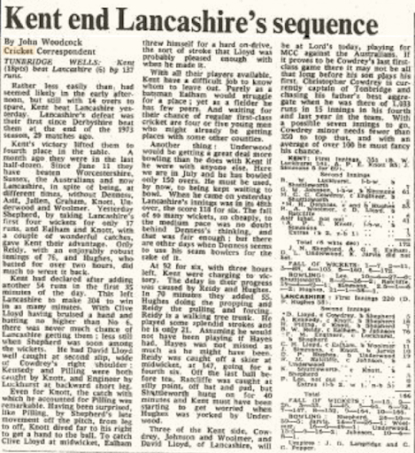
Kent also won the Championship game against the same opposition at Tunbridge Wells. John Woodcock was there for The Times. Most readers will know about Knott’s greatness, as will anybody who has made the mistake of engaging me in conversation at the Basin Reserve. Alan Ealham’s fielding prowess will be less well-known. Being somewhat dumpy in stature, nobody would have picked him as the gun fielder. New overseas players were often caught out in this way, the middle stump flying out of its ground while they were still a couple of yards short of completing what they had thought a safe single. What Woodcock has to say about the Kent team and the captaincy of Denness (of which he was not a fan) is interesting.


 In the 55-over semi-finals Middlesex beat Warwickshire and Leicestershire defeated Hampshire, against form in both cases.  In the latter case it was despite a century by Gordon Greenidge and a storming Andy Roberts, as described by Gerry Harrison in The Times.

With Roberts roaring in from the car park end…Steele, Balderstone and Davison were not sure whether it was Shrove Tuesday or Sheffield Wednesday.

Harrison was, for many years, Anglia TV’s football commentator. His Yorkshire TV counterpart, Keith Macklin, also reported cricket for The Times in 1975.

Middlesex’s win was largely down to a century by Clive Radley, whose batting style was captured by Alan Gibson:

Radley…was, as usual, a mixture of the classical, the baroque and the Old Kent Road.

Radley’s name often comes up as the scorer of key runs at crucial times, and continued to do so for another decade or more. It seems wrong that his England career was so short.

This was the second week of Wimbledon, which was exciting, firstly for the tennis itself, but also because it meant that Clive James would be reviewing the tournament’s TV coverage in The Observer, an annual treat in this era.

In 2025 the BBC lists 39 commentators for the TV coverage, which continues for 12 hours a day and ranges across all 18 courts. Fifty years ago it was limited to Centre and No 1. Harry Carpenter presented coverage that lasted under six hours plus a highlights package in the evening. The commentary team comprised no more than six led by Dan Maskell and Peter West (Peter Walker filled in at the cricket during the fortnight). On the radio Peter Jones presented three hours of commentary by Max Robertson and Maurice Edelston, with expertise provided by Fred Perry and Bob Howe.

It has always seemed a pity that Clive James was the only Australian with no interest in cricket. I only came across him writing about the game once, when he referred to the Chappel [sic] brothers. Cricket broadcasters may have been relieved.


Sunday, June 12, 2022

A Sunday League catastrophe

Kent v Middlesex, 11 June 1972, Folkestone, 40 overs

The 2022 season has been a wretched one for Kent. In each of the county’s first five Championship games, the opposition made more than 500. The Sri Lankan Development XI did the same in an additional first-class fixture. The sequence may be a record. The dismissal of Northamptonshire for a mere 430 in the sixth Championship match was, no doubt, greeted by dancing in the streets of Tunbridge Wells.

If we expected Kent’s status as champions to give us solace in the T20, we were to be disappointed. Despite the recent win at Taunton, they remain ninth of nine in the southern group. Being able to watch the live streams of county cricket here in New Zealand is a wonderful thing, but breakfast watching has been a Groundhog Day of Kentish defeats.

My Blean Correspondent and I have been wondering whether 2022 displaces 1980 as the annus horribilis of our times. In that wet summer, Kent were kept off the bottom of the Championship only by a win over Warwickshire off the penultimate possible ball of Canterbury Week. There were exits at the earliest possible opportunity in both knockout competitions, and Sundays were spent adrift in the bottom half of the league.

Allen Hunt and George Murrell always maintained that the fifties were universally grim. One day, I mentioned that in 1951 Kent had a run of 20 Championship games without a win. George just said “Ah yes” as if remembering a summer spent in a foxhole and preferring not to talk about it.

So it is tempting to take refuge in the past, to return to the seventies when the sun shone every day on a never-ending series of Kentish victories, except when it didn’t.

Exactly half-a-century ago today as I write, Kent played Middlesex in the Sunday League at Folkestone. I loved the Sunday League, but it is in the nature of the shorter forms that many of its matches have not stuck in the mind. I look at scorecards knowing that I must have been there, but struggle to excavate corroboration from the memory.

Not this one. Kent v Middlesex at Folkestone in 1972 is a contest that I have thought about more than any other that I have watched. It was again in my mind just last week as I willed New Zealand to take some wickets even as England were within a couple of shots away from victory at Lord’s. Remember Folkestone ‘72, I thought as I invariably do as cricket matches reach their conclusion with one team well ahead, either from caution or hope, depending on whether it is my team that is winning or losing.

For this was a game in which Kent snatched defeat not just from the jaws of victory, but from its lower intestine, almost fully digested.

It was a top-of-the-table fixture. Kent had won four from five thus far in 1972, Middlesex were unbeaten. The first Ashes test was taking place at Old Trafford so Kent were without Luckhurst and Knott. Middlesex had no international absentees, through Price and Parfitt were both to feature later in the series. The Times sent Peter Marson along. His report supplements my memories and is reproduced below.

Kent won the toss and put Middlesex in. We can’t deduce anything about the pitch from this; it was what usually happened on Sundays in 1972. The visitors struggled from the start. It is unusual to write about a Middlesex one-day match in the seventies and eighties without mentioning a match-winning innings of nudging and nurdling from Clive Radley, but here he was run out for three. With MJ Smith and Parfitt also going for single-figures, Middlesex were 15 for three.

Norman “Smokey” Featherstone and Mike Brearley started a cautious rebuild, but both were out with the total at 40. Brearley was in the second of twelve seasons as Middlesex captain, and had not yet attained the mythical status with which he was later to be invested, but his apprenticeship with the Jedi was well under way and may have been behind the mysterious turn that events were to take.

That Middlesex reached 127 was down to a partnership of 54 in nine overs between former England keeper JT Murray, and Keith Jones, who was from Central Casting’s plentiful stock of bits-and-pieces seaming all-rounders.

Derek Underwood, incomprehensibly omitted from the test team for Norman Gifford, took two for 28, but it was John Shepherd who was the meanest of the Kent attack that day with just 12 runs from his eight overs.

Norman Graham took two for 29, getting Smith and Murray both caught behind, no doubt from balls that did just enough, and bounced a little more than expected off the most inconvenient line and length. As I have written before, Graham probably wouldn’t pass the two-skills athlete test to be a cricketer these days, and the game is poorer for it.

Bernard Julien took three wickets, Parfitt early and Titmus and Price to finish the innings. On the basis that he was West Indian, a left-arm bowler who mixed a little wrist-spin in with the quicker stuff, and had unquestioned talent, Julien was lumbered with the worst of all labels: the new Sobers. Ridiculous as that was, he was potentially a high-quality player who never quite achieved what he promised. It didn’t help that for Kent he, the maker of two test hundreds, was a perennial No 9.

As ever, we should remember that 127 was, in 1972, not quite the cinch that it would be now. But it wasn’t far off. For the greatest part of the chase, Kent made it look easy. Dave Nicholls opened the batting at the ground where, nine years before, he had made 211 against Derbyshire, one of only two double hundreds in the County Championship that year. He was bracketed with Luckhurst and Denness as the future of Kent’s batting in the annual report. But it was eight years until he made his only other first-class hundred. He might have drifted out of the game had it not been for Kent’s lack of a deputy for Alan Knott when the great keeper began his England career in 1967. It was a role that Nicholls filled most capably for a decade. In 1972 he made regular appearances as a batter even when Knott was available. In this game he opened, put on 51 for the first wicket with Graham Johnson and was sixth out, for 54, going for the run that would have levelled the scores. No doubt he returned to the pavilion thinking that a good job had been done.

Denness and Cowdrey were both out for five, and Asif Iqbal was unable to bat at his usual place as he was ill. As so often, it was Alan Ealham who moved things along, with 24 of a fourth-wicket partnership of 33 with Nicholls. Only 19 were needed when Ealham was out, only ten when Shepherd’s was the fifth wicket to fall.

Neither Woolmer’s duck two runs later, nor Nicholls’ departure caused us any worries. People round the ground were packing up their picnic baskets, folding their chairs and making for car park or railway station. Some of them may have gone to their graves ignorant of the catastrophe that unfolded as they left the ground.

Only when Julien edged Selvey behind for the second of five noughts on the scorecard did it sudden occur to us that the victory that had seemed captive since the opening overs was tunnelling beneath our feet and had almost reached the perimeter fence. But still it was only two runs to win, one for the tie.

The next sight offered no reassurance. Peter Marson reported that Asif, who now walked down the pavilion steps, was unwell and running a high temperature. The story that went round at the time was that he had malaria, and had gone into quick decline shortly after the toss. He had left the field not long into the Middlesex innings. Now, this most swift footed of cricketers appeared to be using his bat as a walking stick as he made his way to the middle.

The simple act of scoring a run now seemed akin to splitting the atom or running a four-minute mile. Asif appeared incapable of lifting the bat with sufficient purpose to play a shot, nor of getting down the other end if he had, when normally he would have been there and back in an instant. Twice he watched the ball go by before the desperate attempted slog against Mike Selvey that resulted in the loss of a stump.

It was telling that, so ill as he obviously was, Asif was still considered a better bet to win the game than a perfectly well Norman Graham, in whose hand a bat was as effective as a bow and arrow when charging machine guns. I am not sure if Norman received a ball when he replaced Asif. Marson makes it clear that Underwood was faced the last over, bowled by Sam Black. The “dire alarms” sounded by the first two balls of the over were wild swipes as the collective hysteria that overtook the Kent lower order spread to the usually phlegmatic Underwood.

Frankly, the leg before decision given to the third ball was a relief as much as anything, so unbearable was the tension, so improbable the scoring of even a single run. There was an awful silence as the ground emptied, as spectators tried to work out what they had just seen.

Four wickets fell for no runs when only two were needed for a win. If ever you need to cling onto hope a little longer as your side nears defeat, or if you want to guard against complacency when victory seems certain, say to yourself as I do, “Folkestone ’72”. 


Sunday, May 23, 2021

1982: A War, a Minister and a wait for Chris Tavaré to get off the mark

Continuing the (very) occasional series remembering Lord’s finals at which I was present.

It was a funny year. On 2 April I was revived from the anaesthetic after a lengthy operation in Frenchay Hospital in Bristol to be told that the country was at war with Argentina. For almost a day I believed this to be a delusion brought about by the power of the drugs, but no. The following few months were like living in a lost work by Gilbert and Sullivan. I have recently finished Dominic Sandbrook’s Who Dares Wins, an 800-page reliving of the three years between Mrs Thatcher’s victories at the polls and in the South Atlantic. Just as with Seasons in the Sun, Sandbrook’s history of the previous five years, the unrelenting picture of misery and economic buffoonery that he presents is in contrast with what the young people these days would call my lived experience.  On the whole, these were very good years for me, not least because they were cricket seasons (sometimes) in the sun. 

My spectating summer was delayed by a day due to an encounter with one of Mrs Thatcher’s ministers, William Waldegrave. As MP for Bristol West, he agreed to spend an hour of so of Saturday afternoon talking to a group of school students as part of an introduction to politics course that I ran as part of my postgraduate teacher training. Waldegrave was friendly and engaging, though I became alarmed when he opened his ministerial case and spread a pile of papers, each of which was stamped “Falklands: confidential”, across the floor of our student flat. When I expressed concern he said “Don’t worry, they wouldn’t tell me anything significant. These are all three weeks out-of-date and copied straight out of the Daily Telegraph”. I developed a level of respect for William Waldegrave that day (though not enough to ever vote for him). I enjoyed his memoirs A Different Kind of Weather, particularly the opening paragraph of the chapter on the poll tax, surely the most self-depreciating of any in the genre—

Local government finance is, famously, the most boring and complicated subject in all of public life. The threat of a chapter on it is a serious threat indeed. But my triumph was this, it must be remembered: I made this most tedious of subjects so interesting that it became the cause of widespread riots up and down the land and, one cause of the defeat of a great Prime Minister. This is how I did it.

The following day I went to the County Ground in Bristol for the first time that season, for the best innings I ever saw in the Sunday League. Middlesex were 51 for six when Phil Edmonds joined Clive Radley. They put on 90 as Radley pushed, glanced, nudged, nurdled and contemplated Middlesex to 184 and himself to a century. The home side fell 20 short. Radley was a masterly one-day batsmen, capable of conjuring runs out of nothing, as if he had snuck into the scoreboard and added 50 to the total while nobody was looking. When we get to 1986 in this series on one-day finals (if any of us live that long) we will discover how he denied Kent a trophy.   

It was odd watching John Shepherd, on Sunday debut for Gloucestershire, playing for someone other than Kent. 

With the world of work hurtling towards me like the asteroid that accounted for the dinosaurs, I made full use of my student railcard. Over the Spring Bank Holiday weekend it was Taunton on Saturday and Monday, with a Sunday game at Worcester (yes, Kent were sent on a five-hour round trip up the M5 on one of the busiest weekends of the year in the middle of a Championship game).

In Somerset, there were two centuries that were, to say the least, contrasting. I need say only that they were made by Viv Richards and Chris Tavaré for the reader to infer the nature of the difference. I have written often enough in these columns about the two Tavarés, the carefree strokemaker of Kent, and the survivalist who played for England. Here, the latter bled into the former. He was opening the batting for the national team the following week, so was getting into the mood, though he did hit Vic Marks into the Tone late in the innings. A couple of months later I saw Tavaré take 67 minutes to get off the mark in the Lord’s test against Pakistan (and enjoyed every one of them).

I went to all three days of Kent’s Championship match at Lord’s. Alan Ross was there for The Times, but it was not an occasion for poetry. His report on the second day began “As entertainment, yesterday’s play was pretty much a dead duck”.

Kent squandered a lot of talent in the eighties, none more than Laurie Potter’s. In this game he made a century in the first innings and fifty in the second, the latter described by Ross as “another brawny effort”. Ross described Potter, who had spent the bulk of his childhood in Australia (he captained both Australia and England under-19s), as “Swarthy and with a moustache in the old fashioned manner—one of Ned Kelly’s gang”. Nothing seemed more certain than that Potter would score many more centuries, for Kent and England, and that he would captain both. But there were only seven more first-class hundreds and he spent most of his career as a spin-bowling all-rounder for Leicestershire. 

The Championship match was interrupted by a Sunday League game, quite the most unusual I ever saw. Kent batted first, disastrously it seemed. The first boundary did not come until the 35th over. Graham Johnson top scored with 29 in 28 overs. Only a bit of eyes-shut hitting from Graham Dilley and a ninth-wicket partnership of 22 with Chris Penn took the total to 119 all out in the 39th over.

Yet the Middlesex innings quickly became one of the most gripping that I have seen, with Brearley, Radley and Barlow all gone: seven for three. From that point on, every run was acquired with the difficulty of extracting diamonds from the deepest mine. The Kent bowlers gave nothing; both Ellison and Underwood conceded only 14 from their eight overs. Colin Cook and John Emburey put on 49 for the fifth wicket, but so slowly that they fell well behind the required rate of just three an over. 

Eleven were needed from the last over, bowled by Dilley. Paul Downton brought the urgency and deftness of placement that had been missing so far, and got two from each of the first four deliveries. Up in the Warner Stand, I remember that the tension, which had been ratcheting up for two hours, became unbearable. Three were needed from two balls (points shared for a tie). Downton was run out with no addition from the fifth, so Cook faced the last.  Peter Marson described for The Times what ensued.

Cook drove towards cover and he and Cowans set off like Greyhounds [sic].  Alas, they managed only one run, for as Cook turned he was well-beaten by Ellison’s throw.

So, a most unlikely one-run victory for Kent. I am told by Wisden that these two games were the last that Asif Iqbal played for Kent. He was captain, but stood down to allow Eldine Baptiste to take the overseas place, and to place Tavaré and Chris Cowdrey in an uncomfortable head-to-head leadership trial. Asif never got the send off he deserved, which should have been a full St Lawrence standing to cheer him all the way out and back. If one mental image sums up my early years of cricket it is Asif dancing down the pitch, then sprinting a quick second at a pace that had his teammates gasping. 

It was the last year I was able to attend every day of Maidstone week. Malcolm Marshall took ten in the game to give Hampshire a win by 45 runs in the last hour. Bob Woolmer got one from Marshall in the face. The crack of leather on cheekbone was heard right around the boundary. In the other game, it was Potter’s unbeaten 90 that saved Kent from defeat by Surrey after being behind by 123 on first innings, this a few weeks before that maiden hundred at Lord’s. In the Sunday game, Gehan Mendis made a century and Paul Parker square cut a six into the press box as Sussex won easily. 

Graham Gooch dominated Canterbury week. He made 303 in three innings. A six he hit in the Sunday game was one of the biggest I have seen at St Lawrence. A casual flick off the pads sent the ball over the terrace, bouncing off cars and almost making it to the Old Dover Road. 

The discerning reader will have noticed, in this piece about the one-day finals of 1982 there has been no mention of one-day finals. This is because both games were very dull, two of the three worst of the 26 Lord’s finals I saw. The only match I watched in either of the two knock-out competitions was the 55-over quarter-final in which Kent were, as had become traditional, beaten by Somerset. 

The Kent scorecard is as strange as you will see. A total of 203 contained only two scores (plus extras) bigger than single figures. It was Neil Taylor’s first season as a first-team regular, a position he was to hold for more than a decade. No Kent player was more underrated. He stands twelfth on Kent’s first-class runscorer list, at a similar average to the two just above him, Mark Benson and Brian Luckhurst (as ever, we note that Luckhurst played in the era of uncovered pitches, which will have depressed his figures). Taylor was Luckhurst’s natural successor, less showy than some lower in the order, but more dependable. In an era when selection for the national side appeared to be a trial for the later appearance of the National Lottery, Taylor was unlucky not to pick up a few caps. Some players no better than him did so.

This day, he was unperturbed as Kent’s top order, as Alan Ross told readers of The Times, “seemed bent on self-destruction”. The poet was impressed by the young opener一

Taylor has negligible backlift, but his judgment of length and timing are such that the ball, played very late, fair hums to the boundary. 

The fifth-wicket partnership of 119 with Chris Cowdrey looked likely to take Kent to a fair total, but Garner and Botham blew away the tail, the last six wickets falling for 34. Taylor finished on 121, the same score that he had made against Sussex in the final group game, again undeterred by the sound of wickets crashing around him. Underwood’s three not out dragged Kent to 203, which was almost, but not quite, enough. 

With Richards going early, leg-before to Kevin Jarvis, Rose and Roebuck used the contingency given them by a comparatively low target to exercise caution. They played Underwood out; the Legend went for only 21 from 11 overs, but took no wickets. Botham’s measured innings brought about the required acceleration. Ross reports that he was “hitting boundaries left-handed”, which was his way of describing the reverse sweep. I thought that these were off Underwood, but this could not have been so; it must have been from Graham Johnson, who bowled three expensive overs. 

We can put it off no longer. Somerset reached Lord’s for the fourth time in five years, where they faced Nottinghamshire, at their first Lord’s final. Put in by Brian Rose, they were like tourists in a new city holding the map upside down. Again, the memory misleads. It tells me that, as a means of distracting ourselves from the torpor before us, spontaneous games of I-Spy began, that classes in languages, nuclear physics and rustic crafts broke out and that busloads of counsellors were sent in by the Samaritans, just in time. This may not be the literal truth, but it conveys the general tenor of the occasion. 

Of course, what I was hoping for was another Viv Richards Lord’s century, but a target of 131 provided no scope for that to happen. The great man did make it to fifty, with what Wisden called “a carefree cameo”, and had the decency to finish the game just after five, so we could be at the pubs when they opened.

The September final was from the same template. This time it was Warwickshire trying and failing to get on the right bus after being put in. That the highlight of the innings was a batting partnership that involved RGD Willis tells you most of what you need to know. He and Asif Din put on 22 for the last wicket to take Warwickshire to 158, after Din and Gladstone Small contributed an admirable but unenervating 62 for the ninth, at a rate that would have triggered a slow handclap at a funeral.

Alan Butcher led Surrey home with an unbeaten 86. It was good that Butcher had his day of triumph; three years earlier he had been the subject of the cruel and unusual punishment of having his potential as a test cricketer judged on the basis of one appearance in the final test of the summer. He made 14 and 20 and was never picked again. The man-of-the-match award went to left-arm seamer David “Teddy” Thomas for his three wickets. It was Surrey’s fourth Lord’s final appearance in as many years, but their first win; it would require a very hard heart indeed not to feel some pleasure for them. 


A feast of 50 over finals at the Basin Reserve

  Men’s eliminator final, Wellington v Central Districts Women’s final, Wellington v Northern Districts Men’s final, Canterbury v Centra...