Showing posts with label Stuart Leary. Show all posts

Saturday, September 16, 2017

The season ends: 9 to 15 September 1967


The 1967 season ended with the World Cup, which will surprise those who take the orthodox view that the first World Cup was played eight years later. Neither was it the first, a similar event having taken place the previous year. The tournament consisted of a three-match round robin between England, Pakistan and the Rest of the World XI. All matches were played at Lord’s. The shortening evenings meant that they were 50-over contests at a time when 60 overs were the norm, or 40 on Sunday afternoons.

Just as the designation of the game played in Melbourne in March 1877 as the first test match is somewhat random, so there is a case for regarding these games as the first one-day internationals. The quality of the players was more than good enough to warrant the status, particularly the World XI, with its potent harmony of South Africans and West Indians. For years I intended to write about these matches as the first, lost ODIs, but was beaten to it by Philip Barker, who had an interesting piece on the subject in Wisden 2016.

Eddie Barlow made an unbeaten 74 against England, then took four for 23 against Pakistan. Barlow’s name is rarely mentioned when the great all-rounders are discussed, but it should be on the list, at least. He took 571 first-class wickets at 24, 15 less than his batting average. The margin in his 30 tests is +11. He was outstanding in the 1970 Rest of the World series, scoring two hundreds and topping the bowling averages with 20 wickets at 19.80. 

The three-day match at Scarborough between the World and England XIs had been watched by 30,000, but the one-day tournament met public indifference and was not repeated, which is odd given that domestic one-day cricket had become so popular. Perhaps they should have stayed in Scarborough and replaced the rather dour Yorkshire v MCC game in which Geoffrey Boycott made a century as indigestible as seaside rock. 

My cricket watching for 1967 concluded at Canterbury for the Gillette Cup winners challenge match against the touring side, the second and final such fixture.  The thing I remember best about that day was a six hit by Stuart Leary that cleared the famous in-field lime tree. Not the uppermost branches perhaps, but certainly those that bulged out to one side. I had forgotten that Alan Dixon took five that day, following the seven in the quarter-final. Leary and Dixon both had fine seasons. 

Yorkshire beat MCC, thanks to their young off spinner Geoff Cope. AA Thomson was at Scarborough throughout the nine-day festival, delighting Times readers as he had all season with phrases that said more than others would manage in a couple of hundred words. Barlow and Nurse’s partnership “contained every stroke from the book and several daring ones from the appendix”. Lance Gibbs was “the notorious master of guile, who by autosuggestion made them in turn pick the wrong ball to hit”. Milburn “had his leg stump uprooted and the spectators’ tide of pleasure inevitably receded”. 

These were the last cricket reports that AA Thomson wrote. He was too ill when the 1968 season began and died in early June. Here is his obituary:


Alan Gibson had turned from cricket to rugby and reported from three grounds in three days in the first half of the week. It was a surprise that the third of these was Bristol v Cardiff, one of the games of the season in those pre-league days, oddly scheduled for a Wednesday evening with a 6 30 kick off (presumably there were no floodlights at the Memorial Ground in those days—they had arrived by the time I first stood on the terraces in the late seventies, though a full moon in a cloudless sky would overpower them). Bristol led twice but were well beaten in the end, no disgrace when the opposition had Gareth Edwards and Barry John at Nos 9 and 10. 

Tony Nicholls was John’s opposite number, but not at No 10. He would have been wearing shirt F, in Bristol’s tradition of using letters instead of numbers. It was confusing when Leicester were the opposition; they also used letters, but in sequence from the front row, rather than the full back as Bristol did. If the game was boring spectators could find solace in Scrabble. Nicholls was head of geography at Cotham Grammar School when I did my teaching practice there (as a history teacher) in 1982.

Silbury Hill in Wiltshire was to be excavated. The Times report shows how little was known about it beyond that it was a pre-Roman artificial hill. The excavation found that it may date back as far as 2500BC, but deepened the mystery of why it was constructed, as it was found not to be a burial site. Why would people have spent thousands of hours outside, subject to the worst of the weather, on an apparently pointless endeavour? Perhaps they were passing the time while waiting for the County Championship to be invented.


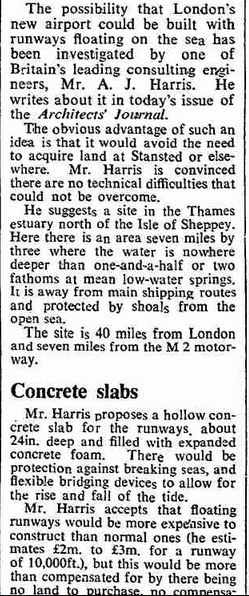
One of the things I have enjoyed about the 1967 project is the realisation that there is little under the sun that is new. This week came a proposal from a civil engineering company to build an airport in the Thames Estuary, an idea that has resurfaced in recent times under the new ownership of Boris Johnson. 

Boris has not taken up another bright idea from fifty years ago—the inevitability of Britain switching to driving on the right-hand side of the road—but it is only a matter of time.

This ends the weekly series of pieces summing up the week fifty years ago. There will be three more posts over the next couple of weeks or so to finish off the 1967 retrospective, looking at the Gillette Cup final, thinking about cricket now and then, and reflecting on the process of recreating a cricket season through social media.

Sunday, August 13, 2017

A Canterbury week to remember: 6 to 12 August 1967


It’s been a bit sad this week keeping an eye from afar on Canterbury week, cricket’s Royal Ascot now more by way of an autumn meeting at Pontefract. The main attraction was a three-day game against the West Indians, once a cast of legends, their roles now filled by understudies. Kent rested a number of players, so I trust that the club didn’t have the gall to charge extra just because it was Canterbury week, as has been recent practice. The T20 games that bookended the week will have got people through the gates, but not in the numbers that they came in 1967.

The Times said that almost 40,000 attended the week, and I suspect that this does not include members, who were not counted as we passed through the members’ gate on Old Dover Road. If this is so, 50,000 would be a better estimate.  The attraction? Kent, leading the Championship, were playing Leicestershire (second), then Yorkshire (third). 

I was there for the first four days. I’m certain of this as I remember that sort of thing, but was puzzled that I couldn’t recall much about the Leicestershire match. Reading John Woodcock’s reports, all was explained. It was as unmemorable a game as was played all season. As the week went on, Woodcock was to become increasingly exasperated with the low-entertainment value of the cricket about which he was writing. As early as Monday he was calling Colin Cowdrey “pensive”, and reporting with an undertone of surprise that the crowd accepted the slow batting in silence. The following day he described Lock’s decision to settle for a draw as “baffling”, given that Leicestershire had played two more games than Kent and three more than Yorkshire.

The game was Stuart Leary’s benefit match. Leary was the epitome of the long-serving professional for whom the benefit system had been designed in an age of poor pay and no retirement provisions. Leary’s winter career as a footballer with Charlton Athletic and Queen’s Park Rangers was over by 1967. It had mostly taken place in the maximum wage era, and even after Jimmy Hill’s successful abolition campaign, there were no crocks of gold in the middle divisions of the Football League. Leary was having a good season, chipping in when runs were most needed. He was often dogged, but could hit to effect when required. His benefit year returned £9,000, a fair sum in 1967 (my parents bought their semi-detached in Herne Bay for £2,500 in 1964).

Stuart Leary was a joker who would interact with the crowd; like many who cultivate a breezy persona, it was in part a disguise. He died by throwing himself off Table Mountain in Cape Town in 1988. There were rumours of Leary’s fears of vice squad investigations and AIDS, so it is important to note David Frith’s account in his book about cricketing suicides Silence of the Heart, in which he presents no evidence that such fears were anything other than the product of Leary’s own tormented mind.

The bored crowd at the Leicestershire game passed some of the time by generating a conspiracy theory. The England XII for the second test was announced on Sunday. Surprisingly, given that England had won three tests out of four so far that season, there were six changes from that picked for Lord’s. Colin Cowdrey, Alan Knott and Derek Underwood were three of the inclusions. Cowdrey was having a good year and remained one of the best batsmen in the country. Underwood was the leading wicket-taker and Knott, as we have seen, was attracting rave reviews from every reporter who watched him, so none of this trio was a controversial selection. But the Salem branch of the Kent Supporters’ Club has always been strong and for many the coincidence of a Yorkshire captain and three of Kent’s best being called into the nation’s service on the eve of a possible Championship decider was too much to bear, especially as Ray Illingworth, who had performed decently in the tests thus far, was dropped and thus available to play at Canterbury. 

Brian Close must have wished that he had such power. In fact, the last thing he would have wanted was Cowdrey, the establishment’s favourite, back in the test team, with the anointment of the captain for the winter tour yet to be made. It was the chairman of selectors, Doug Insole of Essex, who guided the choice. Insole died just last week, taking the story of the selection meeting for the South African tour of 1968 into the silence with him.

Kent needed a wicketkeeper, and thinking that experienced hands were needed in such an important contest, called Godfrey Evans back to the county colours for the first time since 1959. I’ve written before about watching Godfrey Evans that day and later. His return created a stir, with The Times carrying the story on its front page. He was one of that small band of cricketers who inspired lifelong adoration in a whole generation. You could see it at the SCG in the eyes of the elderly sisters in my earlier piece. Compton, Botham and Viv Richards were three others, but there aren’t many.

Once more, roads around Canterbury were jammed because so many people were going to the cricket. Instead of the blandness of the first game of the week, there was tension and incident throughout. We watched from the benches on the northern side of the ground, where the flats have been built. In Brian Close’s absence, Fred Trueman led Yorkshire and played the role of pantomime villain with enthusiasm. Just a year off retirement, Trueman had become a craftsman as skilled as any in the manipulation of the ball at medium-fast pace. But for a couple of overs when required he could roll away the years and bowl with pure speed. He was warned for persistent short-pitched bowling, but only after he had broken Brian Luckhurst’s hand in the opening overs. 

For the rest of the innings Kent mined for runs in difficult terrain: 42 for Denness, 66 for Leary. Evans got a hero’s welcome and Trueman dusted the crease with his cap as Evans reached the middle. The thing that people who were there remember most about the day was the hitting of Alan Brown, coming in at No 10. He made a quick 33 including 18 flayed (as Charles Bray reported) from four Trueman deliveries. When I was back at St Lawrence last year I saw Alan Brown walking around the boundary and went up to say hello. “I remember you hitting Fred Trueman into crowd” I said, pointing towards the Nackington Road End. 

“No” he replied. “Fred was bowling from the Pavilion End. I hit him into these seats here” (gesturing towards what was then the concrete stand). He was pleased to be acknowledged, even if inaccurately. 

It was probably true that the absence of the test players cost Kent the game, and perhaps the Championship. I wasn’t there for the last two days, but more to the point, neither was Derek Underwood, who might, on a sunny second morning after overnight rain, have cleaned up. Alan Dixon (the captain in Cowdrey’s absence) took seven, but at more than three an over, and he put down an easy catch that would have ended the tenth-wicket partnership and given Kent first-innings points. It seems very odd that the 85 overs of the Yorkshire innings were delivered by only three bowlers: Dixon, Brown and Norman Graham, who bowled 37 overs for 60 runs. Young off spinner Graham Johnson did not get a chance, and neither did John Shepherd. Bryan Valentine shrewdly noted in his President’s report on the season that Shepherd’s 54 wickets at 20 were all the more creditable given that he only got on when conditions favoured the bat. 

Kent “went to pieces” (according to the 1968 Kent Annual) in the second innings and were bowled out for 100. Only Bob Wilson, the end of his career just a few weeks away, resisted with any effect, making exactly half the total. Tony Nicholson took five for 37. Nicholson was the only member of the Yorkshire XI who would end his career without playing test cricket, and was a better bowler than some who did. His Wisden obituary says that “he swung the ball, had excellent control and was often found to be sharper in pace than the batsman expected”. We saw the best of him in Kent; the following year he was back at Canterbury and took eight for 22.

There was no way back for Kent. Yorkshire wrapped the game up on the third morning, and Leicestershire took over at the top of the table. Alan Gibson, who spent the latter part of the week at Lord’s watching the new leaders play Middlesex, was grudging:


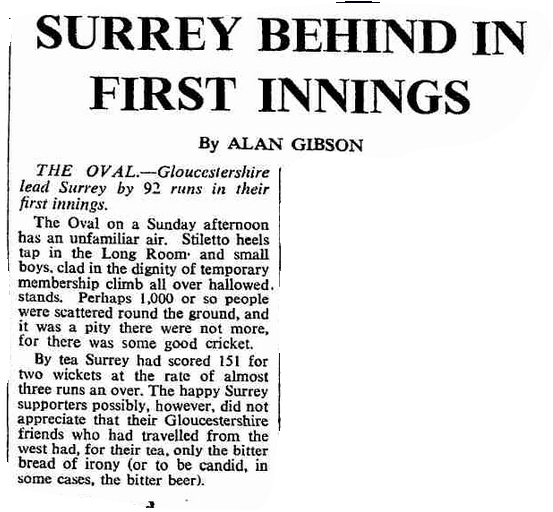
Gibson was in peak mid-summer form. The first two paragraphs of his report on Sunday’s play at the Oval is a typical Gibson opening. 


If this exercise in retrospection introduces a handful of readers to the writing of Alan Gibson, my work will not have been in vain (they should get hold of Of Didcot and the Demon, Anthony Gibson’s collection of his father’s work).

Gibson’s colleague the Sage of Longparish (as he called The Times’ cricket correspondent John Woodcock) was moving ever closer to the end of his tether by the end of the week. Having become impatient at the slow going at Canterbury during the first half of the week, he was exasperated by events on the first three days of the second test, at Trent Bridge, by the end of which England had scored a morose 252 from 135 overs, against an Asif Iqbal-led Pakistan attack. Woodcock did not hold back:


Outside cricket, my eye was taken by a proposal to build a bridge across the Thames Estuary to the Isle of Sheppey, to take traffic from the north to the unbuilt Channel Tunnel while steering well clear of London. On a clear day this bridge would have been visible from our house further along the coast and it was a cracking idea, but it’s the first I’ve heard of it, so cannot have been taken at all seriously.

The playwright Joe Orton died at the hands of his lover Kenneth Halliwell (or “friend” as The Times called him, showing that there was still some way to go after the decriminalisation of homosexuality a few weeks before). I had forgotten that the pair had been jailed a few years before for defacing library books.

The Consumers Council proposed that food should be commonly served in pubs, a suggestion that to some was as if they had suggested holding bingo sessions in the nave of Canterbury Cathedral.

Saturday, May 27, 2017

Gravesend Week: 20 to 26 May 1967


Kent v Northamptonshire 20 to 23 May

This piece sums up a week reported day-by-day on Twitter @kentccc1967. You don’t have to have a Twitter account to view these tweets.

The first of the cricket weeks around which Kent’s home matches were structured in 1967 took place this week, at the unimaginatively named Bat and Ball Ground in Gravesend, one of three venues in the north of the county—along with Blackheath and Gillingham—that had only five years or so left on the first-class fixture list. It has become a curiosity of Kent cricket that the team does not play where the bulk of the county’s population lives, which is why playing a few games each year at metropolitan Beckenham makes sense. I never watched cricket at Gravesend but am pleased to learn that it is still a cricket ground, home to Gravesend CC in the third tier of the Kent League.

The rain that submerged the early weeks of the season washed away most of the first day of the Northamptonshire game, but the rest of the week went well for Kent. There were centuries for Brian Luckhurst and Stuart Leary against Northamptonshire, and for Colin Cowdrey versus Somerset. Derek Underwood took 11 wickets during the week and Alan Dixon ten. Norman Graham, the country’s most in-form bowler, took another five to make Somerset follow on. The first innings lead against Somerset and the innings win against Somerset (Kent’s first of the season in the Championship) made Kent equal on points with third-placed Yorkshire, 16 behind early leaders Hampshire.

Mike Denness did not play against Northamptonshire having been selected for MCC against the Indians at Lord’s, a traditional pre-test series fixture and effectively a test trial. The England captain Brian Close led MCC, the selection including seven uncapped players all of whom went on to be test players. The Indians were blown away by John Snow in their first innings, but the weather enabled them to salvage a draw.

Denness’s absence allowed Alan Ealham to make his first appearance of the season. Along with Shepherd and Graham, here was a third member of the team of the seventies in place in the early weeks of the 1967 season.

At Worcester, Jack Flavell and Len Coldwell—English seamers from central casting—each bowled 19 overs unchanged to dismiss Somerset for 80.

It is well known that a T20 match cannot be played unless there is a bouncy castle on the premises, so that the young folk can elevate themselves to a height where they can better appreciate the field placings. But there is no such thing as a new idea, and there was to be a fair at Grace Road for Sunday’s play against Sussex in 1967 with roundabouts and donkey rides, no doubt a piece of enterprise from Leicestershire’s forward-looking secretary/manager Mike Turner. Alas, a large crowd was disappointed when the fair failed to turn up, as Alan Gibson reports:

It was an itinerant week in cricket. The rescheduled second round Gillette Cup game between Yorkshire and Cambridgeshire was allotted one day, but Headingley was flooded by a morning storm. A desperate phone search around the Ridings revealed that play would be possible at Castleford, a small club ground eight miles to the south-east. After lunch (The Times style guide for 1967 apparently has players taking lunch in the north, but luncheon in the south), the teams made their way there only for another storm to leave puddles across the field. The groundsman cut a new strip on which it was agreed that play would commence and continue irrespective of the rain, as Gordon Ross (editor of the Playfair Annual and Playfair Cricket Monthly) reports:


That professional cricketers, especially Yorkshire cricketers, should agree to play in these conditions seems astonishing to us; presumably they regarded any game of cricket, however biblical the venue, would give them a better chance than the toss of a coin. Yorkshire overtook the minor county’s 43 for eight in the seventh over of their innings.

They wouldn’t have taken long to get there with Brian Close driving. Close was fined £20 for driving at 55 mph in a 30 mph area this week.


Ray Illingworth once said that the kindest thing his wife ever did for him was to ban him from travelling with Close; later at Somerset, being Close’s passenger was the one thing that could frighten the youthful Richards and Botham, especially when he controlled the steering wheel with his knees while turning the pages of the Sporting Life.

It was a big week for football. Tottenham won the FA Cup final beneath Wembley’s twin towers, beating Chelsea two-one in the first all-London final. Now that the FA Cup has become a competition for reserve teams it is hard to understand that the FA Cup final was the biggest sporting day of the year. John Woodcock criticised MCC in The Times for not delaying the start of the match against the Indians until Sunday so as to avoid a clash.

Tottenham’s goals were scored by Jimmy Robertson and Frank Saul, both praised by Geoffrey Green for their wing play. Watching on television that day turned me into a Tottenham supporter, for a decade or so at least, so I was already spoken for when I watched Celtic become the Lions of Lisbon by beating Inter Milan two-one in the European Cup final at Thursday tea time (at that time because Lisbon’s misnamed Stadium of Light had no floodlights). Geoffrey Green reports:


The Middle East was counting down to war between Egypt and Israel, and the conflict in Vietnam continued, pushed onto the inside pages. But 337 US troops were killed that week, so presumably Vietnamese deaths on both sides of the divide were several times that figure, all for nothing as we now know.

Pirate station Radio 390 was declared illegal, though “pirate” is a bit of a misnomer in this case, as 390 was an easy listening station, the Light Programme with a plastic cutlass. The story took my eye, not just because I listened to 390 along with Radios Caroline and London but because from our house we could see the Red Sands Fort in the Thames Estuary from which 390 broadcast. Friends of my Dad’s ran the tenders out to the station. Tony Benn shut these stations down as Postmaster General. 

But the big story of the week was Good News. Francis Chichester was nearing home. Chichester, a pioneer aviator between the wars, was about to become the first person to sail solo around the world. It is a story that shows how far we have come in these fifty years. Now, such journey would be live streamed and would have the remarkableness extracted from it as a result. Then, once he was out on the open ocean, for weeks on end nobody knew where he was, or if he was alive or dead. Then a grainy photo of a speck on the ocean would be splashed on the front pages and we would update the map on our classroom wall. Half a million were expected in Plymouth to greet him, a measure of how the intrepid pensioner captured the public’s interest. 

The people waiting for the fair at Grace Road probably wished they had gone too.

A feast of 50 over finals at the Basin Reserve

  Men’s eliminator final, Wellington v Central Districts Women’s final, Wellington v Northern Districts Men’s final, Canterbury v Centra...