Showing posts with label Tony Greig. Show all posts

Saturday, August 2, 2025

26 July – 1 August 1975: The Bank Clerk Who Went to War


We come now to the curious case of the test-match career of David Steele, as strange a story as English cricket has seen in my time. As the week in 1975 begins, Steele is a 33-year-old batsman in his thirteenth year for  Northamptonshire, the archetypal county cricketer. This is his benefit year. He is having a good season and has already accumulated more than a thousand runs, with steady rather than big scores. Over the years, he had occasionally been mentioned as an outside possibility for England selection, but not this season, except in a piece by Tony Pawson in which he was named in a short list of batsmen whose time had passed, along with MJ Smith, David Turner of Hampshire and Chris Balderstone (who was picked a year later, with much less success). John Arlott wrote that his being a left-hander would be useful, a fair point undermined only by Steele’s being right-handed. Arlott was probably confusing David Steele with his brother, the left-handed Leicestershire opener John Steele. Some thought that the selectors had done the same.

John Woodcock prepared his readers for Steele’s appearance. “A bespectacled figure, almost more white than grey, he is not at all the image of what you would expect of a troubleshooter.” With the upturned peak on his cap there was a touch of Norman Wisdom about him.

It was this Steele that walked down the pavilion steps on the fall of the first wicket at the first day of the test match (having gone via the basement as he was unfamiliar with the route from the home dressing room). He watched three more depart (umpire Bill Alley had a very twitchy finger that morning) before he was joined by Tony Greig on his first day as England’s captain.

Their partnership was worth a usually unremarkable 96, but after months of being pummelled by Lillee and Thomson the sight of this apparent pensioner hooking them to the Grandstand boundary alongside his leader on the counter attack was stirring. Steele had left the pavilion an ordinary man, but returned a hero, a “symbol of national resistance” as John Arlott called him. By Christmas Steele was BBC Sports Personality of the Year. Clive Taylor of the Sun called him "the bank clerk who went to war".

Steele's fall was as precipitous as his rise. There was no winter tour, so the next tests were against the West Indies in 1976. Steele began with his maiden century in the first test and came third in the averages behind Edrich and Close. But he was not included in the touring party for India that winter, and that was that. He continued to play county cricket until 1984 and has made a fair amount of money telling the story of his short but spectacular England career ever since. He appears not much older than he did that day at Lord’s, though that is largely because he looked about 70 then.

Here is Arlott’s account of the first day.


At first, the second day was even better. In reply to England’s 315, Australia subsided to 81 for seven. “Not since the war, I think, had Australia suffered such a collapse on a good pitch against England, in England” reported John  Woodcock. “At lunchtime the atmosphere was like that on VE Day. It was too good to last, of course, but it bucked us all up at the time”.

Ross Edwards with 99 (at which point he became Bob Woolmer’s first test wicket) and a Dennis Lillee’s test-best 73 not out reduced the final deficit to 47.

One thing I noticed on the YouTube highlights confirmed my view that Alan Knott was half a century ahead of his time. Then, the standard guards ranged from leg to middle. Taking an off stump guard was almost unheard of. Ask Arthur Jepson for an off stump guard and he would have come at you with a stump in hand. Yet, as Jeff Thomson runs in, there is Knotty tapping his bat well outside off. Genius.

I saw none of this on television. Canterbury week, starting unusually on a Wednesday, coincided with the test match. Peter Marson, there for The Times, paints an evocative picture that takes me straight back there.


The organisations named in the first paragraph all had marquees at the Nackington Road End that shimmered through the week. It was gloriously hot, like the summers of our youth ought to be. Deal Beach Parlours had a new ice lolly that summer. I don’t remember the flavour, which probably had a lengthy chemical formula, but it was a wonderfully lurid turquoise. I had so many that week that the man in the ice cream van had one ready each time I approached, the transaction taking place wordlessly. The gaps in my teeth remind me fondly of the summer of ’75.

I also remember the rough reception that greeted Hampshire skipper Richard Gilliatt as he returned to the dressing rooms having declared Hampshire’s second innings closed a couple of hours later than was necessary to make a game of it. The winning team in this fixture would lead the Championship. Perhaps the knowledge of Kent’s successful pursuit against the Australians a few weeks earlier deterred Gilliatt, who eventually called a halt when he was 97 not out.


Gilliatt almost had the last laugh. Kent batted testily and quickly lost seven wickets. Cowdrey batted for 100 minutes to save the game.

Ill temper marked this round of matches. The heat was getting to cricketers everywhere. Leicestershire protested against a late Lancashire declaration by having Roger Tolchard bowl an underarm ball at Clive Lloyd. Ray Illingworth then promoted himself to No 3 to block.

Both these games tell us that three-day cricket relied too much on captains being willing to set targets. The restriction of the first innings to 100 overs did not move the game on sufficiently, but encouraged negative, not wicket-taking, bowling.

Hampshire topped the table, with Boycott and Hendrick leading their respective averages.


Saturday, July 19, 2025

12 - 18 July: Chaos at the Crabble


Mike Denness’s England captaincy came to an end on the damp grass of Edgbaston. His fortunes had changed. At first he was a lucky captain, drawing a series in the Caribbean that he deserved to lose, followed by an easy summer against weaker opposition. He became unlucky as soon as the Ashes began in Brisbane, when, without warning, Lillee emerged from a long period of injury and Thomson from obscurity to form one of cricket’s most deadly pace-bowling combinations. Let us remember that later that year Clive Lloyd’s West Indies did even worse in Australia than Denness’s England, losing five-one. His winter nemeses both took five-fors in Birmingham, Lillee in the first innings, Thomson in the second, in the intervals between another piece of Denness bad luck: the rain.

The selectors were quick and merciful. The announcement that Denness was to be replaced by Tony Greig came on what would have been the fifth day of the test match, had it lasted that long. Many names had been mentioned, but Greig was the only candidate who did not fall over any of the hurdles that eliminated the rest.

The only other regular member of the test XI who was a contender was John Edrich, Denness’s deputy in Australia. The Surrey man had the grit and quality as a batter, but his county had a reputation of being disunited under his leadership. Keith Fletcher was developing a good name as Essex captain, but was thought to suffer from traumatised batter syndrome after the experiences of the winter. Of his shaky half century at Edgbaston John  Woodcock said “Fletcher’s second-innings fifty was a mixture of desperation and defiance. He will have to stay, whether he likes it or not”.

Any return to old favourites such as Illingworth or Cowdrey was agreed to be retrograde. Resorting to a county captain outside the team—Richard Gilliatt of Hampshire was mentioned more often than Mike Brearley—was how Denness had got the job. So it was Greig, despite a brashness that was a bit much for some of the establishment figures. Knott and Underwood, wisely, held no ambitions for the captaincy, though Knott stood in for Greig for an ODI in 1976.

John Arlott gave Guardian readers a shrewd and balanced assessment of what the new leader had to offer.


 As it happened, the Australians played Sussex at Hove this week. Greig made a strong statement by scoring a century then  blasting Greg Chappell for not declaring on the final afternoon. Things had changed.

I followed the unfolding disaster at Edgbaston on Saturday on the radio at the Crabble Ground in Dover where I was watching the first day of Championship game between Kent and Nottinghamshire, who made 328 for eight in their 100 overs, with Mike “Pasty” (he was from Cornwall) Harris making 116. He was making plenty of runs despite having taken on the keeper’s role. Harris would have been a candidate for our imaginary MCC winter touring squad that never happened. As I post this I hear that Pasty Harris has passed away (my Blean correspondent keeps me informed about the expiration of cricketers). RIP.

The Crabble was a lovely ground, set into the hillside of the North Downs as they prepared to burst out as the White Cliffs of Dover, but was in its penultimate year as a county venue. When I was back in the UK in 2011 I visited the Crabble, in the company of my Blean correspondent. Here is my account.

Fast forward to September 2023. I was spending a few days in Melbourne and take a day trip to Geelong, a pleasant coastal town an hour south of the city. In a bookshop I came across a title that I had not heard of, Brian Levinson's Cricket Grounds Then and Now. Flicking through it, I saw a piece on the Crabble and was surprised to find my name in it, referring to the piece on Scorecards. What’s more, I was in the index, sandwiched by two of the greats, George Hirst and Jack Hobbs.


 I was not present for the final two days of the Championship game, a pity as there was fun to be had on both. Canterbury’s St Lawrence Ground was, I’m pretty sure, the only venue on the county circuit that operated two full scoreboards, the white one where the cafĂ© is now and the black one that still tops the length of the Leslie Ames Stand. Not all the test grounds provided two full boards.

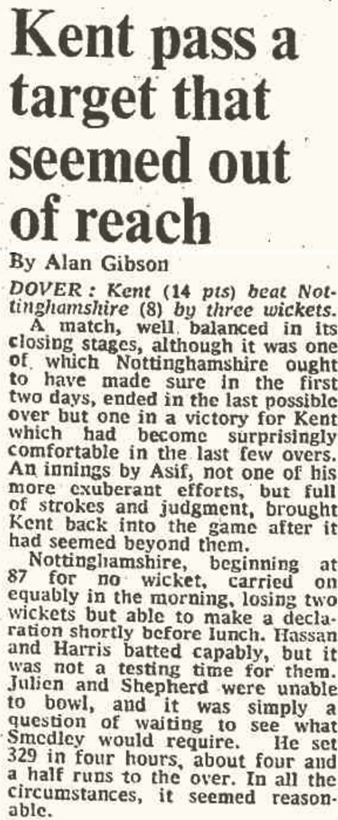
Provisions at the outgrounds were not as efficient. I have forgotten what the arrangements were at the Crabble, or even where the scoreboard was, but it almost certainly involved lots of individual metal sheets hung on hooks with operators who were not as familiar with the process as those at headquarters. On the second day of the Nottinghamshire game there confusion about the visitors’ first-innings score, which became crucial when Kent were in danger of following on. Happily, Alan Gibson was present to record the chaos.


Two years later a similar scoreboard fiasco occurred down the road at Folkestone. With 15 left to get in five overs and six wickets in hand, Kent contrived a collapse that left that epitome of No 11 batters Kevin Jarvis on strike with three balls remaining. To quote the Kent Annual “the scoreboard suggested that two were required and Fletcher set the field accordingly, thus when Jarvis scored the winning run off his first ball confusion reigned as the batsmen left the wicket with the fielders and umpires believing the scores were still level”.

On the third day of the Championship match back in 1975, Kent chased down 330 in 72 overs, a good chase now, then an improbable one. From Gibson in The Times:


Nottinghamshire lost despite losing only ten wickets to Kent’s 17, but that was in the nature of three-day cricket.

I was at the Crabble for the Sunday League match that also ended in a successful Kent pursuit, an unbroken sixth-wicket stand of 60 between Dave Nicholls and Alan Ealham.

After the Championship game finished at 6 20pm on Tuesday the two teams got in their cars and drove 210 miles to Nottingham where they began a 60-over Gillette Cup game at 11 am on Wednesday. Tell the young people of today that you could get 120 overs into a day’s cricket and they won’t believe you. Kent did well to recover from 47 for five to reach 216, but still lost by 31 runs.

Alan Ealham was twelfth man for that game and fielded for the injured Norman Graham. I doubt that there has ever been a greater disparity in the quality of fielding between the replaced and the replacing. It makes the difference between Gary Pratt and the England bowlers he subbed on for in 2005 look as nothing. Ealham took two catches described by Peter Marson in The Times as “splendid”, a level of fielding proficiency of which the gangly bowler could only dream.

My future skiing instructor Barry Dudleston was in fine form, completing his third century in a month. Barry was 80 this week; going round a golf course in less than his age may be a realistic prospect some time soon. Happy birthday to him.


Sunday, April 27, 2025

1975: Setting the Scene

Eight years ago I retrospectively chronicled the English cricket season of 1967 as it unfolded, a half century after it happened. Daily posts on Twitter, as if it had existed in the time of flower power and Tom Graveney, were supplemented by weekly blog posts using hindsight to the full. The cricket was placed in the context of events of the day. This was great fun to do and attracted favourable reviews, notably from Brian Carpenter’s annual round-up of the cricket blogs in Wisden (sadly missing from the 2025 edition). 

I have not repeated the exercise since, largely through lack of time. For six of the intervening years I was House advisor to the New Zealand government of Labour PMs Ardern and Hipkins, responsible for wrangling the government’s programme in Parliament, which kept me busy. The result of the 2023 general election reversed that role into one of undermining the government. Happily, the new administration is doing such a fine job of that themselves that I have been able to cut my hours, and have the time to repeat the exercise in cricketing retrospectivity, this time looking at the cricketing summer of 1975.

Why 1975? It continues the fifty-year-anniversary theme. But mostly, it was a great summer, both for cricket and the weather. There was the first World Cup, the Ashes and county cricket everywhere, all the time. And the sun shone through high summer more than any other in my life to that point (but not as much as the following year).

English cricket began the season in a state of shock following the drubbing received over the winter at the hands of Australia in general and Lillee and Thomson in particular. Kent’s Mike Denness was the incumbent England captain, but it was not yet confirmed that he would still be when the World Cup started in early June. Hampshire’s Richard Gilliatt led MCC in the season opener against champions Worcestershire. The obvious successor was Tony Greig, an option found distasteful by the cricketing establishment mostly because of Greig’s brash approach to cricket and life. His close-of-play riot-provoking running out of Alvin Kallicharran at Port-of-Spain the previous year was still held against him.

The County Championship of 1975 was a contest of 20 three-day matches per county. A possible 60 playing days was only four more than the current programme of 14 four-day games offers, though the Championship then was for high summer not the scrag ends of the season. The 55-over competition started with a group stage of four games a side preceding the knockouts. Sundays were for the 40-over league, and the 60-over knockout took place over the second half of the season.

I am always suspicious of people who proclaim their youth as the best of times. Usually, they are merely regretting that they are no longer young. Nevertheless, I contend that the mid-seventies were a golden age for county cricket. Every county (except Yorkshire, for self-imposed reasons) could sign a world-class player or two. This meant that young English players could learn by bowling to the likes of the Richards, or facing Andy Roberts or Sarfraz Nawaz. Paying at the gate to watch a county game came with a virtual guarantee that an international star or two would be on the field, and, with four trophies to contend for, every county had a chance.

As before, I will mix the cricket together with news and events of the time, one generally regarded as low point in modern British history, with inflation rarely used without its companion adjective “runaway” and strikes, be they lightening, wildcat or other dominating the news. Two of the most prominent television news journalists were Peter Sissons and Ian Ross, industrial correspondents of ITN and the BBC respectively.

Prime Minister Harold Wilson struggled to maintain a bare majority in the Commons, a battle brilliantly recounted in James Graham’s play The House, and one that fascinated me as I was drawn into the world of parliamentary process and procedure as I had been into the world of cricket a few years before. For Christmas that year I asked for the first volume of Richard Crossman’s Diaries of a Cabinet Minister to sit on the shelf alongside Wisden.

Internationally, as the first balls of the season were bowled thousands of Vietnamese associated with the collapsing government of South Vietnam struggled to escape as Saigon fell. Gerald Ford (another Republican who we now view with unexpected nostalgia) was President of the USA; Giscard d’Estaing led France; Gough Whitlam was Australian PM, but was to fall to the Governor-General’s DRS later in the year; Labour’s Bill Rowling was New Zealand’s PM, but was gone by the end of the year.

One change from last time: daily social media updates will be on Bluesky rather than Twitter. I can be found there as @kentkiwi.bsky.social with username Cricket1975. As with 1967 eight years ago, the dates fall conveniently on the same days of the week as they do in the present.

I’d welcome contributions from others with memories of the summer of ’75.

Saturday, August 12, 2023

The Cricketer, July and August 1973


The covers of The Cricketer at this time were often things of some beauty. Perhaps colour printing on good-quality paper at that time precluded too much overlay of text on image. Maybe it was the good judgement of David Frith, from August acknowledged on the masthead as editor. He knew how to make the most of photographs having put together several compilations of them, sometimes with Patrick Eagar, who was responsible for both these covers. 

What we have here are two character studies, framed and drawing us to the subject without distraction. West Indies’ captain Rohan Kanhai signs an autograph, the silver hair of the old campaigner contrasting with the greenness and heat of the Caribbean setting (Queen’s Park Oval in Trinidad, I think). A few weeks later, Kanhai was to make one of the best hundreds I have seen, at Lord’s in the third test.

John Snow, perhaps a little weary, turns at the end of his run up, which had an aesthetic appeal rivalled in the seventies only by those of Holding and Lillee. Does this photo look as dated as one of Rhodes or Woolley would have done to us then? The unadorned whiteness of the kit might make it so. Perhaps the ersatz patriotism of Jerusalem was not necessary when the crown and lions had the entire sweater to themselves. Rolling your sleeves up was more than a metaphor then too. 

Snow had just published a book of poetry, his second collection. It was  reviewed in the August edition by cricket’s most renowned poet, John Arlott, whose reviews were invariably kindly, as evidenced by his annual survey of cricket books in Wisden. Criticism is sugared.


The argument of these uneven, almost haphazard pieces is that, one day, John Snow is going to surprise many people – but not himself – with some highly perceptive writing.

Arlott puts Snow’s achievement in its historical context.


John Snow is the only Test fast bowler to utter a book of verse. Fred Trueman has been known to repeat some pungent rhymes but, as a composer, has always tended to a certain monotony of adjective.

The Captain’s Column had been inherited from the Playfair Cricket Monthly, and reverted to the original practice of featuring a different county skipper each month. In these two editions, Tony Greig was followed by Ray Illingworth. 

They disagreed about the structure of the Championship season. Greig favoured 16 fixtures (there were 20 in 1973). Illingworth favoured the status quo.


To reduce it to 16 would be taking away the chance of eight possible innings for our batsmen and I feel they get insufficient opportunities of playing natural cricket even today.

Both saw these as three-day games, but agreed that the playing day could be extended by an hour on each of the first two days. In Greig’s words:


On a full first day this should produce at least 126 overs. I believe a longer day would bring back more spin bowling.

That would have meant that two days’ of Championship cricket would have seen more balls bowled than three days of tests do now. It is worth noting that in 1973 ten of the 17 counties had at least half their games finish in draws. 

Another of David Frith’s specialities was interviewing old cricketers. In July it was the Leicestershire all-rounder George Geary. The result is a fascinating account of cricket between the world wars, and we learn that players leaving the field to freshen up happened long before Dennis Lillee did it. In the Adelaide test in 1928/29 Geary, prone to cramp, went off for a massage. 


Then an Australian official came into the dressing room and said he would not be allowed back on the field after treatment.


‘I didn’t know who he was. I offered to snap him through the bloody window. Later a taller man came in but I wasn’t afraid. Syd Barnes used to do it. He even went off for a bath sometimes when he felt like it!’

In August, JM Kilburn farewelled Bramall Lane in Sheffield as a cricket venue. A test venue once, in 1902, the ground doubled as Sheffield United’s home (which it still is), and a stand was about to be built across the square. Kilburn is nostalgic, presenting its golden age as being the years before and after the First World War, but the winter game’s encroachment and the decline in cricket-watching from the 1950s on means that he does not lament its passing. 


When spectators could be numbered in tens of thousands they generated a vitality of atmosphere to obliterate the inconveniences, not to say hardships, of watching. Numbered in tens, spectators made the cricket look forlorn and its setting grimly uninviting.

Kilburn lists his own memories of the ground, as we all might of our favourite places.


In my Bramall Lane a young Herbert Sutcliffe will for ever be racing in front of the pavilion rails to hold a breathtaking catch for ER Wilson; a perspiring and grinning Maurice Tate threatens mock strangulation for a downcast wicketkeeper who has just dropped three catches forced by wonderful new-ball bowling; Cameron of South Africa is bombarding the pavilion roof with mighty straight drives; Trueman and Peter May are locked in titanic combat for an hour; Bowes is confusing Bradman; and  AB Sellars is signalling heartbreak with ‘Match Abandoned’.

John Woodcock reported on the first two tests against New Zealand, the first an England victory by 38 runs, the second a draw with New Zealand in the driving seat. Both had featured 170s from Kiwi skipper Bev Congdon, supported in both cases by centuries from Vic Pollard. At Trent Bridge the visitors looked as if they were going to chase down an improbable target of 479. Had they done so, it would have been a record still. At Lord’s the game finished with England nine down and only 165 ahead. New Zealand’s first win over England would come five years later at the Basin Reserve; five years after that they registered the first as tourists, at Headingley. 

In the July edition, Alan Gibson reviewed The Hand That Bowled Bradman by former Somerset player Bill Andrews, who for many years would greet people with an invitation to “shake the hand that bowled Bradman”, the boast uninhibited by the fact that the Australian was on 202 at the time. 

Andrews had the distinction of having been sacked four times by Somerset, twice as a player and twice as coach. Gibson knew him well.


There is no malice or guile in him, though he is at times capable of a certain low cunning, of a kind that would not deceive an infant. Despite his ups and downs he has many more friends than foes. Indeed, anyone who told me that they did not like Bill would go down in my esteem (though anyone who told me he had never been irritated by him would go down too, for quite different reasons).

Gibson reports that at the time of writing, Andrews hoped to be re-employed by Somerset, so that they could sack him for a fifth time.


Saturday, April 22, 2023

The Cricket Magazines: March 1973


What a treat to find two articles by Alan Gibson in The Cricketer. The first is a profile of Tony Greig, England’s outstanding player on the tour of South Asia at the time of publication. I maintain that Greig has never been given quite the recognition he deserves for being one of the best of his time, and one of England’s finest all-rounders across the eras.


Gibson hints that Greig was undervalued at this early stage of his international career too. After two years in Sussex Seconds while he qualified as an overseas player, Greig was an immediate sensation, with 156 on Championship debut. It should be remembered that he committed to playing for England before South Africa’s exclusion from international cricket, yet it seemed that English cricket, presented with such a gift, was unwilling to unwrap it, fearful that it might be a bit showy or extravagant.


Greig eventually made his test debut (or so we then thought) in 1970 against the Rest of the World. Gibson reports:


In the second match at Nottingham, which England won (probably the best performance by an England side since the Second World War) he had as much as anyone to do with the victory, taking four wickets in the first innings and three in the second. The batsmen whose wickets he took were Richards (twice), Sobers (twice), Kanhai, Engineer and Barlow. 


Despite topping the bowling averages, and scoring a fifty in the third match, Greig was omitted from the Ashes tour party that winter, and left out throughout the 1971 season, the selectors’ preference being for the more pedestrian Richard Hutton. 


Both players were selected for the Rest of the World squad that toured Australia the following winter.


No doubt both were chosen in the first place because of Australian determination not to pick a Rest of the World side that approximated to the real strength of the Rest of the World: but it did not turn out to be so pointless a series as was intended, and of the two English all-rounders it was Greig who made his mark.


Gibson concludes by reporting the opinion of his colleague at The Times, John Woodcock, to whom he refers by the usual sobriquet.


The Sage of Longparish is not himself a tall man, and has not always been enthusiastic about Greig in the past. What he really feels is that all the best cricketers are five foot three. A judgement from this quarter is therefore convincing.


Gibson’s second piece is titled Cricket in Fiction. It is an amiable ramble that touches upon, among others, Richards, de Selincourt, Dickens, Sayers and, of course, Wodehouse. Also JL Carr, whose recently published A Season in Sinji is mentioned in the opening paragraph, and to which Gibson returns near the end.


I would have enjoyed it if he had left out the cricket.


He forces his analogies, he strains his language, to show that life is just a game of cricket, which is neither more or less true than that life is just a bowl of cherries, some of them going bad, or a sack of potatoes, or – well, whatever analogy happens to come to you. 


Mr Carr is very strong on breasts and lavatories, which I suppose is mandatory in the modern novel. Just as I was beginning to get interested in the bosoms, there was a piece about cricket; and just as I was beginning to get interested in the cricket, back came the bosoms, and the dirt, and the violence. No doubt life is like that : but since we all have to experience it anyway, I doubt if we have any obligation to read about it as well.


Both The Cricketer and Playfair Cricket Monthly reported on the third and fourth tests between India and England. The hosts took a two-one lead in the third, but only by four wickets. England could not cope with the most renowned of spin trios, Bedi, Chandrasekhar and Prasanna. Fletcher’s unbeaten 97 apart, no England batsman made more than 20 in the first innings, and none more than 21 except Denness’s 76 in the second. These were notable innings by both future England captains, but they went almost unnoticed. Pat Pocock took four wickets as India made hard work of their target of 86. As the Sage writes, “With another 50 runs in the bag [England] would probably have won it”.


One thing that I learned was that Derek Underwood could not play in this game, having awoken with a temperature on the first morning. I had thought that Underwood, round-shouldered smoker that he was, had never missed a test match for fitness reasons, but this was illness, not injury. “If any wicket in India was likely to be suited to Underwood’s many talents it was this one in Madras” said Playfair’s anonymous correspondent, who had probably cobbled the report together from press reports, given that the magazine was now an issue away from oblivion. 


In the fourth test, England achieved a lead of 40, but India’s first innings occupied the whole of the first two days on a slow pitch that offered bowlers little, so a draw was the outcome. The highlight was captain Lewis’s 125, his sole test century. The Sage:


Having said that the time had come to attack the Indian spinners, Lewis, in Kanpur, did something about it. When he came in Bedi had bowled nine overs for eleven runs and England were 48 for two…Lewis at once jumped out to hit him over mid-on for four. He had got 70 against Bedi on a turning pitch in England last season by using his feet, and this is what he did now.


Tony Lewis might have been picked for England at any time in the previous decade. The list of batsmen no better than him who were is long. As Woodcock says, the innings showed what Lewis might have achieved “had he had the advantage of playing on better pitches than those in Glamorgan”. 


Another tour is featured in both magazines, that of Kent, as Sunday League champions, to the West Indies. I have written about this tour before but was unaware that both The Cricketer and Playfair carried extensive reports on it, by Michael Carey and Howard Booth (of the Daily Mirror, if memory serves) respectively.


In my original article I called out Wisden’s description of my former skiing instructor Barry Dudleston’s bowling as “chinamen” as wrong, given that the Playfair annual consistently listed him as “SLA”, but it seems that it was indeed wrist spin that he purveyed on this tour.


According to Booth, Colin Cowdrey “rated him a more effective bowler than Ken Barrington on these pitches”. He got Rohan Kanhai out first ball, although it needed a brilliant catch by Alan Ealham off a full toss.


One promising Antiguan batsman was noticed in both reports. This is Carey’s description:


The locals made an entertaining fight of it, largely due to Vivian Richards, a 23-year-old batsman of sound technique and bold method. Cowdrey felt he would play for the West Indies soon.


In Playfair, Cardus laments “the virtual disappearance of the spin bowler”, which was to overstate the case when most counties still went into matches with two slow-bowling options. He tells a story about SF Barnes (and we must remember that in matters of factual accuracy Cardus was the Fox News of his day) and a match that celebrated his eightieth birthday. Barnes was to bowl the first ball and was asked what he intended. “I’ll bowl the first ball but I don’t know about a full over. I can’t spin now, my fingers are too old. I suppose I’ll have to fall back on seamers—any fool can bowl ‘em”.


Sunday, July 24, 2022

The Cricketer: July 1972


The Ashes were the main attraction of 1972 and The Cricketer was fortunate to have John Woodcock as its test match reporter. The July edition carried his account of the first test, played at Old Trafford in early June.

England won a seam-dominated match by 89 runs. John Snow took eight wickets, backed up by Geoff Arnold and Tony Greig with five each. Greig was making his test debut, though this would have come as a surprise to him, given that he had appeared four times for England against the Rest of the World in 1970, contests that were regarded as test matches at that time. He was also ever present in the Rest of the World team that had played in Australia the previous winter, matches that were never categorised by the Australians as tests, though, as discussed here previously, they were manifestly of test quality. Greig also made two half centuries at Manchester.

Anybody who has read much of this blog will know of my admiration for John Woodcock, but he did have a blind spot when it came to the nationality qualifications of England cricketers in general, and of Tony Greig in particular. It will be remembered that he wrote that one of things that explained the Packer schism was that Greig was “not a proper Englishman”. His report here develops this theme.

The ideal England team would be composed of Englishmen, pure and simple. One might have said the same when Ranji, Duleep or Pataudi were playing, or when D’Oliveira was first picked. If I were an Australian I might wonder about the fairness of it all.

But then I might count up the number of Aborigines in the Australian team, find that there were none, and reflect that my team consisted entirely of players who were, in the great scheme of things, recent immigrants themselves.

Woodcock reports that only 36,000 attended the test, which lasted well into the fifth day. That is less than a third of those who went through the gates of Old Trafford for the equivalent fixture in 2019, a comparison that those who argue that test cricket is on permanent decline should note.

Alex Bannister, long-serving Cricket Correspondent of the Daily Mail (and no relation of Jack Bannister, as far as I know) had a series running featuring a different county each month. In July it was Worcestershire. The article ranges between the past and the present in a pleasing way. I learned several things, including that county secretary Mike Vockins was an agricultural biochemist (which might have come in useful when the Severn made one its regular visits to the Worcester outfield), and that the Nawab of Pataudi senior (the same as cited by Woodcock, above) became a Worcestershire player only after having been turned down by Kent. This would have been around the time that Lord Harris insisted that Walter Hammond had to serve a two-year qualification for Gloucestershire because he had been born in Dover while his soldier father was stationed there, so perhaps embracing Pataudi would have been a double standard too far, even for that scion of the aristocracy.

Bannister rated the 25-year-old Glenn Turner highly.

There are two Turners – one intent on crease occupation; the other a magnificent strokemaker. In either mood – and I prefer the latter – he is one of the world’s leading batsmen.

Another New Zealander, John Parker, was on the Worcestershire staff in 1972. Years later, when I was writing for CricInfo, Turner and Parker joined us in the press box at Seddon Park in Hamilton and reminisced about their New Road days. The conversation turned to the use of statistical analysis in modern coaching. One or other of them said something along the lines of:

We had a computer that gave feedback based on the study of the available data. It was called Norman Gifford and it used to stand at short leg giving insightful readouts such as “what the eff are you bowling that effing crap for?”.

I am writing on T20 Blast finals weekend, against which the ECB have scheduled an ODI against India, thus depriving the participating counties of their international players. A similar issue half a century ago saw the boot on the other foot. Surrey and Sussex both refused to release their players to appear for MCC against the Australians in the traditional pre-tests fixture, preferring to retain their services for the Benson and Hedges Cup. I generally avoid a romantic view of cricket in those days, but a time when counties could tell Lord’s to stuff it was a great one in which to be alive.

Denis Compton and John Snow both defended the decision, but the majority of the cricketing establishment was outraged. Crawford White of the Daily Express wrote that “as a member of Surrey for 20 years and more, I think that this is a disgraceful decision”.  MCC Secretary Billy Griffith called it “absolutely deplorable”, while EW Swanton, as Bryon Butler put it in his monthly press review, “drew his sword”.

History of a most regrettable sort has been made…It never occurred to me for a moment that this fixture would not be held sacrosanct…In football, one hears, England suffers from the selfishness of clubs. That is football’s affair. It is cricket’s affair to put country first rather than the short-term financial advantage of a sponsored competition, however good in itself…cricket has been done a grave disservice, which is sure to have strong repercussions.

This is vintage Swanton. “Football” and “sponsored” become terms of abuse. MCC is awarded dominion status. We see in our mind’s eye the oafish member of the lower classes to whom he slips sixpence for furtive news of the association game. And he gets it completely wrong. By the way, that whirring noise is Swanton turning like a rotisserie chicken at the news that the Varsity match has been exiled from Lord’s.

John Arlott profiles Peter Lever. His opening paragraph will move any of us who treasure county cricket.

The heart of English cricket is the county game; and the essence of county cricket is not the Test star who dominates it but the ordinary county cricketer who is there every day and gives it his constant and fullest effort. He does not, like the representative players, miss a dozen county games a year to play for his country. He is a man for all seasons; county cricket is for him an achieved peak and a fulfilment.

But the highlight of the July edition comes in the School Review. It is the historic first appearance in the press of the great CJ TavarĂ©. Then captain of Severnoaks School, he made 116 including 12 fours and—wait for it—ten sixes.


No doubt this news will provoke ill-judged and distasteful remarks from the class of person who in earlier times would have earned a crust by slipping news of Aston Villa’s away form to Swanton, and who know Tav only as the obdurate fellow who was the tax manual of England’s batting in the early eighties. But it will come as no surprise to those of us who knew the Sunday TavarĂ©, the man who would dismantle any attack in the country over 40 overs. Three of the Australians at Old Trafford would still be around in 1982/3 to play tests against TavarĂ©.


Saturday, July 22, 2017

The first of the great days: 15 to 21 July 1967


It was a great day, the first of the great days, the very day when Kent’s second golden age began. Wednesday 19 July 1967, the Gillette Cup semi-final between Kent and Sussex.

It was the first List A—one-day equivalent of first-class—game to be played at St Lawrence (though it’s a bit tough that the Cavaliers games had no official status). Just short of 17,000 of us crammed into the ground that day, double the current capacity. I began on the wooden benches at the Nackington Road End between the sightscreen and the iron stand, since renamed after Leslie Ames. Later in the day I moved to the boundary’s edge, or possibly beyond it; the boundary shrunk as latecomers took their places on the grass inside the white line. Traffic across Canterbury was gridlocked for much of the morning.

One of the first posts on My Life in Cricket Scorecards I described St Lawrence as it was that day. As I write this, I am watching a recording of a recent T20 game at Canterbury. So much has changed, but the winds of time have left enough in place to make it recognisable. It has not been spoiled, though basing the design of the new flats on the northern side of the ground on that of an East German prison is odd (as an aside, I had thought it impossible that there could be a worse cricket commentator than Danny Morrison, but I listen to Andrew Flintoff at the T20 and reconsider).

Sussex, or more precisely Ted Dexter, worked out the one-day game before anybody else and had won the first two Gillette Cups in 1963 and 1964. Before this season Kent had never beaten a first-class county, so Sussex were favourites. Dexter had given up the game (though was to return for Sussex and England the following year), but Sussex had John Snow, Tony Greig—who had appeared like a whirlwind in the county game that year—, Jim Parks and a team full of experience.

It is worth reproducing John Woodcock’s Times report in full. There is a joy about his writing here that had been absent from his reporting on the test series. It inspired him to reach the top of his game.


I do remember the trepidation caused by the early fall of Denness and the slow restoration of confidence during the second-wicket partnership between Luckhurst and Shepherd, whose contrasting styles Woodcock describes so well. Then, Cowdrey. Yes, he could be stodgy, but on those days when he eluded his captors of caution and reserve he was something to behold, and that day was one of them. His 78 took just 59 balls, and late on in the innings he and Knott made 58 in five overs. All this, bear in mind, with seven or eight fielders back on the boundary. Kent’s 293 was worth at least 350 in a modern 50-over game (the Gillette Cup was 60 overs). 

Woodcock is possibly a little optimistic about Sussex still being in the game until Parks was out; they were well on the way to defeat at 27 for three. This was probably the first time that I became aware of the tremendous feeling of being in control that Kent supporters had when Derek Underwood came on. It was like acquiring a superpower. Woodcock’s account of his defeat of Greig is magnificent; you didn’t trifle with Derek Underwood. 

I will get around sometime to writing about my ten best days at the cricket. The semi-final of 1967 will be one of them.

So to Lord’s, to play Somerset who defeated Lancashire convincingly on the second day after rain took away much of the first. The Palmer brothers, Ken and Roy, both test-match umpires in years to come, delivered the victory, along with Fred Rumsey, Bill Alley and Graham Burgess. Burgess was still there 12 years later on the day Kent’s golden age ended and as Somerset’s began: all out for 60 at Taunton.

Earlier in the week, the Championship game at Southampton (the old ground at Northland Road) vindicated John Arlott’s criticism last week of the points system, quickly becoming a dour battle for first-innings points. Richard Gilliatt, back from captaining Oxford University for the first half of the season, made 122 in six-and-a-half hours, in vain as Hampshire were bowled out four short of Kent’s total. 

David Turner, to become a regular for Hampshire over the next 20 years, scored his maiden fifty in this game. Later in the week he had more success, reaching the last eight of the National Single-Wicket Championship at Lord’s. He beat Hanif Mohammad and Kent’s Alan Dixon before going down to Harvey of Derbyshire. Garry Sobers won the final defeating Brian Edmeades of Essex.

The matches were eight-overs-a-man (they did change ends) but out was out, so some contests were very short. Fred Titmus took one ball to overcome Clive Lloyd’s eight-ball three. There was a full complement of fielders but no non-striking batsman. A batsman who crossed a line halfway down the pitch had to proceed to the other end and stay there until cleared by the umpire to return to the other end. 

It was the fifth year of the competition; apart from the first at Scarborough, all had been held at Lord’s. The following year’s contest, at the Oval, was washed out. It returned to Lord’s in 1970, Keith Boyce the winner and then it seems to have disappeared from the calendar. Previous winners were Ken Palmer, Barry Knight, Mushtaq Mohammad and Fred Titmus. 

In the wider world, Britain was obsessed with sonic booms. With the maiden test flight of Concord (the French imposed the “e” later) imminent, some feared that living in Britain would be like inhabiting the inside of a drum, normal conversation all but impossible because of the mechanical thunder and the sound of windows crashing from their frames. So the Government sent a couple of military supersonic planes to fly at maximum speed over the capital to see what happened. It certainly created a stir over the wider London area, with children in Billericay (and no doubt elsewhere) jumping and crying. The responsible Minister, Anthony Wedgwood Benn treated the matter with a good deal more levity than his later regeneration Tony Benn would have been inclined to, cheerfully telling the House that nobody would know what Concord would sound like until it took off. 

A feast of 50 over finals at the Basin Reserve

  Men’s eliminator final, Wellington v Central Districts Women’s final, Wellington v Northern Districts Men’s final, Canterbury v Centra...