Showing posts with label Bob Willis. Show all posts

Sunday, December 3, 2023

The Cricketer, November 1973


The cover has action shots of two young cricketers who had done well in 1973 and were both off to the Caribbean with MCC and England. For Bob Willis, his home debut in the last test of the summer was an early step on the path to 325 test wickets, the England captaincy and Headingley ‘81. For Frank Hayes, the best was already past. His century on debut at the Oval accounted for almost half his test-career runs, made in nine tests, all against the West Indies. 

The November edition of The Cricketer was the Winter Annual, the centrepiece of which was always the Journal of the Season. Over the years, this was the work of, among others, John Arlott, Alan Gibson and Tony Lewis. In 1973 it was in the hands of Mike Brearley, in his second year as captain of Middlesex after returning from academia, and not yet the deity that he was to become. The rules for the Journal were its author wrote a weekly reflection on the cricketing events that were then posted to The Cricketer so as to prevent the application of hindsight.

Brearley isn’t quite in the class of those other writers as a stylist, but we go to him for insight, of which there is plenty, for example this analysis of Ray Illingworth upon his loss of the England captaincy.

He is very open, a lover of argument; he will have a dispute out with anyone, face-to-face. He supports his players, but expects 100% at all times. He is a devoted captain, never losing concentration, confident in his own ways; he has done marvellously at critical moments. He respects hard work in others, having worked hard himself. He has been a symbol for many cricketers and cricket followers in a still class-infected game.

Brearley, along with Peter Walker and Jack Bannister, had negotiated the first disbursement of TV rights money to the Professional Cricketers Association, all of £3,500 per annum for four years. More significantly, they persuaded the TCCB (the predecessor of the ECB) to initiate a non-contributory pension scheme for county cricketers. 

They were not afraid to deploy the confrontational approach to industrial relations typical of the seventies. 

,,,it was also decided, after a ballot of all members, that if we did not reach agreement we should take action to prevent televised cricket from being as attractive to the public as it normally is.

In this light, we must reassess the career of Geoffrey Boycott. We have clearly been wrong to see him as self-serving accumulator, grimly placing  his own average above the interests of team or paying public. In truth, this son of the People’s Republic of South Yorkshire was waging class war with the willow, making the bourgeoisie regret their colour TVs. 

Boycott is the recurring theme of the Winter Annual. Alan Gibson writes, in his Cricketers of the Year piece:

I cannot help wondering whether Boycott will ever make a good captain. He does not seem able to capture and control the inner man.

BI Gunatunga, on the letters page, disagrees, and thinks that Boycott, not Denness, should lead MCC to the Caribbean. Like many another fan of the Fitzwilliam’s finest, he does not go in for shades of grey in his assessment.

I consider Boycott to be a much-misunderstood cricketer mainly because he appears to be so different from other players. He is an immensely gifted cricketer, whose constant striving after perfection bespeaks a character well-suited to leadership. 

Geoffrey Boycott is the brightest star in the cricket firmament. Is it not, to say the least, a short-sighted act to deny the honour of leading England to a man whose present role in the England team has a classical parallel in that of Aenas in the destiny of Rome?

Mr Gunatunga wrote from Sri Lanka so may not have had his opinion tempered by the experience of watching Boycott bat too often. 

Boycott also turns up in Irving Rosenwater’s survey of 1973’s statistical oddities. During the second test against West Indies, he retired hurt from separate injuries from two successive balls, which Rosenwater thought to be unique. 

Back to Gibson, who was summoned for a nightcap with EW Swanton during the Headingley test.

This turned out to be a delightful occasion, though abstemious and informal. I am pleased to report that his theological position is still sound.

Gibson’s selections as Cricketers of the Year include a British Rail employee. 

…on a crowded train between Bristol and London, I was pleased, but surprised to find myself adopted by one of the buffet car attendants, who plied me with food and drink throughout the journey, when I never stirred a step from my seat. When I thanked him afterwards, he said, ‘Always a pleasure for you, Mr Arlott’.


There is an interview with Bishan Bedi, poignant given his recent passing. The tributes presented him as a man of firm views and strong principles, characteristics on full display here. 

Cricket should be an exciting game with batsmen playing their shots and bowlers trying to get them out. In England, however, too many captains want to keep the game tight. They keep the fielders back to save singles when they should have them up for catches. 

Bedi would have approved of Bazball.

On Sundays we see bowlers like John Snow bowling without a slip. This is ridiculous. Even I must have a slip. Sunday cricket is rubbish in my view. It is not real cricket. People come to watch it because it is Sunday and they have nothing else to do. It is not attacking cricket at all, but defensive cricket. 

No fines then for criticising the product (as he would never have called it). 

David Foot writes about Gloucestershire, focusing not on their Gillette Cup final win against Sussex, but on their Championship game against Glamorgan, a week later. I often finished the season at the County Ground in Bristol, and recognise it from Foot’s description.

It was the last afternoon of the season at Bristol, a ground which had been likened to a mausoleum a little too often for comfort, and more recently to the sands at Weston (by Somerset’s captain Brian Close). You don’t expect stirring sport on the final day. 

The home team were chasing a target of 267, but when the ninth wicket fell at 210 it seemed that the season’s end was only a few balls away. No 10 John Mortimore was capable enough, but he was now joined by Jack Davey, perhaps the only genuine challenger to Kent’s Norman Graham for the title of worst No 11 in county cricket. Davey’s 13 innings thus far in 1973 had produced 29 runs. Yet he had become something of a cult figure for the locals, particularly in the Jessop Tavern. Alan Gibson would leave the press box to shout “put them to the sword Jack” when Davey approached the crease. How fortunate that Foot was there to immortalise his heroics that day. 

The first one he received was right on a length, doing a bit off the seam. He stretched forward and pushed the ball back. The classic defensive forward stroke. Feet and bat positioned exquisitely, elbow up for the gods to see. The MCC coaches could have been inspired to poetry on the spot.

Davey equalled his career best of 17 in a partnership of 57 with Mortimore to take Gloucestershire to victory, and they “returned to an ovation as genuine as anything in the Gillette final”. The win moved Gloucestershire up two places to fifth in the table, but short of the prize of £500 for fourth place. It meant nothing, yet it meant everything and if any of the few that bothered to make their way to the cricket on a dank autumn day are still above ground, they will treasure the memory yet. 

The summarised scores of the Indian Schoolboys tour is replete with names that were to become familiar in the decade to come: Briers, Gatting, Hignell, Parker, Slocombe, DM Smith and the great CJ Tavarḗ,What a treat it would have been to be at Bristol to see 150 by VJ Marks. A King’s School batter name of Gower made 50 against visitors from South Africa.

Geoffrey Howard who was about to retire after a quarter of a century of first Lancashire, then Surrey, provides an informed summary of the changes that he had seen and, in some cases, instigated. More than that, he looks forward with some prescience, foreseeing—

  • a sponsored, 16-match County Championship of two divisions (though he doesn’t approve of the latter; for some years he put together the fixture lists and says that this would become “a nightmare”)

  • ODIs with every tour

  • world cups in England

  • neutral umpires.

Scyld Berry writes about lob bowling. I don’t recall seeing Berry’s name in The Cricketer before this, so it may have been the start of one of cricket journalism’s most distinguished careers. He gives us an entertaining history of the art of lobbing, which he suggests has some science to it, with greater variety than overarm can offer. After running through the options for seam, swing and spin, Berry lists more exotic alternatives. 

Then there is the second-bounce yorker, and of course the daisy cutter; the full toss straight to the shoulder…and as a first-ball speciality the harmless low full-toss to the off-stump that is tentatively driven to extra-cover.

GH Simpson-Hayward of Worcestershire took 23 wickets with lobs against South Africa in 1909-10.

With his low trajectory and ample turn off the matting he could not be “lofted” with safety or even driven along the ground with confidence; pushes and pokes were the best means of resistance. 

Did not Brearley once turn to lobs on the last afternoon of a county game? I suppose that Trevor Chappell might be regarded as the last international lob bowler if the daisy cutter is in the lobber’s armoury. 

What I miss about the seventies is how easy it was to infuriate those who deserved to be infuriated. Here is JF Priestly of Kent on the letters page.

I was appalled at the general turn-out of the two teams in the Varsity match at Lord’s. Only one Cambridge player was wearing his coveted light blue cap when fielding…one player had an unruly beard, long hair generally was the vogue, some of the players had not even bothered to clean their boots, flannels were different shades, and the only good thing to say about them was their good bowling and most excellent fielding.

No doubt when Mr Priestly went to the cinema he judged the film by the straightness of the ice cream seller’s tie. 


Sunday, October 22, 2023

The Cricketer, September and October 1973

September’s edition includes accounts of two games at which I was present. The first was the 55-over final between Kent and Worcestershire. 

I have written about this game before, and recommend the YouTube highlights, in which the players glisten  like ghosts in their pristine white. 


I enjoyed watching Leicestershire’s win in the recent 50-over final. Harry Swindells’ century was as good a backs-to-the-wall innings as there has been in a one-day final for fifty years (see below), and the result was too close to call until the final ball. It is good that three provincial counties have won the competition since the final was moved to Trent Bridge, but that is partly because the Undead (as my Blean Correspondent perceptively calls it) has shorn it of its names. Fifty years ago, half of the participants were contemporary internationals, and four—Cowdrey, D’Oliveira, Knott and Underwood—were gods.


By the time of the second game to be featured in The Cricketer, the 60-over quarter-final at Hove, Kent had the Sunday League all but sown up, so we went to Hove expecting something in the nature of a formality, foolishly bandying about the word “treble”. I cannot agree with Gordon Ross’s assessment in his one-day round up that this was a “wonderfully happy day”. In fact, it was one of the more miserable that I have spent at a cricket ground. 


These were the days before the Ms 23 and 25, so our East Kent coach took a circuitous route across the North Downs and the Weald before becoming caught up in the transportation spider’s web that was the town of Lewes in those days. Lewes is now renowned for its excessive commemoration of Guy Fawkes, but that one visit to the town made me understand that time spent there would cultivate a proclivity to arson. Busses were to be trouble all day, as it turned out. 


We arrived shortly before the first ball was bowled, the only space available being an uncomfortably small area of grass with a limited view in the fifth or sixth row on the boundary at the sea end of the ground, on a sweltering day. It was from here that I watched Richard Elms open the bowling for Kent. 


Elms was a left-arm bowler of sharpish pace, and was a reasonable batter, but never attained a regular place in the team, largely because his control was not reliable. He was included here because Norman Graham was ill and Bernard Julien was on tour with the West Indians. It was the biggest game of his career, but he would not recall it fondly. Elms bowled four wides in the first over of the game, at a time when one-day wides were ruled much more leniently than they are now. 


The make-up of the Kent team was odd, and is inclined to generate retrospective sympathy for Elms. Now captains expect to have six or seven bowling options, and to use them (New Zealand in the current World Cup are an exception, and that worries me). But, as was the norm then, Kent used only five bowlers. Graham Johnson delivered more than 400 overs of off spin in the Championship in 1973, but Denness preferred to flog Elms even though it was obvious that his confidence was going out with the tide on Hove seafront. 


Ross’s report highlights John Snow’s pace, but the damage had already been done by the Sussex batters, with Roger Prideaux’s 79 leading the way. Prideaux was one of those players who could look terrific on his day, of which this was one. With a little luck he might have had a test career that stretched beyond three games. Instead, he is mostly remembered as the man who dropped out of the Oval test of 1968 to be replaced by Basil D’Oliveira, thus initiating the series of events that led to the cancellation of MCC’s tour of South Africa.


Sussex’s 263 for six was more than any side had successfully chased in the Gillette Cup, which was in its eleventh season. After Tony Buss had Luckhurst caught at slip, Snow, with an irresistible combination of pace and movement, accounted for Denness and Asif Iqbal, and at 14 for three that was about it. The great fast bowler finished with figures of 7-5-8-2. I wouldn’t swear to it, but the runs may have been two edged fours, so impossible did it appear to score off him. The trundling Buss brothers took five between them, three for Tony and two for Mike.


Sussex got to Lord’s, and as Gordon Ross reports in the October edition, again removed the top three quickly. But Gloucestershire were Proctershire.


[Mike Procter’s] technique is such that he needs precious little time to find his bearings and he launched himself immediately, seizing on two short balls from Michael Buss…and thumping them good and proper for six.


He followed his 94 with two for 27 in 11 overs as Sussex fell 40 short. This was after 101 and three for 31 in the semi-final against Worcestershire. It was like having a tornado on the team.


As I write this, the collar of my sports shirt is turned up, as has been my habit these fifty-plus years, in perpetual salute to Garry Sobers, who is pictured thus attired on the cover of the September edition. Sobers played for West Indies in the three-test series on which John Woodcock reports in these editions, though he had passed the captaincy on to Rohan Kanhai. 


I was present for the first day of the final test. Lord’s had a quality of light all its own on sunny days late in the season, particularly when watching from the grandstand side of the ground as we were that day. The lower sun combined with a bit of extra moisture to give the spectacle the air of a dream sequence, appropriately enough for West Indies, who were 335 for four by the end of the day, “as large a score from the opening day of a Test match in England as there can have been for some long time” according to John Woodcock.


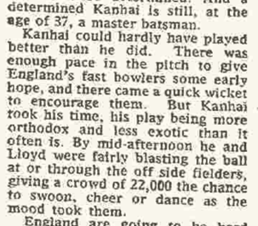
That is from his report in The Times. Strangely, The Cricketer gave him only six paragraphs to sum up this excellent game, half the space allocated to each of the two ODIs that followed the tests, not enough to mention Rohan Kanhai’s 157, one of the finest test innings that I have seen in person. 


By this time, Kanhai had the statesman’s grey hair but still batted like matinee idol. There was plenty of stylish, aggressive support from his Guyanese colleagues Roy Fredericks (51) and Clive Lloyd (63), and at the end of the day from Sobers, who was 31 not out at the close. The great man went on to150 next day, notoriously having caroused through the night in the interim.


One of the things I like about John Woodcock’s writing is that you can always tell when he has really enjoyed himself. He is one of us, somebody who loves being entertained by the best players, regardless of who they play for. In the above extract he conveys something of the joyous atmosphere of a West Indian test match in London. The negligence shown by the cricket authorities in squandering this reservoir of knowledge and enthusiasm is one of the worst things that has happened to English cricket in the last half century. 


It was a match of many landmarks, such as Bob Willis’s debut home test. Woodcock describes the first over of the game as “the fastest over I have seen this season”. This validates the enduring image that I have in my mind of that morning: Willis storming in from the Nursery End through the morning shimmer. 


It was the game of the Saturday bomb scare with most of the crowd on the field and HD Bird initiating his own legend by perching on the covers on Grandstand. Later that afternoon Geoffrey Boycott was caught on the boundary hooking off the last ball of the day, something that many of us remember whenever he fulminates about the recklessness of modern batting. 


This was the last test match to be covered by EM Wellings of the Evening News, and Chris Martin-Jenkins’ first as a Test Match Special commentator.


It was also Ray Illingworth’s last test as England captain. EW Swanton sums up the selectors’ reasoning:


But when some decline in his own form, both as a batsman and bowler, coincided with the second of two shattering Test defeats it was clear that a new leader must be tried.


He reminds us that Illingworth’s selection to replace the injured Colin Cowdrey in 1969 had been a “surprise appointment”. He could have added “inspired”, given that Illingworth was to lead the Ashes-winning side in 1970/71 and hold them at home the following year.


Mike Denness was appointed as his replacement, the announcement tactlessly made while Leicestershire were playing Kent at Folkestone, causing, according to Barry Dudleston of the visitors, Illingworth to exit the dressing room via a window and drainpipe to avoid the waiting press. Appointing a captain from outside the team was not unusual; both Tony Lewis and Illingworth himself had recentlybeen given the job in these circumstances. But the selectors ignored two current county captains—Boycott and Greig—to do so. It was a decision that would lead to Boycott’s boycott. 


It also rekindled one of cricket writing’s great feuds. EW Swanton, in his Off the Cuff column, writes of a generally positive press reaction to Denness’s appointment:


…apart from some odious, sneering comment from a predictable quarter. I imagined that most people would at once identify Michael Parkinson, that caricature of a Yorkshireman who is guaranteed to glorify anything and anyone who comes from his own small corner of the world and to denigrate almost all else. 


He goes on to say that he does not regard Parkinson as a “bona fide cricket writer” before a big finish:


As I say, this sort of piffle no longer attracts intelligent readership. But how the great Yorkshiremen, from Hirst and Verity to Leyland and Rhodes must be turning in their graves at this travesty of the true Yorkshire spirit as it has served the county and England so well and for so long.


Parkinson replied in similar vein in his Sunday Times column.


Robin Marlar contributes an interesting profile of Derek Underwood. Marlar sees Underwood as a seam bowler playing a spinner’s role, and attributes  this down to his father laying a concrete pitch in the garden for the young Underwood to develop his skills upon. Good for seam, not for spin, apparently.


He presents this time, 1973, as a turning point in Underwood’s career. He says that a change in the lbw law, making the bowler pitch in line in all circumstances, had made things more difficult, though this had been reversed in 1972. There were other issues.


Derek Underwood has the action of a medium-pacer. It is a fine action. Rhythmic. Controlled. Plenty of body. It lends itself to accuracy. He also has stamina. He can bowl for hours. But now he knows that this is not enough. To be as great a bowler in cricketing annals and affectations as Wilfred Rhodes or Jim Laker or even Bishan Bedi he has to be able to get wickets all over the world and not primarily in England, the seamer’s paradise. What is he to do? Is he to change his action and become a spinner, pure and simple? Or is he to develop another action and operate in two distinct styles? Who will teach him to spin the ball? 


At this stage Underwood had taken 144 test wickets. He finished with 297, plus 16 more at 27 in World Series Cricket, which probably cost him anything up to a hundred more in his peak years. Overall, in Australia he took 50 wickets at 31, in India 54 at 26, all without making any apparent changes to his action or style. 


The same pattern occurred when uncovered pitches were done away with in 1981. That will sort Underwood out, they said. In the first two seasons under the new rules he took more wickets than anyone other than Malcolm Marshall and Richard Hadlee.


The cover of the October edition has Barry Richards and Gordon Greenidge at Southampton. Richards was already acknowledged as a great player. Greenidge was not yet in the West Indies team, but within a few years these two would be opening for a putative World XI. With quicker thinking, England could still have picked him when the photo was taken. Yet at the time the presence of overseas players in the county game was widely decried. It was a golden age for county cricket, though we were slow to recognise it as such. The photo is of its time. Two kids, shirts off, ignorant of skin cancer (but nobody in shorts). The older guy to the right who would have seen Phil Mead play. The younger guy with the bad haircut and shades, who thinks he’s cool though he isn’t. If the photo had been taken at Canterbury that would have been me. Hampshire were county champions in 1973. 


Friday, January 10, 2014

The Case for a Specialist Captain

It has to be acknowledged that My Life in Cricket Scorecards is not renowned for its topicality. Match reports appear weeks after the matches they describe have been played. Events of significance pass by without comment or acknowledgement. My considered views on the great issues of the time—Packer, Bodyline, whether Dr Grace is a true amateur—remain in formulation. I’ll get back to you any year soon.

But I have an idea. It is about the England captaincy. The ECB has let it be known that Alastair Cook will remain as England captain despite England’s five-nil loss in the Ashes. The patient is well, the post mortem superfluous. At the SCG over the past few days Cook has appeared hollowed out, bewildered by the situation, one of Pirandello’s Six Characters in Search of an Author.
I was put in mind of David Gower in 1989, a similar series which began with England as favourites and ended in a drubbing. By midway through the fifth Test, at Trent Bridge, England found themselves three-nil down and following on 347 behind. Captain Gower suddenly seized the moment and promoted himself to open, brushing aside young Martyn Moxon who had come all the way from Leeds for that very purpose. Gower was bowled by Geoff Lawson for five.

The same degree of desperation to do something, anything, however ill-advised, was evident in Cook’s batting at Sydney. In the first innings he padded up to be lbw and in the second flailed away uncharacteristically and briefly. It is fortunate that England’s next Test is not until mid June, against Sri Lanka. This gives Cook (who should be excused the pointless ODI/T20 visit to the Caribbean next month, and who is not involved in the T20 World Cup) time to recover his equilibrium and enthusiasm (Gower was omitted completely from West Indies tour that followed the ’89 debacle).
But what if he doesn’t? If the burden of the captaincy neutralises Cook as a batsman? If he is not actually a decent captain? Nobody is suggesting that the defeat was down to tactical errors in the field, though a number of commentators have questioned his understanding of the needs of his bowlers in terms of the fields he sets them. There is no question that the tempo of England’s cricket has slowed since he took over. In their now vulnerable position England need a captain who will make the best of the resources available, nuture the fresh talent and inspire the troops. It is not clear that Cook is this man.

Of course Cook, along with almost every other international captain these days, has the disadvantage of not having had the opportunity to learn to be a captain before assuming the role. Until twenty years ago it was unusual for the England captain not to be (or have been) a county captain. Mike Atherton was the first modern exception to this rule. Since the expansion of England’s international programme in 2000 international players have had little opportunity (though that may not be the word they would use) to play county cricket, so the captain will almost inevitably lack experience in the role.
This disadvantages the incumbent, but also means that there are no proven captains in the team ready to take over. Part of the reason for sticking with Cook appears to be the lack of an appropriate successor.

Stuart Broad seems to be the most popular alternative. That would involve overcoming the widely held prejudice against fast bowlers being captains, one that I have to say I share (two words: Bob Willis). Broad does seem too volatile to be captain. For a start, the DRS referrals would be used up in the first 20 minutes of every innings.

Ian Bell, for reasons unexplained, is not seen as captaincy material. Michael Vaughan has called for Kevin Pietersen to be made vice-captain: http://www.telegraph.co.uk/sport/cricket/international/theashes/10550821/Ashes-2013-14-Kevin-Pietersen-must-be-made-England-vice-captain-to-confront-yes-men.html. It is a surprisingly persuasive piece, but it would be like recalling Trotsky from Mexico. Andy Flower would almost certainly prefer the deft application of an ice pick. Prior and Trott are both out of consideration, so Cook it is. Unless…

Ask “who are the best England captains over the past fifty years?” and a debate about the respective merits of Mike Brearley and Raymond Illingworth should ensue. Both were specialist captains who would not have played nearly as many Tests as they did had they not been captain. Tony Lewis, Keith Fletcher, Mike Denness and, ludicrously, Chris Cowdrey were other, less successful, specialist captains of England.

The option of picking a captain from outside the squad, or the central contract system should at least be considered. Who would the contenders be? People who follow the county game more closely than I am able to these days will have their own ideas, but a look through the list of current county captains throws up three contenders.

Paul Collingwood led Durham to the County Championship last year. He has a distinguished international record and has learned more about captaincy since being unimpressive in the role in ODIs a few years ago (though he did lead the winning T20 England side in 2010). Collingwood would not have credibility with the players from the start, unlike other candidates who would have to earn it. His batting has deteriorated; he averaged under 30 for Durham in 2013. But he would still be one of the best fielders and could still produce nuggets of innings from No 7.

Rob Key resumes the Kent captaincy in 2014 after a season’s sabbatical. He has the reputation as one of the county game’s best skippers, is well-liked and is the same cosy shape as Darren Lehmann, the coach who has put the fun back into the Australians. Key is still batting well and could contribute usefully at No 6.

James Foster remains one of the finest wicketkeepers around and averaged in the mid-30s last season. He would fill a Prior-shaped hole in the team (by the way, why is it widely assumed that Prior should return after two shocking series; it’s very odd?). Foster has captained Essex for four years and deserves to have more caps to his name, though I would like to know more about how good a leader people think he is.

If they stick with Cook, another option is to ask Essex to permit him to be captain in the Championship for the five or six games that the England players could play before the international season begins, thanks to the absurdly early start to the domestic season.

A rushed decision into reappointment would be foolish; there is a rare gap of five months in England’s Test schedule providing the opportunity for considered decisions about captain and coach.

The Summer of ’66

  Everyone of my age remembers the summer of 1966, almost all of them for the same two hours or so on the afternoon of Saturday 30 July. The...