Showing posts with label Clive Lloyd. Show all posts

Saturday, September 13, 2025

6 to 12 September 1975: Another Dull Lord’s Final

For the second time in the 1975 season a Lord’s final was an anti-climax, and for the same reason as the first: Middlesex batted first and did not score sufficient runs to make a game of it. Their 180 for eight in the 60-over Gillette final was an improvement on the 146 they scraped together in the 55-over contest, but John Woodcock may have been underestimating when he wrote that “For the second time this season in a one-day final Middlesex needed another 30 runs to give their bowlers a fair winning chance”.

The whole event was conducted at a stately gait, only pushing past three an over in the final stages. Lancashire followed the unwritten rule that the side chasing a small total should extract whatever joy they could from proceedings by using most of the overs available to them. They went so slowly as to induce anxiety in their vociferous if untuneful supporters, but Clive Lloyd, incapable of playing dully, took the game by the scruff of the neck, just as he had the World Cup final in June. He was a wonderful player.

The think I remember most about watching the match on television was the warm reception given to the Middlesex (and in 21 tests, England) wicketkeeper JT Murray as he walked out to bat at Lord’s for the last time. He provided one of the few highlights for the Londoners by taking what Wisden describes as “a brilliant one-handed catch” to dismiss Frank Hayes.

Nobody realised how that mundane match marked the close of one era and the start of another. For Lancashire, it was a fifth final in six years, only that of the previous year lost. “See you next year” they might justifiably have said to the gatemen as they left. Middlesex fans were still more inclined to rhapsodise about Edrich and Compton than dwell on the present.

Yet it was 15 years until Lancashire next got their hands the 60-over trophy, by which time Middlesex had won it four times. The following season Middlesex won the Championship for the first time since 1949 and were to do so (including the 1977 share with Kent) seven times in 18 years, more than any county in the rest of the century. The veneration of Mike Brearley was about to begin.

The County Championship resumed on Wednesday with, rather oddly, just three matches, two of which involved teams that had to win to stand any chance of cresting the tape ahead of Leicestershire. Lancashire succeeded, Hampshire did not.

In his preview, John Woodcock suggested that the absence of the injured Andy Roberts might be a decisive blow to Hampshire, and he was probably right. John Ward made his maiden century for Derbyshire in his final innings and Alan Hill batted with his trademark obstinacy to hold them up for much of the third day. Roberts would surely have blasted through Alan Ward and Mike Hendrick who ground things out into the last hour until Hampshire gave up on the game and therefore their slim hope of winning the Championship.

It is a measure of the times that when Hampshire chose to shake hands, had they taken the last wicket with the following ball they would have had 86 to win from seven overs with Barry Richards and Gordon Greenidge to open. Now, that would be tough but quite possible. Then it was seen as fantasy.

At Old Trafford, Lancashire also faced some dogged resistance, partly from the Gloucestershire batters, but mostly from the rain, which delayed play until mid-afternoon, at which point Lancashire wrapped things up quite swiftly. They were now second in the Championship. If they secured the maximum 18 points against Sussex in the final match, Leicestershire would need the full eight bonus points to top them.

Hampshire had managed to wrap up the Sunday League, also against Derbyshire, at what must be county cricket’s most obscure venue, Darley Dale. As we have discussed, Derbyshire had lost the use of the County Ground in Derby after the opening game of the season, so for the rest of the summer wandered the county as itinerant minstrels in search of a stage. Thus did Darley Dale come to host what remains its only county cricket match, and they got a trophy presentation, fifties by Richards and Greenidge, and John Arlott and Jim Laker thrown in. With a population of 3,500, I cannot think of a smaller place to have hosted a county game. One of two here in New Zealand in the past might have matched it, for example Waikanae, north of Wellington, which has been an occasional venue for Central Districts over the years. Hampshire won easily enough by 70 runs.

Saturday, July 5, 2025

28 June – 4 July: Woolmer’s week

Bob Woolmer had been a Kent regular for seven years by 1975. For most of that time he had batted at No 8 and been a useful purveyor of swing at an amiable pace, most notably in the Canterbury Week of 1972 when he took 17 wickets. These days he would probably have shifted to another county with more space at the top of the order. Now he was showing what he could do when batting was his main purpose. His unbeaten 71 (with a break for injury mid-innings) was valuable support for Cowdrey in Kent’s win over the tourists. For MCC against the same opposition he made 56 and 85 with a hat-trick thrown in taken on the day of the funeral of the last man to take a hat-trick against the Australians in England, HS Enthoven for Middlesex in 1934. International selection was just a few weeks away.

The two other Kent players at Lord’s did not do so well. Colin Cowdrey, leading MCC, bagged a pair, ending sentimental speculation that he would play again for England. Graham Johnson made two and one at No 3 and was not to catch the eye of the selectors again.

Graham Gooch’s first innings 75 attracted considerable praise and resulted in his notorious England debut the following week. Both Arlott and Woodcock focus on Gooch’s build, which led to comparison with Colin Milburn. The daily runs from ground to hotel were still a thing of the future apparently.

I was at Maidstone on Sunday to watch Kent beat Lancashire by 24 runs in a (by the standards of the day) high-scoring game. Luckhurst, Johnson and Cowdrey all made fifties, but the one memory I have of the game is of Clive Lloyd smiting a six over Mote Park’s mock-Tudor pavilion, a mighty blow.

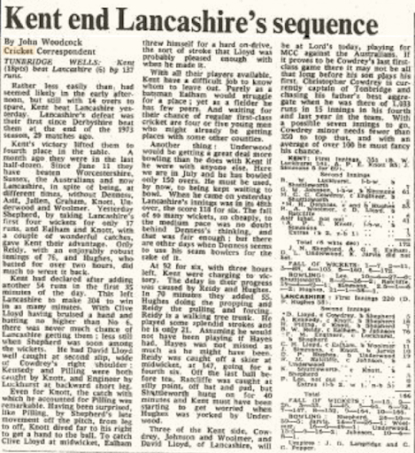
Kent also won the Championship game against the same opposition at Tunbridge Wells. John Woodcock was there for The Times. Most readers will know about Knott’s greatness, as will anybody who has made the mistake of engaging me in conversation at the Basin Reserve. Alan Ealham’s fielding prowess will be less well-known. Being somewhat dumpy in stature, nobody would have picked him as the gun fielder. New overseas players were often caught out in this way, the middle stump flying out of its ground while they were still a couple of yards short of completing what they had thought a safe single. What Woodcock has to say about the Kent team and the captaincy of Denness (of which he was not a fan) is interesting.


 In the 55-over semi-finals Middlesex beat Warwickshire and Leicestershire defeated Hampshire, against form in both cases.  In the latter case it was despite a century by Gordon Greenidge and a storming Andy Roberts, as described by Gerry Harrison in The Times.

With Roberts roaring in from the car park end…Steele, Balderstone and Davison were not sure whether it was Shrove Tuesday or Sheffield Wednesday.

Harrison was, for many years, Anglia TV’s football commentator. His Yorkshire TV counterpart, Keith Macklin, also reported cricket for The Times in 1975.

Middlesex’s win was largely down to a century by Clive Radley, whose batting style was captured by Alan Gibson:

Radley…was, as usual, a mixture of the classical, the baroque and the Old Kent Road.

Radley’s name often comes up as the scorer of key runs at crucial times, and continued to do so for another decade or more. It seems wrong that his England career was so short.

This was the second week of Wimbledon, which was exciting, firstly for the tennis itself, but also because it meant that Clive James would be reviewing the tournament’s TV coverage in The Observer, an annual treat in this era.

In 2025 the BBC lists 39 commentators for the TV coverage, which continues for 12 hours a day and ranges across all 18 courts. Fifty years ago it was limited to Centre and No 1. Harry Carpenter presented coverage that lasted under six hours plus a highlights package in the evening. The commentary team comprised no more than six led by Dan Maskell and Peter West (Peter Walker filled in at the cricket during the fortnight). On the radio Peter Jones presented three hours of commentary by Max Robertson and Maurice Edelston, with expertise provided by Fred Perry and Bob Howe.

It has always seemed a pity that Clive James was the only Australian with no interest in cricket. I only came across him writing about the game once, when he referred to the Chappel [sic] brothers. Cricket broadcasters may have been relieved.


Saturday, June 7, 2025

31 May – 6 June 1975 Snow returns

 On Monday, famously, play between Derbyshire and Lancashire at Buxton was prevented by snow, enough for a covering of the field. Snow also fell at Colchester and it was cold and wet almost everywhere. Both Alan Gibson at  Edgbaston and, more unusually, John Woodcock at Lord’s began their reports on Monday’s play with a weather report.


Derbyshire were having a rough time. They quit the County Ground in Derby after the opening game, for good it was thought, though they were to return two years later. The second XI had been disbanded for financial reasons. By the start of June they had already changed captain, from Brian Bolus to Bob Taylor. They began the Buxton game equal bottom of the Championship and were without their first-choice opening attack of Ward and Hendrick. Their replacements, Stevenson and Glenn, both fell ill on the first day and were unable to bowl a reasonable quota of overs, leaving Philip Russell—who many spectators of the time will remember for the glint of his gold tooth in the sun—to bowl 34 overs of a possible 50 at one end.

The outcome was the highest first-innings total since the 100-over first-innings limit was introduced at the start of the previous season: 477 for five, Hayes 104 and Clive Lloyd 167 not out including a 50-run spell that included seven sixes spread about the Peak District.

The loss of the second day to the snow might have been expected to save Derbyshire, but that was not their luck at that time. Its damp residue left the pitch so treacherous that it might have been at Cambridge in the thirties. All out 42 in the first innings (Lee four for ten) and 87 (Lever five for 16) in the second.

Snow also returned to the England team, with John of that ilk named in the World Cup squad, his first selection fo the national team for two years. There was a reluctant acknowledgement that the limited-overs game required different talents by the inclusion of Frank Hayes, John Jameson and Bob Woolmer, who in June was seen as an accurate medium-pace bowler who could make the ball do a bit and by September as an Ashes centurion and match saver. He would be the only one of the 14-man squad not to get a game.

Jameson had scored a sackful of runs in the 55 and 40-over competitions so far in 1975, and took three for 16 in the quarter-final against Essex on Wednesday. Playfair described his bowling as RM/OB, the indecision because it was rarely seen and possibly hard to tell even then. He was Knott’s reserve as keeper in the World Cup squad should the great man suffer an injury, which did about as often as Captain Scarlet.

Preparation for the tournament was no more than a couple of warm-up games in the few days before it began. Asif Iqbal made 94 of Kent’s 154 as they lost to Championship leaders Hampshire on Tuesday, and on Wednesday led his country against the county at Canterbury, bowling Colin Cowdrey. Alvin Kallicharran and Rohan Kanhai guided Warwickshire home in the 55-over quarter-final against Essex and the next day both made fifties for the West Indians against Nottinghamshire.

In that quarter-final Essex could not recover from 16 for five. At Lord’s, Boycott and Richard Lumb took half the overs on their opening partnership of 68, the rest of the line-up taking the score to 182, two more than Lancashire reached at Leicester. It seems to have been a convention that the team chasing a such modest totals would take up as many of their overs as possible. Leicestershire did so with five balls left, Middlesex with nine. Only Hampshire breached 200, their 223 giving them a comfortable 50-run win. It was a round of unremarkable cricket.

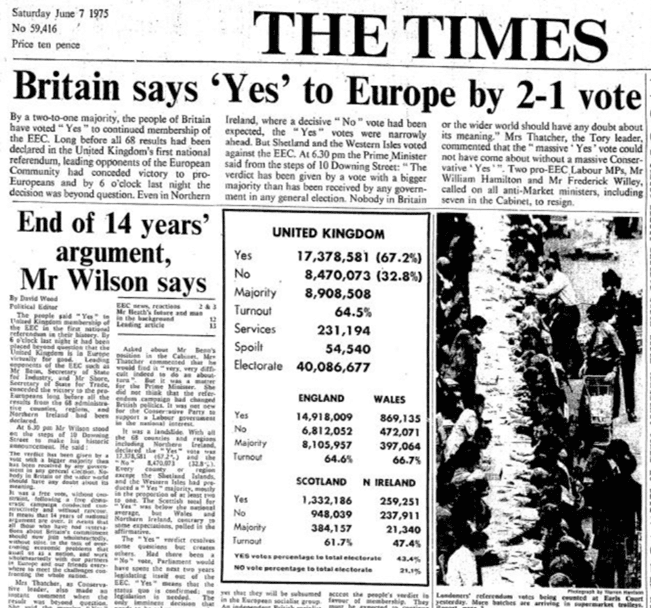
The referendum on whether Britain should continue its membership of the European Economic Community dominated the week’s news. The result was declared on Friday, votes counted by administrative area (in England  mostly counties). Only Shetland and the Western Isles voted against. David Dimbleby anchored a BBC results programme for the first time, while Robert Kee led ITV’s coverage, which was interrupted by the racing from Epsom. George Scott presented on Radio 4.


As we know, the conclusive result was far from the end of the argument, but served Harold Wilson’s purpose in resolving divisions in the Labour Party (or one of them at least). The precedent of deciding a great constitutional question was an unfortunate one, particularly when left in less politically skilled hands than Wilson’s.

The Observer’s cartoonist Trog, aka Wally Fawkes, saw that the idea might catch on.


Daily updates of the 1975 season on X @kentccc1968 and Bluesky ‪@kentkiwi.bsky.social‬


Sunday, May 28, 2023

The Cricketer, May 1973


Dennis Amiss is on the cover of the May 1973 edition of the newly-styled The Cricketer with Cricket Monthly, the title now alone in the cricket magazine market. I noted last month that good performances on MCC’s tour of South Asia had barely registered due to the lack of broadcast coverage. The most acute example is Amiss’s performance in the three-test series in Pakistan.


I had forgotten, if I ever knew, that he made a century in each of the first two tests and 99 in the third, perhaps the best overseas performance by an England batsman in a shorter series until Harry Brooke went one run  better late last year in Pakistan for three hundreds in three games. Amiss is going strong at 80, and was recently interviewed at length on the Final Word


Ken Barrington, with his average of 58, is the most underrated English batsman since the Second World War, but Amiss (46, 51 when opening) is not far behind. His achievement in this series did not convert John Thicknesse to his cause in a piece about the options for England’s selectors. Of Amiss and Fletcher (for whom this was also a breakthrough tour) he says “I hope it’s not uncharitable to say that neither has yet done much more than make people reconsider”. About as uncharitable as buying a poppy with a foreign coin, I’d have thought.


Incidentally, anyone not familiar with the Final Word should do themselves a favour and check it out. It is a podcast run by Adam Collins and Geoff Lemon, with occasional help from others such as Dan Norcross and Bharat Sundaresan. They usually put out two lengthy shows a week, one on current events and the other on cricket history, with donors sending them amounts based on cricket statistics that they then have to work out. Collins and Lemon are cricket’s most interesting audio journalists and I look forward to SEN’s commentary on this summer’s tests in England with Collins leading the team.


The three tests in Pakistan were all drawn. John Woodcock reports that “in each of these there was a time on the last day when a result was possible” and, of Pakistan captain Majid Khan, “There were two occasions when, with more aggression, he might have forced an issue”. Nevertheless, all three games faded away into draws, an outcome that accounted for 16 of the 24 tests played between the two countries in Pakistan before last December’s series.


All the more reason to regard the three-nil victory by Stokes’ team on those same dead pitches as one of the greatest achievements in my time watching cricket, Bazball’s finest moment (so far). 


Two pieces of trivia from the 72-73 series: as well as Amiss, Majid Khan and Mushtaq Mohammad also made 99, the only test in which three have fallen one short of the ton; also, both sides were led by current county colleagues. 


The second and third tests between the West Indies and Australia got considerably more column inches than the series in Asia. Pitches were also a focus for Tony Cozier’s report. That for the second test, in Bridgetown, “offered the bowlers minimal help and simply got progressively slower as the [match] progressed”, rather like those in Pakistan. The strip in Trinidad, however, “readily responded to spin throughout and gave uneven bounce”.


We were now just a couple of years away from the emergence of the West Indies pace quartet that, like the Rolling Stones, changed its personnel from time without compromising its place at the head of the pack. So who opened the bowling with Keith Boyce in Port of Spain?


It was none other than Clive Lloyd, whose dobbly medium pacers could be quite effective in the Sunday League, but whose function here was to remove the shine from the ball as quickly as possible, an action that was to be considered heretical around the Caribbean for at least three decades thereafter. 


Lance Gibbs “was the pick of all the bowlers and was never handled comfortably” but it was Australia’s trio of leg spinners, O’Keefe, Jenner and, more surprisingly, Stackpole, who led the way to a 44-run win, along with Doug Walters’ “truly great innings” of 112. 


There are interviews with two Essex players, John  Lever, and Brian “Tonker” Taylor, just appointed to the selection panel. The byline for the latter is that of Martin Tyler, still Sky’s lead football commentator 50 years on. Tyler wrote a couple of cricket books and commentated for ITV regions on Roses matches, but his best-known link with the game is that he was Bob Willis’s flatmate when the fast bowler was called up as a replacement for the 1970/71 Ashes tour.


As both football and cricket have expanded into twelve-month assignments, cross-fertilisation between writers and broadcasters on the two sports has almost disappeared, which is a loss. It used to be usual for journalists to cover a winter and a summer sport. 


ITV’s Brian Moore was a Kent fan. I sat next to him and an older man (his father, possibly) at a knockout match at St Lawrence in the early 90s. His first appearance on TV was on Sunday Cricket in 1965 (Desmond Lynam also made his TV debut on Sunday Cricket, seven years later). The BBC tried to poach Moore in the 70s, and offered him Peter West’s job as presenter of cricket to sweeten the package, but to no avail. 


On the radio, Peter Jones and Maurice Edelston were both occasional commentators on county cricket, and Jon Champion, Mark Pougatch, Mark Saggers and Arlo White all made appearances as callers on Test Match Special. The sports pages at the height of summer often featured football writers at leisure, including Jimmy Armfield in the Daily Express. Best of all was David Lacey’s annual appearance in the cricket pages of The Guardian, usually at Hove. I came across a Lacey line new to me the other day. In a report on a drubbing of Manchester United by Barcelona he wrote:


Pallister and Bruce appeared to be auditioning for the role of Juliet: “Romario, Romario, wherefore art thou Romario?”


The News of the Month has this:


G Boycott has disclosed that the risk of harm to his health following an operation for the removal of his spleen prompted him to declare himself unavailable for the recent MCC tour of India and Pakistan.


Given the tenor of Boycott’s subsequent commentaries, it is to be wondered if they got it all. 


Friday, December 30, 2022

The Cricket Magazines: October 1972

I have fallen behind in my surveys of the cricket magazines of half-a-century ago. My summer holiday task is to catch up, starting with the October editions.


The focus of both The Cricketer and Playfair Cricket Monthly was the fifth test at the Oval that concluded the best Ashes series in England since the Second World War. It was decided on the sixth day, the last test in England to have such a provision until the final of the World Test Championship in 2021.

Centuries by both Chappells gave Australia a first-innings advantage of 115, but debutant Barry Wood’s 90 led a strong response to set a target of 242, a cinch in the era of Bazball but quite a challenge in 1972.

England were handicapped by the depletion of their attack through the second innings: D’Oliveira had a bad back, Illingworth turned his ankle and Snow had the flu, “sick and shaking” as he managed a single over with the second new ball.

At 171 for five, Jack Fingleton, according to Basil Easterbrook, “groaned and said ‘It’s too many for us now’ ”, but Paul Sheahan and Rod Marsh took them home without further loss.

England’s top scorer in the match was Alan Knott, with 92 and 63. The other day one of the Australian TV commentators said that Adam Gilchrist had re-written the book on how wicketkeepers batted in test matches. Gilchrist, brilliant as he was, merely added a chapter to Knott’s draft. This match was one of many on which Knott had a critical influence with the bat, and in a way that ignored cricket’s geometry. He would have broken the bank in an IPL auction.

Both titles agree that Australia deserved to (at least) draw the series. Easterbrook’s summary put it in historical context.

Australia won both their victories after losing the toss. They had the series outstanding bowler in Lillee, the best supporting bowler in Massie and their batsmen produced five centuries, whereas the best England could manage were three innings in the 90s. If Australia, who were beaten in vile weather in Manchester and on an unworthy pitch at Leeds, did not have the luck this time it perhaps went some way to compensate for the period between 1961 and 1968 when three Australian sides in no way superior to England…undeservedly held on to The Ashes.

John Woodcock agreed that Lillee had a decisive influence, which he expressed in the language of the time.

He runs a tediously long way; yet to see him pounding in to bowl, and to put oneself in the batsman’s shoes, is to know one is watching a man’s game.

Not quite how I would put it, but Lillee running in, shirt billowing, with a Dick Dastardly scowl, was one of the great sights of cricket.

Clive Lloyd made one of the finest Lord’s-final centuries in the first World Cup in 1975. Three years earlier he made another as Lancashire won the Gillette Cup for the third successive year (Jack Bond, Lancashire skipper, is pictured with the trophy on the cover of Playfair). It was the centrepiece of the reports by Michael Melford for The Cricketer and Gordon Ross for Playfair. Melford noted the power of Lloyd’s drives:

…most of them, off fast bowling, went at such a pace that the bowler, deep mid-on and deep mid-off scarcely moved before the ball was past them.

For Ross, it was the cross-bat shots:

Three times he cleared the boundary ropes with massive pulls, and it made no difference whatsoever who was bowling; this was utter domination of the attack.

Bryon Butler’s press review in The Cricketer collected more acclaim for the Guyanan, from Arlott, Swanton, Marlar, and from Dennis Compton, who got quite carried away in the Sunday Express:

This was the greatest innings I have ever seen at Lord’s at any level. I have seen and played against Sir Donald Bradman, Walter Hammond, Stan McCabe, Sir Frank Worrell, Clive [sic] Walcott, Everton Weekes and many other great players in full flow: but I have never seen an attack torn to pieces like this.

The October editions cover the first ODIs—or one-day tests as they were referred to—played in England, the first anywhere except for the hastily arranged inaugural at Melbourne the previous year. England won an entertaining series two-one. In the first game, Dennis Amiss became the first century-maker in this form of the international game.

It will surprise many to see that, in the absence of the injured Illingworth, England were captained by Brian Close. A more obvious choice might have been Tony Lewis, already named as captain of MCC’s tour of India, Pakistan and Ceylon (as Sri Lanka was then known). Illingworth, along with Boycott and Snow, had made himself unavailable for a gruelling schedule that included eight test matches over more than four months.

EW Swanton’s editorial in The Cricketer once again deployed the royal pronoun in critiquing the tour party:

We must admit to disappointment that the promising new material among the 21-25 brigade has been overlooked.

The only player under 25 was Chris Old. The India correspondent of The Cricketer, KN Prabhu, reported on an underwhelmed response to the selection. The editor of a sports magazine demanded that the tour be called off if England were to be represented by a second XI. The Indian Express was barely less damning, saying that the team

…might be well balanced in that the standard of its batsmanships [sic] and bowling are likely to balance each other in mediocrity.

Prabhu himself was not so quick to write off the tourists, noting the success of various members of the party as members of an International XI some years before.

England won the first test in India before losing the next two narrowly, by 28 runs and four wickets. The final two matches in the series were drawn, as were all three in Pakistan, a reminder of how historically difficult it has been to attain a positive result on those pitches. The achievement of the McCullum/Stokes team in winning three-nil in similar conditions is one of the great achievements of the intervening half century.


Sunday, September 10, 2017

Kent win the Gillette Cup, Yorkshire are champions: 2 to 8 September 1967


I’ll be writing separately about the Gillette Cup final. My first visit to Lord’s, and Kent’s first trophy since the First World War, are worth special commemoration, fifty years on. 

The other prize of the week—the only other one available in domestic cricket in 1967—went to Yorkshire, who were assured of the title when Mike Bissex was leg before to Don Wilson to secure first-innings lead. Raymond Illingworth took 14 for 64, all on the second (and final) day. He was on a hat-trick three times, which may be a record.  The match was played at Harrogate, one of seven venues used by Yorkshire for their Championship programme.

So, as it turned out, I had seen the first day of the Championship decider, the game at Canterbury a month or so earlier. Had Kent won that one, the Championship pennant would have flown over Kentish fields three years earlier than it actually did. Had Underwood, Knott and Cowdrey not all been suddenly picked by England…(let it go, just let it go).

Arthur Milton was playing for Gloucestershire in that game. He only scored 38 in the game, but that was enough to make him leading run scorer in first-class cricket, with 2,089 from 49 innings, even more of an achievement as it was made for the bottom county. Milton’s story has been well recorded. He was the last double cricket/football England international. These days, he could open a bank on the back of that, but not then. When when he finished playing sport Milton became a postman, and he enjoyed it so much that when they told him he had to retire he took up paper rounds that covered the same route.

Keith Fletcher and Ron Headley both went to the crease 58 times in first-class matches, both joining 68 other batsmen in passing the thousand mark. Mike Buss of Sussex achieved this at the lowest average: 21.46. 

Tom Cartwright bowled most overs (1,194) and took most wickets (147). In common with eight others in the top 21 of the averages, he conceded under two runs an over. 

A comparison of the first-class averages of 1967 and 2016 shows how much the balance of the game has swung towards the bat (then a slender thing that could be comfortably lifted in one hand and would last for several seasons). Ken Barrington’s 68.84 would have put him in fifth place on 2016. But Barrington was 14 ahead of second-placed Denis Amiss, whose 54.41 would have left him one place short of the top twenty. 

The reverse is true of the bowling, of course. Jimmy Anderson’s top-placed 17.00 would have only got him to No 13 in ’67. There were only three bowling averages under 20 last year (one of which was by Viljoen of Kent, who I’ve never heard of); there were ten times as many in the summer of love. 

The Scarborough Festival, summer’s death rattle for so many years, featured an England XI playing the Rest of the World. These games were an end-of-season feature for several years in the mid-sixties. They were of historical significance for several reasons. When in 1970 the tour by South Africa was cancelled at the last moment, the concept of a Rest of the World team was there waiting, ready to fill the void. The Rest of the World also played a one-day round robin, grandly if hyperbolically called the “World Cup”, of which more next week. 

There is also the composition of the team. Graham McKenzie of Australia, the rest an equal mix of West Indians and South Africans, at a time when apartheid made such a mix illegal had the game taken place within the jurisdiction of the apartheid government. So the opening partnership of 187 between Eddie Barlow and Seymour Nurse was nicely symbolic and would have spoiled Dr Vorster’s breakfast the following morning. 

Barlow made another ninety in the second innings, sharing a partnership of 118 with Rohan Kanhai, who “played, as so often, as though he could have batted with one hand” wrote AA Thomson. England were set 373 in five hours, a target that no England side, official or unofficial, would have contemplated going for in 1967 in any circumstances other than a festival match. John Edrich made an aggressive 87 but Lance Gibbs induced a collapse to 179 for six. However, the Middlesex pair of Murray and Titmus continued to be attacking in a stand of 112 in under two hours to save the game. Thirty thousand spectators watched over the three days and thoroughly enjoyed themselves, though they may have wondered why this sort of enterprise could not be seen other than by the seaside in September. 

It was the first time that world outside Guyana became aware of Clive Lloyd. He looked like a short-sighted librarian who had absentmindedly wandered onto the field, but then there would be a blur as he covered an unreasonable amount of ground with two of three strides, then the stumps would be in disarray, the batsman bemused in mid-pitch, wondering what had just happened.

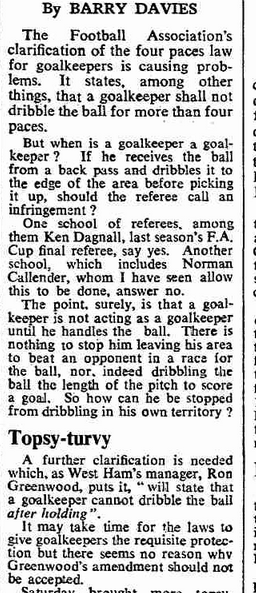
Outside cricket, Barry Davies, then commentating for Granada and writing for The Times, reported confusion over the new four-steps rule for goalkeepers. Did the counting start when they first touched the ball, or when they picked it up?


Alan Gibson switched effortlessly to rugby for the winter, starting with this report, which may have been more entertaining than the match it described (a goal, by the way, is a converted try, with a try worth only three points).


Mr Gilbert Clark of Fishponds in Bristol discovered that his late wife had left their house to a dog’s home. A trusting man, he believed that his wife had taken this action in the belief that she would outlive him. I’m not so sure. He kept the house but it cost him £1,000 for a dog ambulance. A grand would have been a fair slice out of the value of a Fishponds residence in 1967.

Sunday, March 22, 2015

New Zealand v West Indies, World Cup Quarter-final, Cake Tin, 21 March 2015

Scorecard

We’re a cautious lot, we New Zealand fans. If our interest was the theatre, we would have gone to the Cake Tin yesterday hoping for a decent performance of something worthy. Ibsen, say, or Pinter. The provincial reviews had been good, but this was the West End, the knock-out stage. All we wanted was for the Brendon McCullum Players to remember enough lines to get us to the semi-final. Instead we got the most lavish Broadway show imaginable, full orchestra song and dance from start to end. Martin Guptill: the Musical.

What I love about cricket is its capacity for surprise, its ability to exceed expectation. After, yes, half a century watching the game you think you know what the parameters are. You assume, for example, that you will never see someone, particularly a New Zealander, score 237 not out in a World Cup knock-out game.

It was glorious. This New Zealand summer has conjured up cricket that stands with the best of the past fifty years. Williamson and Watling at the Basin, Southee at the Cake Tin, Sangakkara anywhere, McCullum everywhere. This innings of Guptill’s was the best of the lot. It has to be judged against Cowdrey at Canterbury in 1975, Richards at Lord’s in 1979, Slater at Sydney in 1999, to name but three, as the best I have seen.

It was the shots he didn’t play, as much as those he did, that measured its quality. No reverse laps, ramps or premeditated movements. Pure cricket, from the Rolex timing of the push drive that sent the first ball of the innings to the straight boundary to the pull that put the ball on the roof in the final over. Watch a recording of the innings and see how straight is the backlift, even for cross-bat shots. As well as being spectacular and surprising it was aesthetically pleasing, which the best batting always is.

Incidentally, it is not true, as has been reported, that Craig McMillan is the only batsman to hit the ball onto the roof of the Cake Tin. Guptill has done it once before, off Lonwabo Tsotsobe of South Africa in a T20 in 2012, a hit estimated at 125 metres, 15 metres longer than yesterday’s. His two-fingered gesture to McMillan after the hit was not, as Simon Doull said on commentary, to say “two of us have done it” but “I’ve done it twice”. Michael Lumb of England also did it, in a T20 in 2013.

Guptill’s innings changed in tempo. At times early on runs were hard to come by. His century came up in 111 balls, which is hardly laggardly. At that point it was already a classy, memorable innings. He got there in the 35th over, just before the start of the powerplay. With only two wickets down, the foot could be pressed firmly to the floor.

Cricket is a game of numbers, and those for this match stretch credulity. Guptill’s second century came in just 41 balls. All eleven of his sixes came after the century mark. 207 came for New Zealand from the final 15 overs, 85 from the final five. It was wonderful.

From the third ball of the first over, Marlon Samuels became Dick Rowe for a day. Rowe was the Decca Records executive who, in 1962, refused to sign the Beatles on the grounds that guitar groups were on the way out. Samuels had the opportunity to send Guptill back to the rooms, but put down a sharp but catchable low chance at square leg. That was the only one Guptill offered. Just as Rowe would have spent the following years avoiding news of the Fab Four’s record sales, so Samuels spent the next 49 overs looking in any direction but that of the scoreboards as they audited the ever-increasing scale of his error.

A word in praise of Ross Taylor, who has been a worry for New Zealand supporters during the World Cup. He is hard to get out, but has got stuck in situations that he has hit himself out of in the past. Yesterday, he began slowly, with 23 off 43 balls, but he scored a run a ball thereafter and supported Guptill superbly in a partnership of 143, an excellent platform for the ensuing carnage.

Guptill is very fast between the wickets but is sometimes more cagey about his intentions than his partner would find ideal. We had already had one episode in which he and Taylor headed intently for the same end, so it was no surprise when Taylor was run out.

Earlier, Williamson had looked in as good touch as Guptill and it was a surprise when he got out to a soft shot. Later, Anderson, Elliott, Ronchi and Vettori all added to the mayhem.

My heart was filled with joy at New Zealand’s display. Yet it was also a little broken. I have written often enough about how early exposure to the West Indians fed my love of cricket. One of them was at the Cake Tin yesterday: the great Clive Lloyd of Guyana, Lancashire and the West Indies, the captain who brought together Jamaicans, Bajans, Trinidadians et al and made them a great West Indian team.

For Clive Lloyd, watching the shambles that the West Indies became in the final fifteen overs of the New Zealand innings must have been awful. How can the team of Richards, Sobers, Marshall, Greenidge, Holding and the rest have come to this?

To see England humiliated was comedy. To see the degradation of the West Indies was tragedy. The writer Dileep Premachandran recently tweeted “each time West Indies do well, the inner 10-year-old pumps his fist”. Today, the boy wept.

Jason Holder, the 23-year-old fast bowler who has been lumbered with the captaincy, looked bereft towards the end, and placed himself at long on, symbolically near the exit to the dressing rooms. It is always a bad sign when the skipper fields on the boundary. A little later, Darren Sammy, one of many recent captains, was seen in heated debate with the bench.

The fielding lacked commitment. Where were the dives, where were the support fielders? How the crowd roared later when all three of New Zealand’s slip fielders chased a ball to the boundary. What a difference.

So it was good that the West Indies took an adventurous approach to their futile task of chasing 394 for victory. They achieved more than was expected in maintaining a rate of eight an over for the 31 overs that they lasted.

But, in the words of a young member of the catering staff who took a seat behind us when they ran out of chips, West Indies were doing well “apart from the wickets thing”. Indeed. In cricket, it’s the wickets thing that gets you in the end. The wickets fell regularly and they never stood a chance of getting near. New Zealand knew how much protection they had and did not panic.

There were two noteworthy aspects to the innings. First Daniel Vettori’s catch at third man to dismiss Samuels. Vettori has always been highly competent in the field, but has never presented the world with an athletic persona. So, when, at the age of 36, he executed a perfectly timed, improbably high standing jump to pluck the ball from the night, it was as surprising as Maggie Smith rapping.

My Blean correspondent and myself have long been connoisseurs of one-legged innings, those made by batsmen under physical duress. The benchmark has always been Basil D’Oliveira’s half-century in the Benson and Hedges final in ’76. Despite his elderly hamstring having pinged earlier, D’Oliveira almost turned the game.

There was Basharat Hassan’s century at Canterbury the following year. Also Terry (though it might have been Michael) Parlane’s hundred at the Basin four or five years ago.

Chris Gayle’s 61 from 33 balls, with eight sixes, may have beaten them all. He has a bad back and could only hobble singles when there would normally have been a safe two. All of us who thought that Gayle’s non-appearance against the UAE was simply because he couldn’t be arsed, owe him an apology. Yet his hitting was devastating, if Sisyphean.

New Zealand’s two World Cup games at the Cake Tin have been two of the best days I have ever spent at the cricket. Years hence I shall remember them if I can’t recall my own name. The nation has become consumed with cricket. You hear people talking about it as you walk down the street. I have always wanted to live in such a place.

Tuesday, South Africa, Eden Park.

The Summer of ’66

  Everyone of my age remembers the summer of 1966, almost all of them for the same two hours or so on the afternoon of Saturday 30 July. The...