Showing posts with label Lance Gibbs. Show all posts

Sunday, May 28, 2023

The Cricketer, May 1973


Dennis Amiss is on the cover of the May 1973 edition of the newly-styled The Cricketer with Cricket Monthly, the title now alone in the cricket magazine market. I noted last month that good performances on MCC’s tour of South Asia had barely registered due to the lack of broadcast coverage. The most acute example is Amiss’s performance in the three-test series in Pakistan.


I had forgotten, if I ever knew, that he made a century in each of the first two tests and 99 in the third, perhaps the best overseas performance by an England batsman in a shorter series until Harry Brooke went one run  better late last year in Pakistan for three hundreds in three games. Amiss is going strong at 80, and was recently interviewed at length on the Final Word


Ken Barrington, with his average of 58, is the most underrated English batsman since the Second World War, but Amiss (46, 51 when opening) is not far behind. His achievement in this series did not convert John Thicknesse to his cause in a piece about the options for England’s selectors. Of Amiss and Fletcher (for whom this was also a breakthrough tour) he says “I hope it’s not uncharitable to say that neither has yet done much more than make people reconsider”. About as uncharitable as buying a poppy with a foreign coin, I’d have thought.


Incidentally, anyone not familiar with the Final Word should do themselves a favour and check it out. It is a podcast run by Adam Collins and Geoff Lemon, with occasional help from others such as Dan Norcross and Bharat Sundaresan. They usually put out two lengthy shows a week, one on current events and the other on cricket history, with donors sending them amounts based on cricket statistics that they then have to work out. Collins and Lemon are cricket’s most interesting audio journalists and I look forward to SEN’s commentary on this summer’s tests in England with Collins leading the team.


The three tests in Pakistan were all drawn. John Woodcock reports that “in each of these there was a time on the last day when a result was possible” and, of Pakistan captain Majid Khan, “There were two occasions when, with more aggression, he might have forced an issue”. Nevertheless, all three games faded away into draws, an outcome that accounted for 16 of the 24 tests played between the two countries in Pakistan before last December’s series.


All the more reason to regard the three-nil victory by Stokes’ team on those same dead pitches as one of the greatest achievements in my time watching cricket, Bazball’s finest moment (so far). 


Two pieces of trivia from the 72-73 series: as well as Amiss, Majid Khan and Mushtaq Mohammad also made 99, the only test in which three have fallen one short of the ton; also, both sides were led by current county colleagues. 


The second and third tests between the West Indies and Australia got considerably more column inches than the series in Asia. Pitches were also a focus for Tony Cozier’s report. That for the second test, in Bridgetown, “offered the bowlers minimal help and simply got progressively slower as the [match] progressed”, rather like those in Pakistan. The strip in Trinidad, however, “readily responded to spin throughout and gave uneven bounce”.


We were now just a couple of years away from the emergence of the West Indies pace quartet that, like the Rolling Stones, changed its personnel from time without compromising its place at the head of the pack. So who opened the bowling with Keith Boyce in Port of Spain?


It was none other than Clive Lloyd, whose dobbly medium pacers could be quite effective in the Sunday League, but whose function here was to remove the shine from the ball as quickly as possible, an action that was to be considered heretical around the Caribbean for at least three decades thereafter. 


Lance Gibbs “was the pick of all the bowlers and was never handled comfortably” but it was Australia’s trio of leg spinners, O’Keefe, Jenner and, more surprisingly, Stackpole, who led the way to a 44-run win, along with Doug Walters’ “truly great innings” of 112. 


There are interviews with two Essex players, John  Lever, and Brian “Tonker” Taylor, just appointed to the selection panel. The byline for the latter is that of Martin Tyler, still Sky’s lead football commentator 50 years on. Tyler wrote a couple of cricket books and commentated for ITV regions on Roses matches, but his best-known link with the game is that he was Bob Willis’s flatmate when the fast bowler was called up as a replacement for the 1970/71 Ashes tour.


As both football and cricket have expanded into twelve-month assignments, cross-fertilisation between writers and broadcasters on the two sports has almost disappeared, which is a loss. It used to be usual for journalists to cover a winter and a summer sport. 


ITV’s Brian Moore was a Kent fan. I sat next to him and an older man (his father, possibly) at a knockout match at St Lawrence in the early 90s. His first appearance on TV was on Sunday Cricket in 1965 (Desmond Lynam also made his TV debut on Sunday Cricket, seven years later). The BBC tried to poach Moore in the 70s, and offered him Peter West’s job as presenter of cricket to sweeten the package, but to no avail. 


On the radio, Peter Jones and Maurice Edelston were both occasional commentators on county cricket, and Jon Champion, Mark Pougatch, Mark Saggers and Arlo White all made appearances as callers on Test Match Special. The sports pages at the height of summer often featured football writers at leisure, including Jimmy Armfield in the Daily Express. Best of all was David Lacey’s annual appearance in the cricket pages of The Guardian, usually at Hove. I came across a Lacey line new to me the other day. In a report on a drubbing of Manchester United by Barcelona he wrote:


Pallister and Bruce appeared to be auditioning for the role of Juliet: “Romario, Romario, wherefore art thou Romario?”


The News of the Month has this:


G Boycott has disclosed that the risk of harm to his health following an operation for the removal of his spleen prompted him to declare himself unavailable for the recent MCC tour of India and Pakistan.


Given the tenor of Boycott’s subsequent commentaries, it is to be wondered if they got it all. 


Saturday, September 16, 2017

The season ends: 9 to 15 September 1967


The 1967 season ended with the World Cup, which will surprise those who take the orthodox view that the first World Cup was played eight years later. Neither was it the first, a similar event having taken place the previous year. The tournament consisted of a three-match round robin between England, Pakistan and the Rest of the World XI. All matches were played at Lord’s. The shortening evenings meant that they were 50-over contests at a time when 60 overs were the norm, or 40 on Sunday afternoons.

Just as the designation of the game played in Melbourne in March 1877 as the first test match is somewhat random, so there is a case for regarding these games as the first one-day internationals. The quality of the players was more than good enough to warrant the status, particularly the World XI, with its potent harmony of South Africans and West Indians. For years I intended to write about these matches as the first, lost ODIs, but was beaten to it by Philip Barker, who had an interesting piece on the subject in Wisden 2016.

Eddie Barlow made an unbeaten 74 against England, then took four for 23 against Pakistan. Barlow’s name is rarely mentioned when the great all-rounders are discussed, but it should be on the list, at least. He took 571 first-class wickets at 24, 15 less than his batting average. The margin in his 30 tests is +11. He was outstanding in the 1970 Rest of the World series, scoring two hundreds and topping the bowling averages with 20 wickets at 19.80. 

The three-day match at Scarborough between the World and England XIs had been watched by 30,000, but the one-day tournament met public indifference and was not repeated, which is odd given that domestic one-day cricket had become so popular. Perhaps they should have stayed in Scarborough and replaced the rather dour Yorkshire v MCC game in which Geoffrey Boycott made a century as indigestible as seaside rock. 

My cricket watching for 1967 concluded at Canterbury for the Gillette Cup winners challenge match against the touring side, the second and final such fixture.  The thing I remember best about that day was a six hit by Stuart Leary that cleared the famous in-field lime tree. Not the uppermost branches perhaps, but certainly those that bulged out to one side. I had forgotten that Alan Dixon took five that day, following the seven in the quarter-final. Leary and Dixon both had fine seasons. 

Yorkshire beat MCC, thanks to their young off spinner Geoff Cope. AA Thomson was at Scarborough throughout the nine-day festival, delighting Times readers as he had all season with phrases that said more than others would manage in a couple of hundred words. Barlow and Nurse’s partnership “contained every stroke from the book and several daring ones from the appendix”. Lance Gibbs was “the notorious master of guile, who by autosuggestion made them in turn pick the wrong ball to hit”. Milburn “had his leg stump uprooted and the spectators’ tide of pleasure inevitably receded”. 

These were the last cricket reports that AA Thomson wrote. He was too ill when the 1968 season began and died in early June. Here is his obituary:


Alan Gibson had turned from cricket to rugby and reported from three grounds in three days in the first half of the week. It was a surprise that the third of these was Bristol v Cardiff, one of the games of the season in those pre-league days, oddly scheduled for a Wednesday evening with a 6 30 kick off (presumably there were no floodlights at the Memorial Ground in those days—they had arrived by the time I first stood on the terraces in the late seventies, though a full moon in a cloudless sky would overpower them). Bristol led twice but were well beaten in the end, no disgrace when the opposition had Gareth Edwards and Barry John at Nos 9 and 10. 

Tony Nicholls was John’s opposite number, but not at No 10. He would have been wearing shirt F, in Bristol’s tradition of using letters instead of numbers. It was confusing when Leicester were the opposition; they also used letters, but in sequence from the front row, rather than the full back as Bristol did. If the game was boring spectators could find solace in Scrabble. Nicholls was head of geography at Cotham Grammar School when I did my teaching practice there (as a history teacher) in 1982.

Silbury Hill in Wiltshire was to be excavated. The Times report shows how little was known about it beyond that it was a pre-Roman artificial hill. The excavation found that it may date back as far as 2500BC, but deepened the mystery of why it was constructed, as it was found not to be a burial site. Why would people have spent thousands of hours outside, subject to the worst of the weather, on an apparently pointless endeavour? Perhaps they were passing the time while waiting for the County Championship to be invented.


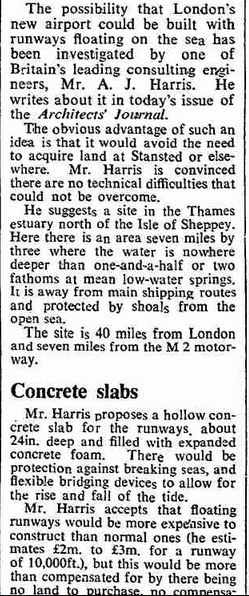
One of the things I have enjoyed about the 1967 project is the realisation that there is little under the sun that is new. This week came a proposal from a civil engineering company to build an airport in the Thames Estuary, an idea that has resurfaced in recent times under the new ownership of Boris Johnson. 


Boris has not taken up another bright idea from fifty years ago—the inevitability of Britain switching to driving on the right-hand side of the road—but it is only a matter of time.

This ends the weekly series of pieces summing up the week fifty years ago. There will be three more posts over the next couple of weeks or so to finish off the 1967 retrospective, looking at the Gillette Cup final, thinking about cricket now and then, and reflecting on the process of recreating a cricket season through social media.

Monday, October 24, 2016

The 1966 West Indians

Cohen, 1966.

Play word association with that, and most will say: George Cohen, doughty Fulham full back, and one of the most famous set of names of English sporting history. A hero of Wembley, 30 July 1966.

Very few will respond as My Life in Cricket Scorecards does: Rudolph Cohen, fast bowler, member of the 1966 West Indian touring team to England. Did not play a test.

The World Cup triumph has been widely and rightly remembered over the past few months, fifty years on. But by the time England kicked off against Uruguay in the tournament’s opening game, My Life in Cricket Scorecards was taking the 1966 Kent CCC Annual to school as his reading book. To him, “Hunt” was not Roger of Liverpool, but Conrad of Barbados, spelt with an “e”.

For cricket people, 1966 was a shaft of Caribbean sunlight in a dull decade. The previous season was described by Wisden as “mainly disappointing”. As for 1964, the recitation of Tom Cartwright’s figures in the Old Trafford Ashes test tell you all you need to know: 77-32-118-2. As a first step in cricket it would have been like giving a child War and Peace as their first reader.

There are some ultimate truths that can be understood as well by a seven-year-old as by anybody. Though, I was far too young to articulate it, at some level I appreciated that the West Indians were playing cricket as a form of self-expression, which is usually when the game is at its best. My attention was grabbed with the first ball of the series, square cut for four by Conrad Hunte. Here was a team that played without reticence or constraint. Hunte finished with 135, though he was dropped on seven by Ken Higgs at long leg. Norman Preston in Wisden provided the fielder with an excuse that would be without credibility almost anywhere but Manchester in summer, namely that he had sighted the ball “very late against the distant background of dark-coated spectators”.    

That day I was freed of an emotional dependence on England winning; I must have realised that it was probable that my cricket watching would be less traumatic if this was not so, a view that continued to enrich my spectating experience through the years.

Garfield Sobers made 161 in that innings at Old Trafford, the smallest of the three centuries he made in the series, which he finished with an average of 101. Then there were 20 wickets, second only to the great off-spinner Lance Gibbs, who took only one more. Against Kent at Canterbury Sobers took his career-best bowling of nine for 49. It is likely that I saw the first two of these wickets taken at the end of the second day; I was there after school for the last part of the day and have Sobers’ autograph in my 1966 Kent CCC junior membership card (cost: one guinea) to prove it, but have no specific recollection of his bowling that afternoon.

I wasn’t particularly lucky watching Sobers. The best I saw him play was at Lord’s in the first day of the final test of 1973 when he came in late in the day and made the 31 not out, carrying on the next day to 150 without any sleep in the intervening period, or so legend has it. But I did see him play, and he was the greatest player of my lifetime, so that’s something.

In 1966 Sobers also scored a Lord’s hundred, saving a match that appeared lost with an unbroken partnership of 274 with his cousin, David Holford.

The strength of the West Indian middle order was the basis of resounding victories in the following two tests to seal the series. England took a 90-run lead in the third at Trent Bridge, but in the second innings a double century from Basil Butcher, supported by fifties from Rohan Kanhai and Seymour Nurse and 94 from Sobers, took the game well beyond the home team.

There was then a month’s break in the tests so that the cricket would not distract people from the World Cup. A different time. Of course, the tour went on. Eight matches were played in the interim, including that game at Canterbury. There were 28 first-class fixtures on the tour itinerary. This would be untenable today, but it did mean that the whole party had the opportunity to become at ease in the conditions. New Zealand’s recent trouncing in India has again illustrated how a side can flounder without that opportunity. Making it compulsory for touring sides to play three first-class games before the tests would do more to make test matches more competitive, and therefore attractive to spectators, than any number of marketing gimmicks.

Here is a Movietone News report on the fourth test, at Headingley. West Indies racked up 500 in the first innings with big hundreds from Nurse and Sobers against an England attack that included the debutant Derek Underwood. The scorecard suggests a mental running of the white flag up the flagpole, with the two innings totalling 55 short of the West Indies’ one. Nurse is rarely mentioned as a significant figure of the great West Indian era, but he averaged 48 with six centuries in 29 tests, so he should be. Here in New Zealand people remember his 826 runs in the three-test series in 1969, when he had already announced his retirement.

It would be wrong though to give the impression that the attraction of that series rested only with the West Indies. For a start there was Colin Milburn, whose presence in the attritional England side of the mid-sixties was as incongruous as Falstaff would have been in Cymbeline. He batted in colour in a black-and-white world. Ninety-four at Old Trafford was followed by a blistering hundred at Lord’s.

Milburn is the subject of a new play written by Douglas Blaxland, the nom de plume of the former Kent all-rounder James Graham-Brown (there have been a few Kent players who might have been well-advised to live out their lives under a false name, but Graham-Brown isn’t one of them). The PCA has imaginatively arranged for the play to tour the county grounds. Expect the ECB to announce that a lavish musical will play the test grounds only on the same dates.

Milburn inspired a love of cricket in those who saw him, notably Matthew Engel. Backwatersman too. And me, though I don’t think that I ever saw him play live.

Tom Graveney was recalled for the second test. He was as old as my Dad, which for a seven-year-old meant that he was as old as Methuselah, but 96 at Lord’s was followed by a century at Trent Bridge, and he smiled as he played.

There was Basil D’Oliveira too. Children have a robust understanding of what is fair and unfair, so I understood with absolute clarity that it was outrageous that D’Oliveira was not allowed to play for South Africa because his skin was too dark. This, along with the brilliance of the West Indians gave me lifelong immunity from the prevailing nonsense of the Alf Garnett-Enoch Powell era.

Then there was Alan Gibson’s Old Bald Blighter, Brian Close, drafted in to lead the side in the final test at the Oval replacing Colin Cowdrey. He brought with him hard-headed professionalism in the form of Edrich, Illingworth and JT Murray. But halfway through the second day, with England 166 for seven in reply to 268, it appeared that Close had made no difference whatsoever.

One of the great rearguard actions then began, led by Graveney and Middlesex keeper JT Murray, who took my eye at first because he wore his cap at the same angle as Norman Wisdom. They put on 217 for the eighth wicket, even now the seventh-best in test history.

On the Saturday I had my first experience of the joyful anarchy of a decent last-wicket partnership, this one between John Snow and Ken Higgs worth 128. I have clear memory of accompanying my father on his grocery delivery round on a sweltering day while following the partnership on my transistor radio, re-tuned for once from Radio Caroline, which broadcast from a ship just over the horizon in the Thames Estuary. The commentators were Robert Hudson, Roy Lawrence and John Arlott. A first chance to listen to Arlott was not least among the influential experiences of 1966.

West Indies were happy enough to let England have the consolation victory, so the series wrapped up on the fourth day.

The thought that, were it not for the talented exuberance of Garfield Sobers and his team, this blog might be called My Life in Football Programmes brings a shudder to the soul.

Finally, a pop quiz, based on a Pathé newsreel coverage of the opening match of the tour, Duke of Norfolk’s XI v West Indians.
  1. Who is the Norfolk XI’s keeper?
  2. Who is non-striker when Sobers is bowling?
  3. What position links him and Sobers?
  4. Who is the bespectacled umpire?
  5. What was his link with the England team of 1966?
By the way, the West Indian opener Michael Carew was more often known as “Joey”.


A feast of 50 over finals at the Basin Reserve

  Men’s eliminator final, Wellington v Central Districts Women’s final, Wellington v Northern Districts Men’s final, Canterbury v Centra...