Showing posts with label Cricket World Cup. Show all posts

Saturday, September 16, 2017

The season ends: 9 to 15 September 1967


The 1967 season ended with the World Cup, which will surprise those who take the orthodox view that the first World Cup was played eight years later. Neither was it the first, a similar event having taken place the previous year. The tournament consisted of a three-match round robin between England, Pakistan and the Rest of the World XI. All matches were played at Lord’s. The shortening evenings meant that they were 50-over contests at a time when 60 overs were the norm, or 40 on Sunday afternoons.

Just as the designation of the game played in Melbourne in March 1877 as the first test match is somewhat random, so there is a case for regarding these games as the first one-day internationals. The quality of the players was more than good enough to warrant the status, particularly the World XI, with its potent harmony of South Africans and West Indians. For years I intended to write about these matches as the first, lost ODIs, but was beaten to it by Philip Barker, who had an interesting piece on the subject in Wisden 2016.

Eddie Barlow made an unbeaten 74 against England, then took four for 23 against Pakistan. Barlow’s name is rarely mentioned when the great all-rounders are discussed, but it should be on the list, at least. He took 571 first-class wickets at 24, 15 less than his batting average. The margin in his 30 tests is +11. He was outstanding in the 1970 Rest of the World series, scoring two hundreds and topping the bowling averages with 20 wickets at 19.80. 

The three-day match at Scarborough between the World and England XIs had been watched by 30,000, but the one-day tournament met public indifference and was not repeated, which is odd given that domestic one-day cricket had become so popular. Perhaps they should have stayed in Scarborough and replaced the rather dour Yorkshire v MCC game in which Geoffrey Boycott made a century as indigestible as seaside rock. 

My cricket watching for 1967 concluded at Canterbury for the Gillette Cup winners challenge match against the touring side, the second and final such fixture.  The thing I remember best about that day was a six hit by Stuart Leary that cleared the famous in-field lime tree. Not the uppermost branches perhaps, but certainly those that bulged out to one side. I had forgotten that Alan Dixon took five that day, following the seven in the quarter-final. Leary and Dixon both had fine seasons. 

Yorkshire beat MCC, thanks to their young off spinner Geoff Cope. AA Thomson was at Scarborough throughout the nine-day festival, delighting Times readers as he had all season with phrases that said more than others would manage in a couple of hundred words. Barlow and Nurse’s partnership “contained every stroke from the book and several daring ones from the appendix”. Lance Gibbs was “the notorious master of guile, who by autosuggestion made them in turn pick the wrong ball to hit”. Milburn “had his leg stump uprooted and the spectators’ tide of pleasure inevitably receded”. 

These were the last cricket reports that AA Thomson wrote. He was too ill when the 1968 season began and died in early June. Here is his obituary:


Alan Gibson had turned from cricket to rugby and reported from three grounds in three days in the first half of the week. It was a surprise that the third of these was Bristol v Cardiff, one of the games of the season in those pre-league days, oddly scheduled for a Wednesday evening with a 6 30 kick off (presumably there were no floodlights at the Memorial Ground in those days—they had arrived by the time I first stood on the terraces in the late seventies, though a full moon in a cloudless sky would overpower them). Bristol led twice but were well beaten in the end, no disgrace when the opposition had Gareth Edwards and Barry John at Nos 9 and 10. 

Tony Nicholls was John’s opposite number, but not at No 10. He would have been wearing shirt F, in Bristol’s tradition of using letters instead of numbers. It was confusing when Leicester were the opposition; they also used letters, but in sequence from the front row, rather than the full back as Bristol did. If the game was boring spectators could find solace in Scrabble. Nicholls was head of geography at Cotham Grammar School when I did my teaching practice there (as a history teacher) in 1982.

Silbury Hill in Wiltshire was to be excavated. The Times report shows how little was known about it beyond that it was a pre-Roman artificial hill. The excavation found that it may date back as far as 2500BC, but deepened the mystery of why it was constructed, as it was found not to be a burial site. Why would people have spent thousands of hours outside, subject to the worst of the weather, on an apparently pointless endeavour? Perhaps they were passing the time while waiting for the County Championship to be invented.


One of the things I have enjoyed about the 1967 project is the realisation that there is little under the sun that is new. This week came a proposal from a civil engineering company to build an airport in the Thames Estuary, an idea that has resurfaced in recent times under the new ownership of Boris Johnson. 
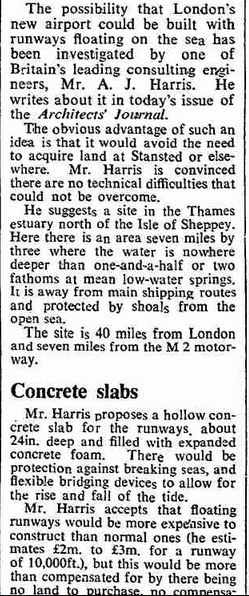

Boris has not taken up another bright idea from fifty years ago—the inevitability of Britain switching to driving on the right-hand side of the road—but it is only a matter of time.

This ends the weekly series of pieces summing up the week fifty years ago. There will be three more posts over the next couple of weeks or so to finish off the 1967 retrospective, looking at the Gillette Cup final, thinking about cricket now and then, and reflecting on the process of recreating a cricket season through social media.

Sunday, March 22, 2015

New Zealand v West Indies, World Cup Quarter-final, Cake Tin, 21 March 2015

Scorecard

We’re a cautious lot, we New Zealand fans. If our interest was the theatre, we would have gone to the Cake Tin yesterday hoping for a decent performance of something worthy. Ibsen, say, or Pinter. The provincial reviews had been good, but this was the West End, the knock-out stage. All we wanted was for the Brendon McCullum Players to remember enough lines to get us to the semi-final. Instead we got the most lavish Broadway show imaginable, full orchestra song and dance from start to end. Martin Guptill: the Musical.

What I love about cricket is its capacity for surprise, its ability to exceed expectation. After, yes, half a century watching the game you think you know what the parameters are. You assume, for example, that you will never see someone, particularly a New Zealander, score 237 not out in a World Cup knock-out game.

It was glorious. This New Zealand summer has conjured up cricket that stands with the best of the past fifty years. Williamson and Watling at the Basin, Southee at the Cake Tin, Sangakkara anywhere, McCullum everywhere. This innings of Guptill’s was the best of the lot. It has to be judged against Cowdrey at Canterbury in 1975, Richards at Lord’s in 1979, Slater at Sydney in 1999, to name but three, as the best I have seen.

It was the shots he didn’t play, as much as those he did, that measured its quality. No reverse laps, ramps or premeditated movements. Pure cricket, from the Rolex timing of the push drive that sent the first ball of the innings to the straight boundary to the pull that put the ball on the roof in the final over. Watch a recording of the innings and see how straight is the backlift, even for cross-bat shots. As well as being spectacular and surprising it was aesthetically pleasing, which the best batting always is.

Incidentally, it is not true, as has been reported, that Craig McMillan is the only batsman to hit the ball onto the roof of the Cake Tin. Guptill has done it once before, off Lonwabo Tsotsobe of South Africa in a T20 in 2012, a hit estimated at 125 metres, 15 metres longer than yesterday’s. His two-fingered gesture to McMillan after the hit was not, as Simon Doull said on commentary, to say “two of us have done it” but “I’ve done it twice”. Michael Lumb of England also did it, in a T20 in 2013.

Guptill’s innings changed in tempo. At times early on runs were hard to come by. His century came up in 111 balls, which is hardly laggardly. At that point it was already a classy, memorable innings. He got there in the 35th over, just before the start of the powerplay. With only two wickets down, the foot could be pressed firmly to the floor.

Cricket is a game of numbers, and those for this match stretch credulity. Guptill’s second century came in just 41 balls. All eleven of his sixes came after the century mark. 207 came for New Zealand from the final 15 overs, 85 from the final five. It was wonderful.

From the third ball of the first over, Marlon Samuels became Dick Rowe for a day. Rowe was the Decca Records executive who, in 1962, refused to sign the Beatles on the grounds that guitar groups were on the way out. Samuels had the opportunity to send Guptill back to the rooms, but put down a sharp but catchable low chance at square leg. That was the only one Guptill offered. Just as Rowe would have spent the following years avoiding news of the Fab Four’s record sales, so Samuels spent the next 49 overs looking in any direction but that of the scoreboards as they audited the ever-increasing scale of his error.

A word in praise of Ross Taylor, who has been a worry for New Zealand supporters during the World Cup. He is hard to get out, but has got stuck in situations that he has hit himself out of in the past. Yesterday, he began slowly, with 23 off 43 balls, but he scored a run a ball thereafter and supported Guptill superbly in a partnership of 143, an excellent platform for the ensuing carnage.

Guptill is very fast between the wickets but is sometimes more cagey about his intentions than his partner would find ideal. We had already had one episode in which he and Taylor headed intently for the same end, so it was no surprise when Taylor was run out.

Earlier, Williamson had looked in as good touch as Guptill and it was a surprise when he got out to a soft shot. Later, Anderson, Elliott, Ronchi and Vettori all added to the mayhem.

My heart was filled with joy at New Zealand’s display. Yet it was also a little broken. I have written often enough about how early exposure to the West Indians fed my love of cricket. One of them was at the Cake Tin yesterday: the great Clive Lloyd of Guyana, Lancashire and the West Indies, the captain who brought together Jamaicans, Bajans, Trinidadians et al and made them a great West Indian team.

For Clive Lloyd, watching the shambles that the West Indies became in the final fifteen overs of the New Zealand innings must have been awful. How can the team of Richards, Sobers, Marshall, Greenidge, Holding and the rest have come to this?

To see England humiliated was comedy. To see the degradation of the West Indies was tragedy. The writer Dileep Premachandran recently tweeted “each time West Indies do well, the inner 10-year-old pumps his fist”. Today, the boy wept.

Jason Holder, the 23-year-old fast bowler who has been lumbered with the captaincy, looked bereft towards the end, and placed himself at long on, symbolically near the exit to the dressing rooms. It is always a bad sign when the skipper fields on the boundary. A little later, Darren Sammy, one of many recent captains, was seen in heated debate with the bench.

The fielding lacked commitment. Where were the dives, where were the support fielders? How the crowd roared later when all three of New Zealand’s slip fielders chased a ball to the boundary. What a difference.

So it was good that the West Indies took an adventurous approach to their futile task of chasing 394 for victory. They achieved more than was expected in maintaining a rate of eight an over for the 31 overs that they lasted.

But, in the words of a young member of the catering staff who took a seat behind us when they ran out of chips, West Indies were doing well “apart from the wickets thing”. Indeed. In cricket, it’s the wickets thing that gets you in the end. The wickets fell regularly and they never stood a chance of getting near. New Zealand knew how much protection they had and did not panic.

There were two noteworthy aspects to the innings. First Daniel Vettori’s catch at third man to dismiss Samuels. Vettori has always been highly competent in the field, but has never presented the world with an athletic persona. So, when, at the age of 36, he executed a perfectly timed, improbably high standing jump to pluck the ball from the night, it was as surprising as Maggie Smith rapping.

My Blean correspondent and myself have long been connoisseurs of one-legged innings, those made by batsmen under physical duress. The benchmark has always been Basil D’Oliveira’s half-century in the Benson and Hedges final in ’76. Despite his elderly hamstring having pinged earlier, D’Oliveira almost turned the game.

There was Basharat Hassan’s century at Canterbury the following year. Also Terry (though it might have been Michael) Parlane’s hundred at the Basin four or five years ago.

Chris Gayle’s 61 from 33 balls, with eight sixes, may have beaten them all. He has a bad back and could only hobble singles when there would normally have been a safe two. All of us who thought that Gayle’s non-appearance against the UAE was simply because he couldn’t be arsed, owe him an apology. Yet his hitting was devastating, if Sisyphean.

New Zealand’s two World Cup games at the Cake Tin have been two of the best days I have ever spent at the cricket. Years hence I shall remember them if I can’t recall my own name. The nation has become consumed with cricket. You hear people talking about it as you walk down the street. I have always wanted to live in such a place.

Tuesday, South Africa, Eden Park.

Wednesday, March 18, 2015

South Africa v United Arab Emirates, World Cup, Cake Tin, 12 March 2015

Scorecard

Public opinion is on the march. Social media is outraged, in a mild, cricket sort-of-way, that the lesser nations are to be excluded from the 2019 World Cup, which will be contested by ten teams. "Let them stay!" is the cry. This match was a rebuttal of that view.

John Arlott used to tell a story about Phil Mead, the prolific Hampshire batsman of the inter-war period. “Mead”, an old spectator said, “was a boring batsman. Saw him at Southampton once, blocked all day for 200”. The obvious point being that Mead was so much better than the bowling that he could score a lot of runs quickly without taking risks or appearing at all spectacular.

So it was today. South Africa—mysteriously put into bat—made 341 without hurrying or straying far from the orthodox. Only in the last over, when Behardien went after Amjad Javed, did any urgency appear in their approach.

AB de Villiers’ innings was a case in point. He made 99 from 81 balls, a pedestrian pace by his standards. After the match, he was flattering about the bowling. But we did not see a single sweep, reverse sweep, paddle or any of the bespoke shots with which de Villiers so magnificently challenges top bowlers. He didn’t need them. He knew that South Africa would reach an unbeatable target without any such exertion.

When they batted, UAE made not the slightest pretence of chasing the target. The required rate started at a little under seven an over. By the 13th over it was eight, by the 19th nine, by the 24th ten and then exponentially on. Runs were taken when available, but for UAE the honour lay merely in survival.

The fact that of the South African bowlers only Morne Morkel—in competition with Abbott for a place in the knock-out phase, according to some reports—was operating at full throttle assisted them, but the margin of victory was still a massive 146 runs. We all knew what would happen and it did. Where’s the fun in that?

Of the associates, only Ireland beat one of the eight major sides, and that was the West Indies, a team that makes the Greek economy look a model of stability. They also beat Zimbabwe, a country no more worthy of test status than it is of being called a democracy.

The twitterati have hailed the Irish for having shown up the ICC. I’m all for red faces among the ridiculous and self-important in Dubai, but on this issue there is scant evidence for it. The eleventh ranked team beat the eighth and tenth ranked teams, which is hardly a sensation.

If, as I hope, the ICC proves uncharacteristically resolute and the next World Cup is a ten-team tournament, there should, of course, be a qualification process. What would be a greater incentive for Ireland to continue to improve? To be handed a near-certain place or to know that if they work very hard, they will qualify to play against all the major teams at a World Cup? They are more than capable of doing so. Meanwhile, the ECB has a responsibility to assist Ireland in a more meaningful way than a one-off ODI in early May for which they will not even bother to recall the captain from the IPL.

I may be cynical, but I fancy that the patriotic devotion of the players to the Irish cause might wane quickly if they were granted the test status to which they aspire and found their county contracts plummeting in value because of their absence touring Zimbabwe or somewhere every July and August.

If there were any justice, England should also have to qualify after their hopeless display this time, but their status as hosts will probably protect them. Perhaps a Champions Trophy could be used to sort out a top six, the bottom team in both groups joining the qualifying process.

If we peer through the sentimental mist generated by the associates issue, we could see a wonderful ten-team World Cup in 2019. The format would replicate the 1992 tournament, the best of all according to many of those who have seen most of them. All teams would play nine games against all the rest, leading to semi-finals. There would be 48 games, one fewer than this year, but without a quarter or more being foregone conclusions like the non-event I watched today, and without a third of the teams having no realistic hope of progression.

I can’t wait. First, to the Cake Tin for New Zealand v West Indies.

Wednesday, March 4, 2015

England v Sri Lanka, World Cup, Cake Tin, 1 March 2015

Scorecard

The crowd on their way to the Cake Tin on Sunday morning comprised three groups, all easily identifiable.

The Sri Lankans were clearly going to enjoy themselves, whatever happened.

The English bore the grim countenance of a congregation on its way to hear a particularly severe Calvinist minister deliver an all-day sermon about them all being sinners and having to live a lifetime of repentance.

The New Zealanders just wanted a cricketing equivalent of a lie down in a darkened room. We were still getting over our traumatic Saturday when the national blood pressure rose to a level seen before only during the last ten minutes of the 2011 Rugby World Cup final. As New Zealand staggered to a one-wicket victory over Australia, the nation experienced more twists of fate and plucks on its heartstrings than can be found in the entire works of Dickens. No more excitement please, not today.

For the English it was a return to Dunkirk a week after evacuation, the memories of devastation and failure so raw. Like last week, they won the toss and batted.

Lasith Malinga opened the bowling, which is always something to see. I am no closer to working out how he bowls the ball so straight with his arm at that angle than I was when I first saw him. In a darts team he would clear the pub. Every time I watch Malinga I am reminded that had he been English he wouldn’t have made it to a county second XI. His extraordinary gift would have been coached out of him before his sixteenth birthday. There were yorkers to order, but perhaps the edge is coming off his pace; batsmen seem to get after him a bit more often these days.

England set off well and there was no collapse, though Ballance and Morgan are still out of form. Moeen Ali took a cheap hundred off the Scots earlier in the week, but does not look convincing as an opener against better opponents.

Joe Root was the hero, England’s youngest World Cup centurion, which might lead one to think that he is still a mere boy. In fact, he is the same age as Pitt the Younger was when he became prime minister, which says something about England’s undistinguished history in the competition.

Root reached his hundred at exactly a run a ball and blended the orthodox with the unorthodox well towards the end of the innings. If there is any consolation for England supporters it is that the batting can be built around Root for the next decade. Buttler did well too, despite being clonked on the swede by Malinga first ball.

309 was a good score, but not as good as England thought it was, Since the game a great deal has been written in the UK press about England’s obsession with statistics, often dodgy ones in that they take in many matches played before the limitation on boundary fielders was reduced, so loading the dice in favour of the batsmen. It’s as indicative as calculating travelling times between venues on the basis that they will be going by sailing ship.

There was certainly drift in the middle overs, but the target was reached with late-innings acceleration. The problem is that there was a target at all. It should be up to the batsmen to work out what is the best that can be achieved in the circumstances and then to strive for it. Another 30 runs mid-innings might have made all the difference.

And then perhaps it wouldn’t. As early as the fourth over, when Root at first slip dropped Thirimanne, thus cancelling out his own century in an instant, there was an inevitability about proceedings. Most of the writers blamed Buttler for the drop, as he had started going for the catch then pulled out. This supports my long-held view that it is always worth picking the best keeper, but Root should have caught it no matter what.

Paul Downton should buy Eoin Morgan a bracelet etched with the phrase “What would Brendon McCullum do?” So, when Sri Lanka lost their first wicket at 100 in the 19th over, and Kumar Sangakkara, scorer of 13,000 ODI runs, came to the crease what would McCullum have done? I’m pretty sure that I know.

He would have twigged that if Sangakkara were allowed to get established he would be mightily hard to shift and would probably take Sri Lanka most of the way to victory. Therefore, he had to stop this happening and would have put on whichever of Boult or Southee was hottest that day, stationed some close catchers and told his bowler to attack, attack, attack.

He would not have put on Joe Root, occasional purveyor of rarely turning off spin, and thought himself crafty in getting through a few overs. He would have known that this would simply be to offer valet parking to one of the greatest batsmen to walk the Earth. Sangakkara scored from every one of the first 20 balls he faced.

Moeen Ali bowled tidily enough in an unbroken ten-over spell and took Dilshan’s wicket, the only one to fall. But he batsmen cruised through his spell at five an over, just right to set up the final push.

It was as if, in homage to the late Leonard Nimoy who had died a couple of days earlier, Morgan was observing Starfleet’s temporal prime directive of not interfering in events so as to change their outcome. Sri Lanka’s victory was already written in the World Cup timeline, so he wasn’t going to do a damn thing that would change it.

This is indeed the summer of Sangakkara. A double century in the test and two at the Cake Tin. It has been such a treat. This was the quickest of his 23 ODI hundreds, though it never seemed faster than languid. It was Shakespeare knocking off a sonnet, Rembrandt a self-portrait. Of course, the need that all the England quick bowlers had to test the theory that he was susceptible to the long hop on leg stump helped him along too.

My Orange County correspondent, a keen and knowledgeable Beatles fan, made a rare visit to the cricket and I must impress on him that Sangakkara batting is the equivalent of McCartney wandering out there and strumming the highlights from Revolver or Rubber Soul.

The England fielders wore a defeated air by the time Sri Lanka were halfway to the target. Run outs appeared the only way in which England might have broken the partnership, but on one of the few occasions the stumps were hit the batsmen took an overthrow.

The end came in the 48th over, though it would have been earlier had the batsmen not lost a little timing at the end, or had Sangakkara felt like it. Thirimanne was 139 not out at the end, a fine innings, but today he was Salieri to Sangakkara’s Mozart.

The joyous cacophony of the Sri Lankan fans added to the day. It reminded me of West Indies matches in England in the seventies, particularly the Monday afternoon at the Oval in ’76 when Greenidge and Fredericks flayed England and Tony Greig grovelled before the Caribbean supporters on the western terrace.

The ludicrous structure of the competition means that England’s convincing impression of the Italian army in full retreat notwithstanding, they should still qualify for the quarter-finals, which is outrageous. Defeat by Afghanistan and elimination would be cricketing justice.

Sunday, February 22, 2015

New Zealand v England, World Cup, 20 February 2015, the Cake Tin


The other day Corey Anderson said that the New Zealand team was a “juggernaut”, which in Britain describes a large truck. That makes England the rabbit transfixed by the headlights, unable to evade the inevitable squashing.

It was sheer joy at the Cake Tin yesterday. For a start, it was sweltering, a word we use sparingly in Wellington. My Khandallah correspondent, who has spent her life under the scorching sun of the upper North Island, passed the first two hours charting the approach of the shade towards our seats.

And I saw the best one-day bowling that I have ever seen; the most spectacular innings I have ever seen; and captaincy so rich in innovation and imagination that it moved me.

McCullum’s field-setting was worth the price of admission. He makes Mike Brearley—who once stationed a helmet at short extra cover—appear cautious and unresourceful by comparison.

The New Zealand captain is in the process of rewriting the one-day captaincy manual. There were three close catchers, then four, then five, then—for Morgan—six. It was breath-taking. McCullum rejects orthodoxy as if it were carrying the plague. His strategy is to restrict scoring by taking wickets. Ross Taylor could play for another 20 years if he can stand at first slip all innings.

McCullum’s conception of cricket’s possibilities is different and exciting. If all captains would commit to attack as he does, all fears about the future of 50-over cricket would be allayed. My Life in Cricket Scorecards is no musician, but watching Brendon McCullum lead a cricket team must be what it would have been like watching von Karajan at his peak conducting the Berlin Philharmonic. A little louder from the piccolos, a second gully. Slightly slower cellos, third man move squarer.

Regular wickets kept the pressure on England in the first part of the innings. Eoin Morgan looked as scratchy as a flea-ridden tabby, but is a good player who could relocate his form at any moment. At 104 for three, Morgan and Joe Root seemed to be close to restoring parity. Who would have guessed then that the game had fewer than 20 overs left to run?

They were a bit slow, mainly thanks to a miserly spell of six overs for 17 runs from Daniel Vettori, who reminded me of Derek Underwood. This was partly because Vettori is a highly skilled and very clever slow left-armer, but also because the batsmen were playing his reputation as much as his bowling. Time and time again I saw batsmen retreat into caution against Underwood because of the years they had spent watching the consequences of failure. Joe Root and his generation cannot remember a time when Vettori was anything other than a one-day tourniquet and it shows in their approach.

England appeared to have decided to play Vettori out, but Morgan’s resolve broke and he went for the big straight shot. My correspondent and myself had a perfect view of the ball coming towards us. It appeared to be about to pitch safe just short of the long-on boundary. But Adam Milne lengthened his last couple of strides before leaping full length, taking the ball in two hands in mid-air and landing safely. That was the moment the game turned on.

McCullum struck with the certainty of a lioness stalking a wounded wildebeest. Southee was brought on at once and immediately bowled Taylor with an outswinger so beautiful that Mark Antony would have spurned Cleopatra to kiss it.

Of course, other captains might have brought back their strike bowler against a new batsman, but fewer would have resisted the temptation to save some of that bowler’s overs for the death. They would have settled for 210 for eight. Only McCullum would have also bowled his other strike bowler out at the same time. 123 all out.

Seven wickets fell for nineteen runs. As an overseer of collapses Peter Moores could arrange a job swap with the Greek finance minister. Joe Root barely faced a ball during these overs, an example of the lack of intelligence that characterised England’s day.

Tim Southee was brilliant. Seven for 33 was the best performance for New Zealand in ODIs. His control of the ball and use of the crease could not have been bettered by Alderman, or even Hadlee. Four of the seven were bowled, all with a graze of the off stump (love the flashing bails by the way). The swing was not huge, but with such precision it did not have to be.

There was no doubt that McCullum would go after the bowling. His name and “steady accumulation” are antonyms. But the ferocity and accomplishment was beyond prediction, best recorded in his scoring sequence: 160044444016404606666401W. It was slugging not slogging, the quickest fifty in World Cup history (previous holder: B McCullum). As in every other aspect of the game, McCullum incinerates the text book and does it his way.

Anderson, Finn and Broad are seasoned international bowlers, but the experience of having an opening batsman rampaging down the pitch in the first overs appeared new to them. There was no plan. They didn’t know what to do.

The four consecutive sixes were off Steve Finn in an arc between cover and long off. One worries for Finn for whom, even more than most bowlers, confidence is the glue that holds his game together. Half an hour in the public stocks would have been no more humiliating.

On a desperate day for England, one member of the team deserves special mention. A woolly resident of any field in New Zealand selected at random would have brought more brainpower to the game than Stuart Broad managed. Who knows why, coming in at 110 for seven, he thought that the best way to deal with Southee (five for 28) was to try to belt him over long on? His first ball to McCullum fed the batsman’s signature lofted cut, and the rest of the over allowed the New Zealand captain to set off flying. That Broad should finish the game with a high-wide bouncer that flew over Buttler’s head to the boundary was somehow fitting.

I can barely express how much I enjoyed this game. New Zealand pushing back the boundaries of what is possible. England gloriously hopeless. Just when you think that cricket has given you all it can along comes Brendon McCullum who says “let’s make it a little bit better”. 

Saturday, February 7, 2015

Two ODIs at the Cake Tin

New Zealand v Sri Lanka, 29 January 2015


The Sri Lanka game was the seventh (seventh!) of a series already won by New Zealand. Everything now is part of the World Cup phoney war.

The World Cup will define how we remember this season, but for me “the summer of Sangakkara” would be fine. After the test match double hundred at the Basin, the great man treated us to a sumptuous century here, a Shakespearian vocabulary of shots making his bat loquacious. Only after he passed three figures did he depart from the orthodox, and it was somehow unfitting, like discovering Darcey Bussell line dancing.

Sangakkara put on 104 for the second wicket with Tillakaratne Dilshan, at which stage Sri Lanka looked set for a total well on the sunny side of 300, but they lost their puff during the powerplay and mustered only 99 runs from the last 15 overs.

As it turned out, that was plenty.

The Guptill question currently troubles New Zealand as the Schleswig-Holstein question perplexed the diplomats of mid-nineteenth century Europe. The question is “Is he any good?”. I think that he is, but continues to be unfortunate in that the only place for him is as opener. A run in the middle order or as a finisher at some point and he would be established. Here, he was out first ball.

That the World Cup squads had to be announced six weeks or more before the first ball is bowled is obviously ludicrous, redolent of an age when the teams would travel by steam packet, but it works in Guptill’s favour. It removes the question of whether he should be in the squad; he has tenure so will be given every opportunity to get into form. Even so, if I were Guptill I’d make sure that I didn’t have a selector behind me when I walked downstairs for the next couple of weeks or so.

Wickets fell regularly until, at 141 for six, the deal appeared done. But Ronchi and Vettori put on 74, including 52 in the powerplay, to bring New Zealand back into the game. However, Kulasekere yorked Ronchi off the last ball of the powerplay and that was that.

It was good to see Vettori back at his crease-wandering, angle-inventing best, but he went for six-and-a-half an over. I hope that the nagging feeling that it is a tournament too far for him proves off beam.

Forty-eight hours later we were back, Sri Lanka’s pleasant blue kit replaced by Pakistan’s luminescent Close Encounters of the Third Kind green for the first of two match series (though series isn’t quite the word for two matches).

While the other cricketing countries have been playing each other in a bewildering number of ODIs, Pakistan have remained in their tent. It showed.

Having been put in (McCullum’s probability-challenging sequence of toss losses has finally abated), only a thoroughbred half-century from Misbah-ul-Haq was other than negligible from the top order, and the final total of 210 was a hundred short.

Yet the Pakistan innings brought us the most memorable cricket of the two matches. Shahid Afridi scored 67 of the 76 runs added while he was in, and took only 29 balls about it. Of course, he’s been peppering the stands for the best part of twenty years, but I had not seen him do so in the flesh before, so had never appreciated the high degree of intelligence and science that he brings to the task. It’s great that there are still some things that you have to be there to appreciate.

This was as far from slogging as Gershwin is from the Eurovision Song Contest. He was not as premeditated as many less successful practitioners of the crash-bang arts. Most shots were a response to the ball as bowled. Setting a field to Afridi when he is firing as well as this is chasing shadows, he finds the empty spaces round the boundary so well.

Mohammad Irfan is Pakistan’s seven foot one left-arm opening bowler. He caused a few problems with height of release and the angle of delivery, and could be lethal on grounds where they have been economical with the height of the sightscreens. But he is 32 and has played only 40 ODIs and four tests, so as a secret weapon is hardly Area 51 material. As a batsman, any aspiration he has to be promoted to No 10 appears about as unrealistic as one to be an astronaut, and he is a liability in the field.

Not that he is alone in that. There was a difference of 30 to 40 runs in the fielding of the two teams. Shahid Afridi’s fury when a boundary fielder declined the opportunity to dive to save a four was as forceful as his hitting had been.

McCullum was McCullum and had a strike rate of 141 when he got one wrong and was out for 17. Another nagging feeling says that McCullum’s golden run is near its end, but we New Zealand supporters are known for our persistence in seeking black edges to silver clouds.

An unbroken stand of 112 for the fourth wicket between Ross Taylor and Grant Elliott settled the matter with more than ten overs to spare. Taylor is making runs again without looking at the top of his form, which only a very good player can do.

Three weeks ago, Elliott’s selection for the World Cup was greeted with disbelief; now, a century, a world-record partnership and a string of good performances with bat and ball (he took three wickets here) and he is the nation’s favourite.

Where does this leave us? People will try to build up a sense of excitement about the group stages, but few would put any money on any other than the top eight teams comprising the quarter finalists. Do away with the quarters and it would be a much more interesting competition.

Sri Lanka, despite the series loss, could well chalk up the three wins in a row needed to take the trophy home. Pakistan look much less likely to do so, but they have the group stages to raise their game. No Waqar or Wasim though.

New Zealand is relishing the World Cup. We do this sort of thing very well and enjoy the attention we get. We also think that we stand a chance. There is more quality in the team than we have had since Hadlee and Crowe, and there is a balance about it too. The selectors can afford to leave out decent players who would have walked into previous World Cup squads, such as Matt Henry, Doug Bracewell and BJ Watling.

I will blog and tweet from two group games and the Wellington quarter-final.

A feast of 50 over finals at the Basin Reserve

  Men’s eliminator final, Wellington v Central Districts Women’s final, Wellington v Northern Districts Men’s final, Canterbury v Centra...