Showing posts with label Sam Northeast. Show all posts

Sunday, September 18, 2016

Take Me Back to the Ballgame: Two Nights Under Lights


Two shirt-sleeved evenings under lights either side of the Atlantic. Two sporting contests played in attractive, homely venues before full houses of around 6,000. Both matches lasted a little under three hours and ended in defeat for the home team. The first was a baseball game in Vancouver, Canada, the second a T20 fixture at Canterbury the following week. How alike were these experiences? Which was better?

My Life in Cricket Scorecards watches a lot of baseball on television, but had never been to a game and was disappointed  to find that both the Giants and the As were to be on the road while I was in San Francisco on my way back to New Zealand. But there was rich consolation in Vancouver on the way out: a minor league game between the Tri City Dust Devils and the Vancouver Canadians (remember that baseball fixtures are listed with the home side second).

The two teams are feeder clubs for major league teams: Tri City for the San Diego Padres and Vancouver for the sole Canadian major league team, the Toronto Blue Jays. They are well down the food chain though, in the Northwest League, North Conference, five levels below the major leagues. Few if any of the players at the Nat Bailey Stadium will ever play at the Yankee Stadium or Fenway Park.

The chances are that readers won’t have heard of the Tri City, but will know that Vancouver is an attractive place on the west coast of Canada. Yet it is Vancouver that feels it necessary to provide further information by way of the name of its baseball team: the Vancouver Canadians. It’s as if they need to say “you Americans may not have heard of Canada; here’s a helpful reminder in our name”. They may have stopped just short of having a map stitched on the team’s uniforms. We New Zealanders know their pain. The Tri City is located about 250 miles south of Vancouver in Washington, not a notably dusty state. The Tri City is presumably a centre of vacuum cleaner manufacturing.

The Nat Bailey Stadium is tucked away in the prosperous southern suburbs four kilometres or so from the city centre. An L shaped stand spreads out from home plate to first and third bases. Behind the fence that had to be cleared to score a home run was a ring of trees. It was Canadian Tunbridge Wells.
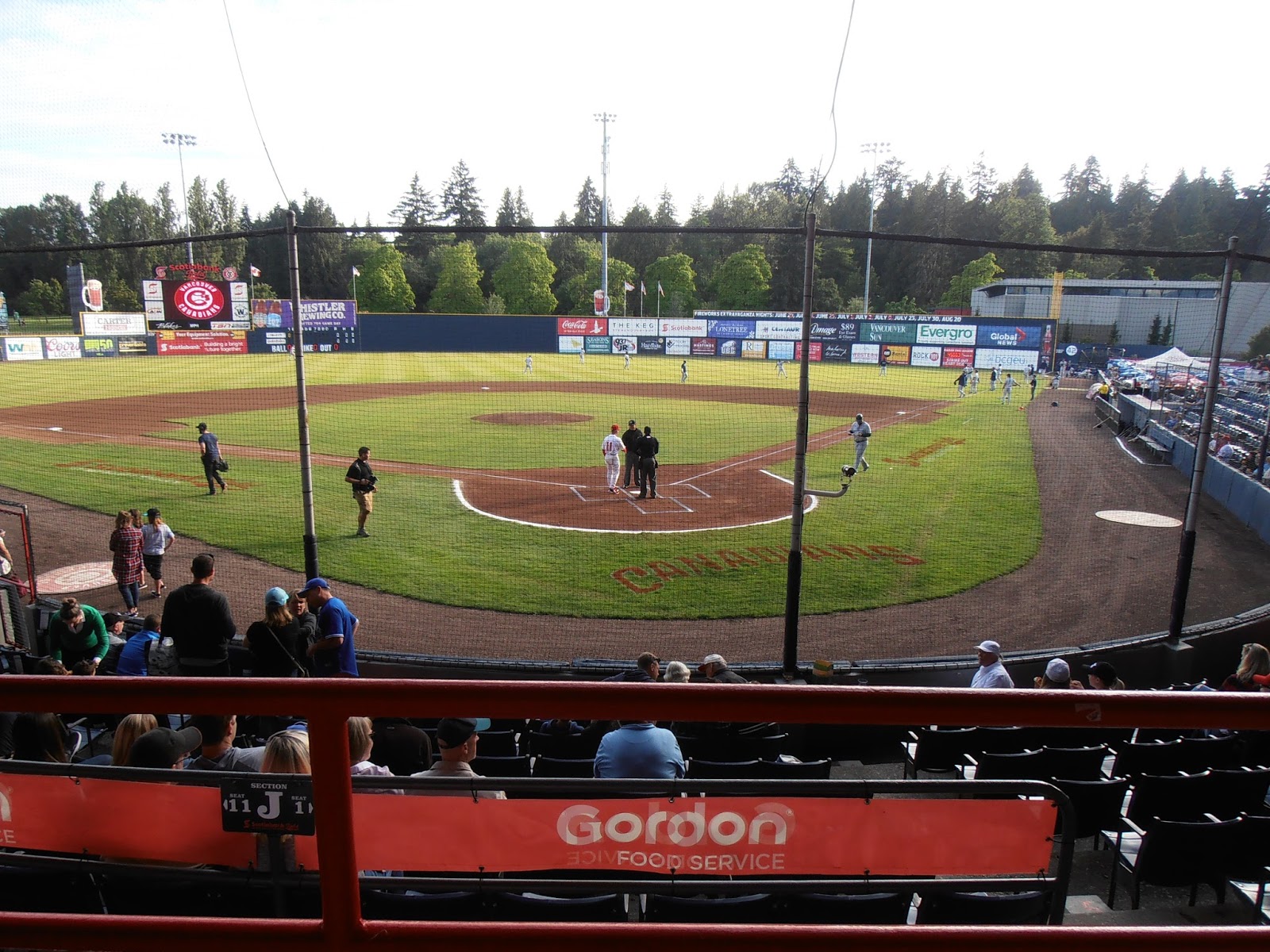
Nat Bailey Stadium, Vancouver


Best of all, it was bring your dog to the game day. Three-hundred-and-eighty-three dogs joined the 6,143 capacity crowd. Mayhem appeared inevitable, but not so. It was the ultimate vindication of the principle that dogs imitate their owners. These were Canadian dogs: pleasant, easy-going, eager to please, and averse to conflict. It was splendid.
Three of the 383 dogs present

You are much closer to the action in baseball than cricket; my modestly priced seat was located above leg slip’s head, so to speak, close enough to the action to agree with those who say that the hardest thing in sport is hitting a pitched baseball.

The sun sets in Canterbury
St Lawrence under lights was enchanting, as it often is to see a familiar place in a new way. I sat next to the sightscreen at the Nackington Road End, and watched the sun set behind the stands, gaining aesthetic pleasure and a ready-made metaphor for Kent’s performance at the same time.

The duration of the two games is the same, but the tempo is not. The scoreboard at the Nat Bailey Stadium didn’t shift from 0-0 until the fourth inning, three-quarters of an hour into the game. In that time, only two batters reached base, and one of them was a walk (ie without hitting the ball). This is more like first-class cricket than T20, which promises constant action. But the lack of scoring did not mean that nothing was happening. As in cricket there was all manner of subtlety there for those equipped to spot it: curve balls, sliders, fast balls, knuckle balls, marked by a ripple of applause here, a murmur of approval there, just like the members’ stand at any county ground when nothing is happening but everything is happening.

Something else that baseball has in common with all forms of cricket is an obsession with statistics. It even records errors, of which there were more this night than you would see in the major leagues. Tri City’s first run was achieved with the help of two errors, first when a wild pitch allowed a runner to advance from first to second, then an errant throw from the catcher that allowed the same runner to get home.

The standard of fielding at Canterbury was higher. Kent only took two Essex wickets, but both were cracking catches. Kagiso Rabada sprinted around the deep mid-wicket boundary to dive full length to dismiss Nick Browne, the best catch I have seen by a member of the arthritic brotherhood of Kent fast bowlers. Sam Northeast’s effort to get rid of Dan Lawrence was even better, an over-the-shoulder running catch that he never looked as if he was going to get and hold on to, but did. And without the assistance of a large glove.

The experience of the batsman and batter is a big contrast. A good batting average for a baseball player is anything above .300 (at the time of writing only 23 batters in the major leagues better this figure this season). This means that a batter who gets to first base once every three at bats is a top performer. Batsmen get only the one go in cricket, but have the chance to build an innings in their own style, something that is at the heart of cricket’s appeal. One reason why T20 has less charm to some of us is that generally the batsman does not have the time to express his individuality in how he goes about this task, though the Canterbury game provided a happy exception. Tom Westley and Ravi Bopara batted through the last 12 overs of the innings undefeated. Bopara’s 35 in 51 balls was a masterclass in running the fielders ragged, Westley’s 74 in 49 no less so. Unusually for T20, craft was favoured over muscle; there were only two sixes all evening.

Richness of language is something that the two sports have in common. Poetic secret codes that capture the beauty of the game. There is no better term in sport than “stolen base”, which conveys perfectly the audacity of the commitment to run the 30 yards between bases made with the ball still in the pitcher’s hand.

T20 maintains a frenetic pace. A baseball game, like a test match, is slower but can explode into action without warning. Fielders and batters must have sharp decision-making abilities. The top of the seventh at the Nat Bailey Stadium provided a fine example. With two out and no runners on, it seemed that the Canadians would have two innings to make three runs to take the game, even after the next batter, Aldemar Burgos, got to second with a fly to left field. A base hit by Nate Easley allowed the swift Burgos to score.

With only two innings left, another run would surely settle the game. In baseball each inning has the potential to be a one-act play of its own, the denouement depending on who remembers their lines under pressure. Here, it was the Canadians who needed the prompter.   

A balk (a dummy pitch) allowed Easley to advance to second, which in baseball commentators’ lingo is scoring position. Balks are comparatively rare (only two MLB pitchers have as many as four at this late stage of the season), a sign of stress. Next to the plate was Buddy Reed, who hit straight to the third baseman. A routine throw to first base would end the inning. But the throw was wild and Easley on second was quick to see his chance and make for home. Had Reed stuck at first, the inning would have continued, but he was also sucked in by the exuberance of the moment and was out at second.

Though the Essex innings provided powerful testimony against one charge against T20, Kent’s batsmen made no case in defence against another: that too often the result is clear soon after the interval. A do-not-resuscitate sign was stuck on the game by halfway through the Kent innings. The final margin of defeat—33 runs—was a chasm in T20 terms, but would have been much worse but for some running-towards-the gunfire hitting by(who else?) Darren Stevens and a six-run penalty for Essex bowling their overs too slowly.

Baseball’s format gives it a chance to apply CPR when the game appears a corpse. The contest at Nat Bailey provided a glorious example. Though they got a runner to third in the eighth, the Canadians went into the bottom of the ninth (the final inning of the game) four-nothing down, an apparently hopeless position.

First-up Lance Jones advanced to first on a walk, but stayed there while the next two at the plate were out, so the last dismissal appeared no more than a formality. The official record says that Jones then advanced to second due to “defensive indifference” a term that cricket could have done with over the years. It makes me think of John Snow at fine leg at Canterbury in 1976, arms folded.

Pitching indifference followed. Christian Williams was walked to first. There was a murmur about the crowd. Some of the dogs emerged from under the benches, sensing that something was afoot. Sports fans pretend to be pessimists, but are really optimists. There was not Vancouverite in the ground who had not shifted an inch or so towards the edge of their seat, knowing that the bases were loaded and the tying run, in the form of the splendidly named Venezuelan Yeltsin Gudino, was at the plate with the bases loaded.

Panic was now spreading through the Dust Devils like a vicious rumour. Pitcher Will Stillman, who had been brought in at the start of the inning, now lost control and walked Gudino, allowing Jones to score: 4-1. A home run from new batter Javier Hernandez would win the game. The coach now came to the mound, for the second time this inning. He brought bad news. Stillman, supposed to be the finisher, was finished, replaced by Bednar.

Hernandez turned out to be of the McCullum all-out-attack school of dealing with tricky situations. First pitch: swing, miss. Second pitch: swing, miss. The count was two and O, which meant that another strike would end the game (a swing and miss is always a strike). Hernandez was more circumspect to the next pitch, and left it as being high. The umpire did not agree and called a strike to end the game.

It would have been extraordinary had one of those swings sent the ball over the fence. Regular baseball watchers would go many seasons before seeing a game decided on a last-inning, grand slam homer, and I was lucky to be there just for the possibility.


So which of these two nights under lights was better? The baseball game represented its code more effectively, a tale of the unexpected. There was much to enjoy in the T20, but in the end it was mundane. Of course, on other nights it might have been the other way round, but it seems to me that baseball is more comfortable in its own skin, fitting perfectly the three hours for which it was designed, happy to see quiet periods as integral to the game. T20 remains an artificial construct. In trying to compress a game of cricket into a small space it sacrifices too much of what is wonderful about it.

Put it this way. If there is a major league game on one channel and a test or 50-over match on another, I’ll choose the cricket. A ball game v a T20 and I’m likely to go for the baseball.


Monday, August 22, 2016

Kent v Gloucestershire, 50 overs, St Lawrence, 31 July 2016


For the first time in 19 years I find myself at Canterbury Week, at least for the first day, a one-day contest between Kent and Gloucestershire. Back then, there was something of the Edwardian stately home about it, with marquees shimmering around a third of the boundary, temporary homes for all sorts of organisations ancient and antiquated: the Buffs Regiment; the Band of Brothers; the Old Stagers; the Association of Men of Kent and Kentish Men. Now most of the house has been sold to ward off impoverishment and the family is reduced to living in a few rooms in one wing. Just five marquees remain, though readers will be relieved to learn that the High Sheriff of Kent was present, perhaps to protect us from the cowboys on the building site that occupies the Old Dover Road side of the ground. A giant crane looms over the playing field as the old lime tree once did from much the same place, an apt symbol of how things have changed. The club has done a good job in retaining the character of the playing arena thus far during the redevelopment. I hope that I can make the same report on my next visit once the building is complete.

The match was the penultimate in the group stage for both teams. A win would come close to ensuring a quarter-final place for Kent. Gloucestershire, who won the competition last year, have had a nightmare and are already out, which is disappointing (you will remember that My Life in Cricket Scorecards lived in Bristol for 19 years and spent many a freezing day on the Hammond Room roof, so retains secondary affection for Gloucestershire).

Kent won the toss and put Gloucestershire in. What followed was consistent with the timeless, retro feel of the day: the visitors proceeded at a leisurely four an over to be all out for 200 in the fiftieth over, an analogue score in the digital age.

The pitch was slow, and from the Pavilion End the odd ball stopped (as they say). Of the 13 wickets that fell, only four were to catches, and three of those were caught-and-bowled, a sure sign that timing is tricky. In these conditions Darren Stevens—the human tourniquet—was predictably abstemious, conceding only 28 from his ten overs. Will Gidman, bowling at a similar pace to Stevens, had the best figures, three for 28 in eight overs. Gidman is on loan from Nottinghamshire, but it would be good if he could be persuaded to stay; he’s more than useful and at 40 Stevens has no more than seven or eight seasons left in him.

Twenty-two-year-old bowler Charlie Hartley bowls a notch or two quicker. He claimed two wickets, both front-foot lbws. With Matt Coles getting Cockbain in the same fashion, Nos 3 to 5 in the Gloucestershire order were sent on their way by Rob Bailey. None of these decisions looked clear cut, which is not to say that they were wrong. There had been a celebration of the 80th birthday of Ray “Trigger” Julian a couple of days before and the thought occurred that umpires around the country were firing ‘em out in celebration.  

Matt Coles took the first two wickets. Like Jesse Ryder, in any other era Coles would have been regarded as a character. In our age of scientific Calvinism he is a problem, just back from suspension after a late night (or nights). He has talent and unpredictability. Is it possible to inject conformability into the mix without diluting it?

The best Gloucestershire batsman was Hamish Marshall, who is finishing at the County Ground this year after 11 seasons. It was a pleasure to see Marshall in prime form. My period as CricInfo’s man in Northern Districts coincided with Hamish and his (absolutely) identical twin James establishing themselves as first-class cricketers, to the confusion of scorers, umpires and journalists everywhere. It was not quite a valedictory as I far as I am concerned, however; it is rumoured that Marshall will play for Wellington in the coming New Zealand season.

He and Michael Klinger put on 42 for the third wicket, the biggest partnership of the innings. At 71 for two in the 18th over, things were pretty even, but by the 37th over it was 138 for eight. Tom Smith, David Payne and Matt Taylor did well to get as far as 200, but it was surprising that Kent did not try to finish the innings off. For the last ten overs only the minimum four fielders were retained inside the circle. The tailenders used the gaps in the field intelligently to take the score to the foothills of respectability. Today the difference between 150 and 200 all out was not significant, but on a pitch that was not straightforward it might have been on another day. At the risk of becoming a one-tune band, I will ask my usual question: what would McCullum do?

Kent’s top order are in rich form at the moment. Daniel Bell-Drummond and Joe Denly were largely untroubled, though the odd ball from the Pavilion End was still struggling to make it  all the way to the batsman. Once past 50, the shots came more freely, with Denly in particular happy to come down the pitch. The partnership was at 92 when Bell-Drummond played around a straight one to be bowled by Howell. This equalled the record for Kent’s first wicket in one-day cricket against Gloucestershire, matching Luckhurst and Johnson in the Gillette Cup in 1972 (I didn’t see that one).
Sam Northeast picks up where he left off each time he comes up to bat at the moment. Like Bell-Drummond, it was a surprise when he was out, to a sharp return catch to Payne. There are vacancies for batsmen in the test team. On form, Bell-Drummond and Northeast have as good a bid as anyone. Will their being being second division players be an insurmountable objection?

Sam Billings, on top of the world a week before for England A, left his timing at home today. What had been brilliantly audacious reverse sweeps were now mere errors of judgement.

Joe Denly was there throughout for 82. He is also playing very well, though his time as an international player has probably passed. Darren Stevens (who else?) saw him through to the end and finished the game with a six onto the bank on the south side of the ground.

A mundane game to finish my visit to the old country, but days in the sun at Canterbury are precious and never disagreeable.

Kent came second in the group, and played Yorkshire in the quarter-final, a game that I was able to watch on TV back in New Zealand. Kent chased 256 on a pitch much like that the Gloucestershire game was played on. Against Yorkshire’s international attack they came just 11 runs short (and the lbw that ended the innings not even Trigger Julian would have given). It supported the view I formed during my short visit that the old county is in better shape on the field than it has been for a while.


Monday, July 25, 2016

Kent v Sussex, County Championship, Tunbridge Wells, 18 July 2016 (second day)


Disgusted of Tunbridge Wells wasn’t even mildly disgruntled. How could he be on such a perfect day? It was 30 degrees celsius (though 86 fahrenheit would be more in the spirit of the retro atmosphere). Rumour had it that in the committee marquee, ties were loosened. The location was gorgeous, the ice cream cold, the beer nicely tepid and the cricket decent, though the last was the least decisive of these factors in making it a relishable day.

Traditionally, the Tunbridge Wells Festival took place at the beginning of June when the rhododendrons made a purple wall of the northern side of the ground, rather like the Christmas scarlet of the pohutukawas at the Basin Reserve. However, the Nevill Ground is less reliant than the Basin on seasonal blooming for its beauty. Marquees shimmer down one side of the ground; opposite, an urban forest shelters the playing area from the traffic—from the twenty-first century in general, in fact. Add a quaint pavilion (rebuilt just before World War One after the original was burned down by suffragettes) and you see why this ground is considered among England’s finest.

CricInfo’s report on the first day described it as a “day for purists”. This was probably not meant kindly, but did not deter more than 2,000 people from turning up this sunny Monday. From this we learn that there is an audience for first-class cricket if it is played in nice places when the sun shines.

Kent resumed at 310 for three, with Sam Northeast and Darren Stevens well-established. Stevens has been one of My Life in Cricket Scorecards’ favourite cricketers since his sublime final-day double century to beat Lancashire three years ago. He deposited Briggs over the deep-square-leg boundary in the second over of the morning, but an attempt at a repeat sent the ball straight up in the air.

Alex Blake replaced Stevens and looked at ease immediately. Blake, a left-hander, has a good technique and straightforward approach, finding his range by lifting Briggs into the trees at deep mid-wicket. He reached his fifty with a similar shot, before falling leg before to the same bowler. Umpire Nick Cook, a distinguished slow left-armer, had the finger up like a shot in sympathy with his fellow practitioner, and did well to restrain himself from joining in with the appeal.

Meanwhile, Sam Northeast just rolled on, in the manner of the Mississippi. He reached his century with a flick off the pads off leg-spinner Beer. Northeast seems a popular choice as captain, unlike some of his predecessors.

With the pitch offering nothing to any bowler, Sussex captain Luke Wright tried a ruse. There is nothing like a skipper’s crackpot theory to brighten the day and this was one of the best . It was a modern take on the umbrella field of the Bodyline era, with the difference that all the fielders were in front of the batsman, six of them initially, from short cover to short mid-wicket. Australian seamer Steve Magoffin was the bowler.

Northeast responded to the conundrum with the ease of Stephen Hawking finding the square root of four. He simply hit the ball to the boundary through the gaps between the catchers (once for four and once for three). The experiment continued in Magoffin’s next over though with fewer personnel. An edge by Northeast through the now-vacated slip area (just about the only edge all day) brought it to an end.

Perhaps there is something in the Tunbridge Wells air that affects Sussex captains. It was here in a Sunday League game in 1994 that Allan Wells set an 8:1 legside field with Neil Taylor the batsman, late on in Kent’s run chase. I’m not sure who the bowler was. Eddie Hemmings was playing for Sussex (I’d forgotten that he’d finished his career at Hove), but I can’t imagine that he’s have stood for it. Anyway, Taylor dealt with it as easily as Northeast did today, by stepping back and biffing it into the void.

Wright’s Professor Branestawm field placing helped Northeast to accelerate after passing the hundred mark, going at more than a run a ball until he became becalmed in the 180s, which is not the worst place for the wind to drop. The frustration led to a false shot and a diving return catch for Magoffin. The innings wrapped up soon afterwards for 575, leaving Kent seven sessions or so to bowl Sussex out twice.

To open the attack, a tall one and a round one, but as unlikely a combination as Stan Laurel and Thomas Hardy: Kagiso Rabada (21) all pace and muscle, and Darren Stevens (40) all waddle and guile. In the opening overs Stevens proved as mean as a German Brexit negotiator, conceding two from his first five overs. It’s the slowing down as he passes the umpire that fools ‘em. It is quite a time for 40s achievers with Misbah’s hundred at Lord’s, and Mickleson and Stenson battling it out at the Open. Stevens will probably give it another five years.


The best contest of the day was that between Rabada and Sussex opener Chris Nash, who looked uncomfortable and hurried  several times in the opening overs but then responded with a series of sweetly timed square and cover drives. Reaching the boundary was an achievement in itself; the outfield was rough, bumpy and as slow as an Ingmar Bergman plot.

The only wicket to fall went to Mitch Claydon, as old school as a Latin primer. Harry Finch played back to one that kept a little low, and was bowled. Sussex finished the day on 69 for one, 506 behind.

This was a day from a picture book of an idealised English settings, probably the one in which John Major found his village green and bobbies on bicycles. These scenes don’t exist in real life, but may occasionally materialise like Brigadoon (hopefully without the bagpipes). The chances of being there when it happens are infinitesimal, but today it happened for me. I'm sure that I glimpsed a suffragette with a box of matches and a petrol can.

Towards the end of the day it seemed that the pitch was offering glimmers of hope to the bowlers: a little variable bounce here, a hint of turn there. These were nothing but mirages, as Sussex, though made to follow on, batted through the two remaining days comfortably enough in my absence. Their hero was none other than Ross Taylor, with 142 not out and 68, but I can get that at home.

Sunday, August 23, 2015

Watching Kent lose on TV


Napoleon, when in exile on St Helena, used to receive news of how badly things were going with the Bourbon Restoration, and mightily did it depress him. The physical distance between him and France did not dampen the disappointment one bit.

Having spent last weekend watching recordings of Kent being swept away by the undercurrent of defeat when just an inch away from the shore of victory not once, but twice, I know how he felt. You would think that being separated from the carnage by 12,000 miles would ease the pain. It does not.

There was also the women’s test match between England and Australia from Canterbury, allowing me to think myself once more at St Lawrence in August. However, my Blean correspondent was quick to send caution. His email compared it to the 1969 Gillette Cup semi-final. It was the summer of Woodstock. My correspondent’s view is that what the festival was to rock’n’roll, the fixture between Derbyshire and Sussex was to slow scoring, a marker that no future event would surpass. So it was a warning to be heeded.

Look at the scorecard and you see his point. Derbyshire hewed 136 from the granite of 57 overs, PJK Gibbs leading the resistance with an innings of 44 that was as dogged as a pack of foxhounds (unfortunately Alan Gibson does not appear to have been there to describe the innings in its full horror). Sussex could merely hang on briefly to the crevices of the rock face; all out for 49 in the 36th over.

The one thing I would say is that limited-overs cricket on a poor pitch (“slow and stopping” is Wisden’s description of the Chesterfield strip on that occasion) can be fascinating. Canterbury this week was merely slow, on the evidence of the two hours or so I have watched so far. Heeding my correspondent’s advice, I turned to the men’s game.

First, I watched Glamorgan v Kent in a group match in the 50 over competition. I used to cross the Severn Bridge to watch cricket at Sophia Gardens at some point in most seasons and always found it a convivial place to spectate. Now, over-reaching ambition has turned it into an arena in which county cricketers are hobbits in the full-sized world.

Though the game was a fortnight old when I watched, I had avoided the result, so the arrow of disappointment met no armour as it pierced my heart. Kent were put in. The Sams Northeast and Billings put on 104 for the third wicket. Northeast has had a good year and seems to be enjoying the captaincy. Rob Key remains club captain, but Northeast leads on the field. Key sits out the shorter forms and was doing a fine job in the commentary box, combining dry wit with observation of the subtleties.

Kent seem to be doing a better job of retaining their young players. The captaincy may be part of the deal that has persuaded Northeast to sign a long-term extension to his contract. Daniel Bell-Drummond has just done the same. It may help that Joe Denly and Matt Coles have returned after unsuccessful stints elsewhere, and that Billings is in the England ODI team without having had to move.

But today all the younger ones were outshone by the old stager, Darren Stevens. What a remarkable cricketer Stevens is. A couple of years ago I was there to watch him play one of the finest innings I have seen to beat Lancashire on the last day of the season. Here he made 110 from 64 balls, with nine fours and six sixes. Just as it was that day at Canterbury, his batting was aggressive, but almost wholly orthodox, each shot right for the ball it dispatched.

How gettable was Glamorgan’s target of 318? The pitch was amiable, if a little slow. There hasn’t yet been time to assess the extent to which the new fielding restrictions will restore the balance between bat and ball in the closing overs. Two fielders are allowed outside the circle in the first ten overs, four in overs 11 to 40 and five thereafter. This suggests that the gorging by batsmen in the final ten overs that we saw at the World Cup will be curtailed. Not today though.

Like Kent, Glamorgan had a solid stand early on: 132 between Bragg and Ingram for the second wicket. Ingram went on to a run-a-ball hundred, but momentum was lost mid-innings, thanks to none other than Stevens, who bowled his ten overs for only 38.

Stevens reminds me of Chris Harris. Both deliver ambling bowling that looks innocuous but makes decent batsmen into fools; both can be devastating bat-in-hand. The difference? Harris played 250 ODIs (taking 203 wickets), Stevens none. I doubt that anybody can think of a better player without an international appearance.

When there was a brief rain interruption in the 42nd over, Glamorgan looked out of it, needing 13 an over with four wickets standing. On the resumption, Kent fell apart in a spectacular manner. The game should have been over when the hard-hitting Chris Cooke was caught-and-bowled off a skyer by Ivan Thomas, only for the replay to reveal a front-foot no ball, one of three no-balls in this period. There was a decent excuse: a wet ball, which made it particularly difficult for spinner Tredwell, but there was some poor bowling and fielding, as well as some fine hitting, by Cooke in particular. The win came with two balls to spare.

The Kentish benchmark for wrenching defeat from the certain hands of victory remains the Sunday League contest against Middlesex at Folkestone in 1972. Chasing 128, Kent were 109 for three, then 126 for six, only to lose the last four wickets without addition (including a malaria-stricken Asif Iqbal at No 10). The Glamorgan game was an honourable contender, but at least, thanks to later rain, they still got through to the knock-out stage.

The second Kent fixture of my weekend was the T20 quarter-final against Lancashire at St Lawrence. I watched this one just a few hours after it was played, again without knowledge of the result. This was a defeat of a different school. Kent struggled throughout, only coming close to an unlikely win at the end, but then losing anyway, by a squeak.

It was good to see the old ground full, though the current definition of “full”—7,000—is less than half the number of us who squeezed in for the Gillette Cup semi-final in ’67. Five-figure crowds were common for the big one-day games of the seventies. It didn’t help that plenty of thought appeared to have been put into finding ways to block the view from the stands. The sightscreen put the lower pavilion out of commission, the TV scaffolding the upper; the dug-outs got in the way of the corner of the Underwood-Knott where I spent seventies summers.

There has been pleasing news about county attendances elsewhere in the last few weeks. There were 6,000 at the Oval for a 50-over game I watched on TV. Best of all, 14,000 attended the three-days of a Championship game at Scarborough. So if county cricket is played at times and in places that suit people, they will watch. This statement of the obvious will be ignored by the ECB as the Championship is further curtailed, probably to take place only on weekdays in April and September.

Kent were put in, and struggled almost throughout, losing wickets whenever a smidgen of momentum had been gained. That they reached 142 was largely thanks to an eighth-wicket partnership of 52 between Tredwell and Fabian Cowdrey, who looks much like his Uncle Graham at the crease, which is no bad thing at all.

A low first-innings in any form of cricket always brings with it the hope that the pitch is to blame, and that the opposition will find run-making just as difficult, if not more so. This strip was next to the one that induced torpor among the women, and shot making was not straightforward; orthodoxy is imposed upon batsmen by this sort of surface. A couple of early wickets gave substance to the hope, but as long as Ashwell Prince remained, there seemed to be inevitability about the outcome, particularly when he was joined by Jos Buttler in a fifth-wicket partnership of 73.

England players appear for their counties so rarely these days that some Lancashire folk may not have remembered that Buttler had joined them from Somerset. He was very impressive, the one batsman able to play cross-bat shots and reverse sweeps with confidence in the conditions. With two overs to go and the partnership intact, 13 were needed, nothing at all in T20 terms. Prince was out to the first ball of the over, but seven were scored off the remainder, leaving six to win, but effectively five as in a tie Lancashire would have lost fewer wickets.

Why is there is no “super” over in the event of a tie in this competition, as there is everywhere else? T20 is only about entertainment so razzmatazz should be pursued to its logical outcome. Deciding a tie on a statistical nicety is like finishing a punk rock concert with the national anthem (actually, the Sex Pistols did end concerts with God Save the Queen so I’ll leave it there).

There was a single off the first ball, then Buttler and Croft holed out in the deep off successive deliveries by Coles. New Batsmen James Faulkner missed the fourth ball, and for the first time in the game Kent were on equal terms.

However, Faulkner—man of the match in the World Cup final a few months ago—is developing the habit of trampling on my dreams. Two runs from the fifth ball left two needed for the tie. They were fluked. Faulkner’s drive hit the stumps at the bowler’s end and ricocheted at precisely the angle needed to place the ball between two fielders to allow a safe two to be taken. It was Jack Bond diving to catch Asif Iqbal all over again.

I look back to the glory days of the seventies and think that we should have enjoyed them even more than we did had we known that decades of frustration were to follow. Distance does not temper that feeling, but the thing about sport is that there is always another game. Surrey v Kent in the 50-over quarter-final, in this case.

Saturday, October 25, 2014

Kent v Gloucestershire, County Championship, Canterbury, 23-26 September 2014: first day

http://www.espncricinfo.com/county-cricket-2014/engine/match/693007.html

First, the good news. Scotch eggs—the absence of which triggered the pork pie avalanche of 2013—were abundant on the shelves of the on-ground Sainsbury’s, and no doubt in anticipation of the presence of My Life in Cricket Scorecards, had been placed close to the ground to minimise the risk of slither among the processed meats.

There was a pleasing familiarity about the St Lawrence. For one thing, only a year had elapsed since my last visit. For another, Sky Sport New Zealand has shown almost all the English county cricket broadcast by BSkyB in the UK this season, including several games from Canterbury. Last year I could name fewer than half of the Kent XI as it first took the field; this year my recognition rate was 100%, thanks to technology’s ability to shrink the world.

Gloucestershire captain Alex Gidman won the toss, chose to bat, and would not have expected to be 29 for five after an hour’s play, routed by Darren Stevens and Mitch Claydon, sharing the new ball with a combined run up of 27 paces. Fifteen of these are Stevens’, and they get shorter as he tires passing the umpire. “Mince up” might be convey the experience more accurately. I can’t think of a regular opening pair with such an economy of sole use since John Shepherd and Norman Graham. Like Graham, Claydon uses his height to get lift and has had a good year, finishing with more than 50 wickets. He follows Graham’s admirable approach to the game in other ways, which we will come to.

Another novelty of this partnership is that Stevens stands at first slip for his partner. Opening bowlers in the slips are novelty enough, though there have been a few good ones, most obviously Ian Botham. Mike Hendrick also springs to mind. But I cannot recall any others at first slip. It was here that Stevens got the carnage under way, taking a straightforward catch to remove Dent in the third over.

A residue of damp in the autumn air might have been a factor; the ball appeared to stop a bit and it certainly moved around, as the new ball should. Also, it was one of those days when edges carried and fielders held them. The ball that Gloucestershire’s promising young keeper Roderick edged to second slip reared up too, but there was nothing here to induce any doubt that it is a thoroughly good idea to extend the English county season to the end of September.

Hamish Marshall came in at No 5. I wrote about Hamish often when I was CricInfo’s man in the Northern Districts so it was a pleasure to watch him again, not least because there was no risk of the unwary scribe mistaking him for his identical twin James (or vice versa). The joy was short-lived; Marshall was caught by Northeast at third slip of the back of the bat as tried to steer Stevens through the onside.

Gloucestershire’s pre-lunch recovery was merely relative; three more wickets fell by the interval. Sam Northeast, captain in Rob Key’s absence, kept the opening bowlers going for 22 overs. When Claydon finally got a rest, Tom Smith flailed away in relief at Calum Haggett’s first ball, to be well caught by Northeast in the gully. There was no rest for Stevens, who sauntered in from the Nackington Road End until lunch.

There’s always something new at the cricket. Today it was the sponsorship of the match by a firm of funeral directors, who positioned their limo (filled with balloons, bizarrely enough) on the bank on the hospital side. Given the demographic of the average County Championship crowd, the presence of a funeral car risked instigating unease, especially at the last game of the season when the minds of older spectators turn to whether they will be back next year. As a metaphor for the Gloucestershire innings thus far, it was compelling.

The interval found me carrying out a humanitarian act at the second-hand bookstall. Among the Wisdens sat a pristine 1966 edition. That sounds just what a collector wants, but consider. It was as-new because it had been neglected, for nigh half a century ignored on a shelf or in the back of a cupboard, unable to give out the good news about the second XI averages and Other Matches at Lord’s. Now it is free to shout all this out, sitting on the shelves at My Life in Cricket Scorecards Towers, alongside 52 yellow-jacketed friends.
 
The Gloucestershire batting was also in better spirits after lunch. The ninth-wicket partnership of Craig Miles and David Payne put on 90 in 24 overs, just on the polite side of tail-end slogging. Some felt that Northeast persisted with the quicker bowlers for too long as the ball became middle-aged.

When Adam Riley was brought on he had Miles caught at long on for 48 and was then hit for six by Payne, coming down the pitch to reach 50.  After more merriment from last man Liam Norwell, Gloucestershire were all out for 179, not as many as Gidman envisaged when he won the toss, but a total he would happily have settled for at lunchtime.

James Tredwell did not get a bowl. He has had an odd season, loaned to Sussex for first-class games, but a regular for England in the short forms. Kent rightly give Championship precedence to Adam Riley, already spoken of as a test player of the middle future, but would like to hold on to Tredwell for the limited-overs stuff. The fact that both are offies does not help, especially at Canterbury where the slope makes things difficult from the Pavilion End.

Kent’s top order did only marginally better than Gloucestershire’s, subsiding to 47 for four before Billings and the inevitable Stevens rallied towards the end of the day.

During the final session I watched under lights for the first time at St Lawrence, but only briefly. The lights were switched on at tea as the cloud thickened. They kept the players on for longer than would have been the case, but at the point when the artificial light became stronger than the natural light (which, one might have thought, was their purpose) the regulations demanded that the umpires called a halt. It is probably the case that the ball becomes a shade more difficult to see at this point, just as it was a shade more difficult to play first thing, but this should be regarded as one of the variables that makes the first-class game interesting.
It confounded my Blean correspondent who shelled out the full admission price for very little cricket.
 

Monday, November 11, 2013

Kent v Lancashire, County Championship, St Lawrence Ground, 3rd day, 26 September 2013

http://cricketarchive.com/Archive/Scorecards/472/472601.html

First, a staffing matter. I am pleased to announce that my (former) Waikato correspondent has accepted reassignment as my Khandallah correspondent and will henceforth be based at My Life in Cricket Scorecards Towers. In these constrained times we must harbour our resources prudently.

She left to return to New Zealand to take up her new duties on the second day of this game, which entailed a trip round the M25 in the morning rush hour, the motoring equivalent of watching Derek Shackleton bowling to PJK Gibbs all day. So it was not until the third day that I took my place in the stand for the rare treat of Championship cricket at St Lawrence.

It was the first time that I had watched cricket this late in September. In my cricketing adolescence the season always ended sharply in the first week of September as if fun was rationed. But here, in autumn’s vanguard, it was perfect, the sun warm and constant, and no more than a hint of seasonal rust about the foliage. None of the threat to life that the extension of the beginning of the season to Arctic early April brings with it. If I were in charge there would be two things done on the first day, the first being an absolute ban on cricket in England before the last weekend in April (the second we’ll come to).

The match had nothing on it. Lancashire were already champions of Division 2, Kent long out of the running to join them back in the top league. Yet the match was played keenly and never descended to the depths that some end-of-season games that my Blean correspondent (who was there to enjoy the fun today) and I have dutifully sat through.

In 1976, for example, John Snow gave a display of boundary fielding as unenthusiastic as a sulky teenager at a great aunt’s birthday party. My Blean correspondent and I are uncertain whether the great fast bowler actually kicked one back to the keeper but it would have been completely within the spirit of his performance had he done so. Another time, Chris Cowdrey devoted part of the first day to improving Kent’s over rate by bowling himself and others off two or three paces.

No, this was proper cricket, with meaning.
Kent 2013. More hangers on than in days gone by. Coach Jimmy Adams is back row left. He made a brief appearance as a substitute fielder

The day began with Lancashire 75 without loss in their second innings, a lead of 99. According to all reports Lancashire’s first innings lead was down to the slippery fingers of the Kent fielders. The affliction continued now as opener Luis Reece was dropped by Rob Key, diving at second slip. Key broke his thumb and ended his participation in the game (or so we thought at the time).

Reece did not stay long. He gave Tredwell the charge in the Kent skipper’s first over and was stumped with time to spare by Sam Billings. Billings replaced Geraint Jones for the final two Championship games bringing to an end Jones’ run of 115 consecutive Championship games. Whether it means that the (mostly) distinguished line Kent keepers now moves to the next generation is not yet clear. Billings was generally sound, but mangled a straightforward stumping chance, and it is what they miss that keepers are judged by. 

Reece’s departure brought in Ashwell Prince to join Paul Horton. They treated us to some fine batting, putting on 167 for the second wicket, 42 short of the Lancashire record against Kent, set by Harry Makepeace and Johnny Tyldesley at St Lawrence as the young men of Europe signed up for death in August 1914. Both Horton and Prince scored hundreds, in Prince’s case his second of the match, the first time this had been achieved for Lancashire for 15 years and only the sixteenth time in the county’s history. Horton’s innings was a model of proficiency and consistent tempo, which is not to say that it unattractive. Prince’s was a cut above. His timing and ease of shot meant that he scored at a good rate without ever seeming to hurry.

The latter overs of the Lancashire innings were brightened by some spirited tonking by Andrea Agathangelou with a half century off 35 balls including two sixes. At this stage it was just a question of how much Horton would choose to leave Kent to chase. He settled on 418 and left Kent 40 minutes and the whole of the last day to get them.
We sat in the old stand, next to the dressing rooms

What of the Kent bowling? Mark Davies was ordinary and the young left-armer Adam Ball erratic. Nineteen-year-old Matt Hunn was making his first-class debut. He’s tall and has the potential to be quick and awkward, but my he’s thin. The physios will be busy there, mark my words. Today, as on so many days, the attck was carried by Tredwell and Stevens, who bowled well over half the overs between them.

Stevens is Kent’s go-to guy for everything except wicketkeeping and supervising the car park. He finished the season as leading run scorer and was only one behind Charlie Shreck as wicket-taker. With an open-chested action and rolling approach to the crease he put me in mind of John Shepherd, but without Shep’s ability to fire a quicker short ball in to keep the batsman honest (Shepherd has just turned 70 by the way).

Tredwell bowled well, 40 overs at under three an over, mostly against batsmen with their eye in. Not long ago he seemed likely to be picked for the Australia tour, but a mauling in the ODIs put paid to that, though I can’t see why it should.

At least Tredwell got a game. The saddest sight at the St Lawrence on these two days was that of Simon Kerrigan carrying out twelfth man duties for Lancashire.  A little over a month before he had made his Test debut at The Oval, a decent performance there a quick path to fame and fortune, or at least a cushy winter carrying the drinks around Australia. Instead Shane Watson attacked him and his bowling repertoire was reduced to full tosses and long hops. His confidence was so damaged that he lost his county place as well.
Kerrigan on lonely twelfth man duty

In the absence of Key, Daniel Bell-Drummond opened with Sam Northeast, but fell lbw to Newby from the last ball of the day. Kent are giving young talent its chance; perhaps the finances mean there’s no option, but it is a good thing as long as they can save up enough to keep the best ones when the richer counties come in for them. Kent were 32 for one at the close.

Delightful as the day was, I never quite got over the disappointment with which it began. I have been much taken with there now being a small Sainsbury’s supermarket on the ground. In fact, it rests partly on the space on which Cyril Garnham’s scorecard hut used to be found, just behind the white scoreboard. (Scorecards now, by the way, cost a pound. I remember when you couldn’t lift all the scorecards you could buy for a pound). There was a pleasingly large supermarket at Folkestone right beside the ground, and there’s a whole shopping centre across the road from Seddon Park in Hamilton. 

So with a spring in my step not dissimilar to that of a five-year-old entering Santa’s grotto, in I went, seeking to recreate the extensive supply of provisions that kept a hungry young cricket watcher nourished in the seventies, but without the need to lug it all up the Old Dover Road. There were Jaffa Cakes, Club biscuits, sausage rolls and even prawn cocktail flavoured crisps.

But no Scotch eggs.

So that’s the second thing. Any food store within 500 metres of a first-class cricket venue must, on any scheduled playing day, ensure that Scotch eggs are available for sale up to the advertised end of play on pain of immediate closure.


The Summer of ’66

  Everyone of my age remembers the summer of 1966, almost all of them for the same two hours or so on the afternoon of Saturday 30 July. The...