Showing posts with label Ron Headley. Show all posts

Sunday, August 24, 2025

16 – 22 August: George Davis is innocent but only this time ok?

The fourth day of the third test set up us up for a wonderful fifth. England, already 337 ahead, added another 107 to their overnight score at a rate of five an over, roughly equivalent to the speed of sound in test cricket in 1975. “Even Steele came out of his shell” reported Norman Preston in Wisden. The man in question top scored with 92. It is hard to convey the extent to which he had become a national totem in just a couple of weeks. The anticipation of his maiden century was akin to waiting for the birth of a new royal heir. “When Thomson hit Steele under the ribs the Australians’ lack of compassion was a kind of compliment to him”, reported John Woodcock. The hundred would have to wait for another year.

Australia did well in pursuit of a daunting target of 445, quickly dispatching any thoughts that the game would finish that day. At the close they were 220 for three, fast enough to leave an attainable 225 on the final day. Opener Rick McCosker was still there on 95. Doug Walters also, on 25. Perhaps this would be the day when he would finally show an English crowd how good he was. With Gary Gilmour as high as No 7, England remained favourites.

We returned from our Devon holiday on the Monday evening and I looked forward to a tense day in front of the TV. It must have been at about 8am that the news broke that the groundsman had discovered upon removing the covers that holes had been dug in the pitch and that oil had been poured over a length at one end. That was it. Rightly, there was no question of transferring to a different strip. There was loose talk about arranging an extra test, but that was dismissed pretty quickly too. Thus were the Ashes retained by Australia.

It began to rain at midday, so the game would have been drawn anyway. Or would it? With play underway, so the pitch would have been uncovered. Deadly Derek would have needed half an hour…

The protest was to draw attention to the plight of George Davis, in prison for armed robbery after (according his supporters) a miscarriage of justice. Given how easily the match could have finished on the fourth day, there appeared to be a lack of cricket intelligence about the timing of the action. Davis was given a royal pardon by Home Secretary Roy Jenkins the following year, though the guilty verdict was not overturned until 2011. However, Davis was subsequently convicted of involvement in robberies of a bank and of mailbags, in 1977 and 1987 respectively. In both cases, he was plumb with no question of wasting a DRS review.

The Gillette Cup semi-finals were played on the day following the Headingley debacle. Younger people might be surprised at what huge occasions in the cricketing calendar these games were. There were 25,000 at Old Trafford for Gloucestershire’s visit, a repeat of the famous semi-final five years before, won by David Hughes hitting John Mortimore for 26 in an over as the BBC delayed the Nine O’Clock News. There was tension here too. Opener Sadiq Mohammad made 122, but only three other batters got into double figures, so 236 was fewer than Gloucestershire should have got. Lancashire started well as openers Wood and Kennedy put on 75 , but wickets fell regularly. Eighteen runs were needed off 11 balls with three wickets left, an equation that would lead to failure more times than not in 1975, but Simmons and Ratcliffe got them over the line with three balls to spare.

The other semi-final was at the more picturesque surroundings of Queen’s Park in Chesterfield, Derbyshire being without access to the County Ground in Derby because of a dispute with the council. Mike Hendrick’s four for 16 helped limit Middlesex to 207. Derbyshire would have been confident when Ron Headley (son of George, father of Dean) and Phil Sharpe put on 81 for the first wicket. The occasion got to them after that. They lost by 24 runs.

Yorkshire remained top of the Championship, 14 points ahead of Surrey who had a game in hand. Rain at Cardiff prevented Boycott’s men from taking full advantage of a 96-run lead on first innings, but Glamorgan had knocked off 78 of those for the loss of only one wicket so it was far from  certain. The innings of the week was Rohan Kanhai’s 192 for Warwickshire against Worcestershire. Essex, Hampshire and Kent were level on top of the Sunday League.

Readers who have come to the view that this exercise in retrospection is merely a pretext for me to read again Alan Gibson’s reports in The Times are not far from the mark. Gibson was also a commentator on Test Match Special, and brought to that role the same wit and descriptive originality that characterised his writing. With Martin-Jenkins, Mosey and Blofeld joining the rota, opportunities were becoming more limited and his appearance in the team at Headingley was the only one that season. It was also his last. The circumstances are described by Anthony Gibson (the BBC’s Somerset commentator) in his collection of his father’s writing Of Didcot and the Demon. I agree with the first line completely.

At the top of his form Alan was a match for any of [the TMS commentators] with the possible exception of Arlott. But finding him at the top of his form was increasingly difficult, especially after lunch, and the new BBC regime was less tolerant of this amiable weakness, as Alan saw it, than their predecessors. In the end, Cliff Morgan puthis foot down. Alcoholic drink was banned from the commentary box. Alan’s response was to turn up for his next commentary session armed with a pint of whisky and water, which he proceeded to drink whilst on air…when Cliff Morgan heard Alan on the Monday evening, clearly the worse for drink, he swore there and then that he would never commentate for the BBC again.

So ended the career of one of the best radio commentators. He continued to write for The Times for another 11 years, during which he wrote the classic The Cricket Captains of England, recently republished by Fairfield Books with a new companion by Vic Marks to bring the story up-to-date.

Sunday, September 10, 2017

Kent win the Gillette Cup, Yorkshire are champions: 2 to 8 September 1967


I’ll be writing separately about the Gillette Cup final. My first visit to Lord’s, and Kent’s first trophy since the First World War, are worth special commemoration, fifty years on. 

The other prize of the week—the only other one available in domestic cricket in 1967—went to Yorkshire, who were assured of the title when Mike Bissex was leg before to Don Wilson to secure first-innings lead. Raymond Illingworth took 14 for 64, all on the second (and final) day. He was on a hat-trick three times, which may be a record.  The match was played at Harrogate, one of seven venues used by Yorkshire for their Championship programme.

So, as it turned out, I had seen the first day of the Championship decider, the game at Canterbury a month or so earlier. Had Kent won that one, the Championship pennant would have flown over Kentish fields three years earlier than it actually did. Had Underwood, Knott and Cowdrey not all been suddenly picked by England…(let it go, just let it go).

Arthur Milton was playing for Gloucestershire in that game. He only scored 38 in the game, but that was enough to make him leading run scorer in first-class cricket, with 2,089 from 49 innings, even more of an achievement as it was made for the bottom county. Milton’s story has been well recorded. He was the last double cricket/football England international. These days, he could open a bank on the back of that, but not then. When when he finished playing sport Milton became a postman, and he enjoyed it so much that when they told him he had to retire he took up paper rounds that covered the same route.

Keith Fletcher and Ron Headley both went to the crease 58 times in first-class matches, both joining 68 other batsmen in passing the thousand mark. Mike Buss of Sussex achieved this at the lowest average: 21.46. 

Tom Cartwright bowled most overs (1,194) and took most wickets (147). In common with eight others in the top 21 of the averages, he conceded under two runs an over. 

A comparison of the first-class averages of 1967 and 2016 shows how much the balance of the game has swung towards the bat (then a slender thing that could be comfortably lifted in one hand and would last for several seasons). Ken Barrington’s 68.84 would have put him in fifth place on 2016. But Barrington was 14 ahead of second-placed Denis Amiss, whose 54.41 would have left him one place short of the top twenty. 

The reverse is true of the bowling, of course. Jimmy Anderson’s top-placed 17.00 would have only got him to No 13 in ’67. There were only three bowling averages under 20 last year (one of which was by Viljoen of Kent, who I’ve never heard of); there were ten times as many in the summer of love. 

The Scarborough Festival, summer’s death rattle for so many years, featured an England XI playing the Rest of the World. These games were an end-of-season feature for several years in the mid-sixties. They were of historical significance for several reasons. When in 1970 the tour by South Africa was cancelled at the last moment, the concept of a Rest of the World team was there waiting, ready to fill the void. The Rest of the World also played a one-day round robin, grandly if hyperbolically called the “World Cup”, of which more next week. 

There is also the composition of the team. Graham McKenzie of Australia, the rest an equal mix of West Indians and South Africans, at a time when apartheid made such a mix illegal had the game taken place within the jurisdiction of the apartheid government. So the opening partnership of 187 between Eddie Barlow and Seymour Nurse was nicely symbolic and would have spoiled Dr Vorster’s breakfast the following morning. 

Barlow made another ninety in the second innings, sharing a partnership of 118 with Rohan Kanhai, who “played, as so often, as though he could have batted with one hand” wrote AA Thomson. England were set 373 in five hours, a target that no England side, official or unofficial, would have contemplated going for in 1967 in any circumstances other than a festival match. John Edrich made an aggressive 87 but Lance Gibbs induced a collapse to 179 for six. However, the Middlesex pair of Murray and Titmus continued to be attacking in a stand of 112 in under two hours to save the game. Thirty thousand spectators watched over the three days and thoroughly enjoyed themselves, though they may have wondered why this sort of enterprise could not be seen other than by the seaside in September. 

It was the first time that world outside Guyana became aware of Clive Lloyd. He looked like a short-sighted librarian who had absentmindedly wandered onto the field, but then there would be a blur as he covered an unreasonable amount of ground with two of three strides, then the stumps would be in disarray, the batsman bemused in mid-pitch, wondering what had just happened.

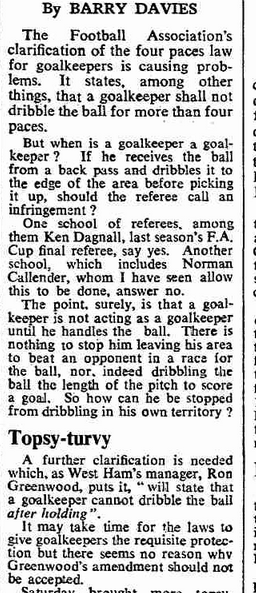
Outside cricket, Barry Davies, then commentating for Granada and writing for The Times, reported confusion over the new four-steps rule for goalkeepers. Did the counting start when they first touched the ball, or when they picked it up?


Alan Gibson switched effortlessly to rugby for the winter, starting with this report, which may have been more entertaining than the match it described (a goal, by the way, is a converted try, with a try worth only three points).


Mr Gilbert Clark of Fishponds in Bristol discovered that his late wife had left their house to a dog’s home. A trusting man, he believed that his wife had taken this action in the belief that she would outlive him. I’m not so sure. He kept the house but it cost him £1,000 for a dog ambulance. A grand would have been a fair slice out of the value of a Fishponds residence in 1967.

A feast of 50 over finals at the Basin Reserve

  Men’s eliminator final, Wellington v Central Districts Women’s final, Wellington v Northern Districts Men’s final, Canterbury v Centra...