Showing posts with label Majid Khan. Show all posts

Sunday, May 28, 2023

The Cricketer, May 1973


Dennis Amiss is on the cover of the May 1973 edition of the newly-styled The Cricketer with Cricket Monthly, the title now alone in the cricket magazine market. I noted last month that good performances on MCC’s tour of South Asia had barely registered due to the lack of broadcast coverage. The most acute example is Amiss’s performance in the three-test series in Pakistan.


I had forgotten, if I ever knew, that he made a century in each of the first two tests and 99 in the third, perhaps the best overseas performance by an England batsman in a shorter series until Harry Brooke went one run  better late last year in Pakistan for three hundreds in three games. Amiss is going strong at 80, and was recently interviewed at length on the Final Word


Ken Barrington, with his average of 58, is the most underrated English batsman since the Second World War, but Amiss (46, 51 when opening) is not far behind. His achievement in this series did not convert John Thicknesse to his cause in a piece about the options for England’s selectors. Of Amiss and Fletcher (for whom this was also a breakthrough tour) he says “I hope it’s not uncharitable to say that neither has yet done much more than make people reconsider”. About as uncharitable as buying a poppy with a foreign coin, I’d have thought.


Incidentally, anyone not familiar with the Final Word should do themselves a favour and check it out. It is a podcast run by Adam Collins and Geoff Lemon, with occasional help from others such as Dan Norcross and Bharat Sundaresan. They usually put out two lengthy shows a week, one on current events and the other on cricket history, with donors sending them amounts based on cricket statistics that they then have to work out. Collins and Lemon are cricket’s most interesting audio journalists and I look forward to SEN’s commentary on this summer’s tests in England with Collins leading the team.


The three tests in Pakistan were all drawn. John Woodcock reports that “in each of these there was a time on the last day when a result was possible” and, of Pakistan captain Majid Khan, “There were two occasions when, with more aggression, he might have forced an issue”. Nevertheless, all three games faded away into draws, an outcome that accounted for 16 of the 24 tests played between the two countries in Pakistan before last December’s series.


All the more reason to regard the three-nil victory by Stokes’ team on those same dead pitches as one of the greatest achievements in my time watching cricket, Bazball’s finest moment (so far). 


Two pieces of trivia from the 72-73 series: as well as Amiss, Majid Khan and Mushtaq Mohammad also made 99, the only test in which three have fallen one short of the ton; also, both sides were led by current county colleagues. 


The second and third tests between the West Indies and Australia got considerably more column inches than the series in Asia. Pitches were also a focus for Tony Cozier’s report. That for the second test, in Bridgetown, “offered the bowlers minimal help and simply got progressively slower as the [match] progressed”, rather like those in Pakistan. The strip in Trinidad, however, “readily responded to spin throughout and gave uneven bounce”.


We were now just a couple of years away from the emergence of the West Indies pace quartet that, like the Rolling Stones, changed its personnel from time without compromising its place at the head of the pack. So who opened the bowling with Keith Boyce in Port of Spain?


It was none other than Clive Lloyd, whose dobbly medium pacers could be quite effective in the Sunday League, but whose function here was to remove the shine from the ball as quickly as possible, an action that was to be considered heretical around the Caribbean for at least three decades thereafter. 


Lance Gibbs “was the pick of all the bowlers and was never handled comfortably” but it was Australia’s trio of leg spinners, O’Keefe, Jenner and, more surprisingly, Stackpole, who led the way to a 44-run win, along with Doug Walters’ “truly great innings” of 112. 


There are interviews with two Essex players, John  Lever, and Brian “Tonker” Taylor, just appointed to the selection panel. The byline for the latter is that of Martin Tyler, still Sky’s lead football commentator 50 years on. Tyler wrote a couple of cricket books and commentated for ITV regions on Roses matches, but his best-known link with the game is that he was Bob Willis’s flatmate when the fast bowler was called up as a replacement for the 1970/71 Ashes tour.


As both football and cricket have expanded into twelve-month assignments, cross-fertilisation between writers and broadcasters on the two sports has almost disappeared, which is a loss. It used to be usual for journalists to cover a winter and a summer sport. 


ITV’s Brian Moore was a Kent fan. I sat next to him and an older man (his father, possibly) at a knockout match at St Lawrence in the early 90s. His first appearance on TV was on Sunday Cricket in 1965 (Desmond Lynam also made his TV debut on Sunday Cricket, seven years later). The BBC tried to poach Moore in the 70s, and offered him Peter West’s job as presenter of cricket to sweeten the package, but to no avail. 


On the radio, Peter Jones and Maurice Edelston were both occasional commentators on county cricket, and Jon Champion, Mark Pougatch, Mark Saggers and Arlo White all made appearances as callers on Test Match Special. The sports pages at the height of summer often featured football writers at leisure, including Jimmy Armfield in the Daily Express. Best of all was David Lacey’s annual appearance in the cricket pages of The Guardian, usually at Hove. I came across a Lacey line new to me the other day. In a report on a drubbing of Manchester United by Barcelona he wrote:


Pallister and Bruce appeared to be auditioning for the role of Juliet: “Romario, Romario, wherefore art thou Romario?”


The News of the Month has this:


G Boycott has disclosed that the risk of harm to his health following an operation for the removal of his spleen prompted him to declare himself unavailable for the recent MCC tour of India and Pakistan.


Given the tenor of Boycott’s subsequent commentaries, it is to be wondered if they got it all. 


Saturday, July 8, 2017

Bong! Two centuries for Majid Bong! Boredom at Neath Bong! News at Ten Begins: 1 to 7 July 1967


It was a week off for Kent, in Championship terms at least, though the first half of the week was occupied by a game against the second touring side of the summer, the Pakistanis. Unlike the earlier game against the Indians, the opportunity was taken to rest three bowlers: Graham, Sayer and Dixon. David Nicholls came in for his first game of the season. A punchy left-handed batsman, Nicholls started with a roar in 1963 with a double century, but had not reached three figures since. He made a duck in his only innings in this match and might have been contemplating the possibility that this would be his last season, but an opportunity for a change of role was about to present itself that would keep him in the game for another 13 years.

Majid Jehangir scored a century for the tourists. We know him better as Majid Khan and he was to make another hundred in the second half of the week, against Middlesex. John Arlott-Silchester described him there as a “pleasantly extrovert batsman”. Unfortunately, Majid also opened the bowling, revealing that Pakistan would be no more able to field an opening attack of test class than India had been. At Lord’s Eric Russell and Mike “Pasty” Harris rattled up a Middlesex first-wicket record of 312 against them. The most significant action of the game at Canterbury was a breezy 41 from Majid’s new ball partner, one Asif Iqbal. That day may have been when the idea germinated that here might be a player who would enhance the Kent team and please its crowds when the overseas player rules were liberalised for the 1968 season.

Majid Khan became as popular at Glamorgan as Asif Iqbal was to be with Kent. They could have done with his strokeplay to liven up proceedings at Neath this week. As was so often the case, Alan Gibson’s report contained more to please than anything that happened on the field of play. 

On this occasion the Glamorgan secretary Wilf Wooller did not take to the public address to offer spectators their money back as he was to do on a later occasion when Brian Close was captain of Somerset. The game looked a certain draw when Tony Lewis put himself on and won the game with a little filthy legspin.

The big match of the week was at Grace Road where Championship leaders Leicestershire hosted second-placed Yorkshire, who reclaimed what everybody from Middlesbrough to Sheffield believed was their rightful place on top of the table. Ray Illingworth took 11 in the match to follow 14 over the first two tests, though John Woodcock was about to describe him as having a “limited future” as a test cricketer. Mike Brearley is the standard example of a player picked as a captain rather than on his own playing merits, but Illingworth would do just as well. Leicestershire were to wait another eight years for their first Championship, led by Ray Illingworth.

John Newcombe became the last amateur men’s singles champion at Wimbledon with an easy victory over Bungert of Germany. The men’s final was always played on a Friday in those days, with Ann Jones to play Billie Jean King in the ladies’ final on Saturday.

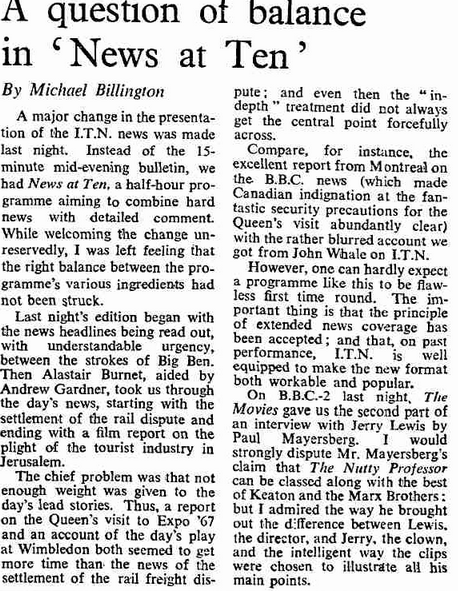
The first News at Ten was broadcast on ITV on 1 July 1967 presented by Alastair Burnet and Andrew Gardner. This was the first nightly news programme that had the space for longer reports and analysis, with journalists, rather than announcers, as presenters. It began the golden age of ITN during which it set the style of British TV news with the BBC catching up as best it could. 

Of course, news and current affairs were regarded as altogether different things then, and the BBC still had the lead in the latter field. Panorama was presented by Robin Day with a reporting team that included Richard Kershaw, James Mossman and Michael Charlton (who had been the guest Australian radio commentator on the 1956 Ashes series). The nightly Twenty-Four Hours programme was delivered by as rich a collection of presenting and reporting talent as there has been in a British current affairs show: Cliff Michelmore, Ian Trethowan, Robert McKenzie, Kenneth Allsop, Julian Pettifer, Fyfe Robertson, Michael Barrett, Leonard Parkin, and even the young Michael Parkinson (it was of Fyfe Robertson that Clive James once wrote “he described himself as an intelligent man in the street, which he proved half right by standing in a street as he said it”).


The reviewer of the first News at Ten in The Times was Michael Billington, also deputy to Irving Wardle as theatre critic. In 1971 Billington became the Guardian’s theatre critic, a position in which he serves still. Few have spent the half-century more enjoyably than Michael Billington.

This week, Leo Abse’s private member’s bill that decriminalised homosexual activity between consenting males over the age of 21 completed its passage through the House of Commons. It was read a third time at 5.50 am after eight hours of filibustering from the backwoodsmen, mining deep into their considerable reserves of malice and ignorance to keep proceedings going. Some of these splutterings might seem amusing now, but this week in 2017  here in New Zealand the House of Representatives passed a motion of apology to those men convicted before our law was changed, almost twenty years later than in Britain. The debate reminded us that thousands of decent men lived their lives in secrecy and fear because of the kind of ridiculousness that these fools expounded. So not funny at all.

Even Roy Jenkins, the epitome of the liberal Home Secretary whose initiative the bill was and who ensured that it was given sufficient parliamentary time to pass, referred in his third reading speech to “those who suffer from this disability” showing that the passing of the bill by the Commons was a beginning not an end.

A feast of 50 over finals at the Basin Reserve

  Men’s eliminator final, Wellington v Central Districts Women’s final, Wellington v Northern Districts Men’s final, Canterbury v Centra...