Showing posts with label County Championship 1967. Show all posts

Sunday, October 1, 2017

1967 or 2017: which is better?


These days the County Championship is the supply teacher of the fixture list, its role to fill gaps in the timetable and occupy the discontented, success measured by the lack of bother caused, so as not to draw attention away from the showcase class in the best room. The frustration of the Championship’s almost total absence from the height of summer is clear enough from the work of Backwatersman, Cricket Nick and others on whom I depend for the vicarious experience of following county cricket from New Zealand. 

How enticing the 1967 schedule looks in contrast. Twenty-eight three-day games per county plus a tourist fixture or two. Cricket every Saturday. And the chance to watch at places that have long forgotten that they ever hosted first-class cricket. They should be set to music, just as Flanders and Swann sung a list of railway stations axed by Dr Beeching: Harrogate, Portsmouth, Pontypridd, Nuneaton, Kettering, Coventry, Bath, Basingstoke, Buxton, Lydney, Ilkeston, Glastonbury, Dover, Folkestone, and more.

But how good was the cricket at these lost venues? The players and commentators of that era and those before present their cricket as a sort of Socratic dialogue in which the skills of batsman and bowler were constantly honed until they reached levels of technical accomplishment now unknown. It was an intellectual exercise as much as a sporting one; Freddie Ayer perpetually bowling to Bertrand Russell. 

Uncovered pitches were a foundational belief of this creed, the test that would expose the heretics of the cross bat and of the leaden footwork.
I have always bought into this interpretation of cricket’s past, partly as a result of watching cricket in such conditions and seeing how interesting it is. But the string of low scores that pepper the 1968 Wisden are by no means all due to drying pitches. Many taxed batting without help from the rain. A few, such as that at Mote Park on which Hampshire were bowled out for 31, were so explosive that they would now be outlawed by anti-terror legislation. More pitches were simply slow and tired. 

There were days when the cricket lived up to the image of halcyon struggle between champions, but more often it was simply dull. Their batting techniques may have been superior, but were deployed almost completely in defence. Boycott’s monastic 246 in the Headingley test against a weak attack was the most renowned example of the timidity that captured most batsmen of the era, but we have discovered many others on our journey through 1967.

A match between, say, Yorkshire then and now played on a difficult 1967 surface might lead us to admire the impeccable straightness of Boycott’s bat, but would likely result in a win for 2017 as Bairstow, Root or one of the others, not being content to await their fate in the crease, would manufacture an ugly 40 that would be the difference. It would be a better contest to watch too.

This isn’t the present being wise about the past either; exasperation was the default tone of John Woodcock’s reports in The Times that summer. In the 1968 Wisden Denis Compton bemoaned the attitude of cricketers: “The safety-first outlook has bedevilled professional cricket far too long and like the traffic in our big cities the three-day game has come almost to a full stop.” Had the expression “political correctness” been current in 1967 one fears that Compton would have given it a hammering.

Colin Cowdrey is an interesting case study in the cricketing mentality of 1967. In the Gillette semi-final he made 78 in 59 balls, a rate of scoring that would be respectable today. “Better than his best” said Woodcock. Yet a couple of weeks later on the same ground he was diffidence personified, to Woodcock’s despair:

I’m with Woodcock; more exposure to one-day cricket earlier in his career might have liberated Cowdrey from his inhibitions and allowed him to become a great player rather than one who had greatness within him.
Weekly one-day cricket, in the form of the 40-over Sunday League, was still two years away, but inevitable and necessary. The International Cavaliers have not featured as much as they should have I my recreation of 1967, as I spent most Sunday afternoons watching them on BBC2, with Learie Constantine commentating. But The Times ignored them, as did Wisden, so the only record of the Cavaliers’ matches in 1967 is behind the Cricket Archive paywall. It could be argued that those games were the most important cricket played that year, the start of a half-century long shift towards shorter forms of the game. For me, the ideal fixture list would always contain one-day cricket; fine dining is all very well but a burger once a week does no harm. 

Not that the County Championship was without appeal to spectators. The Kent grounds were packed at weekends. Woodcock wrote that it seemed that the whole of Kent was at Gillingham for the Sunday of the Glamorgan game. Weekend after weekend it was said that 10,000 were there, and Kent was not the only county to benefit from the introduction of Sunday cricket. Unfortunately, in most Kent grounds there was nowhere for the great majority them to sit comfortably. If they found a place the chances are that they would have been breathing in a fog of cigarette and pipe smoke. The catering was either lamentable or non-existent, real ale a future dream. Whatever was happening on the field, there is no doubt that off it spectators are better served in 2017.

The frustration that Woodcock and Compton expressed with the reticence of the cricket meant that 1967 was the last season of its kind. The following year saw two changes designed to promote “brighter cricket” (a phrase that was a synonym for “Holy Grail” at that time). 

First, in 1968 the bonus points system replaced points for the first-innings lead, an innovation that has remained with us, though often tinkered with, ever since.

Second, in the same year each county was allowed one overseas player without a qualification period. Those in the county game in 1967, such as John Shepherd and Keith Boyce, had undergone a two-year qualification period during which they could not play international cricket, a condition that deterred current test players. From 1968, a generation of the world’s finest cricketers would be seen on county grounds. There were incessant complaints about this, of course, mostly about a supposed block on English talent. But how helpful would it be for selectors attempting to discern which batsmen are up to test cricket in Australia and which are not, to be able to watch them play in the County Championship against some of the world’s best fast bowlers? 

Despite the batting torpor of 1967, I do regret that the tricky (for batsman) pitch is now a rare phenomenon. The terminology for the state of pitches is determined by batsmen, who use words—“good” and “bad”—that measure how easy it is for them to practise their art. Ideally, over a series or a season pitches will range across the continuum of favouring the bat or the ball (and in the latter case sometimes seam, sometimes swing, sometimes spin). 

How pleasing it was that relegation from Division One of the County Championship in 2017 was decided on a Taunton turner, though the pitch was marked below average (apparently a similar mark next season will put Somerset at risk of a points deduction; yet when England batsmen in India look like an infant class trying to solve The Times crossword there will still be some who are surprised). How much better than the contrived declaration game that Middlesex won to clinch the Championship in 2016. Pitches should spin in England at season’s end. Presumably the Beckenham surface on which Kent scored 701 and Northamptonshire 568 was considered average or better.

It was the pitches becoming more batsmen-friendly and regulated that did for three-day cricket in the end. Without a bit of help most teams could not take the 20 wickets necessary to win a match without artifice in three days. Perhaps—though nobody thought so at the time—the best structure for the Championship was the mix of three and four-day games that existed from 1988 to 1992, though the three-day matches should be played on 1967 pitches and the four-day on contemporary ones.

Following events day-by-day revealed the rhythm of 1967. Kent’s season began hopefully, became expectant, then confident, finally triumphant. It was a wonderfully optimistic time that captured the imagination of the Kent sporting public that for decades had had only the Ryanair of sporting stock, Gillingham FC, in which to invest its hopes.

By the end of May both Norman Graham and John Shepherd had secured places that were theirs for 10 and 15 seasons respectively. Mike Denness and Brian Luckhurst became likely England players. Graham Johnson and Alan Ealham did not achieve much in 1967 but were on their way. It was pleasing to discover what a tremendous season Alan Dixon had.

Best of all, it was becoming clear that Alan Knott and Derek Underwood were world-class performers in the making. In Knott’s case every reporter who followed Kent produced a paean of praise about his keeping, usually invoking Godfrey Evans as a point of comparison. As I have said often enough, Underwood was regarded by some as being not quite a proper spinner, but it was enough that he was Underwood. How much would each attract in the IPL auction, particularly Knott who batted like a T20 player half a century ahead of time?

Knott played in every home test match for the next ten seasons, Underwood in most of them. There was usually at least one other Kent representative in the England XI. Had this not been the case perhaps more Championships would have been won. Kent finished second to Yorkshire once more in 1968, before slipping back into the bottom half of the table in 1969. The Championship was won, at last, in 1970.

One more piece on 1967 to come, reflecting on the process of recreating a cricket season 50 years on.


Sunday, September 10, 2017

Kent win the Gillette Cup, Yorkshire are champions: 2 to 8 September 1967


I’ll be writing separately about the Gillette Cup final. My first visit to Lord’s, and Kent’s first trophy since the First World War, are worth special commemoration, fifty years on. 

The other prize of the week—the only other one available in domestic cricket in 1967—went to Yorkshire, who were assured of the title when Mike Bissex was leg before to Don Wilson to secure first-innings lead. Raymond Illingworth took 14 for 64, all on the second (and final) day. He was on a hat-trick three times, which may be a record.  The match was played at Harrogate, one of seven venues used by Yorkshire for their Championship programme.

So, as it turned out, I had seen the first day of the Championship decider, the game at Canterbury a month or so earlier. Had Kent won that one, the Championship pennant would have flown over Kentish fields three years earlier than it actually did. Had Underwood, Knott and Cowdrey not all been suddenly picked by England…(let it go, just let it go).

Arthur Milton was playing for Gloucestershire in that game. He only scored 38 in the game, but that was enough to make him leading run scorer in first-class cricket, with 2,089 from 49 innings, even more of an achievement as it was made for the bottom county. Milton’s story has been well recorded. He was the last double cricket/football England international. These days, he could open a bank on the back of that, but not then. When when he finished playing sport Milton became a postman, and he enjoyed it so much that when they told him he had to retire he took up paper rounds that covered the same route.

Keith Fletcher and Ron Headley both went to the crease 58 times in first-class matches, both joining 68 other batsmen in passing the thousand mark. Mike Buss of Sussex achieved this at the lowest average: 21.46. 

Tom Cartwright bowled most overs (1,194) and took most wickets (147). In common with eight others in the top 21 of the averages, he conceded under two runs an over. 

A comparison of the first-class averages of 1967 and 2016 shows how much the balance of the game has swung towards the bat (then a slender thing that could be comfortably lifted in one hand and would last for several seasons). Ken Barrington’s 68.84 would have put him in fifth place on 2016. But Barrington was 14 ahead of second-placed Denis Amiss, whose 54.41 would have left him one place short of the top twenty. 

The reverse is true of the bowling, of course. Jimmy Anderson’s top-placed 17.00 would have only got him to No 13 in ’67. There were only three bowling averages under 20 last year (one of which was by Viljoen of Kent, who I’ve never heard of); there were ten times as many in the summer of love. 

The Scarborough Festival, summer’s death rattle for so many years, featured an England XI playing the Rest of the World. These games were an end-of-season feature for several years in the mid-sixties. They were of historical significance for several reasons. When in 1970 the tour by South Africa was cancelled at the last moment, the concept of a Rest of the World team was there waiting, ready to fill the void. The Rest of the World also played a one-day round robin, grandly if hyperbolically called the “World Cup”, of which more next week. 

There is also the composition of the team. Graham McKenzie of Australia, the rest an equal mix of West Indians and South Africans, at a time when apartheid made such a mix illegal had the game taken place within the jurisdiction of the apartheid government. So the opening partnership of 187 between Eddie Barlow and Seymour Nurse was nicely symbolic and would have spoiled Dr Vorster’s breakfast the following morning. 

Barlow made another ninety in the second innings, sharing a partnership of 118 with Rohan Kanhai, who “played, as so often, as though he could have batted with one hand” wrote AA Thomson. England were set 373 in five hours, a target that no England side, official or unofficial, would have contemplated going for in 1967 in any circumstances other than a festival match. John Edrich made an aggressive 87 but Lance Gibbs induced a collapse to 179 for six. However, the Middlesex pair of Murray and Titmus continued to be attacking in a stand of 112 in under two hours to save the game. Thirty thousand spectators watched over the three days and thoroughly enjoyed themselves, though they may have wondered why this sort of enterprise could not be seen other than by the seaside in September. 

It was the first time that world outside Guyana became aware of Clive Lloyd. He looked like a short-sighted librarian who had absentmindedly wandered onto the field, but then there would be a blur as he covered an unreasonable amount of ground with two of three strides, then the stumps would be in disarray, the batsman bemused in mid-pitch, wondering what had just happened.

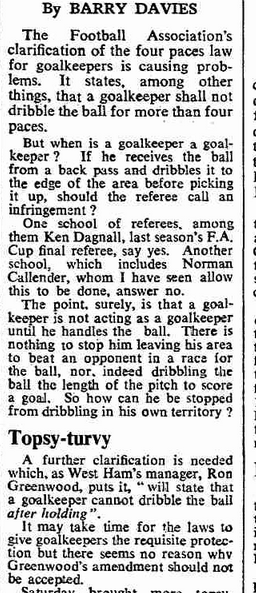
Outside cricket, Barry Davies, then commentating for Granada and writing for The Times, reported confusion over the new four-steps rule for goalkeepers. Did the counting start when they first touched the ball, or when they picked it up?


Alan Gibson switched effortlessly to rugby for the winter, starting with this report, which may have been more entertaining than the match it described (a goal, by the way, is a converted try, with a try worth only three points).


Mr Gilbert Clark of Fishponds in Bristol discovered that his late wife had left their house to a dog’s home. A trusting man, he believed that his wife had taken this action in the belief that she would outlive him. I’m not so sure. He kept the house but it cost him £1,000 for a dog ambulance. A grand would have been a fair slice out of the value of a Fishponds residence in 1967.

Saturday, August 5, 2017

Derek the Conqueror: 28 July to 4 August 1967


No outsider had wrought such havoc in Hastings since 1066. And William of Normandy only passed through; Derek Underwood returned year after year to pillage afresh. His 1967 bounty was about average: seven for 38 and seven for 44. Neither was a career-best: that had been achieved at Hastings three years before, nine for 28. In 1973 he took eight for nine. In just nine first-class appearances at Hastings, Underwood collected 61 victims. But that’s not all. Seventeen years after this appearance, Underwood’s one and only century was made here, in his 618th first-class innings. The previous day he had taken six for 12 in the Sunday League. My appreciation of Derek Underwood on his seventieth birthday is here.

Underwood’s mesmerisation of Sussex had resulted in Kent’s second win by an innings and a hundred-plus is a week. The county went into August as Championship leaders, a position that they had not been in at that time of the year since at least the Second World War, and quite possibly the First. Leicestershire were four points behind, but had played two more games. Yorkshire had a game in hand and were 12 points behind, exactly the number available for a win plus first-innings points. 


What’s more, Leicestershire and Yorkshire were the visitors for Canterbury week, which would decide the 1967 Championship. More of that next week, including a conspiracy theory that some Kent supporters propound to this day.

The first test against Pakistan was drawn, the visitors refusing any attempt at chasing a target of 256 at 79 an hour, which John Woodcock described as “eminently attainable”, but seems tough by the standards of the time. Even now, 256 in under two sessions on the fifth day would be challenging. Woodcock had been patient in the face of some laboured batting, describing Hanif Mohammad’s  187 not out as a “masterly exhibition of defensive batting” that was “never dull”, but he was testy by the final afternoon, writing that Khalid Ibadulla’s batting “makes postal chess seem a lively game”. 

In passing he notes that John Murray had an indifferent game behind the stumps, bad timing with every cricket writer in the country lauding Alan Knott. Though they didn’t know it, Murray and his Middlesex colleague Eric Russell were playing their last test matches.

After the test John Woodcock went to Hove to report on Sussex v Worcestershire and Basil D’Oliveira’s sixth century of the season. He noted that John Snow “summoned no great speed for the occasion”. Snow was a pioneer of resting fast bowlers between tests, with the difference that he took a break while still in the selected Sussex XI (it was an approach Bob Willis was to adopt, and I don’t criticise either man for it). Snow was a fine fast bowler with as aesthetically pleasing an action as any, apart perhaps from Dennis Lillee. Yet my abiding memory is of his loitering on the boundary, arms folded, not moving in with bowler, bored by a meaningless late season match and not caring to hide it.

It was announced that Leslie Ames, secretary-manager of Kent (a role that occupies a medium-sized team of people these days) was to manage MCC (and therefore the England test team) on its forthcoming tour of the Caribbean. Ames had filled this role on the under-25 tour of Pakistan the previous winter. More than anyone else, Ames was responsible for Kent’s rise to the top of English cricket. As respected a figure as any in the game, the maker of a century of centuries, he was able to neutralise the meddling of the amateurs in the cricket-week marquees. More here. But, speaking as we were of conspiracy theories, read John Woodcock’s piece on Ames’s appointment. 


It seems strange that an England captain with a record of four wins from five matches would not be named as scheduled, and that two men not at that time in England team would be offered as alternatives. Watch this space.

In the rest of the paper the big story of the week was the report of the Aberfan disaster of the previous year. A slag heap collapsed killing 140 people, mostly primary school pupils. It was the first national event that I recall feeling affected by, the victims mostly sitting in classrooms presumably much like our own on the north Kent coast as they perished.

The report allocated the blame two-thirds to the National Coal Board (NCB), one-third to Merthyr Tydfil Council. Lord Robens, Chairman of the NCB, had chosen to be installed as Chancellor of the University of Surrey rather than travel to Aberfan, eventually turning up 36 hours after the event. He did not resign (he offered knowing that the Minister of Power, Richard Marsh, would refuse to accept), nor did anyone else. £150,000 was taken from the victims’ relief fund to pay for the removal of remaining tips. 

Of course, disasters caused by incompetence or negligence still occur, such as the Grenfell Tower tragedy. But it is inconceivable now that there would be such a lack of accountability. The music may have been better in ’67, but this exercise provides plenty of evidence that not much else was.

I tweeted other stories this week that show that the world was different then. There was debate on the letters page of The Times as to whether pipe-smoking drivers should drive with the windows open or closed.

Finally, Mr William Freeman, 62, of Neasden, pleaded not guilty to driving his bus without consideration, a law that might fill the courts with bus drivers if strictly applied, then or now. 

A feast of 50 over finals at the Basin Reserve

  Men’s eliminator final, Wellington v Central Districts Women’s final, Wellington v Northern Districts Men’s final, Canterbury v Centra...