Showing posts with label Peter West. Show all posts

Saturday, September 2, 2017

The Green Pitches of Dover: 26 August to 1 September 1967


Kent played their final two Championship games of the season at the Crabble in Dover, as attractive as any ground in the county. It has not hosted county cricket since 1976, but on a visit to England in 2011 I returned there for a look around: In Search of the Crabble.

Kent finished on the charge, with two wins, the first with just two minutes remaining, the second with a day and a half to spare. We will begin with Peter West’s report on the half day’s play that ended the week. 


It’s funny reading that report now, fifty years after I watched West write it. As recorded in the earlier piece, that day the Crabble became the second ground on which I watched county cricket. With game over in mid-afternoon and my Dad not picking us up until later (in our brand new Ford Cortina: I had watched him write a cheque for £700 for it at the start of the month and could barely believe that there was so much money in the world), hanging about for autographs passed the time satisfyingly. Norman Graham signed after passing a hundred wickets for the season while taking 12 for 80. Bob Wilson also did so, but was rueful when asked by another hunter if he was playing at Lord’s in the final on Saturday. “I don’t know” he said, but he did, and he wasn’t. In fact, a second-innings duck in the Warwickshire game had been the last of 647 innings that brought just short of 20,000 runs with 30 centuries.

With the players gone, my attention turned to the press box, a standalone hut on one of the terraces, painted in green and white stripes. West politely rebuffed someone trying to have a chat, explaining that he had a report to write. So I observed as he wrote the piece in longhand, then listened as he phoned it through to the copy desk at Printing House Square. Work done, Peter West (one of television’s best-known faces in 1967) was happy to add his name to the autograph collection (which I still have but can’t find). 

The thing that did for Dover in the long-term, besides the reduction of Championship fixtures, was the poor quality of the pitches. West’s judgment that the pitch for the Essex match “cannot have failed to implant a sense of insecure tenure” identifies him as the Ishiguro of the sports pages in his use of understatement. Its nature may be gleaned by the fact that Underwood—the country’s leading wicket taker—bowled not a single ball in the game. Six of the second-innings wickets that I saw fall on the second day were caught either behind or at first slip as the ball seamed as if from Saville Row. Not many matches are won by as comfortable a margin as nine wickets by a team that has not scored 200 in the match. 

The pitch for the Warwickshire game was also green, more of a risk when the opposition included Tom Cartwright, who duly took ten in the match. A fine 86 not out by Mike Denness got Kent home. The schedulers were, as discussed last week, either sadists or geographical ignoramuses; Warwickshire finished at Dover later on Tuesday afternoon then had to drive to Middlesbrough to start a new game against Yorkshire the following morning.

Leicestershire also won twice this week to finish their season, but in vain as Kent’s extra win kept them ahead with the teams level on points. Alan Gibson described them as the team that had most the most of its talent, thanks to the captaincy of Tony Lock, who bore a strong resemblance to Brian Close, both physically and in his bugger-them-all approach. Lock did not return in 1968, but Leicestershire made another from the same mould when Ray Illingworth joined them in 1969. 

Yorkshire’s draw at Trent Bridge early in the week mean that Kent finished the week at the head of the table, hoping either that bottom-of-the-table Gloucestershire would gather themselves for a redemptive win at Harrogate the following week or, more likely, that the northern weather would wash the Championship pennant to Canterbury (a pennant was all the winners got, by the way; there was no trophy then). 

Brian Close’s 98 put Yorkshire in a winning position against Warwickshire in their second game of the week, a heroic performance on the day that he was defrocked from the England captaincy. If a Times leader couldn’t sway the establishment in his favour, nothing could. Later in the week one of his businesses went into liquidation.
Given Colin Cowdrey’s fortuitous inheritance of the captaincy it is odd that The Times ran this headline on Wednesday:


It is interesting that the selectors supported Close, but it was the MCC Committee—a body including six knights of the realm, two of whom were generals—who signed the execution warrant, declaring the future MCC President as his successor. Amateurism may have been abolished on the field, but it remained the creed of the committee room, in all its senses.

Derek Underwood was the surprise omission from the touring party, despite taking eight wickets at a cost of 16 each in the two tests in which he had played. Titmus, Pocock and Hobbs were the selected spinners. Perhaps Underwood suffered from being regarded as not a proper spinner. John Woodcock continued to him as a cutter, and EW Swanton was forever saying that he should give the ball more air. A season’s haul of 136 wickets at 12.39 were not enough. Geoff Arnold’s fine performance in the final test was also ignored.

The final day of the test series produced the most entertaining international cricket of the season: a joyous world-record partnership of 190 for the ninth wicket between Asif Iqbal and Intikhab Alam. I recall watching this on television and wanting it to go on and on. It was the first time I watched Asif’s Road Runner footwork, enjoyed from slip by Colin Cowdrey. So when it became known that each county would be able to recruit an overseas player without a qualification period for 1968, it was Asif Iqbal that Kent went for, and joyously so.

Outside cricket the story of the week was the death of Brian Epstein at 32. 

The letter of the week in The Times (for me anyway) was this reminiscence of WG Grace:


And so to Lord’s for the Gillette Cup Final.


Saturday, June 3, 2017

Kent trip up at Grace Road: 27 May - 2 June 1967


There is no sentence that can tell us more definitively how different things were in 1967 than that which follows. For several hours on Saturday 27 May and again on Bank Holiday Monday 29 May, the only thing on television in much of the Britain was County Championship cricket. BBC 1 had Middlesex versus Sussex from Lord’s. Most ITV regions showed the Roses Match from Old Trafford, while BBC Wales covered Glamorgan against Hampshire. BBC 2 did not open up until the evening, so it was county cricket or nothing.
In the event, on Saturday it was nothing, as the early summer deluge continued. No county cricket was played anywhere on Saturday. Most matches got going on Bank Holiday Monday, but the rain returned everywhere but Trent Bridge on Tuesday. Kent’s fixture at Edgbaston was washed away completely.

In the absence of any cricket to write about, John Woodcock devoted his Monday piece in The Times to an interview with Frank Woolley, holder for ever more of Kent’s first-class run scoring (47,868), appearance (764) and catching (773) records. Not forgetting 1,680 wickets, bettered only by Freeman, Blythe, Underwood and Wright. There were plenty of people around the Kent grounds in 1967 who had seen Woolley play, and he was always their favourite, not for the weight of the statistics, but because of the style in which he made his runs. Woolley was left-handed, and those who were still going strong when David Gower appeared said that he was the nearest they had seen. Woolley lived in Canada by this time, but returned reasonably often. I remember him sitting in the President’s tent one Canterbury Week in the late sixties, and there is a famous photo of Woolley, Ames and Cowdrey together in 1973, Kent’s three makers of a hundred hundreds.
 

Egged on by Woodcock, Woolley criticised the growing commercialisation of cricket, this at a time when advertising hoardings around the boundary were still a decade away on the Kent grounds. What would he have thought of logo-laden shirts and outfields?

There was more substance in his complaint about the slow scoring of the modern game, of which there was much evidence this week, notably at Grace Road where on the first day against Kent, Leicestershire squeezed 155 runs from the first 90 overs. Peter West’s report notes the arrival of drinks as the highlight of the first session (West’s piece is a rarity in that it records a dropped catch by Alan Knott).


This exercise in reliving 1967 is unapologetically nostalgic, but that is not the same as saying that cricket was better then. A torpor could quite easily possess proceedings then in a way rarely seen now. When was the last time you heard a slow hand clap? It was common enough then. A day’s County Championship these days is likely to be more reliably entertaining than it was fifty years ago (though uncovered pitches would be fun).

Kent lost the game because Leicestershire outdid them in the very qualities that had served them so well so far in 1967. Their pace attack of John Cotton (19 overs off the reel) and Terry Spencer was more dangerous than Graham and Sayer, and Jack Birkenshaw followed a hat-trick at Worcester by being Underwood’s equal.
Leicestershire’s other advantage was Tony Lock’s captaincy. Lock was lured back to English cricket from Perth by the offer of the captaincy at Grace Road. By 1967, his third season, he had brought about something of a renaissance (or perhaps simply naissance). Ray Illingworth completed the job, with five trophies in five years in the seventies. Meanwhile, Lock repeated the trick in the southern hemisphere, leading Western Australia to their first Sheffield Shield in twenty years. In 1967 he was still good enough for Peter West to describe him as the finest slow left-armer in the country, and was to be called up to join the MCC party in the Caribbean in the winter.

Earlier in the week, Leicestershire visited Worcester where 22 wickets fell on the Bank Holiday Monday. Off spinner Birkenshaw took his hat-trick as Worcestershire were dismissed for 91. Len Coldwell and Jack Flavell then bowled 35 overs between them (though not unchanged this time), taking nine wickets as Leicestershire gained a lead of 20, which Worcestershire overcame by the end of the day, though with the loss of two further wickets only for the rain to return on the third day.

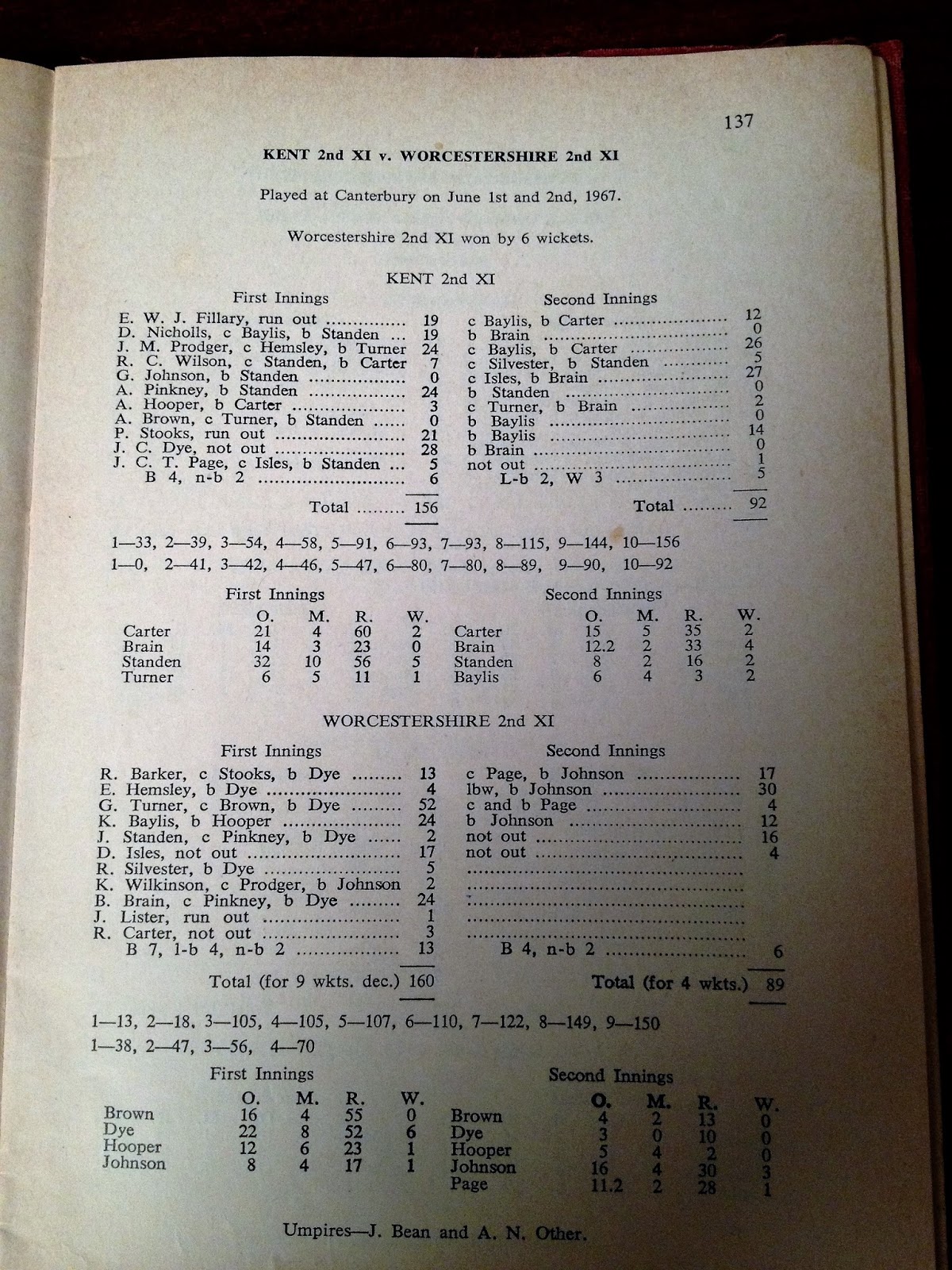
I tweeted the result of the second XI match between Kent and Worcestershire at St Lawrence. It is not the intention to make this a regular feature unless something noteworthy occurred, but I was there for the first afternoon and remember two things about it. First, I collected the autographs of some Worcestershire players, including Joe Lister and Jim Standen. Lister was Worcestershire secretary. That one man could run the club and still find time to captain the second XI goes some way to refuting Woolley’s view of a game being overtaken by commercial interests. Lister went on to be secretary of Yorkshire during Boycott Civil War. Standen was the most distinguished of the dwindling band of footballer-cricketers, having kept goal at Wembley in winning West Ham teams in the FA Cup in 1964 and the European Cup Winners’ Cup in 1965. Another, Ted Hemsley—at that time Shrewsbury Town’s left back—was also in the Worcestershire team.


The other thing I recall was that I retrieved a ball that had been hit for four and returned it to the fielder, John Dye, something that, as a dweller of the upper decks of stands where possible, I have never done since, though I did once dive out of the way at Maidstone from a six that a braver man would have tried to catch. Glenn Turner made the highest score of the match, and I probably saw him do it, the first time I watched one of New Zealand’s finest.

The scorecard of that game reveals that batsman and former vice-captain Bob Wilson was in the Kent side, dropped from the first team for the first time in more than a decade. From then on he was a mere stopgap, and retired at the end of the season. I recall at Dover in late August somebody asking him if he was playing in the Gillette Cup Final a few days later, a question that even a child could spot as insensitive given that everyone knew that the answer was no.

Sgt Pepper’s Lonely Hearts Club Band was released that week, and received an intelligent review in The Times.


The Summer of Love was not a universal phenomenon. The war in Vietnam raged on, the Middle East was about to explode and now Nigeria found itself on the brink of a civil war. The coastal province of Biafra seceded from the rest of the country this week, a decision that resulted in the Blue Peter Christmas appeal of 1968 being devoted to easing its children's starvation.

A feast of 50 over finals at the Basin Reserve

  Men’s eliminator final, Wellington v Central Districts Women’s final, Wellington v Northern Districts Men’s final, Canterbury v Centra...