Friday, July 14, 2023

Early adventures in autograph hunting

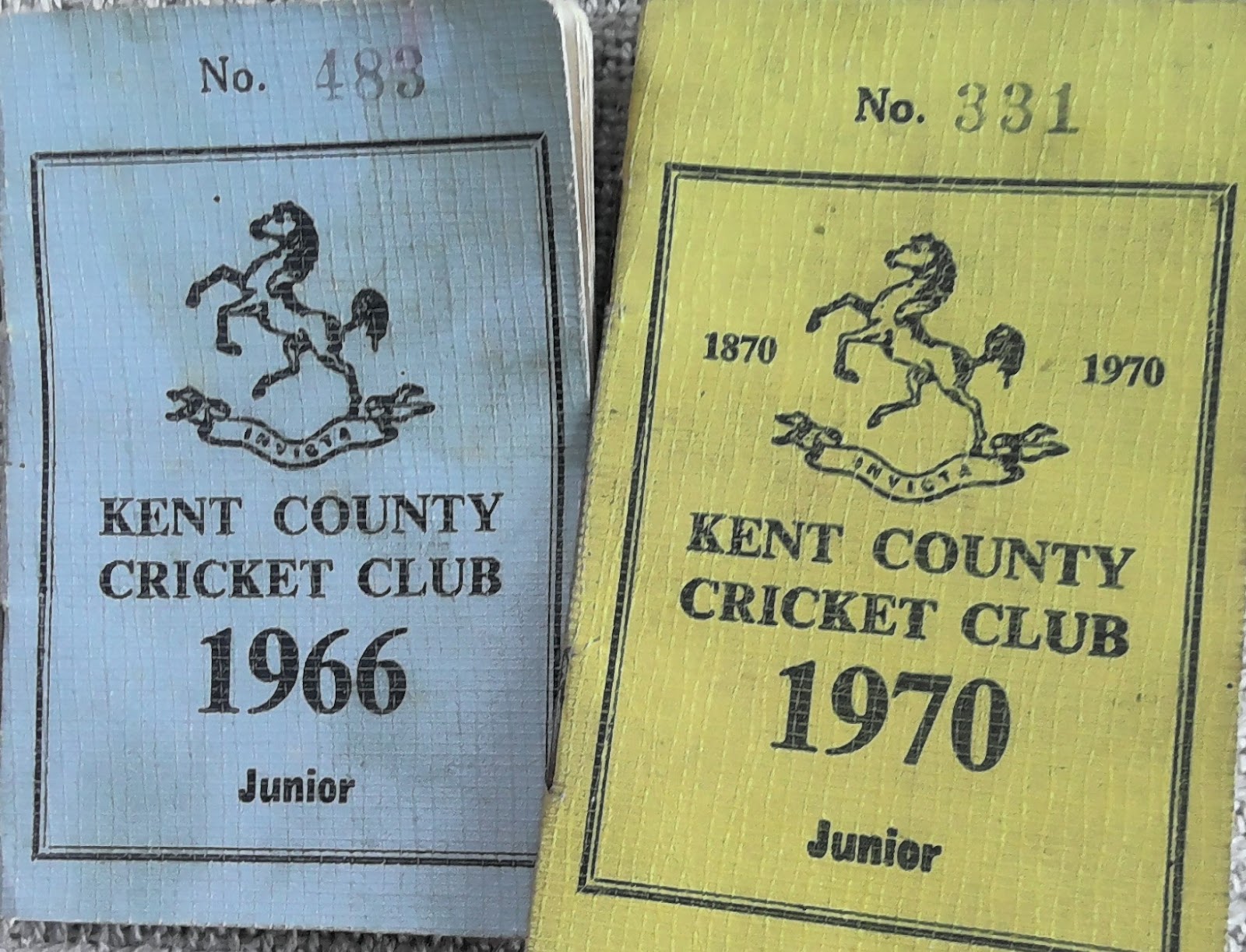
The two Kent junior membership passes pictured both cost a guinea, or a pound and a shilling, or one pound five pence, for which the keen young cricket fan got entry and a seat in the stand at all Kent’s home games bar tourist and Gillette Cup matches, for which ground admission had to be paid. The 1966 pass was my first.


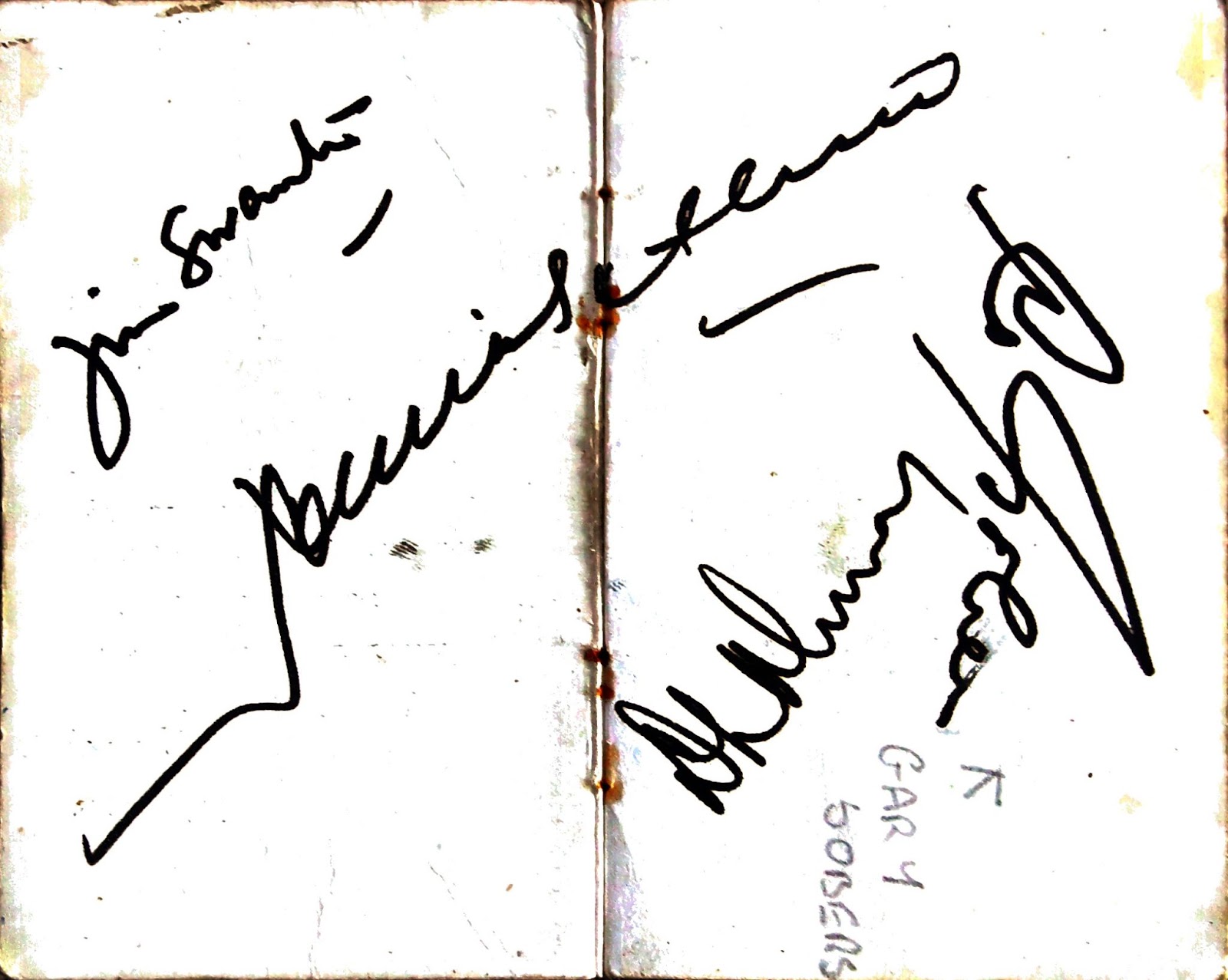
They could also be used as impromptu autograph books. Below are the back two pages of the 1966 edition. Clockwise from the left are the signatures of Colin Cowdrey, Garry Sobers, Alan Knott and David Nicholls. 


The first two were collected on Monday 11 July, the second day of the match between Kent and the West Indians. I was there on a school day because I was recuperating from the measles, which dates me pretty effectively. It was a cautious first expedition outside home for a few hours in the afternoon. 


It was the match in which Sobers took his career-best figures of nine for 49, in slow left-arm mode. One of these was late on that second day, so I assume that I saw a small part of the great man’s best bowling, but I have no memory of doing so. An amnesiac reaction to Sobers will become a theme of this piece, as you will see.


The West Indian captain’s signature must have been secured after the close of play, given that he would have been on the field throughout the afternoon (there was no racing on the TV—I checked). My memory is that Cowdrey signed earlier, on the spot where the Cowdrey Stand was built two decades later. Cowdrey was England captain at that time, having replaced MJK Smith after the first test before handing over to Brian Close for the fifth.


Of these four names, David Nicholls is the only one that will require introduction to the general reader. Three years previously, as a nineteen-year-old, he had made a double century, a rare thing in the three-day era. But there had not been much since then, and he had become a fringe player. 


I assume that Nicholls also signed earlier in the day. If it was at the close it says much for his well-known affability, as he got his second duck of the game shortly before. The following year, he found the role in which he served the county well for the next decade; that of stand-in keeper when Alan Knott was playing for England, which gave him a place in the team for half the season.


I see from the TV listings that England played Uruguay in the opening game of the World Cup that evening. It was a dull nil-nil draw that could not compare watching the West Indians play cricket.


Knott’s autograph was added a few weeks later, on August Bank Holiday Monday. It was a wet day, as public holidays invariably seemed to be when we were young. Kent were hosting Nottinghamshire at St Lawrence. An on-off, interrupted day ended just before tea, by which time most of the spectators had drifted away. My mother and I went to the back of the pavilion to collect a few autographs as we waited for my father to pick us up. 


Cowdrey came out. Thank you, but I had his autograph (membership card proffered as supporting evidence). Was there anyone else I was waiting for to sign? Alan Knott. Wait there.


Cowdrey returned to the dressing room and a minute later a beaming Alan Knott appeared, as if there was nothing he wanted to do more than leave the warmth of the pavilion to stand in the rain signing a raggedy card. Cowdrey was a flawed individual in some ways (see the D’Oliveira affair), and he lumbered us with the ridiculous Spirit of Cricket in the laws but his kindness that day made a big impression on a seven-year-old. It presented cricket as a game with a heart, as a place of safety where you would be looked after. 


The 1970 signatures were all secured at the Oval on the second day of the fifth and final match in the series between England and the Rest of the World, a replacement for the cancelled tour by white South Africa. In my last piece I bemoaned that the series was retrospectively stripped of test status when the cricket was of a quality rarely equalled and never surpassed in my time. 


Not that it was all brilliant. On the first day, 115 overs had been bowled, almost a session more than the sedentary over rates of the 21st century. But look at the score: 229 for five—a fraction under two runs scored in each of those extra overs. In The Times, John Woodcock blamed the Kent captain: “What had promised to be a classical innings by Cowdrey was beset by apprehension”. 


Things went a little more quickly when we were there on Friday, as they tended to when Alan Knott was making a half-century. But a slow pitch meant that, until tea, great players—Barry Richards, Eddie Barlow, Rohan Kanhai—struggled to be more than mundane. 


Then, something special happened, as Woodcock reports:
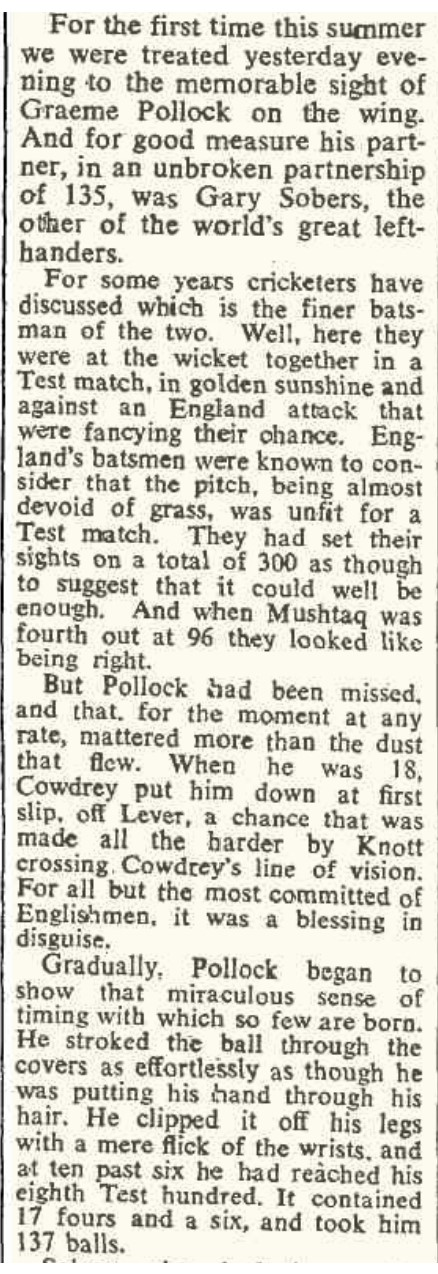

Here were the two great left-handers of the age together and at their best, since equalled, but not surpassed, only by Lara and Sangakkara. More than that, it was a partnership between two men who could not have shared the same railway carriage or used the same bathroom in the homeland of one of them. How Vorster must have choked on his breakfast biltong as he read the reports on the South African papers the following morning. 


This should surely make the top ten of my personal cricket-watching list. Trouble is, I can’t remember any of it. I was certainly there, as the autographs in the member’s card testify. It must have been Friday, as that was my mother’s day off from the china-and-glass department. We would not have left before the end. I recall sitting in the Vauxhall Stand, and certain details, such as Don Wilson’s return catch to dismiss Kanhai. But nothing of two great players nearing perfection. 


Though too young to provide analysis or useful insight, I have impressions of everything significant that I had watched up to that point—Cowdrey in the 67 Gillette semi-final; the whole course of the  final that year; Denness’s painful debut innings against New Zealand. Much that was insignificant too, like slow-left-armer Andy Hooper’s first five overs in first-class cricket being maidens in 1966. So why not this? Maybe Kent players not being involved? 


I do remember waiting at the back of the Oval pavilion to collect the autographs shown above. Garry Sobers (my annotation is badly spelt) shows consistency of signature over the years. Deryck Murray uses his initials, as befits a Cambridge man. Dennis Amiss was that year’s victim of Oval-test syndrome, where the selectors based their selection of fringe players for the winter tour just on performance in that match. In the second innings he made 35, but Fletcher scored 63, so got the place on the plane to Australia.


I intercepted EW Swanton as he left the pavilion having delivered his summary of the day’s play on Test Match Special (for those too young to have experienced Swanton’s daily address, it was like the Queen’s Christmas message, but in the summer). Given the fun I have at Swanton’s expense in the monthly cricket magazine pieces, I should report that he was charm itself, saying “happy to oblige a Kent man” with a beaming smile as he returned the card. 


Sunday, June 18, 2023

The Cricketer, June 1973

 The Cricketer, June 1973


This month’s edition was likely in my bag when I spent three days at St Lawrence in the late-May half-term holiday for a three-day game between Kent and MCC. Matches between these sides have an interesting history. If I had a cricketing time machine, one of the first places I would head would be August 1876, to see WG Grace score 344, to this day the highest individual score made at St Lawrence. What’s more, MCC were following on, and WG had bowled 77 overs in Kent’s innings. These were probably, but not certainly, six-ball overs. Six was the norm, but could be varied by agreement of the captains. Over the three days, 398 overs were bowled, 130 or so a day not being excessive for the time.


By the seventies, MCC usually only played a county in the season opener against the champions, so this fixture is a curiosity. Apparently, it came about because of concern of lack of first-class cricket early in the season. Kent fielded a full-strength side, lacking only the injured Brian Luckhurst. Led by Intikhab Alam, half MCC’s side might have been contenders for the test side given a good season. Frank Hayes scored a century on debut against West Indies a couple of months later, and Jackman, Stead, Edwards and Harris were among the better county players of the time. Younis Ahmed added some class. Bob Carter of Worcestershire was notable for an idiosyncratic running style, with arms flailing, that attracted the scorn of the younger element of the crowd. Kent topped the team up with Dave Nicholls, and Peter Topley, slow left-armer and brother of Don. Modern players would be horrified that pacemen Stead and Jackman considered 20 Championship games as insufficient opportunity to display their craft, and were keen to bowl another 33 and 39 overs respectively, and that their counties were happy for them to do so.


The match was played seriously, but just a degree more carefree than a Championship game. I remember it most for Asif Iqbal’s 72-minute hundred on the last morning, all road-runner feet, and laser driving. Of all Kent’s talented, attractive batters, Asif was the most joyous. He was 80 the other day. Happy birthday. The finish, an eight-run win for Kent with nine balls left, was as close as I had seen. 


The cover star this month is Glenn Turner, touring with the New Zealanders and on his way to a thousand runs in May, the last to do this except Graeme Hick in 1988. The exiling of the County Championship to the extremities of the season makes this one of the few old records that are more likely to be achieved these days. 


EW Swanton, now editorial director, laments the lack of young talent in the English game. 


How many young men of Test potential have come onto the scene in, say, the last five years? The sombre fact is that of those who went with MCC to the East last winter…only Tony Greig and Chris Old might not equally have been representing England in 1968. 


Swanton makes a good point. Of the Kent XI that played MCC, only left-arm quick Richard Elms was under 25 and qualified for England. Most counties were the same. This may have been no more than a glitch in the timeline; just three years later Botham, Gooch, Gatting and Gower had all emerged from an unchanged structure. 


Swanton identifies other reasons for this dearth of precocious talent.


It’s impossible for anyone in regular touch with the county to be impressed by the ability of most of the official coaches. One hopes that the calibre improves as the jobs become better paid.


He regrets that counties favour the skills likely to bring success in the one-day game, but chooses an unfortunate example as illustration.


A team of [Keith] Boyces would not, however, have much chance in a five-day test match.


Within three months Boyce was leading wicket-taker and decisive performer in West Indies’ two-nil test series victory over England. The Great Pontificator’s conclusion will still resonate with county cricket’s many supporters with only minor adaptation.


…the one institution suited to producing the complete and balanced England XI of the future remains the County Championship. The one-day competitions…do not produce players, they only exercise those who have been brought on by the traditional system.


Tony Cozier reports on the final two tests of Australia’s visit to the Caribbean, in which Boyce and his colleagues were less successful than they were to become. The fourth test was lost by ten wickets, despite Clive Lloyd’s hometown 178. The fifth was drawn with Australia a session away from making it three-nil. 


Cozier will have re-used his description of the defeat in Guyana time and again over the following two decades, substituting the names of the home team and its players.


Indisciplined batting against spirited fast bowling by Hammond and Walker backed by aggressive out-cricket resulted in a comfortable Australian victory…


Alan Ross reviews the 1973 Wisden, and reproves editor Norman Preston for including the 1970 series between England and the Rest of the World in the test records after the ICC had declared otherwise. Here, I am on Preston’s side. The cricket in that series was of a quality rarely equalled before or since, and we regarded them as tests at the time. Anyway, why should a governing body determine how data should be sorted? Statisticians should feel free to be creative.


A more recent example is the directive to include all international games in T20 records, which has rendered them meaningless (what is the second highest score in a T20 international?; the Czech Republic’s 278 for four against Turkey in 2019, of course). So the Scorecards database says that Derek Underwood has 304 test wickets, not 297, and will not enter into any correspondence. 


Speaking of Underwood, the News of the Month records that the great man took eight for nine at Hastings against Sussex, who were skittled out for 54. Not mentioned is that these were not Underwood’s best figures at this ground. For those not familiar with the geography of south-east England, Hastings is in Sussex, so it was an away ground on which Underwood would play once a year, if that. In 1964, he took nine for 28, three years later 14 in the match. Fast forward to 1984, when he made his only first-class hundred there, the day after he took six for 12, his best performance in the Sunday League. 


It wasn’t just Hastings; Deadly was partial to Sussex grounds in general. In 1977, when they came up with the cunning plan of moving the game to Hove, he took the only hat-trick of his career (I was there for that one). 


In checking a couple of facts for this piece, I discover that Underwood was the retrospective No 1 ranked test bowler from September 1969 to August 1973. So he must have been selected for the test team in June 1973? He was not, Ray Illingworth’s curious preference for Norman Gifford (none for 142 in the first two tests) triumphed again. 


Gifford was in charge of The Captain’s Column this month. A topic of the time was the requirement to bowl 18.5 overs an hour (or 111 overs in a six-hour day). Gifford asks for the co-operation of spectators behind the bowler’s arm. He would have loved me. On my headstone will be the inscription “He never moved behind the bowler’s arm”.


Sunday, May 28, 2023

The Cricketer, May 1973


Dennis Amiss is on the cover of the May 1973 edition of the newly-styled The Cricketer with Cricket Monthly, the title now alone in the cricket magazine market. I noted last month that good performances on MCC’s tour of South Asia had barely registered due to the lack of broadcast coverage. The most acute example is Amiss’s performance in the three-test series in Pakistan.


I had forgotten, if I ever knew, that he made a century in each of the first two tests and 99 in the third, perhaps the best overseas performance by an England batsman in a shorter series until Harry Brooke went one run  better late last year in Pakistan for three hundreds in three games. Amiss is going strong at 80, and was recently interviewed at length on the Final Word


Ken Barrington, with his average of 58, is the most underrated English batsman since the Second World War, but Amiss (46, 51 when opening) is not far behind. His achievement in this series did not convert John Thicknesse to his cause in a piece about the options for England’s selectors. Of Amiss and Fletcher (for whom this was also a breakthrough tour) he says “I hope it’s not uncharitable to say that neither has yet done much more than make people reconsider”. About as uncharitable as buying a poppy with a foreign coin, I’d have thought.


Incidentally, anyone not familiar with the Final Word should do themselves a favour and check it out. It is a podcast run by Adam Collins and Geoff Lemon, with occasional help from others such as Dan Norcross and Bharat Sundaresan. They usually put out two lengthy shows a week, one on current events and the other on cricket history, with donors sending them amounts based on cricket statistics that they then have to work out. Collins and Lemon are cricket’s most interesting audio journalists and I look forward to SEN’s commentary on this summer’s tests in England with Collins leading the team.


The three tests in Pakistan were all drawn. John Woodcock reports that “in each of these there was a time on the last day when a result was possible” and, of Pakistan captain Majid Khan, “There were two occasions when, with more aggression, he might have forced an issue”. Nevertheless, all three games faded away into draws, an outcome that accounted for 16 of the 24 tests played between the two countries in Pakistan before last December’s series.


All the more reason to regard the three-nil victory by Stokes’ team on those same dead pitches as one of the greatest achievements in my time watching cricket, Bazball’s finest moment (so far). 


Two pieces of trivia from the 72-73 series: as well as Amiss, Majid Khan and Mushtaq Mohammad also made 99, the only test in which three have fallen one short of the ton; also, both sides were led by current county colleagues. 


The second and third tests between the West Indies and Australia got considerably more column inches than the series in Asia. Pitches were also a focus for Tony Cozier’s report. That for the second test, in Bridgetown, “offered the bowlers minimal help and simply got progressively slower as the [match] progressed”, rather like those in Pakistan. The strip in Trinidad, however, “readily responded to spin throughout and gave uneven bounce”.


We were now just a couple of years away from the emergence of the West Indies pace quartet that, like the Rolling Stones, changed its personnel from time without compromising its place at the head of the pack. So who opened the bowling with Keith Boyce in Port of Spain?


It was none other than Clive Lloyd, whose dobbly medium pacers could be quite effective in the Sunday League, but whose function here was to remove the shine from the ball as quickly as possible, an action that was to be considered heretical around the Caribbean for at least three decades thereafter. 


Lance Gibbs “was the pick of all the bowlers and was never handled comfortably” but it was Australia’s trio of leg spinners, O’Keefe, Jenner and, more surprisingly, Stackpole, who led the way to a 44-run win, along with Doug Walters’ “truly great innings” of 112. 


There are interviews with two Essex players, John  Lever, and Brian “Tonker” Taylor, just appointed to the selection panel. The byline for the latter is that of Martin Tyler, still Sky’s lead football commentator 50 years on. Tyler wrote a couple of cricket books and commentated for ITV regions on Roses matches, but his best-known link with the game is that he was Bob Willis’s flatmate when the fast bowler was called up as a replacement for the 1970/71 Ashes tour.


As both football and cricket have expanded into twelve-month assignments, cross-fertilisation between writers and broadcasters on the two sports has almost disappeared, which is a loss. It used to be usual for journalists to cover a winter and a summer sport. 


ITV’s Brian Moore was a Kent fan. I sat next to him and an older man (his father, possibly) at a knockout match at St Lawrence in the early 90s. His first appearance on TV was on Sunday Cricket in 1965 (Desmond Lynam also made his TV debut on Sunday Cricket, seven years later). The BBC tried to poach Moore in the 70s, and offered him Peter West’s job as presenter of cricket to sweeten the package, but to no avail. 


On the radio, Peter Jones and Maurice Edelston were both occasional commentators on county cricket, and Jon Champion, Mark Pougatch, Mark Saggers and Arlo White all made appearances as callers on Test Match Special. The sports pages at the height of summer often featured football writers at leisure, including Jimmy Armfield in the Daily Express. Best of all was David Lacey’s annual appearance in the cricket pages of The Guardian, usually at Hove. I came across a Lacey line new to me the other day. In a report on a drubbing of Manchester United by Barcelona he wrote:


Pallister and Bruce appeared to be auditioning for the role of Juliet: “Romario, Romario, wherefore art thou Romario?”


The News of the Month has this:


G Boycott has disclosed that the risk of harm to his health following an operation for the removal of his spleen prompted him to declare himself unavailable for the recent MCC tour of India and Pakistan.


Given the tenor of Boycott’s subsequent commentaries, it is to be wondered if they got it all. 


Sunday, May 7, 2023

The Cricket Magazines: April 1973


This was the last edition of Playfair Cricket Monthly. Founder and editor Gordon Ross was to become executive editor of The Cricketer incorporating Cricket Monthly. This is presented as a marriage of equals, a blend of the two titles, but my memory is that The Cricketer, which does not mention the merger, remained much as it was, with the coda to its masthead disappearing fairly soon. The spirit of Playfair continued in The Cricketer Quarterly, edited by Ross, a compendium of scores and statistics that filled the gap before the information became available in the following year’s Wisden.


The magazine emerged from the Playfair Cricket Annual, which started in the forties and which Ross continued to edit until his death in 1985. He passed away at Lord’s at the end of a day’s cricket, a departure that any of us might wish for ourselves. The Playfair Cricket Annual continues; this year’s will arrive in our mailbox yesterday, and it is still the most convenient way of looking up a wide range of information. 


A flick through shows why magazine one survived while the other did not. The Cricketer is attractively laid out with photographs on almost every page. Playfair has great slabs of text and lengthy paragraphs. It appears to be short of advertising.


There is plenty of international cricket recorded this month. England’s series in India ended on a flat pitch in Bombay (as it then was), with centuries for Engineer, Vishwanath, Fletcher and Greig, the last two both maidens. India therefore won two-one. A million-and-a-quarter spectators attended the five games. John Woodcock describes it as:


…the series which England should have won; as the one they threw away with some really rather faint-hearted batting in the second and third Test matches.


That was not the end of the tour. A victory by MCC against Sri Lanka is reported this month (test status was still nine years away), and then it was off to Pakistan for three more tests. 


The hosts in that series were recently returned from New Zealand, where they won a three-test series one-nil, as RT Brittenden reports in The Cricketer. What a batting line-up Pakistan had. Zaheer Abbas, Kent’s own Asif Iqbal, Majid Khan, Wasim Raja and Sadiq and Mushtaq Mohammad. The bowling—Sarfraz Nawaz, Saleem Altaf and Intikhab Alam—was not too bad either. In no country has the mismatch of talent and achievement been so large as Pakistan’s. Peter Oborne’s excellent history of Pakistan’s cricket, Wounded Tiger, explains why this is so. More recently, Wasim Akram’s Sultan, ghosted by Gideon Haigh, shows how undermining internal division and rivalry could be. This one was a Christmas present from my wife, a convert to the view that there is no such thing as too many cricket books.


Pakistan’s victory came at the old Carisbrook ground in Dunedin, built on 201 from Mushtaq and 175 from Asif. But here in New Zealand the series is remembered mostly for the world-record breaking tenth-wicket stand of 151 at Eden Park between Brian Hastings and Dick Collinge. The previous record was held by Wilfred Rhodes and RE Foster during the latter’s famous 287 at Sydney in 1903. The Cricketer asked the 96-year-old Rhodes for his memories of a stand that lasted little more than an hour. “I made 40 in that time. I weren’t just defending” said the great man.


Tony Cozier reports in The Cricketer on the first test between West Indies and Australia in Jamaica, a high-scoring draw. I notice that Rod Marsh was out hit wicket for 97, so the air would have been as blue as the sea. 


Of the five tests featured this month, only one was not drawn. The rest were all a day or so off a definitive result. Such matches are now quite unusual. It is a paradox that now, when test cricket’s existence is under threat, the long form of the game itself is much more entertaining than it was fifty years ago. 


Both magazines devote several pages to events in South Africa, particularly the recent tour by the DH Robins XI, ostensibly a private affair but bearing a marked resemblance to an England A team, including Bob Willis, John Hampshire, John Lever, Frank Hayes and several other future test players. 


You wouldn’t think it possible to devote seven pages to cricket in the Cape in this era without using the word Apartheid, but they manage it. The extent of the self-delusion is massive, that cricket can exist in splendid isolation, free of all social and political context, and that the non-white populations should be content with a small amount of money to improve facilities and a few days’ coaching. 


Gordon Ross reported on his recent visit to the Republic. After two pages of crayfish mayonnaise and trips to the races he eventually addresses the issue, but shamefully so:


We paused for some time at the section reserved for the Coloureds [at Newlands]. How absorbed they were in the cricket; how magnificently behaved they were. I couldn’t help but see in the mind’s eye, a D’Oliveira somewhere among them, and fervently hoped that they might enjoy better facilities than ‘Dolly’ did. I am interested only in cricket and cricketers; not politics, race or colour. I only wish somewhere there was a solution to it all.


There was Gordon, yes there was. 


Alan Gibson reviews four books by the same author, who, having been dead for 57 years, was in no position to rebut; it was WG Grace, or rather, his ghostwriters.


Of course, the books were ‘ghosted’, though that practice was not quite so common in his day as it is in ours, nor so widely accepted by the public. Had WG been exposed on television, his most innocent admirers might have wondered where all those fine phrases came from.


Arthur Porritt held the pen for what Gibson considers the best of these books. In his own autobiography, Porritt describes the challenges of this collaboration:


Grace was choke full of cricketing history, experience and reminiscences, but he was a singularly inarticulate man, and had he been left to write his own cricketing biography it would never have seen the light. …Grace accepted me as collaborator with his utmost heartiness, and, although the task of getting the material from him was almost heartbreaking, I enjoyed the work immensely.


The Cricketer has an account by Mike Brearley on his winter travels, first in India, covering the first three tests for The Guardian and The Observer, then in the Caribbean, guesting for Kent, as described in the March editions. He reflects on the challenge of being a current player who turns reporter.


I found cricket-watching enhanced by the journalistic duty; my concentration was sharper and I like having to formulate my response to the day’s play…As a colleague of the players I felt faintly inhibited from any harsh words I might have thought, partly by a sense of solidarity in the face of a public which can be unappreciative, partly by the fear that criticism from me might be taken to imply a belief in my own ability to do better.


The next time England played in India, Brearley was a member of the team, allowing judgment to be made on this matter. 


Saturday, April 22, 2023

The Cricket Magazines: March 1973


What a treat to find two articles by Alan Gibson in The Cricketer. The first is a profile of Tony Greig, England’s outstanding player on the tour of South Asia at the time of publication. I maintain that Greig has never been given quite the recognition he deserves for being one of the best of his time, and one of England’s finest all-rounders across the eras.


Gibson hints that Greig was undervalued at this early stage of his international career too. After two years in Sussex Seconds while he qualified as an overseas player, Greig was an immediate sensation, with 156 on Championship debut. It should be remembered that he committed to playing for England before South Africa’s exclusion from international cricket, yet it seemed that English cricket, presented with such a gift, was unwilling to unwrap it, fearful that it might be a bit showy or extravagant.


Greig eventually made his test debut (or so we then thought) in 1970 against the Rest of the World. Gibson reports:


In the second match at Nottingham, which England won (probably the best performance by an England side since the Second World War) he had as much as anyone to do with the victory, taking four wickets in the first innings and three in the second. The batsmen whose wickets he took were Richards (twice), Sobers (twice), Kanhai, Engineer and Barlow. 


Despite topping the bowling averages, and scoring a fifty in the third match, Greig was omitted from the Ashes tour party that winter, and left out throughout the 1971 season, the selectors’ preference being for the more pedestrian Richard Hutton. 


Both players were selected for the Rest of the World squad that toured Australia the following winter.


No doubt both were chosen in the first place because of Australian determination not to pick a Rest of the World side that approximated to the real strength of the Rest of the World: but it did not turn out to be so pointless a series as was intended, and of the two English all-rounders it was Greig who made his mark.


Gibson concludes by reporting the opinion of his colleague at The Times, John Woodcock, to whom he refers by the usual sobriquet.


The Sage of Longparish is not himself a tall man, and has not always been enthusiastic about Greig in the past. What he really feels is that all the best cricketers are five foot three. A judgement from this quarter is therefore convincing.


Gibson’s second piece is titled Cricket in Fiction. It is an amiable ramble that touches upon, among others, Richards, de Selincourt, Dickens, Sayers and, of course, Wodehouse. Also JL Carr, whose recently published A Season in Sinji is mentioned in the opening paragraph, and to which Gibson returns near the end.


I would have enjoyed it if he had left out the cricket.


He forces his analogies, he strains his language, to show that life is just a game of cricket, which is neither more or less true than that life is just a bowl of cherries, some of them going bad, or a sack of potatoes, or – well, whatever analogy happens to come to you. 


Mr Carr is very strong on breasts and lavatories, which I suppose is mandatory in the modern novel. Just as I was beginning to get interested in the bosoms, there was a piece about cricket; and just as I was beginning to get interested in the cricket, back came the bosoms, and the dirt, and the violence. No doubt life is like that : but since we all have to experience it anyway, I doubt if we have any obligation to read about it as well.


Both The Cricketer and Playfair Cricket Monthly reported on the third and fourth tests between India and England. The hosts took a two-one lead in the third, but only by four wickets. England could not cope with the most renowned of spin trios, Bedi, Chandrasekhar and Prasanna. Fletcher’s unbeaten 97 apart, no England batsman made more than 20 in the first innings, and none more than 21 except Denness’s 76 in the second. These were notable innings by both future England captains, but they went almost unnoticed. Pat Pocock took four wickets as India made hard work of their target of 86. As the Sage writes, “With another 50 runs in the bag [England] would probably have won it”.


One thing that I learned was that Derek Underwood could not play in this game, having awoken with a temperature on the first morning. I had thought that Underwood, round-shouldered smoker that he was, had never missed a test match for fitness reasons, but this was illness, not injury. “If any wicket in India was likely to be suited to Underwood’s many talents it was this one in Madras” said Playfair’s anonymous correspondent, who had probably cobbled the report together from press reports, given that the magazine was now an issue away from oblivion. 


In the fourth test, England achieved a lead of 40, but India’s first innings occupied the whole of the first two days on a slow pitch that offered bowlers little, so a draw was the outcome. The highlight was captain Lewis’s 125, his sole test century. The Sage:


Having said that the time had come to attack the Indian spinners, Lewis, in Kanpur, did something about it. When he came in Bedi had bowled nine overs for eleven runs and England were 48 for two…Lewis at once jumped out to hit him over mid-on for four. He had got 70 against Bedi on a turning pitch in England last season by using his feet, and this is what he did now.


Tony Lewis might have been picked for England at any time in the previous decade. The list of batsmen no better than him who were is long. As Woodcock says, the innings showed what Lewis might have achieved “had he had the advantage of playing on better pitches than those in Glamorgan”. 


Another tour is featured in both magazines, that of Kent, as Sunday League champions, to the West Indies. I have written about this tour before but was unaware that both The Cricketer and Playfair carried extensive reports on it, by Michael Carey and Howard Booth (of the Daily Mirror, if memory serves) respectively.


In my original article I called out Wisden’s description of my former skiing instructor Barry Dudleston’s bowling as “chinamen” as wrong, given that the Playfair annual consistently listed him as “SLA”, but it seems that it was indeed wrist spin that he purveyed on this tour.


According to Booth, Colin Cowdrey “rated him a more effective bowler than Ken Barrington on these pitches”. He got Rohan Kanhai out first ball, although it needed a brilliant catch by Alan Ealham off a full toss.


One promising Antiguan batsman was noticed in both reports. This is Carey’s description:


The locals made an entertaining fight of it, largely due to Vivian Richards, a 23-year-old batsman of sound technique and bold method. Cowdrey felt he would play for the West Indies soon.


In Playfair, Cardus laments “the virtual disappearance of the spin bowler”, which was to overstate the case when most counties still went into matches with two slow-bowling options. He tells a story about SF Barnes (and we must remember that in matters of factual accuracy Cardus was the Fox News of his day) and a match that celebrated his eightieth birthday. Barnes was to bowl the first ball and was asked what he intended. “I’ll bowl the first ball but I don’t know about a full over. I can’t spin now, my fingers are too old. I suppose I’ll have to fall back on seamers—any fool can bowl ‘em”.


Sunday, April 16, 2023

The Cricket Magazines: February 1973


Both
The Cricketer and Playfair Cricket Monthly featured reports on England’s first two test matches in India. Print media were the way in which we learned what had happened in this series. There are short, grainy highlights packages of the second and third tests on YouTube, but I do not recall any of it appearing on television in Britain, even on the news. There was no radio commentary. BBC Radio, without a cricket correspondent following the compulsory retirement of Brian Johnston at 60, did not even send a reporter, relying on Crawford White of the Daily Express to phone in reports to Today on Radio 4 and at the close of play.

The two tests were terrific contests that followed a similar pattern, with low scores on turning pitches—238 was the highest of eight innings—with England chasing targets of around 200 in both. They succeeded in the first test, but failed in the second.

The absence of sound and pictures meant that some fine performances barely registered at the time and have been forgotten about since, most notably Geoff Arnold’s nine wickets in the first test, in which India’s quicker bowlers (if Abid Ali and Erinath Solkar can be so described) delivered only 12 overs. 

At 107 for four chasing 206 and the ball turning like a cornered viper, the match looked to be India’s for the taking, but an unbeaten century partnership by Tony Lewis and Tony Greig took England home. John Woodcock, reporting for The Cricketer, called Greig “the outstanding English cricketer”. Like nobody else until Ben Stokes, the future England captain thrived when the odds were stacked high on the side of quality opposition. 

Lewis was captaining England on test debut, the first to do so since Nigel Howard twenty years before, also on an India tour that the established captain didn’t fancy. None have done so since, for England, at least. Lewis made a duck in the first innings,and came in for the second with the match in the balance, so his unbeaten 70 was quite a performance, unnoticed by most as it was made on Christmas Day, with few papers printing on Boxing Day. England’s victory “was worth all the mistletoe in the world” according to Woodcock, who gives us a sense of how India was consumed by cricket, more specifically test cricket, by describing the aftermath of their win in the second test.

The streets around the hotel where the Indian team was staying had to be closed to traffic; thousands of those inside the ground kissed the turf and performed cartwheels of delight. The result may have been a setback to England, but it was a marvellous thing for cricket in India. Had India lost I would have hated to be Wadekar, so short are people’s memories.

Ajit Wadekar had led India to their first test and series win over England fewer than 18 months before, but his house was attacked when his team lost three-nil in 1974, so Woodcock is not being alarmist. 

Playfair was now on its last legs, three issues away from oblivion, a pity as there is some fine writing in the February edition. Basil Easterbrook’s piece is entitled How a Cricket Writer Can Cope With Wet Days

You can of course dash off a feature article, which might fill in half an hour, or compile your expenses account, which will take all morning.

Easterbrook then embarks on an entertaining survey of some of the public houses near cricket grounds in which he has passed wet days. 

Neville Cardus was in the final two years of his life and not terribly well but his piece on Sussex is a late glimpse of a craftsman capable yet of top form atthe tail end of his career, like Cowdrey’s winning century for Kent against the Australians in ‘75. 

In the first paragraph he describes turn-of-the-century Manchester as “a city of begrimed solid dignity” and follows with a word—ratiocinative—that I had to look up, which is always fun. Here it is. 

Both titles carry pieces by former players on the contemporary game, which always have the potential to become a bog of better-in-my-day self-justification. 

In The Cricketer HL “Stork” Hendry, who played 11 tests for Australia in the 1920s, starts with a paragraph that swallow dives into heart of the morass, rescue improbable.

Cricket-lovers are disappointed and disturbed that the great game of cricket, hitherto regarded as a character-builder, is losing some of its attraction to the public.

He dismisses the counter-attractions of other sports as a factor, as they had always been around, but concedes that “the craze of young people to own motor cars has been a contributing factor”.

Hendry’s explanation is “Averages”, his shorthand for batsmen paying too much attention to their own statistics, and not enough to the needs of the team or the crowds. 

Decades ago the goal of the batsman was a century; having attained this they usually proceeded to get out.

The introduction to the piece records that Hendry scored 325 not out against the New Zealanders in 1925-26.

In The Cricketer Charles Barnett, whose Gloucestershire career also began in the twenties, is altogether more understanding of the challenges faced by the modern cricketer, with whom he sympathises for having to adapt between different forms of the game and back again over a single weekend. It does seem astonishing that counties would begin a Championship game on a Saturday, play a separate 40-over match on a Sunday (sometimes in a different county), then resume the three-day game on Monday morning. 

Barnett puts forward a common proposal of the time, that young batsmen of promise should be omitted from one-day teams in their formative years. He even takes the trouble to suggest that counties make arrangements with golf clubs so that these youthful flowers might be fully occupied on their days off, presumably lest their unoccupied minds strayed to unclean thoughts of reverse sweeps.

Barnett is dismissive of the orthodox view that the influx of overseas players to county cricket is a bad thing, 

Their very example is now there for every young player to see and if wise try to copy.

He also has the good idea that run outs from direct hits should be recorded as ‘thrown out”, with the fielder credited.  


A feast of 50 over finals at the Basin Reserve

  Men’s eliminator final, Wellington v Central Districts Women’s final, Wellington v Northern Districts Men’s final, Canterbury v Centra...