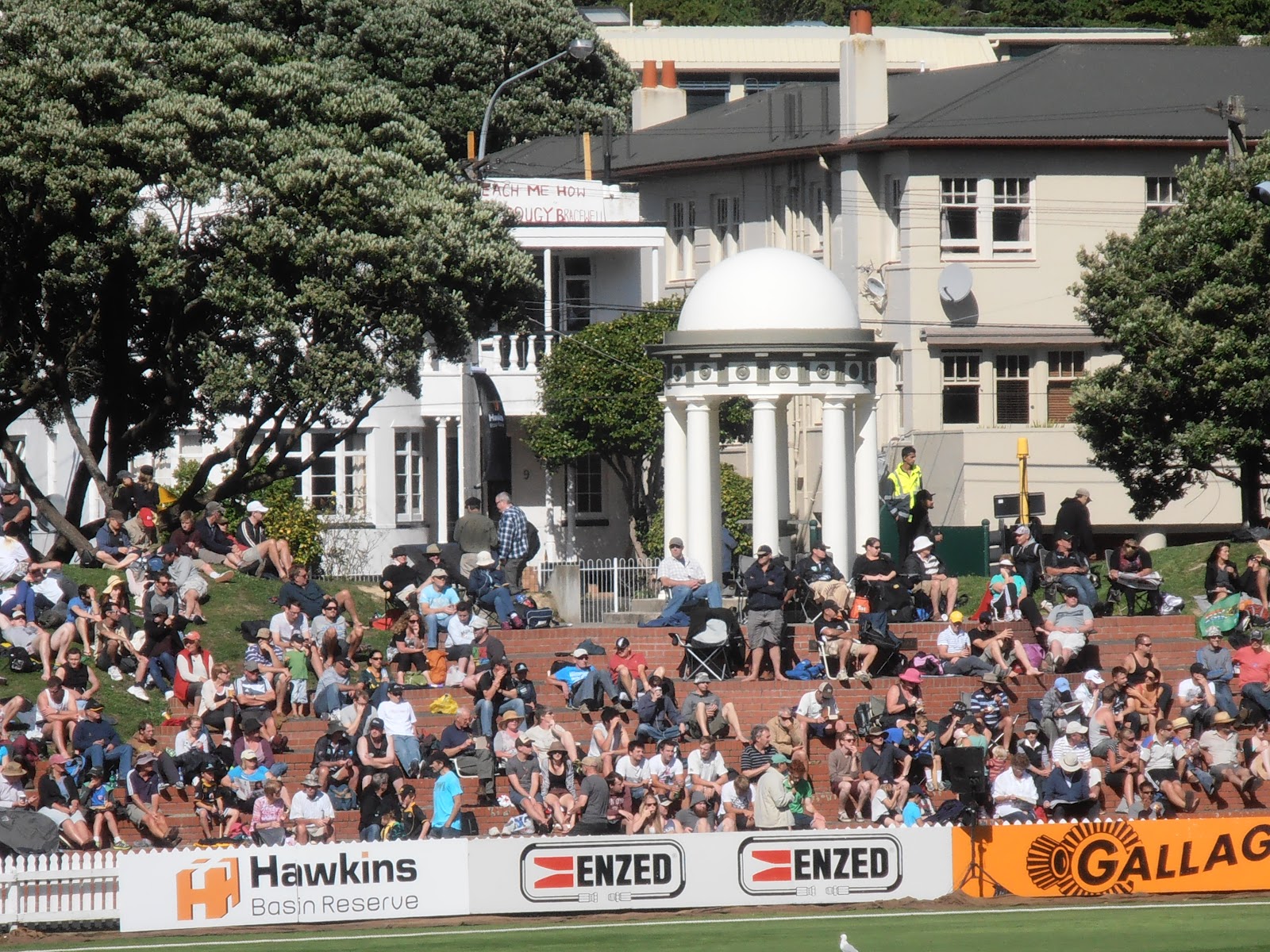
Monday, August 27, 2012

Kent v Leicestershire, Gillette Cup quarter-final, Canterbury, 31 July 1974

http://cricketarchive.com/Archive/Scorecards/34/34529.html

It is always cheering to wake up in the Wellington chill to news that the old county has won overnight. This has happened pleasingly often recently, particularly in the Sunday League (as my Blean Correspondent and I still choose to refer to 40-over cricket).  Six wins in a row have taken Kent to the top of their group with one match to play. That will be against Sussex, who are just a point behind. So it will, almost, amount to a quarter-final at the St Lawrence Ground on Bank Holiday Monday. Almost, because the best second-placed team will join the three group winners in the semi-final draw, and my calculations (not always a reliable guide) suggest that the defeat would have to be huge for Kent to be pushed out of this position.

I hope that the ground will be full, just as it was in the glory days. Let us select a scorecard from July 1974 by way of illustration. Harold Wilson was Prime Minister, Richard Nixon was about to resign from the White House, George Macrae’s Rock Your Baby was No 1, and Kent played Leicestershire in the quarter-final of the Gillette Cup.

The two counties had already contested a quarter-final at Canterbury that year, in the 55-over competition. Leicestershire won that one. They batted first and reached 238 for six, a reasonable score for the time. Barry Dudleston’s 79 was the top score, his partnership with Brian Davison of 98 from 18 overs the heart of the innings. Dudleston was to become my personal ski instructor a decade or so later, but that’s a story for another day.

It was a school day, so I saw none of that, arriving hotfoot down the Nackington Road in mid-afternoon to be told by a collective groan that things were not going well. You can read the noise of a cricket crowd quite easily if you have been in enough of them and there was no mistaking that this was a “God there’s another one gone” groan: Kent were 12 for three.

Brian Luckhurst was steadfast at one end, but wickets kept falling at the other. Some hope was retrieved when Bernard Julien was promoted to No 7 and shared a partnership of 87 with Luckhurst at a reasonable pace. It was the only time I can remember Julien being given any responsibility with the bat and the result suggests that it might have been done more often. He had scored a quick hundred in a Test at Lord’s the previous year, after all. But there was talent everywhere in the Kent order in those days, and Julien at No 7 meant that Bob Woolmer, who was to score a Test hundred against Australia the following year, was down at No 9.

Luckhurst was out for 111 trying to hit the penultimate ball of the innings for six when ten were needed. He won the man-of-the-match award despite Graham McKenzie having taken five for 34, winning the game with decisive spells at either end of the innings. It’s a batsman’s game.

So seven weeks later the teams met again to contest another quarter-final, this time with 60 overs a side. That year, these two counties were the best in the country, at one-day cricket, at least. Just to make it even more interesting, there was the sub-text of Denness v Illingworth, the incumbent England captain against his predecessor. Raymond Illingworth had not been pleased by this turn of events and – I was to learn during the après-ski at a later date – was particularly keen to put one over on Kent. As we will see, it was not to be his day.

I was there by nine o’clock, but the cars would have been lining up down the Old Dover Road from daybreak, the first in observing the tradition of what John Arlott called “the Canterbury breakfast” by getting out the camping stoves and starting the sausages sizzling. By the time McKenzie bowled the first ball to Luckhurst at 11 o’clock the ground was full; Wisden gives the attendance as 12,000. It was the best day of a wet summer.

All day, there were echoes of the match a few weeks earlier. Again, Kent lost early wickets, starting with Graham Johnson. Colin Cowdrey came in at three. Cowdrey’s reputation as a fine batsman, but a cautious one led opposition supporters to expect him to block all day. In the 55-over final the previous year, there were jeers and laughter from some Worcestershire folk as he came to the middle with only a couple of overs to go. But he increased the scoring rate with shots so deft and well-weighted that he scored two from almost every ball he faced, even with the field back in those pre-circle restriction days. He was puffed at the end though.

By the way, guess where Cowdrey often fielded in one-day cricket. At backward point. So did Norman Graham. It was where the captain hid his slow fielders. A generation later and it had become the place from where Jonty Rhodes, Paul Collingwood and the other guns leapt, dived and threw the stumps down.

This day was not Colin Cowdrey’s. He was out for a duck and Kent were 22 for two. That was where our anxiety peaked for the day, as Mike Denness joined Luckhurst for a partnership of 149. One of the great pleasures for Kent supporters was to watch these two bat together. They complimented each other so well, Luckhurst strong on the onside, Denness on the off. Almost a decade of opening the batting together had given them the trust and understanding that made them thieves of a quick single, two baseball batters stealing base at the same time. There was no calling to alert the opposition to their mischief either; no need when both knew what the other was thinking.

When Denness went for 72, Alan Ealham came in to rev things up. When people look at the Kent line-up in the seventies they might wonder how Ealham came to have a regular place in a team that otherwise comprised international players, and how he went in above Knott, Shepherd, Woolmer and Julien for many years. His career figures – an average of 28 with only seven centuries in 16 seasons – are ordinary. They tell not a quarter of the story. Besides being the finest boundary fielder I have seen, he made his runs when they were most needed. Look through the scorecards and count how often his 50 or sixty was highest score in a low total, or, like today, when quickfire 40 was the difference between a gettable total and one that was beyond reach.

Ealham added 57 with Luckhurst (who finished with 125) then 42 in four overs with Knott. Illingworth drew much of the fire, conceding 23 from one over and finishing with the figures of 12 overs, no maidens, 76 runs and no wickets. Mention Illingworth (and it should be made clear that he was a fine cricketer and one of England’s best captains) to my Blean correspondent or myself to this day and we will intone these figures with the seriousness of a Buddhist monk teaching the eightfold path.

Kent’s total of 295 disappeared over Leicestershire’s horizon thanks to parsimonious use of the new ball by Graham and Shepherd. Brian Davison gave them hope with a splendidly aggressive 82. He hit Derek Underwood for 18 in one over, as many as the great man ever went for I would think. It was good to see Davison featured on the Tasmanian avenue of fame at the Bellerive Oval a few weeks ago. He had a few years at Bristol when he was past his best, as so many did. When he was out, that was effectively it, and the final margin of victory was 66 runs.

I hope that the modern Kent team go into their big match with something of the confidence of their predecessors from 40 years ago. They could do with a Luckhurst or an Underwood of course, but Rob Key would have had a place in that great team, there is exciting young talent (I’d love to see young Sam Billings bat) and a few Alan Ealham types who can make a difference on the day. I’ll be up early to see how they get on.

Update: I said that only a huge defeat could exclude Kent from the semi-final, and so it was, by 9 wickets with ten overs to spare.


Sunday, August 12, 2012

Cricket Grounds in Winter: the Bellerive Oval, Hobart

I recently spent a week in Hobart, Tasmania, and what a delight it was. I believe that, millennia ago, Tasmania nestled happily alongside its brother and sister, the North and South Islands of New Zealand. Then, in a Dickensian rearrangement of the geological timeline, it was snatched away from its siblings and sold into servitude under the Mr Gradgrind of continents, Australia.  It waits, in lonely exile, for the day when it is reunited with its siblings on the other side of the Tasman Sea, where its landscape, climate and equability would be at home.

Hobart spreads itself out either side of the estuary of the River Derwent, with the Bellerive Oval (I eschew its rebranded name) on the opposite side to the city centre. The ground shares the virtues of the town of which it is a part, being proportioned, intimate, open and attractive.

Though it has been nestled into the hillside since 1914, the Bellerive Oval only became the first-class venue for cricket on the island 25 years or so ago, developed so that Tasmania would have an international venue. The first ODI here was played (between New Zealand and Pakistan) in 1988. The first Test followed the next year.

Tasmania is unrepresented in national competitions in any of the winter sports – though Aussie Rules is followed passionately – so, as in Kent, the cricket team is the focus of aspirations for top-level sporting success (hush, Gillingham fans, I said top level). Cricket is also the only sport played at international level on the island, which is why the Bellerive Oval still looks like at a cricket ground.
The northern half of the ground houses is a collection of stands along with facilities for players, members, sponsors and the media. Clearly, this arrangement is not the result of a master plan, but has emerged over the years, which is how cricket grounds should develop, and how they carry their history with them. At the river end there is a large, single-storey stand that provides excellent viewing. Between these areas is a grass bank, always a welcome feature. The Bellerive Oval occupies an area no bigger than the Basin Reserve, and there are some good ideas here when a refresh of the Basin takes place.
For too long Tasmania was shunned by the Australian cricketing establishment (something else the island has in common with New Zealand); it was not allowed to participate in the Sheffield Shield until 1977.  Like Wellington’s Clarrie Grimmett, some of Tasmania’s early cricketing heroes had to decamp to the Australian mainland to further their careers. Fast bowler Ted Macdonald, who terrorised the English along with Jack Gregory in the years after the First World War, and Max Walker, the under-estimated support act to Lillee and Thomson, were two such players.

The ground’s relatively newness does not prevent it from displaying a pleasing awareness of Tasmania’s cricketing history. A roller and a pair of turnstiles (imported from Britain) from the old Tasmanian Cricket Association ground are garden features. Then there is this lawn, saluting Tasmania’s cricketing heroes.


The statue, despite its Edwardian appearance, is of David Boon, the island’s greatest cricketer, pre-Punter, obviously. You will observe that he is represented with a somewhat smaller trouser size than we remember. Presumably the cost of the extra bronze necessary for a true likeness was prohibitive.

And who’s this at the top of the list of famous players? It can’t be. But it is. Jack Simmons, of Lancashire…and Tasmania. Flat Jack spent seven winters here as captain, and during a memorable fortnight in 1979 led the side to its first trophy – the one-day Gillette Cup ­– and to their first win in a Sheffield Shield match. I found a 1988 article from The Age that suggested that Simmons was so popular in Tasmania that he could have led a successful coup d’etat. As the island contains the finest fish-and-chip shops I have encountered in the southern hemisphere, it was clearly a match made in heaven.

Brian Davison succeeded Simmons and is also commemorated. Rohan Kanhai, Khalid Ibadulla, Jack Hampshire and even the young Alan Knott also spent time here.

In recent years, Tasmania has kept the national team well supplied with talent. Aside from the obvious, there has been Boon, and Colin “Funky” Miller, best remembered for turning up to a Test match with blue hair, and the only bowler I have seen switch between fastish medium off a long run, and off spin, and back in the same over, depending on whether a right or left-hander was facing. Today, Ben Hilfenhaus has often looked the most consistent of the fast bowlers, Tim Paine contends to be Brad Haddin’s successor, and Xavier Docherty is one of the legion of spinners tried in the post-Warne era.

And, of course, there’s Ricky Ponting, who contends with Errol Flynn and Mary Donaldson, now better known as Crown Princess Mary of Denmark, as the most famous Tasmanian (on the Tasmania Top 10 website, Boon and Walker also make the list, so the competition is not hot). Though circumstances have meant that he has played little domestic cricket for the past decade or so, he has remained loyal to the island, and is now turning out for them more often If they really want a different name for the Bellerive Oval, the Ponting Oval would be the one. Unless they plan to rename Hobart after him, that is.

Monday, July 2, 2012

Trophies and Tribulations – Forty Years of Kent Cricket by Clive Ellis and Mark Pennell

We were like the young men of Europe in the high summer of 1914, going home after a day in the sun, oblivious to the misery about to spread itself across the decades to come.

It was 9 September 1979, around 7 pm. We Kent supporters were making our way from the St Lawrence Ground in Canterbury. The team had lost the final Sunday League game of the season, to Middlesex. Somerset beat Nottinghamshire at Trent Bridge, so it was Brian Rose of Somerset rather than our own Alan Ealham who received the trophy.

We were disappointed, but not downcast. There had been ten trophies in the seventies, and there was no reason to think that the eighties would be any less rewarding. The odd loss like today’s merely sharpened expectation of the next, inevitable, triumph. Not one of those people walking down the Old Dover Road that evening believed that the day would be long delayed.

What fools we were.

It was 16 years until a Kent captain raised a trophy aloft once more, and the 33 years that have passed by since that September evening have reaped the paltry harvest of two Sunday Leagues and a T20. The big prizes – a Lord’s final win and the Championship – have been entirely elusive.

For many years I thought that there should be a book that explained all this, and in 2010 it came along: Trophies and Tribulations – Forty Years of Kent Cricket by Clive Ellis and Mark Pennell. Ellis was a supporter through the glory years before joining the Daily Telegraph sports staff. Mark Pennell covered almost every game that Kent played between 1993 and 2008 for the Kent Messenger and now heads a sports reporting agency that performs heroic work in keeping county cricket in the public eye.

After a perfunctory survey of the first century or so of the club’s history, the authors adopt a season-by-season format starting in 1967, the year Gillette Cup became the first prize won since the First World War. Ellis deals with the first 26 seasons; Pennell takes up the narrative from 1993 to 2009. The quality of the writing deteriorates with the handover; Pennell’s first paragraph would be a worth a punt in a cliché-writing contest:


The Garden of England was transformed into a cricketing hot-bed [sic] when Kent’s team of the ‘glory years’ reaped 11 titles in 12 golden summers.

He might have checked the precise meaning of “hotbed” before embarking on the gardening metaphor too. The word would more appropriately apply to more recent periods in the county’s history, dependent on significant quantities of manure as hotbeds are. And wrapping a cliché in single quotes merely draws attention to it.

The book’s great contribution to Kent’s history is the information that emerges from interviews with surviving players and officials. The candour that comes with passing of time illuminates several murky corners, and takes us a considerable way towards answering the big question that could be the book’s alternative title: what went wrong? The chronological structure of the book means that the authors do not always organise the evidence they present into themes that cross the years, but it is laid out clearly, allowing readers to join the dots easily enough.

The retirement of Les Ames from full-time administration in 1974 was a crucial turning point. As secretary-manager, Ames had led the club from mediocrity to the top of the county game. One of Kent and England’s great players, Ames’ reputation, strength of character and good judgment enabled him, the ex-professional, to protect the county to a good extent from the meddling of the elected amateurs on the committee.

With Ames gone there was no counterbalance. The grey men were able to mess things up. It should surprise few that Ellis and Pennell point to the committee room as the source of strife, but interesting that the Band of Brothers – the wandering club side to which many of the county’s establishment belong – emerges as the Opus Dei of Kent cricket, emerging from the murk every few years to finish off another captain.

Chief villain is EW (Jim) Swanton, who retired in 1975 as cricket correspondent of the Daily Telegraph, from which position he had become the Cardinal Richelieu of English cricket. At his funeral the former Archbishop of Canterbury Robert Runcie said “Jim was not a man plagued by self-doubt”. Swanton devoted the last two decades of his life to interfering in Kent’s affairs, to an extent, according to Ellis and Pennell, that was breathtaking. In 1996, as Matt Walker was about to overtake Frank Woolley’s St Lawrence record score of 270, Swanton is said to have stormed into the dressing room demanding a declaration so that his hero’s landmark would remain intact.

Of course, the membership has to take the blame for electing Swanton and the rest of the committee in the first place. Edmund Burke – MP for Bristol, so a wise man – might have had Kent County Cricket Club in mind when he wrote:

All that is necessary for the triumph of evil is for good men to do nothing.

For some time, asterisks appeared on the ballot paper next to the names of the candidates for election to the committee that the committee itself favoured. A clearer admission of corruption it is hard to imagine, but there are flocks of sheep that are free-thinking iconoclasts in comparison with the Kent membership of the eighties, of whom few followed my practice of voting only for those not supported by the self-perpetuating elite.

The first sign of how devastating the impact of Ames’ departure was to be came in 1976 with the sacking as captain of Mike Denness. At the time this was incomprehensible to most supporters. After all, there were two trophies in the cabinet at the end of that season, and Denness left for Essex, making it clear that it was a sacking, not a resignation. Denness says here that the whole affair would have been managed much better had Ames still been in charge.

Despite his great success in terms of winning trophies, Denness had always had mixed reviews as captain, inside the dressing room and in the stands. Bob Woolmer, for example, wrote in his autobiography Pirate and Rebel (or rather, his ghost wrote) that Denness was the best one-day captain that he played under, but that Denness’s communication let him down in the first-class game. It was in that knowledge of views such as these were held by some of the team that Denness himself raised the possibility of his standing down in favour of Graham Johnson for the 1977 season. This idea soon gained a life of its own, and a few weeks later Denness was invited to take the revolver into the library and do the decent thing.

Asif Iqbal, not Johnson, took over, led the side to a share of the Championship and was sacked because of his involvement with World Series Cricket. Bizarre as this now seems, in the context of the apoplectic reaction of the English game to Kerry Packer and his plans, it was to be expected. The real surprise was that Alan Ealham was chosen to succeed him.

There were several candidates who appeared more likely. Woolmer had also signed with the Great Satan, so was not considered. As vice-captain, Johnson might have been expected preferment. Here, he says that he was seen as being a bit bolshie, based on not much more than having been a student at the London School of Economics when it was the centre of sixties radicalism. Ealham fairly points out that Johnson had not played well in 1977. There are people reading this blog who hold to this day the belief that the loveliness of Johnson’s eyes were grounds enough for giving him whatever he wanted.[1]

John Shepherd also believed that he should have got the job. Like Johnson, he would have done it very well. “I don’t know whether Kent were ready for a black captain” Ellis quotes him as saying. I believe that members of the committee were capable of holding just about any prejudice going in late-seventies Britain (several of them will have been rotating steadily in their graves when Shep became President of the club last year), but I think that the more influential stereotype in operation here may have been that bowlers do not make good captains. There may have also been the feeling that Shepherd and Johnson were both their own men to an extent that the committee would have been uncomfortable with, while Ealham had more old-fashioned loyalty about him, so would be more pliable.

As it was the Championship was won in 1978, and 1979 was not such a bad year (though we might have spotted the all-out-for-60 rout at Taunton in the Gillette Cup quarter-final as a sign of the coming apocalypse), so none of us were thinking about ditching the skipper as we walked disconsolately down the Old Dover Road that September Sunday evening. But 1980 was horrendous, quite as bad as any recent season, and at its end Ealham was gone. In the circumstances, this was an understandable decision; it was the shabby treatment of the ex-captain the following year that revealed those in charge to be clueless about how to value people. Despite still having plenty to offer as a player, Ealham was hardly picked at all in 1981.

Bob Woolmer would have been the right choice, but instead they went back to Asif Iqbal, much more popular with the supporters, but then reaching the end of a distinguished Kent career. Asif is quoted here as believing that he should have retired at the end of the 1980 season. The speculation about his successor began at once. Much of the 1982 season became an extended trial between the two contenders, Chris Cowdrey and Chris Tavaré who were joint vice-captains (which Cowdrey calls “a strange decision, and a bad one”).

The account of the damaging way in which this situation was handled is related here much as we perceived it at the time. For genetic reasons Cowdrey was the man the committee room and the Band of Brothers marquee favoured, but his form was not good enough to guarantee him a place in the side, so they gave the job to Tavaré.

The first two years of what we hoped would be the Tavaré era were trophyless, but promising, with two Gillette Cup final defeats and improved performances in the championship. Had one more Glamorgan wicket be taken in the final game of the season, Kent would have finished third. What is more, despite his studious demeanour Tavaré had the dressing room behind him (there were stories of the players willingly crawling round ancient pavilions in search of insects for their captain – an Oxford zoology graduate with a speciality in entomology – to identify and dissect) and was popular with the supporters.

So they sacked him, obviously.

The most commonly offered explanation was that Tavaré had paid for mishandling Derek Underwood in both the Lord’s final defeats. As far as 1983 goes, the accusation is groundless. Cowdrey, brought on for an over or two, did well and was kept on, finishing with two for 29 from ten overs. If anything, this was a sign of alert, flexible captaincy. It was the batting that lost that game, not the bowling.

In 1984, Underwood was taken off with three overs left to bowl at a time when Middlesex were struggling to stay in the game. I felt at the time that this was a mistake, and indeed when Underwood returned to the attack he was not so effective. But that was one error in two very positive seasons.

My theory was that Tavaré’s fate was sealed at Lord’s a week before the Gillette final. Against a weak Sri Lankan Test attack he laboured painfully from lunch to tea on Saturday for just 14. David Gower, the England captain, was moved to apologise at the close of play for the stultifying nature of the cricket. Before that, it had been expected that Tavaré would be Gower’s deputy in India that winter; after it, he was not picked at all. I felt at the time that Kent would not have had the nerve to have sacked the England vice-captain. But according to Ellis, the decision had been taken some weeks before, so neither Lord’s Saturday made a difference. It was a decision taken without consultation with the manager, Brian Luckhurst, or senior players such as Derek Underwood and Alan Knott. The Kent committee room was the only place in the cricketing world that would not have regarded these two great players as being worth listening to.

So Chris Cowdrey was Kent captain and the stripy-tie brigade congratulated themselves on restoring the natural order. But it was a palace, not a popular, revolution, and the manner of the succession meant that Cowdrey was never fully accepted by some supporters (including myself and my wise friend Allen Hunt), and not by some of the team. One of the many fascinating revelations in the book is Cowdrey’s account of his first team meeting as skipper. “Possibly the most senior player in the dressing room”, which has to be either Underwood or Knott, neither of whom was ever a member of the awkward squad, “…told me he didn’t want to come in” because of the way in which Tavaré had been treated.

We sceptics were never persuaded from our view that the committee had replaced General Montgomery with Field-Marshall Haig. Terry Alderman agreed with us. I know this because I was part of a group talking to him in the Hammond Room bar at Bristol in 1988, while he was having a season with Gloucestershire. Alderman had been asked by a committee man during his second season with Kent in 1986 where the county was going wrong. “Simple”, he had replied, “you’ve got the wrong captain”. Cowdrey now agrees.

It’s hard to say they made the wrong decision to appoint me as captain, but I think they did.

The book does not make quite enough of the quantity of talent lost by Kent in these years. Laurie Potter, who had managed to captain both England and Australia at under-19 level, was seen more as a slow bowler than the fine batsman he might have become, and left for Leicestershire. Derek Aslett, leading scorer in both seasons under Tavaré, faded quickly under Cowdrey and, on Cowdrey’s call, was released in 1987. Oddest of the lot was the decision to release Eldine Baptiste as overseas player in 1987. Baptiste had performed handily since making his debut in 1981, averaging 30 with the bat and slightly less with the ball; a true all-rounder. He performed with obvious enthusiasm and commitment throughout. This was said to be part of a damn-fool move to build a squad consisting entirely of Kent-born or educated players. This at a time when even Yorkshire was close to abandoning its nineteenth-century stance on the origin of its players. In the event, he was replaced by Roy Pienaar, a classy batsman and trundling bowler, Hartley Alleyne, one of the worst-performing overseas players the county has had, and later by Tony Merrick, who was leading wicket-taker in 1991, but no batsman and a reasonable impersonator of a medium-sized shed in the outfield.

Since Cowdrey’s resignation in 1990, the county has shown much more wisdom in its choice of captain, and has usually picked the right (or at least most obvious) man at the right time, and given them the time to improve in post, though Matthew Fleming has an interesting take on his two immediate predecessors.

If we could have found a captain who was a combination of Benson and Marsh, it could have been a great side. But Benny was too quiet and though Marshy was aggressive and pugnacious there was always an element to him.
The club is fortunate to have had Rob Key as captain during the last few, difficult years. He could easily have gone elsewhere and is unlucky to have played in the only era in English cricket in which a degree of portliness was not considered a virtue in a Test player.

At the end of the book both authors pick their best side from the four decades or so in question, and irritate this reader no end in doing so. For a start, they get the selection criteria wrong. Martin van Jaarsveld is deemed to be England-qualified (only one overseas player is allowed), but John Shepherd is not. Yet Shepherd was certainly England-qualified in his final few years in Kent; he went to Gloucestershire on that basis. At least Ellis picks Shepherd. Pennell’s incomprehensible choice as overseas player, and (you’ll need to sit down at this point) captain is Steve Waugh. Yes, the Steve Waugh who played all of four games for Kent, not one of them as captain (though Waugh did become the first Canterbury-born player to be capped by Kent, though the Canterbury in question is a suburb of Sydney). Surely any compilation Kent team must be picked solely on the basis of performances for the county. If not, I nominate WG Grace in my all-time Kent team. Grace played once as a guest for Kent in 1877, scoring 50 in his single innings. This gave him the highest career average of any Kent batsman until Aravinda de Silva came along 118 years later.

And who does Pennell reckon a better middle-order batsman than Colin Cowdrey, Mike Denness or Chris Tavaré? Why, Trevor Ward of course. I enjoyed Ward’s batting too, but that he never got close to an England cap at a time when mediocrity was not a barrier to selection says it all.

Both authors pick Key and van Jaarsveld, which, having seen too little of either batsman, I won’t quibble with. Mike Denness was very good though, and remember to add ten to the averages of batsmen who played mostly on uncovered pitches.

But enough carping. Trophies and Tribulations is an invaluable resource for Kent historians and answers a good many questions that have troubled some of us for too long. It is well-produced too, even if the picture of the fallen lime tree on page 253 is back to front. Ellis and Pennell are to be congratulated and thanked.


[1] A question beyond the scope of this discussion is how did Johnson never play for England when Geoff “Thriller” Miller did so on 34 occasions?

Saturday, May 12, 2012

Wisden Cricketers' Almanack 2012, edited by Lawrence Booth


The 2012 Wisden has arrived, its yellow cover for us in New Zealand representing autumn leaves rather than spring flowers.

Each almanack records a cricketing year, but when you have 45 yellow jackets on your shelves, as I do (46 if you count the 1964 edition that I picked up from the second-hand-book stall at the Basin Test a couple of years ago) you find that each Wisden represents another notch on the stick of your own mortality.  I mention this because the 2012 edition is the first to be edited by Lawrence Booth.
37-year-old Lawrence Booth.

That is to say, Wisden is now in the charge of a man who has no recall of the first two World Cup finals, the Test match career of David Steele or Headingley ’81, and who never watched cricket in black-and-white. Booth is the first of the Good Book’s sixteen editors to have made his name, in part at least, through his on-line writing, for The Guardian’s over-by-over coverage of Tests and its email newsletter The Spin (an email newsletter – how quaint). That seems to be the way in these days. Talented young sports writers such as the Daily Telegraph’s Jonathan Liew and The Guardian’s Barney Ronay serve apprenticeships in front of television screens in newspaper offices in the dead of night before being allowed out to file from a proper press box.
Lawrence Booth’s appointment is a response to the question “What is Wisden for?” Throughout the twentieth century the answer was so obvious that the question was not worth asking. Wisden was the game’s record, unrivalled in its breadth, depth and completeness. Then the internet arrived and Wisden suddenly found itself as contemporary and useful as a powdered wig. Like most cricket followers, I turn first to CricInfo and Cricket Archive for statistics (which are up-to-date to the second) and scorecards, and when I get around to owning a smart phone it will probably be with a view to having all this information at hand when I am spectating at the Basin.

Wisden was, in fact, an early adapter to the digital age, or tried to be. It had a website going early in the new century, and experimented with a paywall for access to its archive, but that did not work so it bought CricInfo, saving it from financial oblivion (and allowing a few of us in distant corners of the world to be paid when we had almost given up hope). A few years later CricInfo was sold to ESPN and Wisden appeared to be left on the platform waving a handkerchief as the age of electronic publishing sped towards the horizon.
Lawrence Booth’s brief is to ensure that Wisden catches up and remains as indispensable in the twenty-first century as it was in the twentieth. Not that the Almanack is in commercial decline. On the contrary, sales have held up well, and it remains one of the British publishing’s most bankable titles. But it cannot remain immune to the effects of changing times, which will see any number of familiar titles ceasing to appear in printed form over the next few years.

So the 2012 Almanack is the first to be available as an ebook. Booth has also initiated Wisden Extra, an online pamphlet full of good writing, but which can only be easily read if printed out, which seems to rather miss the point. The content of the Almanack is also increasingly influenced by on-line competition, though some of these changes pre-date Lawrence Booth’s accession to the editor’s chair by several years. The records section has migrated to the back of the book, reflecting the loss of its status as the main reason to buy the Almanack. The Wisden website will henceforth update records in real time, but it would be a mistake to put much effort into duplicating what is available elsewhere.
Almost all scorecards of English domestic one-day and T20 cricket appear in potted form. All hell was let loose when the Sunday League scores for 1976 appeared in this form in the 1977 Almanack, as this removed the only collected source of these records. Now the omitted scores are freely available on-line, so nobody cares. But brief reports, not necessarily easily available with the full cards, are retained, which is sensible.

And there we have the reason why Wisden remains relevant, essential indeed, in digital times. It’s not the numbers, it’s the words.
The biggest change in Wisden in the period represented on my shelves is the quality of the writing, for so long pedestrian, now often outstanding. I reached for the 1972 edition for comparison. The features give the impression of having been written in a particularly dusty corner of the Carlton Club for a readership in another part of the room. The editor’s notes have the dull air of the bowls club AGM about them. Norman Preston, editing his 22nd edition, is sniffy about the success of Ray Illingworth’s Ashes-winning side because of “unsavoury” incidents that occurred during the series.

Though not yet aspiring to the heights of pontifical infallibility achieved by Matthew Engel, Lawrence Booth’s notes are intelligent and pleasingly written. They lead a consolidated comment section of more than 200 pages, a book in its own right and more than double the ration of forty years ago.
The overall standard is so high that it is almost invidious to nominate a favourite. Mike Brearley’s insightful piece on depression among cricketers contends. So does Gideon Haigh’s account of the development of the International Cricket Council from the time 20 years ago when it was housed in a converted canteen at Lord’s to its present location in luxurious premises in Dubai. Haigh nails it by the second paragraph in which he notes the appropriateness of the proximity of the animal so often described as a horse designed by a committee.

Michael Henderson writes an uncharacteristically cheerful, almost romantic, piece inspired by the moment at Taunton when
Croft of Blackpool hit the runs that threw a hoop around almost eight decades of history
and won Lancashire the Championship.

For those who moved away long ago, and will never go back, Lancashire – and Lancashire cricket – still grips us, for it is part of that personal mythology without which no human being can feel entirely fulfilled.
So true, just substitute the name of your county or team. Will Kent win another Championship in my lifetime?

Colin Schindler, another Lancashire man, marks the fifty seasons that have passed since amateurism was abolished in English first-class cricket with a few stories that suggest the move was overdue, such as that of Peter Murray-Willis, captain of Northamptonshire in 1946, who once stopped chasing a ball to the boundary because his cap fell off.
But it is PJK Gibbs – yes, Alan Gibson’s bête noire again – who tops the rest with his account of a day in 1964 that he spent in the company of SF Barnes, perhaps the greatest bowler ever to play the game. It is like somebody still living describing a day spent chopping down trees at Hawarden with Gladstone. Gibbs, a junior player in the Staffordshire team playing in the Minor Counties Championship against Bedfordshire at Walsall, was assigned the task of looking after 91-year-old Barnes, a short straw given the great man’s reputation for irascibility. Barnes was a century ahead of his time when he followed the money to the leagues when Lancashire would not pay him enough. He would play for England only if “the money was right” and would have approved enthusiastically of Chris Gayle and the like, seasonally migrating from T20 team to another across the globe.

Despite his great age Barnes’s mind and prejudices were steel-tipped.
“Batsman?” he said after a pause. “Yes”. “Oxford?” “Yes”. “Blue?” His voice had a dark, accusing tone.
His opinions on the modern game and its players were acute.

“Frank Worrell, fine player, fine man. Laker? Those pitches in ’56 were a travesty. Money for old rope. What did he do in Australia?”
Barnes took 77 Test wickets in Australia, in just 13 Tests. On that day in 1964 Gibbs got a pair.

And then there are the obituaries, the anticipation of which has kept my Blean correspondent and myself reason to live through many a cold English winter. Year by year, the number who I saw play edges up. Abberley, Bailey, Carew, Dilley, d’Oliveira, Pataudi, Reifer, Roebuck, Saxena, Titmus, only a wicketkeeper short of a team. All the notices are unsigned, so I don’t know who to praise for the outstanding piece on Peter Roebuck, which gets the blend of dark and light just right (though I’d guess Gideon Haigh). Those on Graham Dilley and Basil d’Oliveira manage to say something fresh despite the thousands of words written about both men in the days after their deaths.
But the real attraction of the obituaries is the stories told of minor figures, some of whom are included only because there is a good story to be told, not necessarily related to cricket. So the notice for Martin Searby, the Yorkshire journalist who was something of legend on the county circuit, records an exchange that took place in a cruise ship swimming pool. “Are you Martin Searby?” asked a woman he did not recognise. “Who wants to know?” “I was your first wife” came the reply. I met Searby once. “A good bloke before nine in the evening” was what I had been told about him. As he entered the Vittoria on the Whiteladies Road in Bristol – the last call of an all-day drinking session in the company of David Green of Lancashire, Gloucestershire, and the Daily Telegraph – I looked at my watch. It was ten to ten. The next hour was a long one.

Sir Roger Jowell is included on two grounds. In 1965 he was protesting at Lord’s against the team representing white South Africa, but was so taken with a shot by Graeme Pollock that he put down his placard to applaud; and “one of the Americans he succeeded in converting to the game” (this conjures up a marvellous image of him going from door to door in the mid-West, Wisden in hand) was Bill Clinton’s campaign chief of staff.
Richard Douglas-Boyd’s claim for inclusion is slim: his company published a few cricket books. But had he been omitted we would not have known that he severed his big toe with a lawnmower, or that his spaniel ate the toe before it could be recovered.

So callow youth as Lawrence Booth may be, the first Wisden in his charge matches the high standards set by his recent predecessors. The 2013 edition will be the 150th

Sunday, April 22, 2012

Adult Book by Malcolm Knox

The cricket novel is in fashion, a genre, almost. There is Joseph O’Neill’s Netherland, in which the game is a symbol of calm in post 9/11 New York. Today’s Guardian carries a favourable review of Chinaman by Shehan Karunatilaka. The recent history of Sri Lanka is contemplated through the story of a journalist making a documentary about a disappeared spin bowler.

Then there is 28 for 3 by “Jennie Walker” – a pen name for a writer called Charles Boyle (what if cricketers had game names?; another time, perhaps) – in which an eternal triangle is played out to the background of an England v India Test.
And I learn from the 2012 Wisden – received a couple of days ago – that Alan Gibson’s nemesis PJK Gibbs has a cricket novel, Settling the Score, on the way. Gibbs’ dogged approach to opening the batting for Derbyshire regularly prompted Gibson to scorn:

When Gibbs…was out for 40 scored in 223 minutes, he walked back to the pavilion in a silence which was eloquent and not, in the circumstances, churlish. 7 June 1968
After giving up the unequal struggle against the new ball Peter Gibbs became a successful writer, for stage, screen and radio, including more than 50 episodes of Heartbeat and several dramas with cricket themes or connections. Like several cricket players turned journalists (I mean you, Mark Nicholas), it is to be hoped that he is more entertaining to read than watch.

Any of these works might have been included in The Wisden Cricketer’s list of the top 50 cricket books had they been published a few years earlier. As it is, Adult Book by Malcolm Knox is the only fiction represented. Knox is in the tradition of Alan Ross as a writer whose work can be found in both the sport and literary sections of the paper. He was cricket correspondent, then deputy literary editor of the Sydney Morning Herald, and still writes about the game, most recently as Greg Chappell’s ghost.
The story moves between two timelines, one before and one after a Sydney New Year early this century. The central characters are the Brand family. Dr John Brand, the father, is alive in the first timeline, dead in the second. His wife Margaret, and their three sons are the other major characters. Davis, the eldest has followed his father into medicine. Hammett, the youngest – estranged from the family as the story begins – is a significant figure behind the scenes in Sydney’s pornography industry (hence the title). The middle son, Chris, is the lynchpin of the Australian middle order. He is 34 and has played 91 Tests and 201 ODIs. To describe him as hard-bitten is an understatement. In comparison Ricky Ponting and Steve Waugh are happy-go-lucky chancers.

The later timeline takes us through the New Year Test against South Africa at the SCG. As it begins Chris Brand is dealing with his father’s death and is fighting to save his career: his last six innings have accrued 0, 0, 0, 0, 1 and 1.
And there’s the thing. We would understand that the player was struggling to hold his place if a couple of low double-figure scores had been thrown in to that sequence, or the ducks halved in number. But Knox carries a heavy bat and wants to clear the ropes, when delicate shots played with a lighter blade would be more satisfying to the discriminating spectator. Throughout the book such points are underscored too heavily. For example, we have already got that John Brand is a porn-obsessed old man by the time Knox has him leave a family gathering to slather over more of the hard stuff on the internet.

The best parts of the book are the descriptions of the cricket, particularly Chris Brand’s redemptive innings. After –predictably – being dropped at third slip early on, he survives through to lunch, rediscovering form and confidence in the process.
…Chris’s mind is drained. There is no longer a need for solutions. There is only a ball, and his bat…His bat and the ball start arriving at the same place at the same time. The scratchiness, the hesitation, the undecided shotmaking of recent weeks seem to have fallen away like a snake’s skin, a decayed product of his last form cycle.

By close of play he has a century, and by tea the next day has a double, though only after being caught (you’ll never guess) off a no-ball. At the close he is 331 not out, three short of Bradman and Taylor’s joint landmark, and with Hayden’s 380 in sight (publication preceded Lara’s 400), but his despised skipper Tom Pritchard (not obviously based on any recent Aussie leader) declares overnight.
As it happened, I read Adult Book during this year’s Sydney Test, when Michael Clarke passed RE Foster’s 287, the individual record score at the SCG for 108 years, a few years after Chris Brand had done so in fiction. For a time as I read and watched they matched each other, run for run. Clarke declared when he was 329 not out, two short of Brand’s mark.

Off the field, Knox’s portrayal of life around the Australian Test team is less convincing. It must, of course, be acknowledged that any author’s obligation to present the world as it really is extends only as far as they themselves determine it should. Knox has spent plenty of time in the world of international cricket, but it would be disappointing if the reality closely resembled Chris Brand’s world, summed up thus:
No matter how individually talented, no matter how great they all think they are…the glue that holds them together is the lowest common denominator. They’re boys.

The glue is spread very thin. None of the Australian players appear to like or respect any of the others. Off the field their main form of entertainment is solitary surfing for internet porn, punctuated by trawling for groupies, wives and girlfriends kept away. Only a fool would imagine that there is not a strong element of truth about this, the Australian team consisting of rich, successful twenty-something males as it does. But few of them will be quite this one-dimensional and the majority will be more interesting and nicer people than their fictional counterparts.
Mind you, none of the spheres of life represented in Adult Book would be delighted with their portrayal in it, particularly the medical profession. It is not a book that makes it easy to sympathise with any of its characters. Like a ground-out 40 on a seaming pitch it is to be admired for its technical proficiency, but it is a relief to be able to turn to the newspaper for diversion while it proceeds. O’Neill’s Netherland is more deserving of fiction’s token place on in the top 50, even though the cricket is more tangential to its story.

Sunday, April 1, 2012

New Zealand v South Africa, Basin Reserve, Wellington, 3rd Test, 3rd day (25 March 2012)

http://cricketarchive.com/Archive/Scorecards/345/345883/345883_bbb.html

The New Zealand season is over, just three days before the first-class season in England begins. The South Africans have gone home having impressed us greatly. That they took the Test series only one-nil was down to weather interference in the first and third matches. Given England’s ineptitude when faced with the turning ball, South Africa are the best team in the world. I was at the Basin for the third day of the final Test.  
Our Lord Lucan of a summer was finally apprehended today and there were blue skies at the Basin. This was a welcome contrast to the unremitting grey of the first two days, during which only 79 overs were bowled. South Africa began on 246 for two, achieved against an insipid New Zealand attack on a flat pitch.
The two wickets that fell were both down to third umpire Billy Doctrove’s eccentric interpretations of the DRS evidence. Graeme Smith had to go despite neither hotspot nor super slow motion supporting the view that his bat had made contact with the ball on its way through to the wicketkeeper. Hashim Amla was not reprieved after being caught from a top-edged hook even though the replay showed that Mark Gillespie’s heel had cut the return crease, in contravention of the no-ball rule.

Amla will take no further part in the match having sustained (and my eyes water as I type these words) blunt trauma to his groin region, which required surgery overnight. Unfortunately, Jacques Kallis is also missing, with a neck injury, a double blow for those of us who go to Test matches to see the best players first and our team do well second.
Alviro Petersen reached his hundred in the second over of the day, and went on to 156, the biggest of his three Test centuries. He deserves a break having served last year as captain of Glamorgan, a sentence that I was unaware a South African court could impose.

Petersen and  JP Duminy (in for Kallis and playing his first Test in a couple of years) attacked from the off, which was pleasing. For a long time after their return to international cricket the South Africans tended to bat with a fifties-style grimness, as if news of the acceleration that one-day cricket had brought to Test cricket had not reached the Cape. Of all the Tests I have attended, the session I would least care to re-live (and I do not exclude those throughout which it rained) is that between lunch and tea of the second day at Eden Park in 1999, during which South Africa – 352 for three at the resumption – prodded 64 from 35 overs for the loss of a single wicket. It was good now to see them going about things with an urgency that suggested that a win was still the primary goal.

New Zealand’s bowling in this first session was unimpressive, and Ross Taylor appeared flummoxed as to how to deploy the scarce resources at his disposal. It was surprising that Chris Martin took the new ball with the wind behind him, rather than Mark Gillespie, who is the fastest member of this attack, and in prime form. The state of Taylor’s mind was betrayed by his decision to seek a review of an lbw appeal against Petersen that was at the conspiracy-theory end of the continuum, being both too high and hitting the pad outside off. The reappearance of Vettori in the attack after just 11 overs with the new ball suggested that the strategy of picking an extra batsman was not a raging success.
JP Duminy cover drove three fours in one Doug Bracewell over. The Hero of Hobart’s fine first international season is tailing off, but he has earned a trip to the Caribbean in a couple of months. Duminy slowed down as he neared three figures, but reached the mark with a push to leg off Gillespie (who was switched to the northern end just as the breeze died down). The 200 partnership came up, but Duminy fell shortly thereafter, edging Gillespie to Taylor at slip. He has given the South African selectors the best of problems: more in-form batsmen than there are places available.

The first session was South Africa’s: 115 runs for the loss of Duminy.
As Chris Martin took up the attack after lunch I noted that this would probably be his last home Test. But I wrote to that effect last season, and the one before that, only to be proved wrong. Sure enough in the first over of the spell he dismissed Petersen lbw, playing across a straight one. It was disappointing that few joined me in standing as Petersen returned to the rooms, as an attractive 156 surely deserves such a courtesy.

Reinforcing his reputation as cricket’s Ol’ Man River, Martin followed with the wicket of de Villiers, who played on as he tried to work the ball to the leg side. On the radio Iain O’Brien (who has taken John Morrison’s summariser’s seat, so some prayers are answered) made the point that Martin still gets good batsmen out, which is true, even if they have scored 150 first.
Kruger van Wyk had the least impressive day of his short Test career behind the stumps. He conceded four byes when he failed to follow a turning ball down the leg side from Williamson, then bodged a run out when Taylor quickly flicked the ball back as Jacques Rudolph was stranded a couple of metres down the pitch, only for the keeper to dislodge the bails with his foot as he collected the ball.

Van Wyk made amends by collecting a low catch from the first ball of Gillespie’s new spell to dismiss Rudolph. Eyebrows were raised at the selection of Gillespie for the second Test, but a few days before I had seen him deliver as hostile a spell of fast bowling as I have seen for some time in domestic cricket, for Wellington against Northern Districts.
John Buchanan, the former Aussie coach who is now our Director of Cricket, appointed Kim Littlejohn as selection manager. Even by Buchanan’s unconventional standards, this is not so much left field as from a paddock in the next county, as Littlejohn’s previous post was as high performance manager for Australian bowls (the point should be made that coach John Wright has the final say in selection matters). They have not got everything right – the mysterious replacement of Boult by Arnel in Hamilton springs to mind – but they have brought in players at the peak of their form, the selection of Daniel Flynn here being another example.

Gillespie bowled with intelligence and determination and worked his way through the middle and lower order to finish with his best Test figures, six for 113. South Africa did declare, but with only one wicket remaining, and were not able to kick on in the middle session as they might have wished.
Daniel Vettori was a strong influence in this respect. For the first time since he made his debut fifteen years ago, there has been debate about whether Vettori should retain his place. I have strong reservations about his ability as an attacking spinner in the second innings, but criticism of his performance here fails to understand that his role in South Africa’s first innings was entirely defensive.
In bowling 42 overs for 98 runs (including a spell of ten overs for 11 runs in the morning when Petersen and Duminy were scoring for fun from the other end) he did precisely the job that Ross Taylor asked of him. Gillespie could never have taken six wickets without that control from the other end. Though he has not batted well in this series, Vettori’s record over the past four or five years means that New Zealand should be loath to dispense with him in that capacity either.
New Zealand faced 25 overs before the close, and it was wonderfully gripping, Test cricket at its best. Guptill and Flynn (in cracking form, but not an opener), saw it out to the end of the day against the best pace attack in the world, putting on the highest opening partnership of the series along the way.

They got the approach dead right by concentrating and defence, leaving alone what they could, but taking runs when available at low risk. At one point there were 21 consecutive scoreless deliveries, but they did not waiver. Vernon Philander’s opening spell was the first such in his short but devastating Test career in which he has not taken a wicket. There was one, hard, chance when Flynn inside-edged off Morkel, but the diving Boucher could not hold on.
I retain the view that Guptill would be better allowed to develop naturally in the middle order, but New Zealand do not have the resources to allow this. Again here he showed that he has the determination and concentration of a good Test batsman.
Martin Guptill, hurried up by Morne Morkel
Flynn’s innings was his first in Tests since 2009, and all the more impressive for being against type; he has been scoring at around a run a ball in domestic cricket.
It should not be thought that the South Africans bowled poorly; on another day they could have taken four or five wickets in this period of play with the same quality of bowling. But not today. The introduction of Duminy’s affable off spin near the end of the day was a moral victory for the home side, though with two days left and the weather forecast good, nobody the draw remained a port far distant.

The Basin was perfect today, pleasantly full, but not crowded, and the sun shining from first to last. There is no better venue for Test cricket anywhere. You get an educated crowd here too. According to CricInfo, the Wellington Grammar Police, in which I serve as a special constable, were present. Apparently, there was a sign at one end saying “when bowling from this end remain seated”, causing someone to shout to Gillespie as he ran in that he should be sitting down.
England are here next year, so we have something to look forward to over the southern winter.


Saturday, March 24, 2012

New Zealand v South Africa, ODI, the Cake Tin, Wellington, 25 February 2012

http://cricketarchive.com/Archive/Scorecards/345/345878/345878_bbb.html

The optimism of New Zealand cricket fans of which I wrote in the previous post evaporated like a puddle in the desert over the following week. It may have been a mirage all the time.
Things started to go bottom-up at Hamilton in the second T20 when Richard Levi, unjustly mocked in these columns after the first T20, hit a world-record 13 sixes on his way to a century and a total that the home team could not get close to.

Three days later New Zealand contrived to lose when a win appeared as inevitable as Hamlet’s death. Needing 17 from four overs with six wickets left, they finished three short, despite being gifted a free hit off the last ball.
The first of three ODIs, played at the Cake Tin, was all about key moments and seizing the opportunities they offered. South Africa controlled the turning points and won the game by six wickets with more than four overs to spare, though it was not quite as straightforward as that might suggest.

The great attraction of the day for me was the first chance in eight years to watch Graeme Smith and Jacques Kallis, and the first-ever to see the game’s leading fast bowler, Dale Steyn.
Smith has handed the one-day captaincy on to AB de Villiers and spent most of the game as a boundary fielder, an art of which he is not the most athletic of practitioners.

Kallis is, at last, recognised as a great player. Despite having been in most people’s World XIs for a decade or more, his unspectacular methods have left spotlight on others. Kallis is not as silky as Tendulkar, as punishing as Ponting, or as dominating as Sangakarra, but he has a higher Test batting average (57.02 currently) than any of those three, or than anybody else since Garfield Sobers, come to that. There is also the matter of the 274 Test wickets he has taken.
Steyn left the new ball to Morne Morkel and Landabo Tsotsobe, both of whom exploited the extra bounce in the pitch early on, and kept the batsmen on the back foot. When Steyn came on he began with a cracker, a full length ball that swung away from Nicol late. There were several more like that, but there were scoring opportunities too, and twice in Steyn’s first over Nicol drove him to the boundary.  He was a bit rusty after a month off, but did more than enough to support the view that he will run through New Zealand at some time during the tour, probably more than once.

I have no idea who Brendon McCullum prays to, but the deity concerned was putting in overtime on the New Zealand captain’s behalf today. His former Otago teammate Chris Gaffney gave him out first ball, padding up to Tsotsobe. McCullum immediately called for a review, which seemed bold given that one failed review and that would be that for the innings. But he is captain, and KiwiEye (or whatever the local variant is called) vindicated him, showing the ball (just) passing over the stumps.
McCullum drove hard at the next ball, which went low to cover, where it was dropped. Three overs later he resorted to the review system for a second time and was reprieved from a caught behind decision, this time by Richard Illingworth, the former Worcestershire slow left-armer. On 11, a third review went his way, this one wasted by South Africa, a clear inside edge negating the lbw decision that they sought.

McCullum reached 56 from 67 balls, including two sixes, and put on 79 for the third wicket with Williamson, before being out to a magnificent catch on the square cover boundary by Peterson. But he never looked at his best. CricInfo’s statistics editor S Rajesh recently analysed McCullum’s record at the top of the order in ODIs, and the results are not flattering. He finds that McCullum has the worst average, and, more surprisingly, the worst strike rate of any of the regular openers of the top eight teams over the past three years.
http://www.espncricinfo.com/magazine/content/current/story/555013.html

This makes it worth asking again where McCullum should bat in ODIs. I stick to the view that he would be best as a finisher, batting at six or seven and guiding the innings home. If it was good enough for Michael Bevan and Michael Hussey (though Hussey bats higher now), then it should be good enough for McCullum. With Vettori gone from the lower middle order the need for somebody in that role has become more pressing.
Jesse Ryder got a good reception despite copping much of the blame for the T20 loss at Eden Park. He had made only six when he top-edged a catch to deep square leg.

Williamson reached his fifty from 59 balls, faster than McCullum without appearing to be so. With James Franklin he navigated New Zealand unscathed through the rapids of the batting powerplay between the 36th and 40th overs.
Since the discretionary powerplays were introduced in 2005, batting sides have rarely opted to use theirs before the last seven or eight overs of the innings. Now, in order to spice things up in the supposedly dull middle period of the innings, the ICC has ruled that the batting and bowling powerplays must be used between the 15th and 40th overs. It is as if the hosts of a party decide to ask guests to arrive at five rather than eight, in the belief that this will lead to three hours’ more fun. As we all know, what actually happens is that everybody goes home at half past seven, leaving the rest of the evening an anti-climax.

Such is the effect of the change on the shape of one-day innings. In quite a number of domestic one-day games the loss of two or three wickets in the powerplay has meant that the closing phase of innings were spent with the lower order scratching around for runs, rather than with big shots being played by the leading batsmen.
So the approach adopted by Williamson and Franklin was wise. They got runs where they could by playing orthodox shots, but made not getting out their priority. The risks to wickets that aggression during the powerplay involves means that captains might consider taking the batting powerplay immediately after the bowling powerplay, to get it out of the way.

Unfortunately, the advantage was lost when Williamson was caught behind of Tsotsobe in the over following the powerplay, and the momentum was hard to maintain against Steyn and Morne Morkel in the closing overs. Only 54 came from the last eight, leaving South Africa with 254 to win, which appeared at least 25 short of a testing target.
There was early encouragement when both Amla and Smith went early. This brought in Kallis, who immediately looked comfortable. But I had just made a note about how good he was at manufacturing legside shots to short balls despite having almost no room when he was out in exactly that fashion, caught at square leg off Bracewell.

At 35 for three the match was New Zealand’s to win, but coming out to bat was AB de Villiers, who in the recent home series against Sri Lanka averaged 110. Supported first by JP Duminy, and then by Faf du Plessis (whose absence from the Test squad measures the depth available to South Africa) de Villiers took South Africa home in the 46th over, scoring an unbeaten 106 from as many balls. He batted with the ease of somebody solving The Times crossword during a tea break without a dictionary.

The uncomfortable truth that South Africa are a much better side than New Zealand is just dawning on home supporters. This is no disgrace as South Africa are better than pretty well everybody at the moment, England included if the recent debacle in the Gulf against Pakistan is anything to go by. They return to Wellington for the third Test.

The Summer of ’66

  Everyone of my age remembers the summer of 1966, almost all of them for the same two hours or so on the afternoon of Saturday 30 July. The...