Saturday, May 12, 2012

Wisden Cricketers' Almanack 2012, edited by Lawrence Booth


The 2012 Wisden has arrived, its yellow cover for us in New Zealand representing autumn leaves rather than spring flowers.

Each almanack records a cricketing year, but when you have 45 yellow jackets on your shelves, as I do (46 if you count the 1964 edition that I picked up from the second-hand-book stall at the Basin Test a couple of years ago) you find that each Wisden represents another notch on the stick of your own mortality.  I mention this because the 2012 edition is the first to be edited by Lawrence Booth.
37-year-old Lawrence Booth.

That is to say, Wisden is now in the charge of a man who has no recall of the first two World Cup finals, the Test match career of David Steele or Headingley ’81, and who never watched cricket in black-and-white. Booth is the first of the Good Book’s sixteen editors to have made his name, in part at least, through his on-line writing, for The Guardian’s over-by-over coverage of Tests and its email newsletter The Spin (an email newsletter – how quaint). That seems to be the way in these days. Talented young sports writers such as the Daily Telegraph’s Jonathan Liew and The Guardian’s Barney Ronay serve apprenticeships in front of television screens in newspaper offices in the dead of night before being allowed out to file from a proper press box.
Lawrence Booth’s appointment is a response to the question “What is Wisden for?” Throughout the twentieth century the answer was so obvious that the question was not worth asking. Wisden was the game’s record, unrivalled in its breadth, depth and completeness. Then the internet arrived and Wisden suddenly found itself as contemporary and useful as a powdered wig. Like most cricket followers, I turn first to CricInfo and Cricket Archive for statistics (which are up-to-date to the second) and scorecards, and when I get around to owning a smart phone it will probably be with a view to having all this information at hand when I am spectating at the Basin.

Wisden was, in fact, an early adapter to the digital age, or tried to be. It had a website going early in the new century, and experimented with a paywall for access to its archive, but that did not work so it bought CricInfo, saving it from financial oblivion (and allowing a few of us in distant corners of the world to be paid when we had almost given up hope). A few years later CricInfo was sold to ESPN and Wisden appeared to be left on the platform waving a handkerchief as the age of electronic publishing sped towards the horizon.
Lawrence Booth’s brief is to ensure that Wisden catches up and remains as indispensable in the twenty-first century as it was in the twentieth. Not that the Almanack is in commercial decline. On the contrary, sales have held up well, and it remains one of the British publishing’s most bankable titles. But it cannot remain immune to the effects of changing times, which will see any number of familiar titles ceasing to appear in printed form over the next few years.

So the 2012 Almanack is the first to be available as an ebook. Booth has also initiated Wisden Extra, an online pamphlet full of good writing, but which can only be easily read if printed out, which seems to rather miss the point. The content of the Almanack is also increasingly influenced by on-line competition, though some of these changes pre-date Lawrence Booth’s accession to the editor’s chair by several years. The records section has migrated to the back of the book, reflecting the loss of its status as the main reason to buy the Almanack. The Wisden website will henceforth update records in real time, but it would be a mistake to put much effort into duplicating what is available elsewhere.
Almost all scorecards of English domestic one-day and T20 cricket appear in potted form. All hell was let loose when the Sunday League scores for 1976 appeared in this form in the 1977 Almanack, as this removed the only collected source of these records. Now the omitted scores are freely available on-line, so nobody cares. But brief reports, not necessarily easily available with the full cards, are retained, which is sensible.

And there we have the reason why Wisden remains relevant, essential indeed, in digital times. It’s not the numbers, it’s the words.
The biggest change in Wisden in the period represented on my shelves is the quality of the writing, for so long pedestrian, now often outstanding. I reached for the 1972 edition for comparison. The features give the impression of having been written in a particularly dusty corner of the Carlton Club for a readership in another part of the room. The editor’s notes have the dull air of the bowls club AGM about them. Norman Preston, editing his 22nd edition, is sniffy about the success of Ray Illingworth’s Ashes-winning side because of “unsavoury” incidents that occurred during the series.

Though not yet aspiring to the heights of pontifical infallibility achieved by Matthew Engel, Lawrence Booth’s notes are intelligent and pleasingly written. They lead a consolidated comment section of more than 200 pages, a book in its own right and more than double the ration of forty years ago.
The overall standard is so high that it is almost invidious to nominate a favourite. Mike Brearley’s insightful piece on depression among cricketers contends. So does Gideon Haigh’s account of the development of the International Cricket Council from the time 20 years ago when it was housed in a converted canteen at Lord’s to its present location in luxurious premises in Dubai. Haigh nails it by the second paragraph in which he notes the appropriateness of the proximity of the animal so often described as a horse designed by a committee.

Michael Henderson writes an uncharacteristically cheerful, almost romantic, piece inspired by the moment at Taunton when
Croft of Blackpool hit the runs that threw a hoop around almost eight decades of history
and won Lancashire the Championship.

For those who moved away long ago, and will never go back, Lancashire – and Lancashire cricket – still grips us, for it is part of that personal mythology without which no human being can feel entirely fulfilled.
So true, just substitute the name of your county or team. Will Kent win another Championship in my lifetime?

Colin Schindler, another Lancashire man, marks the fifty seasons that have passed since amateurism was abolished in English first-class cricket with a few stories that suggest the move was overdue, such as that of Peter Murray-Willis, captain of Northamptonshire in 1946, who once stopped chasing a ball to the boundary because his cap fell off.
But it is PJK Gibbs – yes, Alan Gibson’s bĂȘte noire again – who tops the rest with his account of a day in 1964 that he spent in the company of SF Barnes, perhaps the greatest bowler ever to play the game. It is like somebody still living describing a day spent chopping down trees at Hawarden with Gladstone. Gibbs, a junior player in the Staffordshire team playing in the Minor Counties Championship against Bedfordshire at Walsall, was assigned the task of looking after 91-year-old Barnes, a short straw given the great man’s reputation for irascibility. Barnes was a century ahead of his time when he followed the money to the leagues when Lancashire would not pay him enough. He would play for England only if “the money was right” and would have approved enthusiastically of Chris Gayle and the like, seasonally migrating from T20 team to another across the globe.

Despite his great age Barnes’s mind and prejudices were steel-tipped.
“Batsman?” he said after a pause. “Yes”. “Oxford?” “Yes”. “Blue?” His voice had a dark, accusing tone.
His opinions on the modern game and its players were acute.

“Frank Worrell, fine player, fine man. Laker? Those pitches in ’56 were a travesty. Money for old rope. What did he do in Australia?”
Barnes took 77 Test wickets in Australia, in just 13 Tests. On that day in 1964 Gibbs got a pair.

And then there are the obituaries, the anticipation of which has kept my Blean correspondent and myself reason to live through many a cold English winter. Year by year, the number who I saw play edges up. Abberley, Bailey, Carew, Dilley, d’Oliveira, Pataudi, Reifer, Roebuck, Saxena, Titmus, only a wicketkeeper short of a team. All the notices are unsigned, so I don’t know who to praise for the outstanding piece on Peter Roebuck, which gets the blend of dark and light just right (though I’d guess Gideon Haigh). Those on Graham Dilley and Basil d’Oliveira manage to say something fresh despite the thousands of words written about both men in the days after their deaths.
But the real attraction of the obituaries is the stories told of minor figures, some of whom are included only because there is a good story to be told, not necessarily related to cricket. So the notice for Martin Searby, the Yorkshire journalist who was something of legend on the county circuit, records an exchange that took place in a cruise ship swimming pool. “Are you Martin Searby?” asked a woman he did not recognise. “Who wants to know?” “I was your first wife” came the reply. I met Searby once. “A good bloke before nine in the evening” was what I had been told about him. As he entered the Vittoria on the Whiteladies Road in Bristol – the last call of an all-day drinking session in the company of David Green of Lancashire, Gloucestershire, and the Daily Telegraph – I looked at my watch. It was ten to ten. The next hour was a long one.

Sir Roger Jowell is included on two grounds. In 1965 he was protesting at Lord’s against the team representing white South Africa, but was so taken with a shot by Graeme Pollock that he put down his placard to applaud; and “one of the Americans he succeeded in converting to the game” (this conjures up a marvellous image of him going from door to door in the mid-West, Wisden in hand) was Bill Clinton’s campaign chief of staff.
Richard Douglas-Boyd’s claim for inclusion is slim: his company published a few cricket books. But had he been omitted we would not have known that he severed his big toe with a lawnmower, or that his spaniel ate the toe before it could be recovered.

So callow youth as Lawrence Booth may be, the first Wisden in his charge matches the high standards set by his recent predecessors. The 2013 edition will be the 150th

Sunday, April 22, 2012

Adult Book by Malcolm Knox

The cricket novel is in fashion, a genre, almost. There is Joseph O’Neill’s Netherland, in which the game is a symbol of calm in post 9/11 New York. Today’s Guardian carries a favourable review of Chinaman by Shehan Karunatilaka. The recent history of Sri Lanka is contemplated through the story of a journalist making a documentary about a disappeared spin bowler.

Then there is 28 for 3 by “Jennie Walker” – a pen name for a writer called Charles Boyle (what if cricketers had game names?; another time, perhaps) – in which an eternal triangle is played out to the background of an England v India Test.
And I learn from the 2012 Wisden – received a couple of days ago – that Alan Gibson’s nemesis PJK Gibbs has a cricket novel, Settling the Score, on the way. Gibbs’ dogged approach to opening the batting for Derbyshire regularly prompted Gibson to scorn:

When Gibbs…was out for 40 scored in 223 minutes, he walked back to the pavilion in a silence which was eloquent and not, in the circumstances, churlish. 7 June 1968
After giving up the unequal struggle against the new ball Peter Gibbs became a successful writer, for stage, screen and radio, including more than 50 episodes of Heartbeat and several dramas with cricket themes or connections. Like several cricket players turned journalists (I mean you, Mark Nicholas), it is to be hoped that he is more entertaining to read than watch.

Any of these works might have been included in The Wisden Cricketer’s list of the top 50 cricket books had they been published a few years earlier. As it is, Adult Book by Malcolm Knox is the only fiction represented. Knox is in the tradition of Alan Ross as a writer whose work can be found in both the sport and literary sections of the paper. He was cricket correspondent, then deputy literary editor of the Sydney Morning Herald, and still writes about the game, most recently as Greg Chappell’s ghost.
The story moves between two timelines, one before and one after a Sydney New Year early this century. The central characters are the Brand family. Dr John Brand, the father, is alive in the first timeline, dead in the second. His wife Margaret, and their three sons are the other major characters. Davis, the eldest has followed his father into medicine. Hammett, the youngest – estranged from the family as the story begins – is a significant figure behind the scenes in Sydney’s pornography industry (hence the title). The middle son, Chris, is the lynchpin of the Australian middle order. He is 34 and has played 91 Tests and 201 ODIs. To describe him as hard-bitten is an understatement. In comparison Ricky Ponting and Steve Waugh are happy-go-lucky chancers.

The later timeline takes us through the New Year Test against South Africa at the SCG. As it begins Chris Brand is dealing with his father’s death and is fighting to save his career: his last six innings have accrued 0, 0, 0, 0, 1 and 1.
And there’s the thing. We would understand that the player was struggling to hold his place if a couple of low double-figure scores had been thrown in to that sequence, or the ducks halved in number. But Knox carries a heavy bat and wants to clear the ropes, when delicate shots played with a lighter blade would be more satisfying to the discriminating spectator. Throughout the book such points are underscored too heavily. For example, we have already got that John Brand is a porn-obsessed old man by the time Knox has him leave a family gathering to slather over more of the hard stuff on the internet.

The best parts of the book are the descriptions of the cricket, particularly Chris Brand’s redemptive innings. After –predictably – being dropped at third slip early on, he survives through to lunch, rediscovering form and confidence in the process.
…Chris’s mind is drained. There is no longer a need for solutions. There is only a ball, and his bat…His bat and the ball start arriving at the same place at the same time. The scratchiness, the hesitation, the undecided shotmaking of recent weeks seem to have fallen away like a snake’s skin, a decayed product of his last form cycle.

By close of play he has a century, and by tea the next day has a double, though only after being caught (you’ll never guess) off a no-ball. At the close he is 331 not out, three short of Bradman and Taylor’s joint landmark, and with Hayden’s 380 in sight (publication preceded Lara’s 400), but his despised skipper Tom Pritchard (not obviously based on any recent Aussie leader) declares overnight.
As it happened, I read Adult Book during this year’s Sydney Test, when Michael Clarke passed RE Foster’s 287, the individual record score at the SCG for 108 years, a few years after Chris Brand had done so in fiction. For a time as I read and watched they matched each other, run for run. Clarke declared when he was 329 not out, two short of Brand’s mark.

Off the field, Knox’s portrayal of life around the Australian Test team is less convincing. It must, of course, be acknowledged that any author’s obligation to present the world as it really is extends only as far as they themselves determine it should. Knox has spent plenty of time in the world of international cricket, but it would be disappointing if the reality closely resembled Chris Brand’s world, summed up thus:
No matter how individually talented, no matter how great they all think they are…the glue that holds them together is the lowest common denominator. They’re boys.

The glue is spread very thin. None of the Australian players appear to like or respect any of the others. Off the field their main form of entertainment is solitary surfing for internet porn, punctuated by trawling for groupies, wives and girlfriends kept away. Only a fool would imagine that there is not a strong element of truth about this, the Australian team consisting of rich, successful twenty-something males as it does. But few of them will be quite this one-dimensional and the majority will be more interesting and nicer people than their fictional counterparts.
Mind you, none of the spheres of life represented in Adult Book would be delighted with their portrayal in it, particularly the medical profession. It is not a book that makes it easy to sympathise with any of its characters. Like a ground-out 40 on a seaming pitch it is to be admired for its technical proficiency, but it is a relief to be able to turn to the newspaper for diversion while it proceeds. O’Neill’s Netherland is more deserving of fiction’s token place on in the top 50, even though the cricket is more tangential to its story.

Sunday, April 1, 2012

New Zealand v South Africa, Basin Reserve, Wellington, 3rd Test, 3rd day (25 March 2012)

http://cricketarchive.com/Archive/Scorecards/345/345883/345883_bbb.html

The New Zealand season is over, just three days before the first-class season in England begins. The South Africans have gone home having impressed us greatly. That they took the Test series only one-nil was down to weather interference in the first and third matches. Given England’s ineptitude when faced with the turning ball, South Africa are the best team in the world. I was at the Basin for the third day of the final Test.  
Our Lord Lucan of a summer was finally apprehended today and there were blue skies at the Basin. This was a welcome contrast to the unremitting grey of the first two days, during which only 79 overs were bowled. South Africa began on 246 for two, achieved against an insipid New Zealand attack on a flat pitch.
The two wickets that fell were both down to third umpire Billy Doctrove’s eccentric interpretations of the DRS evidence. Graeme Smith had to go despite neither hotspot nor super slow motion supporting the view that his bat had made contact with the ball on its way through to the wicketkeeper. Hashim Amla was not reprieved after being caught from a top-edged hook even though the replay showed that Mark Gillespie’s heel had cut the return crease, in contravention of the no-ball rule.

Amla will take no further part in the match having sustained (and my eyes water as I type these words) blunt trauma to his groin region, which required surgery overnight. Unfortunately, Jacques Kallis is also missing, with a neck injury, a double blow for those of us who go to Test matches to see the best players first and our team do well second.
Alviro Petersen reached his hundred in the second over of the day, and went on to 156, the biggest of his three Test centuries. He deserves a break having served last year as captain of Glamorgan, a sentence that I was unaware a South African court could impose.

Petersen and  JP Duminy (in for Kallis and playing his first Test in a couple of years) attacked from the off, which was pleasing. For a long time after their return to international cricket the South Africans tended to bat with a fifties-style grimness, as if news of the acceleration that one-day cricket had brought to Test cricket had not reached the Cape. Of all the Tests I have attended, the session I would least care to re-live (and I do not exclude those throughout which it rained) is that between lunch and tea of the second day at Eden Park in 1999, during which South Africa – 352 for three at the resumption – prodded 64 from 35 overs for the loss of a single wicket. It was good now to see them going about things with an urgency that suggested that a win was still the primary goal.

New Zealand’s bowling in this first session was unimpressive, and Ross Taylor appeared flummoxed as to how to deploy the scarce resources at his disposal. It was surprising that Chris Martin took the new ball with the wind behind him, rather than Mark Gillespie, who is the fastest member of this attack, and in prime form. The state of Taylor’s mind was betrayed by his decision to seek a review of an lbw appeal against Petersen that was at the conspiracy-theory end of the continuum, being both too high and hitting the pad outside off. The reappearance of Vettori in the attack after just 11 overs with the new ball suggested that the strategy of picking an extra batsman was not a raging success.
JP Duminy cover drove three fours in one Doug Bracewell over. The Hero of Hobart’s fine first international season is tailing off, but he has earned a trip to the Caribbean in a couple of months. Duminy slowed down as he neared three figures, but reached the mark with a push to leg off Gillespie (who was switched to the northern end just as the breeze died down). The 200 partnership came up, but Duminy fell shortly thereafter, edging Gillespie to Taylor at slip. He has given the South African selectors the best of problems: more in-form batsmen than there are places available.

The first session was South Africa’s: 115 runs for the loss of Duminy.
As Chris Martin took up the attack after lunch I noted that this would probably be his last home Test. But I wrote to that effect last season, and the one before that, only to be proved wrong. Sure enough in the first over of the spell he dismissed Petersen lbw, playing across a straight one. It was disappointing that few joined me in standing as Petersen returned to the rooms, as an attractive 156 surely deserves such a courtesy.

Reinforcing his reputation as cricket’s Ol’ Man River, Martin followed with the wicket of de Villiers, who played on as he tried to work the ball to the leg side. On the radio Iain O’Brien (who has taken John Morrison’s summariser’s seat, so some prayers are answered) made the point that Martin still gets good batsmen out, which is true, even if they have scored 150 first.
Kruger van Wyk had the least impressive day of his short Test career behind the stumps. He conceded four byes when he failed to follow a turning ball down the leg side from Williamson, then bodged a run out when Taylor quickly flicked the ball back as Jacques Rudolph was stranded a couple of metres down the pitch, only for the keeper to dislodge the bails with his foot as he collected the ball.

Van Wyk made amends by collecting a low catch from the first ball of Gillespie’s new spell to dismiss Rudolph. Eyebrows were raised at the selection of Gillespie for the second Test, but a few days before I had seen him deliver as hostile a spell of fast bowling as I have seen for some time in domestic cricket, for Wellington against Northern Districts.
John Buchanan, the former Aussie coach who is now our Director of Cricket, appointed Kim Littlejohn as selection manager. Even by Buchanan’s unconventional standards, this is not so much left field as from a paddock in the next county, as Littlejohn’s previous post was as high performance manager for Australian bowls (the point should be made that coach John Wright has the final say in selection matters). They have not got everything right – the mysterious replacement of Boult by Arnel in Hamilton springs to mind – but they have brought in players at the peak of their form, the selection of Daniel Flynn here being another example.

Gillespie bowled with intelligence and determination and worked his way through the middle and lower order to finish with his best Test figures, six for 113. South Africa did declare, but with only one wicket remaining, and were not able to kick on in the middle session as they might have wished.
Daniel Vettori was a strong influence in this respect. For the first time since he made his debut fifteen years ago, there has been debate about whether Vettori should retain his place. I have strong reservations about his ability as an attacking spinner in the second innings, but criticism of his performance here fails to understand that his role in South Africa’s first innings was entirely defensive.
In bowling 42 overs for 98 runs (including a spell of ten overs for 11 runs in the morning when Petersen and Duminy were scoring for fun from the other end) he did precisely the job that Ross Taylor asked of him. Gillespie could never have taken six wickets without that control from the other end. Though he has not batted well in this series, Vettori’s record over the past four or five years means that New Zealand should be loath to dispense with him in that capacity either.
New Zealand faced 25 overs before the close, and it was wonderfully gripping, Test cricket at its best. Guptill and Flynn (in cracking form, but not an opener), saw it out to the end of the day against the best pace attack in the world, putting on the highest opening partnership of the series along the way.

They got the approach dead right by concentrating and defence, leaving alone what they could, but taking runs when available at low risk. At one point there were 21 consecutive scoreless deliveries, but they did not waiver. Vernon Philander’s opening spell was the first such in his short but devastating Test career in which he has not taken a wicket. There was one, hard, chance when Flynn inside-edged off Morkel, but the diving Boucher could not hold on.
I retain the view that Guptill would be better allowed to develop naturally in the middle order, but New Zealand do not have the resources to allow this. Again here he showed that he has the determination and concentration of a good Test batsman.
Martin Guptill, hurried up by Morne Morkel
Flynn’s innings was his first in Tests since 2009, and all the more impressive for being against type; he has been scoring at around a run a ball in domestic cricket.
It should not be thought that the South Africans bowled poorly; on another day they could have taken four or five wickets in this period of play with the same quality of bowling. But not today. The introduction of Duminy’s affable off spin near the end of the day was a moral victory for the home side, though with two days left and the weather forecast good, nobody the draw remained a port far distant.

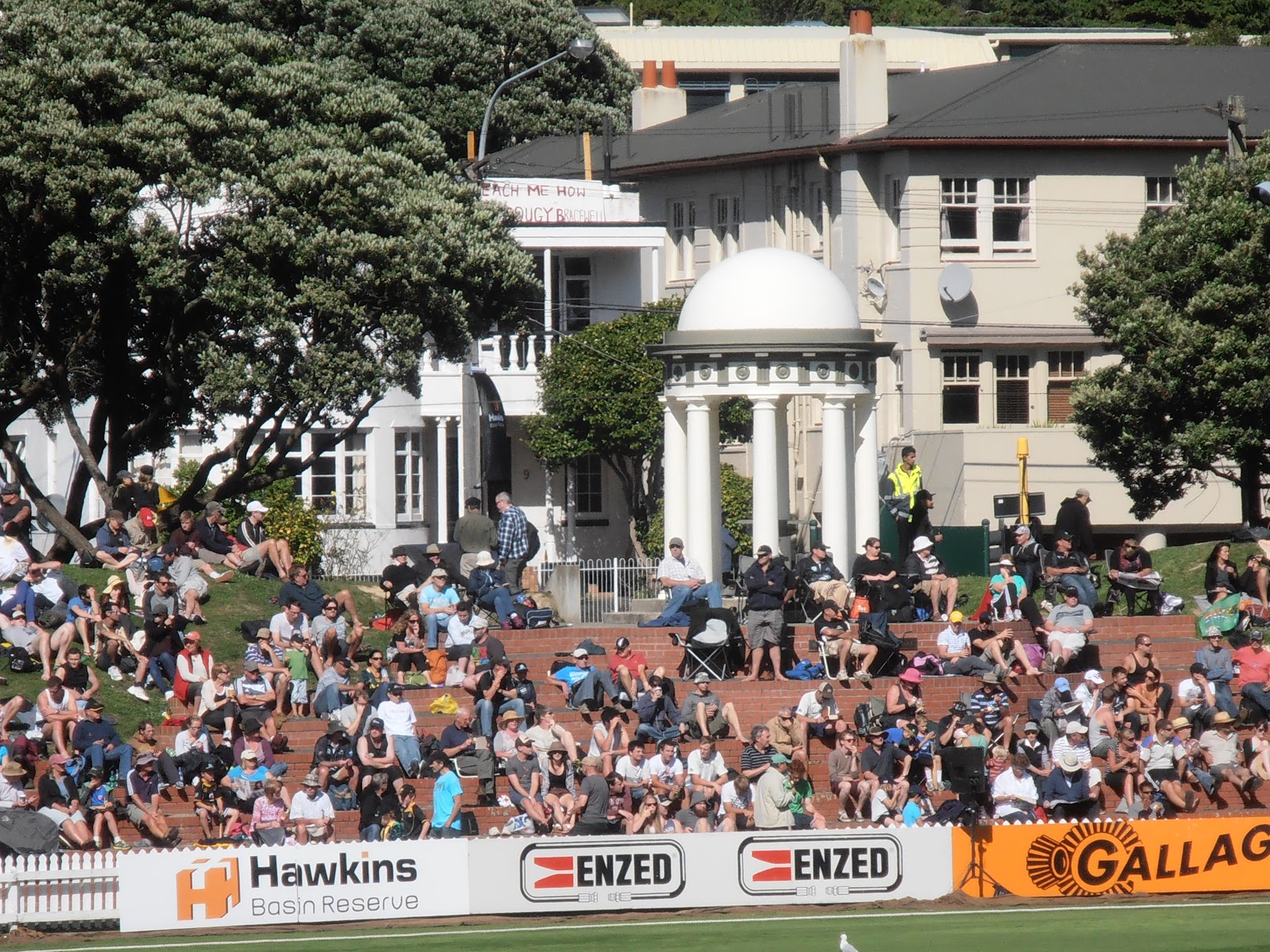
The Basin was perfect today, pleasantly full, but not crowded, and the sun shining from first to last. There is no better venue for Test cricket anywhere. You get an educated crowd here too. According to CricInfo, the Wellington Grammar Police, in which I serve as a special constable, were present. Apparently, there was a sign at one end saying “when bowling from this end remain seated”, causing someone to shout to Gillespie as he ran in that he should be sitting down.
England are here next year, so we have something to look forward to over the southern winter.


Saturday, March 24, 2012

New Zealand v South Africa, ODI, the Cake Tin, Wellington, 25 February 2012

http://cricketarchive.com/Archive/Scorecards/345/345878/345878_bbb.html

The optimism of New Zealand cricket fans of which I wrote in the previous post evaporated like a puddle in the desert over the following week. It may have been a mirage all the time.
Things started to go bottom-up at Hamilton in the second T20 when Richard Levi, unjustly mocked in these columns after the first T20, hit a world-record 13 sixes on his way to a century and a total that the home team could not get close to.

Three days later New Zealand contrived to lose when a win appeared as inevitable as Hamlet’s death. Needing 17 from four overs with six wickets left, they finished three short, despite being gifted a free hit off the last ball.
The first of three ODIs, played at the Cake Tin, was all about key moments and seizing the opportunities they offered. South Africa controlled the turning points and won the game by six wickets with more than four overs to spare, though it was not quite as straightforward as that might suggest.

The great attraction of the day for me was the first chance in eight years to watch Graeme Smith and Jacques Kallis, and the first-ever to see the game’s leading fast bowler, Dale Steyn.
Smith has handed the one-day captaincy on to AB de Villiers and spent most of the game as a boundary fielder, an art of which he is not the most athletic of practitioners.

Kallis is, at last, recognised as a great player. Despite having been in most people’s World XIs for a decade or more, his unspectacular methods have left spotlight on others. Kallis is not as silky as Tendulkar, as punishing as Ponting, or as dominating as Sangakarra, but he has a higher Test batting average (57.02 currently) than any of those three, or than anybody else since Garfield Sobers, come to that. There is also the matter of the 274 Test wickets he has taken.
Steyn left the new ball to Morne Morkel and Landabo Tsotsobe, both of whom exploited the extra bounce in the pitch early on, and kept the batsmen on the back foot. When Steyn came on he began with a cracker, a full length ball that swung away from Nicol late. There were several more like that, but there were scoring opportunities too, and twice in Steyn’s first over Nicol drove him to the boundary.  He was a bit rusty after a month off, but did more than enough to support the view that he will run through New Zealand at some time during the tour, probably more than once.

I have no idea who Brendon McCullum prays to, but the deity concerned was putting in overtime on the New Zealand captain’s behalf today. His former Otago teammate Chris Gaffney gave him out first ball, padding up to Tsotsobe. McCullum immediately called for a review, which seemed bold given that one failed review and that would be that for the innings. But he is captain, and KiwiEye (or whatever the local variant is called) vindicated him, showing the ball (just) passing over the stumps.
McCullum drove hard at the next ball, which went low to cover, where it was dropped. Three overs later he resorted to the review system for a second time and was reprieved from a caught behind decision, this time by Richard Illingworth, the former Worcestershire slow left-armer. On 11, a third review went his way, this one wasted by South Africa, a clear inside edge negating the lbw decision that they sought.

McCullum reached 56 from 67 balls, including two sixes, and put on 79 for the third wicket with Williamson, before being out to a magnificent catch on the square cover boundary by Peterson. But he never looked at his best. CricInfo’s statistics editor S Rajesh recently analysed McCullum’s record at the top of the order in ODIs, and the results are not flattering. He finds that McCullum has the worst average, and, more surprisingly, the worst strike rate of any of the regular openers of the top eight teams over the past three years.
http://www.espncricinfo.com/magazine/content/current/story/555013.html

This makes it worth asking again where McCullum should bat in ODIs. I stick to the view that he would be best as a finisher, batting at six or seven and guiding the innings home. If it was good enough for Michael Bevan and Michael Hussey (though Hussey bats higher now), then it should be good enough for McCullum. With Vettori gone from the lower middle order the need for somebody in that role has become more pressing.
Jesse Ryder got a good reception despite copping much of the blame for the T20 loss at Eden Park. He had made only six when he top-edged a catch to deep square leg.

Williamson reached his fifty from 59 balls, faster than McCullum without appearing to be so. With James Franklin he navigated New Zealand unscathed through the rapids of the batting powerplay between the 36th and 40th overs.
Since the discretionary powerplays were introduced in 2005, batting sides have rarely opted to use theirs before the last seven or eight overs of the innings. Now, in order to spice things up in the supposedly dull middle period of the innings, the ICC has ruled that the batting and bowling powerplays must be used between the 15th and 40th overs. It is as if the hosts of a party decide to ask guests to arrive at five rather than eight, in the belief that this will lead to three hours’ more fun. As we all know, what actually happens is that everybody goes home at half past seven, leaving the rest of the evening an anti-climax.

Such is the effect of the change on the shape of one-day innings. In quite a number of domestic one-day games the loss of two or three wickets in the powerplay has meant that the closing phase of innings were spent with the lower order scratching around for runs, rather than with big shots being played by the leading batsmen.
So the approach adopted by Williamson and Franklin was wise. They got runs where they could by playing orthodox shots, but made not getting out their priority. The risks to wickets that aggression during the powerplay involves means that captains might consider taking the batting powerplay immediately after the bowling powerplay, to get it out of the way.

Unfortunately, the advantage was lost when Williamson was caught behind of Tsotsobe in the over following the powerplay, and the momentum was hard to maintain against Steyn and Morne Morkel in the closing overs. Only 54 came from the last eight, leaving South Africa with 254 to win, which appeared at least 25 short of a testing target.
There was early encouragement when both Amla and Smith went early. This brought in Kallis, who immediately looked comfortable. But I had just made a note about how good he was at manufacturing legside shots to short balls despite having almost no room when he was out in exactly that fashion, caught at square leg off Bracewell.

At 35 for three the match was New Zealand’s to win, but coming out to bat was AB de Villiers, who in the recent home series against Sri Lanka averaged 110. Supported first by JP Duminy, and then by Faf du Plessis (whose absence from the Test squad measures the depth available to South Africa) de Villiers took South Africa home in the 46th over, scoring an unbeaten 106 from as many balls. He batted with the ease of somebody solving The Times crossword during a tea break without a dictionary.

The uncomfortable truth that South Africa are a much better side than New Zealand is just dawning on home supporters. This is no disgrace as South Africa are better than pretty well everybody at the moment, England included if the recent debacle in the Gulf against Pakistan is anything to go by. They return to Wellington for the third Test.

Sunday, February 19, 2012

New Zealand v South Africa, T20, the Cake Tin, Wellington, Friday 17 February 2012

http://cricketarchive.com/Archive/Scorecards/345/345875.html

After six years in Wellington, at last! An evening sufficiently warm and windless for it to be a pleasure to watch cricket under floodlights past 10 pm. The game was worthy of the weather, with some quality play evading the format’s attempts to suppress it. It was the first international contest of a tour that features three matches in each version of the game.

In six weeks’ time we will know if the unusually upbeat attitude of local supporters is warranted. This optimism has its origins largely in a pulsating couple of hours at Hobart in December, when productivity in this country slumped as people gathered round televisions to watch the New Zealand attack knock over the Australian middle order only for Warner and Lyon to edge within eight runs of victory before Doug Bracewell sealed New Zealand’s first Test win over the West Islanders in two decades.

Also, the triumph of the All Blacks in the Rugby World Cup has breached the levees of pessimism that habitually protect the Kiwi sports fan from the disappointment borne by unreasonable expectations. National sporting self-belief is at record levels. Nevertheless, the smashing of the Zimbabweans in all forms has been discounted; we don’t like to lose, but neither do we enjoy winning too easily. The South Africans will tell us whether Guptill, Williamson, Bracewell and the rest are genuine diamonds, or merely paste.

Brendon McCullum, captain in the absence of the injured Ross Taylor, won the toss and put South Africa in. Opening the batting were Richard Levi and Hashim Amla. I first saw Amla when I covered some of the South African under-19 tour here for CricInfo in 2001. He was gangly, bespectacled, beardless and bursting with class as a batsman. Amla was picked for the Test team when only 21. The South African selectors persevered with him despite a return of only one century and one fifty in the first couple of years. As with all non-white cricketers picked for South Africa who do not perform to the upper limit of expectations all the time, the accusation was made that he owed his place to racial quotas. In fact, the selectors were making a long-term investment in talent, just as England did with Ian Bell. The statistics show the wisdom of this. Amla’s Test average is 46 and he is No 1 in the ODI batting rankings.

Tonight, he cover drove Mills for six in the fourth over, but was run out in an unusual way next ball. Mills stopped a straight drive, but continued following through, leaving the ball stationary in the bowling crease. Amla set off for a single, but had underestimated Guptill who slid in from mid off to collect the ball, the stumps and the batsman in that order. They won’t underestimate Guptill again, not after today.

The McCullums combined to dismiss Ingram for a duck. Nathan turned one sharply past the advancing outside edge and the younger brother collected the ball at the second attempt and whipped the bails off. The off spinner bowled the first four overs from the Southern End, three in the powerplay, and went for only 16.

Tim Southee came on at the other end and immediately tested Levi’s patience, not to mention his IQ, by pushing mid on back to the fence. The batsman failed on both counts, slogging the first ball after the change straight to the relocated fielder. In the belief that if he’d fall for that, he’d fall for anything, I attempted to find Levi after the game to offer to sell him the Beehive for $500.  

Southee is bowling, at least when the spirit moves him, at over 140 kph, 10 kph faster than a year ago. If he can still swing it at that speed it will take him to the next level as an international bowler. Today, he finished with 3 for 28.

De Villiers scratched around to little effect before driving Roneel Hira hard to cover where Guptill claimed a low catch. The South African captain waited for the TV replay to offer clarification. Of course, it did nothing of the sort. It never does for low catches. We will have to wait for 3D TV to become established before technology can help in this area. De Villiers went anyway, and it seemed the right decision.

New Zealand had something of a strangle on at this point. Kane Williamson conceded only two from his first over and after 13 overs South Africa were only 72 for 4 on a pitch where a par score would be 160-plus. Justin Ontong – a controversial selection ahead of Graeme Smith – addressed the situation in Williamson’s next over by hitting four sixes from successive balls (all to the mid-wicket/wide long-on area), something I had not seen in 47 years of spectating. John Shepherd hit four sixes in one over off Hallam Moseley of Somerset in a Sunday League game at Canterbury in 1973, but they were not off successive deliveries.

Ontong fell to the next ball he faced, Southee pulling off a caught and bowled almost as spectacular as Shane Bond’s to dismiss Cameron White at this ground in 2007. This was representative of a brilliant fielding display. Not a chance was dropped, not a run given away. The difference between the two sides in the field was about 20 runs, the difference between defeat and victory. Another example was provided by Kyle Mills, who dived in from long leg to catch top scorer JP Duminy for 41.

South Africa finished on 147 for six, better than looked likely half an hour before, but not enough to stretch New Zealand, particularly if Martin Guptill could continue his recent form.

Guptill had hit five fifties in as many innings against Zimbabwe; could he continue the run against stronger opposition? A hint came quickly enough with a pulled six off Albie Morkel in the third over. Three overs later the question was answered, first with a six that went into the upper reaches of the stand at mid-wicket. Then came a quite extraordinary repeat, which hit the roof of this sizeable stadium, a feat I would not have believed possible had I not been there to see it. TV estimated the distance as 127 metres. Essex supporters will be pleased to note that the unfortunate bowler was Lonwabo Tsotsobe, sacked by the county for poor effort and attitude last season.

I have often compared Guptill with the great CJ TavarĂ©, on the basis that he concentrates on defence in Tests, but unleashes hell in shorter forms. Even I have to admit that the roof would have been beyond Tav’s range (though I was there when he put Vic Marks in the Tone at Taunton one sunny day in 1982).

If you don’t like Guptill enough already, consider this: he has turned down the chance of an IPL contract to improve his game in county cricket. For Derbyshire! Cricket’s Albert Schweitzer.

Guptill was 78 not out at the end, well supported by Brendon McCullum and Kane Williamson, but it was by no means a straightforward progress. Indeed, with 30 required from four overs, the situation was uncomfortably redolent of the last sporting fixture I saw at this venue, the Rugby World Cup quarter-final between Australia and South Africa. For much of the game nothing seemed more certain than that the Springboks would romp away at some point, but the Wallabies held on for an unlikely win.

You could tell it was getting exciting because at least half the crowd abandoned alternative forms of entertainment, such as drinking, starting Mexican waves, mesmerising each other with shiny objects, shouting and drinking, and started watching the cricket. In the event, the South Africans blinked, just as their meatier compatriots had done, and the game was secured when Jimmy Franklin cover drove a boundary with four balls to spare.

It is foolish to draw any conclusions from a single T20 match, particularly when the South Africans have Kallis, Smith, Steyn and Philander in reserve for the proper stuff. But New Zealand’s performance today makes the prospect of what is to come all the more relishable.

Monday, January 16, 2012

Cricket grounds in winter: St Lawrence Ground, Canterbury

Unlike my visits to Bath and Bristol, this was not a return after a long absence. I have had a wander around the St Lawrence Ground on almost every occasion on which I have been back to the UK, and have watched cricket there several times, most recently in April 2010:


This time, I was looking forward, not back. My purpose was to inspect the redevelopment, which, after some delay, has got under way in the 18 months since I was last here. We are promised that it is Kent's financial salvation, but at what other cost? On a glorious November afternoon, quite nice enough for there to be play, I went to find out.
Continuity is what I was looking for. That it would remain recognisably the same ground as that on which I first watched cricket on in the sixties, or that on which Les Ames and Frank Woolley batted and Tich Freeman bowled, come to that. It is pleasing to report that, so far at least, impressions are favourable.

The old practice area, an attractive part of the ground backed by a converted oast house, has disappeared under housing. Alec Stewart will be pleased. In a recent edition of The Cricketer, he blamed the St Lawrence practice pitches for England's early exit from the 1999 World Cup. It was not clear where they have been relocated. Nor did I work out how the new owners get to and from their homes. Will they have to pay admission on matchdays?
There is more building going on off the main driveway, consisting of a new administration block and other facilities including, it was announced this week, a small Sainsbury's. This is very good, though they had better lay in extra supplies of Scotch eggs next time I'm there. Every ground should have a supermarket close by. Folkestone had one right outside, one of the reasons why it was such a great place to watch cricket. Here in New Zealand, Seddon Park in Hamilton has a shopping centre just across the road. I once had a haircut and a sit-down lunch and was still back in my seat by the time the first ball of the afternoon session was bowled. More building, including a hotel on the Old Dover Road side of the ground, is to follow.
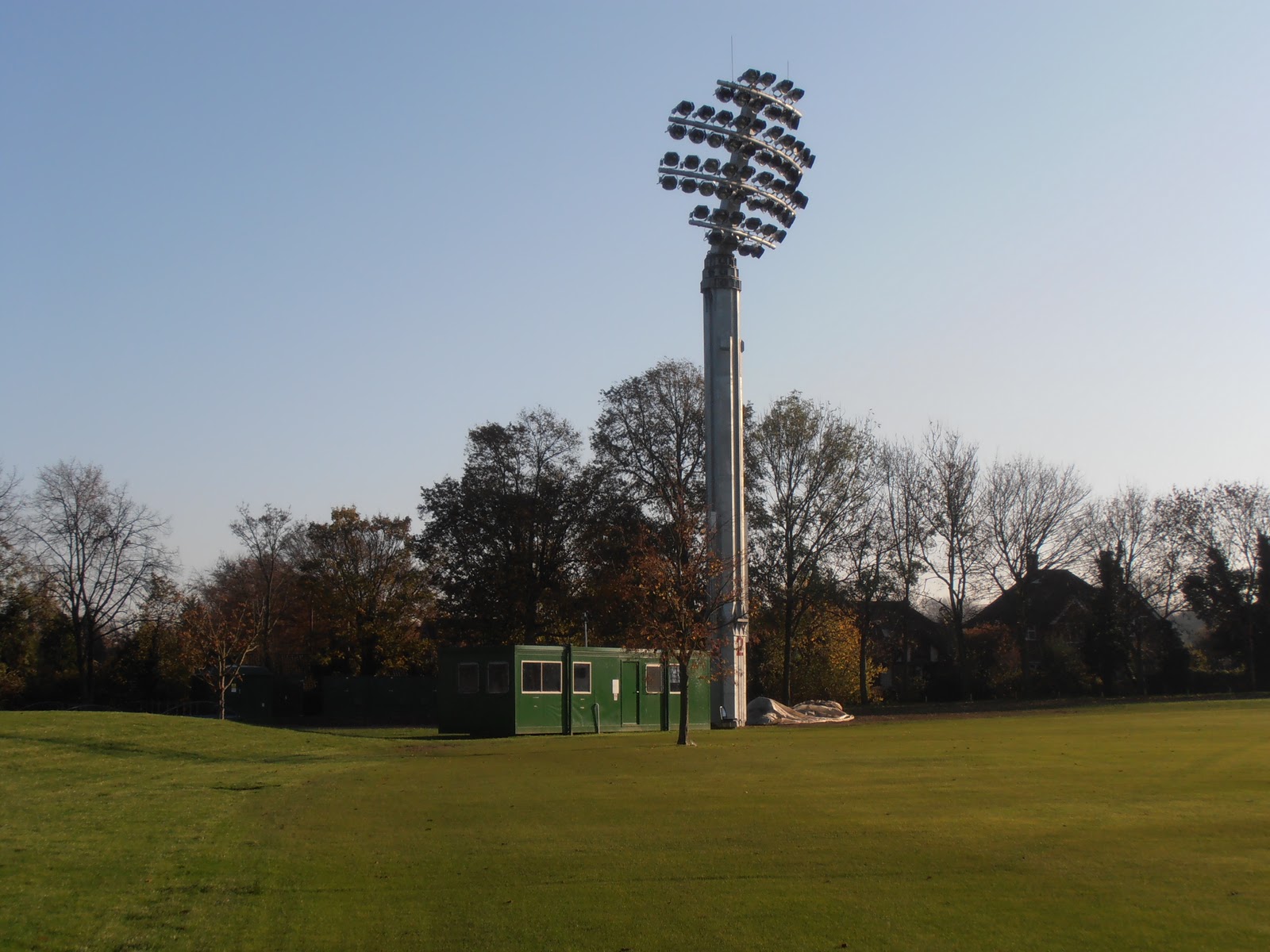
Five floodlight towers have been installed (all telescopic so as not offend to the sensibilities of the residents in this well-heeled part of town): next to the Leslie Ames Stand, beside the indoor school, next to the Frank Woolley Stand, behind where the white scoreboard used to be and near the site of the old lime tree. I disapprove of course, but not on aesthetic grounds. Floodlights, lit or not, add a certain grandeur to sports grounds. It is simply that conditions in England are not suited to floodlit cricket. I have long thought that English cricket should make more use of long summer evenings with matches in June and July starting later and finishing at 8 or 8.30 pm. It would be perfectly possible to begin T20 games at 6 pm, or even 6.30 pm in the north. Outside the height of summer, conditions are rarely conducive to after-dark viewing, spectacular though it can be.

The good news is this: far from being ruined as some of us feared, the stands that define the playing arena have been entrenched and enhanced. I worried that they might do away with the wooden stand, or pavilion annexe as it was officially known. But it has been given a proper name at last, and what a good one: the Underwood and Knott Stand. The very place from which I used to watch the two great heroes of my youth now named after them. Splendid.

Best of all, the regretable late-sixties brick dressing rooms have been extended and transformed so as to fit in perfectly with the wooden, red-tiled buildings on either side. They look as though they might have been there since 1906, when the Underwood and Knott Stand was built.
The shop was open and I was sufficiently relieved and impressed by what I had seen to buy a club polo shirt, so the white horse will be seen at the Basin this summer. The redevelopment seems to be having the desired financial benefits too; the club has just announced a six-figure profit for the past year. Too late to keep Joe Denly on the premises, but a sign that things will soon be on the up, we hope.

Thursday, January 12, 2012

Wellington v Northern Districts, T20, Basin Reserve, 11 January 2012

http://www.espncricinfo.com/new-zealand-domestic-2011/engine/current/match/526638.html

The pohutukawas are out so the Basin is wrapped in cardinal's scarlet, even if more fitting attire for today's match – a bottom-of-the-table affair with neither side having a realistic chance of qualifying for the final – might be the rough-hewn vestments of a country priest.

The shorter format has the cricket world in its grip as the year begins. Two games from the West Indies T20 competition were on offer on the telly earlier in the day. The first was Sussex v the Netherlands in Antigua. Only a decade ago such a contest in such a place would have seemed the stuff of fantasy. Later, there was a game from the Big Bash competition. Who knew that the Australians could do onomatopoeia?

Before the game began the teams lined up for a minute's silence in memory of the eleven victims of the ballooning accident that took place last weekend 40 miles or so from Wellington. The home players wore black armbands. With our small population, tragedies of this kind are more deeply felt in New Zealand than they are in more populous countries. But these memorial moments at sports fixtures now happen so often that they are in danger of becoming mere tokenism (“who is it today then?” I have heard people say as we rise to make solemn observance). The Australians, it sometimes appears, rarely take the field these days without their armbands. It cannot be long before the marketing people bring their characteristic soullessness to this, mark my words: “Granny dead?The Woolongong Wombats have a space on their armband for her and, in return for a large sum, will stand around looking non-specifically sad for several seconds before play (unless it rains in which case Duckworth-Lewis applies)”.

Northern Districts won the toss and chose to bat. Kane Williamson opened and anchored the innings with 53 from 41 balls. He continues to look a class above almost everybody else at this level. When he was out the innings lost momentum. Scott Styris scored 23 without looking convincing. He was dropped off a towering top edge, wicket keeper Brendon Taylor waiting under it for an age before the Wellington wind made a fool of him, as it will. He barely touched it. Andy McKay was outstanding with one for 16.

The last over started with Northern Districts on 138. Wellington appeared to have every chance of restricting the total to below 150, which would leave the home team in the box seat. Vettori (hirsuiteness update: short hair, big beard, a look of the ayatollah about him) took a single from the first ball leaving Peter McGlashan to face Mark Gillespie. My mind went back to a 50-over game three years ago when the same combination faced each other at the climax. McGlashan then needed nine from the last two balls for a one-wicket win. He dealt with the matter straightforwardly by twice hitting Gillespie past the scoreboard and out of the ground for wind-assisted sixes. Today it seemed that McGlashan had remembered those events while Gillespie had forgotten. The second ball of the over was lifted onto the roof of the JR Reid Gate, the third clearing the boundary squarer. A third successive six enabled McGlashan to demonstrate that he is New Zealand's most proficient reverse hitter, as he pulled the ball over the cover boundary. A four in the same manner with a single to finish took Northern Districts to a formidable 162.

Three wickets fell in the first four overs of the reply, and that was more or less it. One of T20's main weaknesses is that there is no coming back from a bad start. Rory Hamilton-Brown, the Surrey captain brought in for the second half of the T20 competition in the manner of a pilot coming on board the Titanic just as it hits the iceberg, hung around for seven overs as opener, but scored only seven runs, a Boycottian rate of progress in this context.

The whole Northern Districts attack was proficient, with Vettori applying a mid-innings strangle as Derek Underwood used to do of a Sunday afternoon, and Tim Southee outstanding. The wonder is how a side so full of talent could find itself superior to Wellington only on run rate at the start of the game. Another of T20's issues is that it is too great a leveller.

It will be a month before I can watch more live cricket, but then it will be the South Africans, in town in all three forms, so it will be worth the wait.

Friday, January 6, 2012

Cricket grounds in winter: the County Ground, Bristol

Not even its best friends would call the County Ground attractive. On one side there is the grey stone and narrow windows of what used to be the orphanage. Jack Fingleton noted the sad faces of the orphans peering over the fence when the Australians visited in 1948. Opposite is a back view of the terraced houses of Kennington Avenue. The pavilion is an asymetrical arrangement, again in trademark grey, that still looks a bit of a hotchpotch despite the redevelopment of the mid-nineties. There are no views of note. The fathers of Gloucestershire cricket might have had more foresight and located their headquarters in Clifton, or on the Downs, rather than in artisan Horfield.

Yet, if I had to to nominate the place from which I would watch cricket for the rest of eternity the roof of the Hammond Room at the County Ground would be in serious contention.

I lived in Bristol for 19 years, from 1978, when I went to Bristol University, to 1997, when I left for New Zealand. I must have watched more cricket at the County Ground than anywhere else, apart of course from the St Lawrence Ground, Canterbury.

Though I have been back to Bristol several times over the past 15 years, I had not returned to the County Ground until last November. I found it largely unchanged, apart from the pleasing addition of the Jessop Stand on the site of the old Jessop Tavern. This might be thought surprising, given that the ground is now a regular international venue, with an ODI or a T20 international most summers, but on those occasions the majority of spectators are accommodated in temporary stands.

Watching international games on television being played before a full house, it has sometimes occurred to me that there were more spectators present than there had been in whole seasons, possibly several added together, in my time at the ground.

Alone of the county headquarters, Bristol has always been something of a poor relation. The season would begin there (it was a dank, drizzly day when I visited, but up on the Hammond Room roof it was warmer than was usually the case in April or early May) but when summer got into its stride the county would decamp north, first to Gloucester and then to Cheltenham for the festival. It was common for there to be little of no cricket for six weeks or more at the height of the season. Then, with autumn's chill in the air, it was back to Bristol (this pattern has been reinforced by the modern obsession with T20: in 2011 there was no Championship cricket at Bristol between 2 June and 30 August).

So why, when the evidence presented so far would suggest otherwise, do I nominate the Hammond Room roof as a likely location for eternal spectating?

Good humour and conviviality have much to do with it. The Bristol faithful went to the cricket to enjoy themselves, whereas too many in Kent seemed to prefer any opportunity to disapprove of something. The roof was an open-necked sort of place, whereas ties – many attached to stuffed shirts – predominated on the top of the pavilion at Canterbury.

In part, the different attitudes were the result of recent history. The seventies was Kent's great era: nine trophies in as many years. Success was expected and there was disgruntlement when it did not arrive. Gloucestershire had won the Gillette Cup in 1973 and the B&H Cup in 1977 (beating Kent in the final), but winning was neither habit nor addiction. During my period in Bristol, Kent won only one trophy – the Sunday League in 1995 – and Gloucestershire nothing (though a golden period followed my departure, with seven one-day trophies in six seasons from 1999). In Kent the apoplexy increased with each year, but in Bristol it was accepted as the natural state of things, and we roof dwellers continued to enjoy the cricket whatever the result.

A look at a Gloucestershire line-up in the mid-eighties suggests that expectations might have been a bit higher. For a start, there was Courtney Walsh, with 869 wickets at an average of 20 over as distinguished and dedicated a career as any overseas player has had in county cricket. Gloucestershire chose their overseas players wisely; Walsh followed the equally committed Mike Procter, and Zaheer Abbas and Sadiq Mohammad are remembered fondly too. The classy Bill Athey, who might have won many more England caps, led the batting, supported by some good county players, such as Andy Stovold, Phil Bainbridge, Jeremy Lloyds and Paul “Human” Romaines. The peerless Jack Russell chattered away behind the stumps, while David “Syd” Lawrence joined Walsh in county cricket's most fearsome attack. David Graveney led intelligently, bowled good left-arm spin and rolled over in the gully just too late to stop the ball several hundred times a season (this was not a great fielding side). There was a third place in 1985, and a second the following year (but well behind Essex, the champions) and that was as close as the team came to winning something in my time.

Incidentally, Syd Lawrence's career was cut short in 1992 at the Basin Reserve of all places, when his kneecap split. He made a forlorn comeback five years later, by which time his second career as a bar/restaurant owner had contributed to his growing to the size of a small bus. In his first game back, against Hampshire at the County Ground, he set out off to the boundary in pursuit of the ball but was slow to get steam up and was overtaken by one of the young guns, who collected the ball and turned ready to throw it to the keeper, only to find Syd, whose stopping distance now crossed postcodes, bearing down on him. Player and ball were wiped out as Syd passed through, and all parties ended in a heap over the boundary. It was several minutes before play resumed, not because anybody was hurt, but because it took that long for everybody on the ground to stop laughing.

There was also the day when the sightscreen blew over, sending the bike that was tethered to it flying through the air. This sort of thing was always happening at Bristol, which was why it was fun to watch cricket there.

It was also the scene of the zenith of my own playing career, one Sunday afternoon in August 1988. I got a call-up from a friend inviting me to play for a team representing whichever insurance company owned the ground at that time. It was the holiday season and they were clearly desperate. I did not enquire how many people they had been turned down by, but suspect that a figure in the low eighties would be adjacent. The team was of a standard well above my usual village-green level, and was playing a Welsh side at least a couple of grades above them. I batted at ten, making three with a couple of late cuts so subtle that they were mistaken by the undiscriminating for edges.

It was in the field that the difference between recreation or school field cricket and that on a first-class ground became clear. Several times I turned from mid on to chase a ball on its way to the boundary. I found that the bumps and hollows that would slow the ball down more than I slowed down were absent, so I stayed two or three yards behind it all the way to the rope.

Towards the end of the game my moment of glory came. The ball was top edged and it soon became clear that it was coming down straight at me, I did not have to move. What disappointed me was not that I failed to catch it, but that I failed to touch it. I was never asked again.

Tuesday, December 27, 2011

Cricket grounds in winter: the Recreation Ground, Bath

As well as my expedition to the Crabble Ground in Dover (http://mylifeincricketscorecards.blogspot.com/2011/11/in-search-of-crabble.html) I returned to three other old haunts during my recent trip to the old country. This post and two to follow will record these visits, and the memories that I took with me.

You would not think it on a drizzly November day like that on which I was there, but the Rec in Bath is one of the five most attractive grounds on which I have watched cricket. Seeing as you ask, Pukekura Park, New Plymouth tops the list without question. Bath would certainly be on it. The other three might be subject to change according to mood, but today they are the Crabble; New Road, Worcester (before they knocked the old pavilion down); and Mote Park, Maidstone (Disgusted of Tunbridge Wells is filling his pen with green ink having read that, but the rhododendrons are not out all summer).

The Bath Festival – consisting of two three-day matches and a Sunday League game or two when I first attended in the eighties – was usually held in mid-June, with the sun shining from a cloudless sky, the hills that surround the city collecting the heat in a bowl, marquees around the boundary, the Abbey looking on over mid-wicket and the sound of the Avon gushing over Pulteney Weir. On such a day all these grounds share a timeless quality, regardless of whatever modern-day commercial ephemera are on view. Catherine Morland could pass through the Rec on her way to the Pump Rooms without looking at all out of place.

In those conditions it is unsurprising that big scores are at the forefront of the memory rather than match-winning bowling performances, or that IVA Richards features prominently, particularly when Kent were the visitors. In 1986, on a day just like that described above, his forceful, fluent 128 set up Somerset to score 433 for six declared in just 98 overs, this against a Kent attack that, on paper at least, was as good as the county has fielded: Dilley, Alderman, Ellison and Underwood. Brian Rose and Vic Marks (who could be an entertaining batsman in an anarchic sort of way) put on 167 for the sixth wicket to set up an innings victory, Joel Garner taking nine wickets.
http://cricketarchive.com/Archive/Scorecards/47/47337.html

There is often poignancy in a scorecard. We could not have known as we enjoyed the spectacle that this would be the last time when the West Indian duo would combine to win a match for the county; the great Somerset schism took place later that summer, and then they were gone.

It also occurs to me that early that sparkling Saturday morning Graham Dilley would have bowled to Peter Roebuck. Both have died these past few weeks. As I write, I am watching Australia taking on India in the Boxing Day Test, and missing Roebuck's judgment and wit, on the radio and in print. Bath was his home town.

Things did not always go Richards' way against Kent at the Rec. In a Sunday League match in 1981 the Antiguan all-rounder Eldine Baptiste, making his competitive county debut, found himself bowling at his legendary compatriot. And he got his man, lbw for a duck. I never saw a bowler happier to take a wicket. Somerset were shot out for 136. Laurie Potter (one of many whose talents were squandered by Kent in the eighties), also on debut, took four for 27, while Derek Underwood, a Scrooge on Sundays, conceded only eight runs from eight overs.

The finest innings I saw at Bath was not by Viv Richards, or any other Somerset player. It was Mike Gatting's 196 in 1987. Gatting was one of the best players I have seen at county level. That day his runs came from only 269 balls (though the report in Wisden is more excited by Martin Crowe's final-day 102 from 109 balls on a drying pitch, which unfortunately I did not see).

The Rec was also the place where I came as close to death as I ever have at a cricket ground. It was in 1985, Gloucestershire were the visitors and had made 300 for nine when Courtney Walsh took a fancy to Vic Marks' off spin, hitting him high, long and often into the very seats at long on where I was in residence. It was like being under Howitzer fire down there. Twice I had to take last-second avoiding action (What's that? Why did I not try to catch it? You clearly have no idea who you are talking to).

The last Championship match at the Rec was played five years ago. Last season it staged only a measly T20 fixture, which is like hiring an opera house for a shove ha'penny contest. The fact that Bath RFC (which shares the ground, the rugby pitch taking up the area next to the river, while the cricket field is on the eastern side of the field) has risen above its proper station to become one of the country's leading teams does not help. What used to be a temporary stand on the cricket side of the rugby pitch has now become a grander, permanent structure, which precludes the use of the rugby pitch as a car park (the use for which we Bristol supporters think it best suited). The pavilion is obviously in need of attention; perhaps they use the rugby facilities these days.


So blissful, lazy Championship days in the sun belong in the past as much as the Roman Baths and the Jane Austen Museum, which is a shame. The next two posts will feature visits to grounds where the real thing can still be seen.

Thursday, December 8, 2011

Wellington v Otago, 50 overs (reduced to 40), Basin Reserve, 4 December 2011

http://cricketarchive.com/Archive/Scorecards/349/349234.html

New Wellington coach Jamie Siddons has all the qualifications you would want for the job. The scorer of most runs in the Sheffield Shield until overtaken by Darren Lehman and Jamie Cox, he made an appearance in Australia's one day side before embarking on a coaching career that has taken him from South Australia and the national set-up under John Buchanan to being head coach of Bangladesh for four years.

But his most important attribute is that he has no hair. This means that there is no danger of him being injured in attempting to pull it out as he watched Wellington once more pick defeat from the pocket of victory with the expertise of a Victorian scallywag, as occurred on Sunday at the Basin. Several times his team was within a couple of proficient overs of taking the game away from Otago, only to go down by six runs in the evening gloom.

For most of a rainy morning it appeared unlikely that there would be any cricket, but play began with sufficient time for a 40-over game on a Sunday afternoon, just like the old days. It was thoroughly pleasant, warm despite the heavy cloud cover and – here's a word used to describe the Basin no more than once a decade – still. The pohutukawas could barely restrain themselves from bursting into a cascade of scarlet.

I arrived in time to see Otago succumb to the waft-aimlessly-outside-the-off-stump epidemic that is ravaging cricket here; New Zealand's finest had gone down to a particularly virulent strain in Brisbane an hour or so before. Aaron Redmond was first, followed by Craig Cumming and Nathan McCullum. Neil Broom, with 38 from 44 balls, played well before skying Woodcock to Rhodes, coming in from the cover boundary.

There was also a Bracewell, as there is in most New Zealand teams; the name is now as common as Jones in the valleys. An understanding of the Bracewell family tree is as essential as is that of the Tudors to a student of sixteenth century England. This was Michael, nephew of John and Brendon and cousin of Doug. By the time I had worked that out he was gone, lbw to Jeetan Patel for a duck.

When Wells swept Woodcock to deep square leg Otago were 97 for six with more than half their overs gone. That they accrued a final total of 219 was largely due to an intelligent and determined 55 from Jimmy Neesham, a 21-year-old Aucklander in his first season with Otago. He was well-supported in seventh and eighth-wicket partnerships by Derek de Boorder and Neil Wagner. The Otago dressing room applauded every run as if each were the product of a Jack Hobbs cover drive, a surfeit of enthusiasm filling the gap left by the departure of discrimination.

But they were helped by some poor cricket from Wellington. There were too many loose deliveries. Two chances were missed in Woodcock's seventh over: a difficult catch to Pollard in the covers and as simple a stumping chance as debutant wicket-keeper Craig Cachopa could have wished for. Barry Rhodes spilled a straightforward boundary catch two overs later.

Wellington skipper Grant Elliott had impressed earlier in the innings, maintaining close catchers longer than is usual, but later he changed the bowling as often as a super model changes her shoes. There is merit in allowing bowlers (especially spinners) to build up pressure. Bringing himself on late in the innings did not work either: Neesham hit him over the scoreboard.

Even so, in good batting conditions 220 in 40 overs was eminently attainable.

Michael Papps dominated in the first part of Wellington's reply with a robust fifty, full of trademark pulls and cuts. Papps has moved north after ten seasons with Canterbury. He will be an asset, but whether keeping in the game a 32-year-old whose international days are several years behind him is in the wider interests of New Zealand cricket is open to question. Ten years ago, when there was less cash around, he would have retired, leaving a space for a young player.

Meanwhile, Neesham was proving as potent with the ball as he had been with the bat. He accounted for Boam and Elliott with slower deliveries. When Woodcock was bowled by Ian Butler in the 28th over Wellington needed 94 to win, having let the rate required drift over the previous half dozen overs. Nick Beard bowled a tight spell of slow left arm from the northern end.

Everything now depended on James Franklin, who batted with assurance and some style throughout. He was well supported by Cachopa, until the little keeper attempted a dilscoop, and ended up flat on his back, stumps spreadeagled. The Otago bowlers did their bit: both Neesham and Wagner bowled wides that went to the boundary (I was looking forward to seeing Wagner, the great hope of New Zealand bowling when he finally qualifies next year, but today he had a bad day, as anyone can).

We waited for Franklin to produce the big over that would swing the game. Perhaps T20, in which Franklin has been very successful as a batsman, has created a false sense of empowerment, the feeling that the the big hit can be rolled out at will. Here, thanks in part to more good bowling from Beard, the moment never came, and Wellington began the final over needing 12.

Neesham was brought on to replace Beard, which I still think was a mistake, so well was the spinner bowling. The outcome vindicated Redmond's choice, but it was a close run thing. Scott Kuggeleijn (son of Chris, who used to coach Northern Districts and gave short answers to long questions from CricInfo's man) pulled the first ball, a long hop, to the boundary. A leg bye gave Franklin the strike. He sent the ball high in the direction of long off. It seemed at first that it would clear the boundary by some way, but Nathan McCullum had his eagle eye on it, and knew that it was heading straight into his hands. An ounce more power and the game would have been won. Kuggeleijn was also caught at long off, this time some way in from the rope, and that was that.

A fine start to my season of spectating, and it was free. As with four-day games, it seems that the money taken at the gate would not have paid those who collect it. There was no food on sale, and the game was not advertised. The weather meant that the game was not expected to start, so it is unfair to draw too many conclusions from the sparse crowd. But there is something of the self-fullfilling prophesy about this approach, and that domestic cricket appears to bestaking everything on T20, which has the prime holiday period to itself, worries me.

But I was not as downcast as Jamie Siddons, who stormed into the rooms leaving the air blue behind him.


A feast of 50 over finals at the Basin Reserve

  Men’s eliminator final, Wellington v Central Districts Women’s final, Wellington v Northern Districts Men’s final, Canterbury v Centra...