Sunday, January 4, 2015

New Zealand v Sri Lanka, 2nd Test, 2nd day, Basin Reserve

http://www.espncricinfo.com/new-zealand-v-sri-lanka-2014-15/engine/match/749779.html

Let me take you back, my friends, to the December of 1946. At the Sydney Cricket Ground on the 13th of that month, Don Bradman made 234 against England. It was his eleventh test double century. The next time a batsman scored his eleventh double century was today at the Basin Reserve, and I was there.

Once in a while you wish for something very, very hard and it comes true. I wished for a Kumar Sangakkara century and got a double.

The match situation—five down and 143 behind at the start of the day—constrained Sangakkara from deploying the full range of his talent. He was a great actor performing at a matinee, holding something back for the second house. But a bad first session would have lost Sri Lanka the match, and the series. Now, even if New Zealand bat all day tomorrow, getting back on level terms is the best they can hope for as a reward, all thanks to one great innings.

Through the morning Sangakkara’s focus was on accumulation, featuring some astute running between the wickets with Chandimal. He rarely played a false shot and—the hallmark of a great batsman—always had time to spare. In the afternoon we saw more chocolate-smooth cover drives, back knee almost on the ground, bat over the shoulder in the follow through. There is no sight more pleasing in cricket than a left-hander’s cover drive.

He became a little ragged in the final session as tiredness combined with milking what he could from the tail, to the extent of 148 combined for the seventh, eighth and ninth wicket partnerships. Only then did he offer several chances at the difficult-to-impossible end of the continuum.

One of Trent Boult’s trademark Basin miracle catches—this one half dolphin, half weightless astronaut—was needed to end Sangakkara’s innings, for 203. Every one of the New Zealand team shook his hand before he departed. We should run a cricketing etiquette class; reduced rates for needy Australians.

That Sangakkara is a great batsman is beyond question, but where does he stand among the batting aristocracy? As the best left-hander since Graeme Pollock, I would suggest. Some will favour Brian Lara, and if we are thinking of attack only, I might agree. But Sangakkara combines the fluency of Gower with the obduracy of Lawry and adds something of his own to the compound.

He was well-supported. Chandimal shared a sixth-wicket partnership of 130 without ever quite having his timing, but this did not worry him, suggesting that he has a test-match temperament.

Rangana Herath appears to be the first batsman in test history to choose the airspace over the slips as his preferred scoring area. He got the rough end of the DRS, being given out after more repeat showings than The Sound of Music. Unless it is immediately obvious that the original decision was wrong, it should not be overturned.

The New Zealand openers began the second innings with a 135 deficit and 11 overs to face, something they achieved, though not before some in the RA Vance Stand had begun to applaud Rutherford whenever he left the ball outside off stump, to reinforce and reward positive behaviour. There is a growing feeling that there is a repeating computer glitch that includes him in the test team when he should be in the ODIs.

New Zealand will not be able to put themselves in a winning position on the third day, but could go most of the way to losing the match and drawing the series.

Saturday, January 3, 2015

New Zealand v Sri Lanka, 2nd Test, 1st day, Basin Reserve


Three hundred runs, fifteen wickets. What a perfect distraction test cricket is. Well worth having to be lashed to the heater for half an hour on my return to My Life in Cricket Scorecards Towers so as to mitigate the effects of a day in the teeth of the southerly “breeze”, as we Wellingtonians choose to describe the blastfreezer wind that blights our lives.

The calendar said 3 January; the pitch said St Patrick’s Day. No surprise that Angelo Mathews put New Zealand in. The toss is in international cricket in New Zealand is a meaningless formality, like asking if anybody at a wedding knows any reason why the bride and groom should not be married. This is because Brendon McCullum is, in his own words, “a useless tosser”. He is Superman. He tosses a kryptonite coin.

Tom Latham looked by some way the more secure of New Zealand’s opening pair, yet he was first out, playing at a short ball from Lakmal that he could have left alone. Hamish Rutherford scored 37 from 53 balls, but every shot is the closing scene of a soap opera, leaving you not knowing what will happen next.

Kane Williamson and Ross Taylor took New Zealand through to lunch, the verdancy of the pitch threatening more than it delivered. Is it my imagination, or is Ross Taylor getting more square on? Once or twice there he reminded me, and not in a good way, of the great CJ Tavaré, who would get full-chested against bouncy bowling.

After lunch, it was as if New Zealand’s great year of 2014 had all been a dream. Taylor started it, playing on to Pradeep. That brought in Brendon McCullum, who had been given the keys to the city of Wellington by Mayor Celia Wade-Brown at lunchtime.

He was out first ball, swishing at Lakmal and playing on. I hesitate to say it, given McCullum’s current place at Richie McCaw’s right hand in the New Zealand sporting pantheon, but it was a God-awful shot to play first ball in a test match on a questionable surface.

Only 79 were added after that, and 26 of them were from proper shots by Bracewell and selected grotesqueness from Boult for the last wicket.

Sri Lanka certainly bowled better after lunch, pitching the ball up more and maintaining a stricter off-stump line, but the fact that New Zealand’s three best batsmen all played on (Williamson did so too) is evidence that the pitch was not trustworthy.

In years gone by, the fragile local sporting psyche would have been plunged into gloom by these events, but the recent run of success meant that there was keen anticipation between innings at the prospect of Boult and Southee exploiting the conditions.

The breakthrough came in the ninth over when Karunaratne edged Boult to third slip.

Kumar Sangakkara was next in. Test cricket transcends partisanship, and I was hoping to see a great batsmen make a century. That Sangakkara is a great batsman is beyond question. Only Bradman has made more double hundreds and only him, Pollock, Sutcliffe and Headley, of batsmen who have played more than 20 tests, have done so with a higher average (the admirable Allen McLaughlin of Radio Sport is to be acknowledged as the source of this information).

The Basin crowd rose to its feet for Sangakkara when he passed 12,000 runs in tests, a touching and uplifting moment.

At the other end, Silva became the fourth batsman today to play on, and with delightful quirkiness. His forward defensive sent the ball spinning into the air well above his head. He turned just in time to watch it fall on top of the bails. It was Conan Doyle’s Spedogue’s Drifter come to life.

That was Doug Bracewell’s first wicket on his return to the test team. He took two more before the close. Neil Wagner has reason to be disappointed to be dropped (not a term coaches use these days, but it’s the truth) after a good performance in Christchurch, but it shows how intense competition for places has become. “Depth” and “New Zealand cricket” may now be deployed in the same sentence for purposes other than satire.

So New Zealand won the day. But we may still be blessed with a Sangakkara century tomorrow.

And, did I mention? 1953 Wisden, $20 from the Museum at lunchtime. Perfect day.

Friday, January 2, 2015

Owen Delany Park, Taupo

My Khandallah correspondent and myself have just returned from our Christmas trip to the Waikato (for Christmas, she added the 1958 Wisden to the yellow-spined brotherhood on the library shelves at My Life in Cricket Scorecards Towers, regular readers will be pleased to hear).

There and back we passed by Owen Delany Park on the outskirts at Taupo, in the central North Island. Last year we stopped there to give the dog a run and had a walk round (the accompanying photos are from that visit).
Its location is spectacular, surrounded by forest and overlooked by the dormant volcano Mt Tauhara. On a clear day, the volcanic triplets Mt Ruapehu, Mt Ngarahoe and Mt Tongariro, snow-capped and ready to rumble, can be seen across Lake Taupo. The lake is the biggest volcano of the lot. When it last let loose, in 176 AD, writers in China and Rome commented on the curious colours of the skies, unaware that were looking at volcanic detritus from Taupo. There has been no bigger eruption anywhere on Earth since.


The ground itself is quintessential New Zealand, perfect for watching under blue skies from the roomy grass banks that form the arena.

What a shame then that it is not a cricket ground any more. The park is still a venue for King Country rugby and there was an athletics track marked out when we were there, but there is no longer a cricket block on the main ground. Bat and ball are relegated to the outer ovals behind the stand.

Not so long ago, Owen Delany Park was a regular host of Northern Districts matches, and an international venue too, staging ODIs over the holiday period from 1999 to 2001.


Owen Delany Park and its ineffective floodlights
It was the ground at which I first watched cricket under lights, and from where I first reported for CricInfo, so it has good associations for me besides being a pleasant place to watch cricket.

The floodlit game was played between Northern Districts and Otago in my first New Zealand summer, just after Christmas 1997. I say “lights”, though the pallid luminosity that emanated from the four towers stationed for that purpose around the ground barely warranted the term. The point when the power of the artificial light surpassed that of the natural light would never have been reached under a full moon.

The lack of effective lighting was the main reason for Owen Delany Park’s downfall. Seddon Park in Hamilton acquired state-of-the-art lights in 2002 and took over the day/night games that had previously gone to Taupo. In the last few years, Northern Districts has had an enhanced choice of venues, with new grounds, both with excellent facilities, at Mt Maunganui and Whangarei.

A little under two years later I was back at Owen Delany Park, this time with pen in hand. I had recently forsaken educating for the freelance life, and planned to send CricInfo daily reports on New Zealand A v the West Indians. These were the infant days of digital communication when “wireless” still meant the old wooden radio in your grandparents’ loft. I wrote the pieces at the ground then at the close of play drove back to Rotorua, an hour away, to key them in before dispatching them at (if I was lucky) 56 bytes per second. Yet we were happy then.

The results can be seen here.
The reader is invited to compare my reports with those of the Barbados NationI have yet to hear from Bridgetown regarding my pleasantly worded suggestion that they might pay me for my material.

Shiv Chanderpaul’s double century was the feature of the match. He was then what he is now: the Thomas the Tank Engine of batsmen, not much to look at, but reliable and steady, getting to the destination ahead of the bigger, flasher engines in the shed. Here’s the scorecard.

CricInfo liked this and other unsolicited pieces that I supplied for the daily newsletter that season, enough to give me regular work when a New Zealand operation was set up for the 2000/01 season. Until the money ran out three years later, my patch was pretty well everything south of Auckland and north of Wellington. Taupo was right in the middle of this area, so I returned there often.
The main stand (also the only stand). CricInfo used to operate from benches at the back of the stand.
 

Even by the congenially high standards of New Zealand’s cricket grounds, the hospitality at Owen Delany Park was particularly warm and welcoming. Interesting people passed through and were happy to chat (no doubt seeing my attempts to present myself as a hard-nosed journalist for the sham they were). They included Sir Richard Hadlee, John Bracewell, and John R Reid, who reminisced about the 1949 tour of England.

Our usual station was the radio commentary box where Radio Sport’s Phil Stevens was pleased to have the assistance of CricInfo’s live scorer, usually the excellent Gareth Bedford, and myself.

We reported on plenty of good cricket from Owen Delany Park, notably a couple of one-day games between the New Zealand and South Africa under-19 sides, including Hashim Amla and Johann Botha (then a tearaway quick rather than the bent-armed spinner who was to become South Africa’s one-day captain) for the visitors and Brendon McCullum, Ross Taylor and Jesse Ryder for the hosts. I am relieved that my reports show that, by and large, I could spot who the good players were.

The last ODI to be staged at Owen Delany Park was played between New Zealand and Zimbabwe, just after New Year 2001.  I was there as a spectator. Zimbabwe won the game convincingly, a brilliant display of reverse-sweeping by Andy Flower doing much to get them into a winning position. New Zealand won the second game only for Zimbabwe to take the series with a one-wicket win at Eden Park.

At that time, Zimbabwe were well on the way to establishing themselves in international cricket in a place similar to New Zealand’s: on the second level, but with the capability to surprise the best teams quite often. Mugabe’s tyranny put an end to that, reducing the country to also-rans with no prospect of improvement in the foreseeable future.

Owen Delany Park and Mote Park bear a passing resemblance to each other if the Photoshop of the mind replaces the chalk of the North Downs with Lake Taupo’s igneous outpourings. Both are places where the cricket has been good and the sun bright, but where I am unlikely to set up my folding chair on the grass bank again.


Wednesday, December 24, 2014

Wellington v Auckland, Plunket Shield, Basin Reserve, 11 to 14 December 2014

http://www.espncricinfo.com/new-zealand-domestic-2014-15/engine/match/770765.html

Fourth day

My Life in Cricket Scorecards achieved a lifetime’s ambition at 10 am on Sunday morning; for the first ten minutes of the day it constituted the entire crowd. The first two-and-a-half overs were its private entertainment and it could barely suppress a cry of “Proceed!” before the first ball was bowled.

The early start was down to the weather, which had curtailed progress over the first three days. Play did not begin on the third day until 4 pm when the temperature was measured at six degrees. A penguin wouldn’t accept a free ticket in those conditions. I’m sure that the mercury dropped to similar levels on the Hammond Room roof at the County Ground, Bristol in April days of yore, but I was younger then and my desperation for cricket after the long English winter always set my judgement askew.

So it was not until the fourth day of this Plunket Shield game that I put in my first appearance of the season. Overnight, Wellington were 77 ahead with seven wickets standing, so anything could happen. That’s the delight of first-class cricket: a run chase; a collapse; a canny declaration; elegant attack; sticky defence; the ball turning square; the ball not turning at all; a great catch; a missed stumping; a shambolic run out. Or the whole thing can end in torpid anti-climax. A night at the theatre with a different ending every performance.

One thing was certain: a Cachopa would be involved. There were three of them playing for Auckland: Carl, the all-rounder, Craig, the opening batsman, and Brad, the wicket-keeper. All the size of pixies. In Wellington’s first innings the Cachopii had a hand in nine of the ten wickets.

Today’s script dropped some heavy clues about the denouement almost before the orchestra had finished playing the overture. Left-arm opening bowler Michael Bates removed both the incumbent batsmen in the first quarter of an hour. Stephen Murdoch was caught behind driving at a ball that left him. Tom Blundell was struck on the pads playing across the line. Umpire Ashley Mehrotra took an age to rule. By the time the finger was raised Blundell had already taken several steps towards the rooms.

Another thing that makes cricket the king of pastimes is that even when you have watched for as long as I have it will still conjure something new. Today, when fast bowler Matthew Quinn bowled to debutant Henry Walsh, he did so with seven in the slip cordon, a silly mid off and a mid off. Nobody left to field on the legside then. So when Walsh turned a ball from outside off stump into the vacant acres, as was inevitable, it was the bowler who had to pursue it.

Rob Nicol's 9 - 0 field for Matt Quinn
The best that can be said for this is that it offered Rob Nicol (the Auckland captain) a controlled environment in which to exercise his psychological need to test half-witted theories, rather than exposing society at large to harm.

Walsh lasted for ten overs before losing his leg stump to Bates. It took only a further eight overs for Auckland to finish Wellington off. The most eye-catching feature of the lower-order batting was a series of millionaire off drives from Ili Tugaga, his preferred approach to getting off the mark. When, against expectation, he succeeded in hitting the ball with one of these pieces of speculation, he was caught at mid off for a duck.

That was Carl Cachopa’s third wicket; Bates finished with four for 47.

So what explains Wellington’s subsidence? There was movement, certainly, though the report that described the pitch as “green” was exaggerating, from what I could see at least.

Just as happened when I watched Gloucestershire collapse on the first morning against Kent in September, the ball tended to find the edge of the bat rather than beating it entirely, and most of the edges went to hand. Still, seven wickets had fallen for 50 today, so Auckland’s target of 128 might not be the early Christmas present it seemed.

Opener Jeet Ravel started impressively. He is a tall left-hander with a wide stance and expansive style. A square-driven boundary off Arnel was the shot of the day, but Ravel was out quirkily off the next delivery. As the ball rose off his thigh pad, Ravel attempted to lift his arms clear, but in doing so committed the very indiscretion he was seeking to avoid. He deflected the ball with just enough power to dislodge one bail when it came into contact with the stumps.

Two of the Cachopii—Carl and Craig—were now united. Carl had earlier survived a Gillespie appeal on the grounds that it was too high on the leg, a rare event for one of the brotherhood. The partnership was worth only four when Craig was bowled by a full-length Matt McEwan delivery.

With Auckland 29 for two, Wellington were bouncy. Another couple of wickets and they would be on top.

Colin Munro put an end to such pretensions. Munro is one of those cricketers who takes much the same approach regardless of the format or state of the game. Hard, clean hitting is to Munro what cold baths were to the Victorians: the palliative for all ills.

Here, 59 off 49 balls, 52 of them from boundaries (four sixes), settled the matter. He was particularly harsh on the normally abstemious Arnel.

Munro was out 24 short of victory, but look at the scorecard and you will be misled. It says that he was caught by Walsh. It was indeed Walsh who caught the ball on the long-off boundary, but he was still shuffling his feet to ensure that he did not connect with the boundary rope when he threw the ball to the nearby McEwan, who should therefore be credited with the catch.

McEwan is a bustling medium-fast bowler in the manner and shape of Tim Bresnan. This was his Wellington debut after a couple of seasons with Canterbury. The ball followed him about for a while. He took a fine catch to get rid of Carl Cachopa, running back with his hands above his head, but dropped an even harder chance diving in from the fine-leg boundary in a brave attempt to intercept a Nicol top edge.

It was too late to make a shred of difference anyway. Auckland won the game by six wickets and were top of the table after two rounds. Most of the Plunket Shield will be played while the World Cup is in progress, so I may be a lone spectator again before the season is out.

Sunday, December 7, 2014

Mote Park, Maidstone

On our recent visit to the old country I treated my Khandallah correspondent to a trip to Mote Park in Maidstone. The park contains 450 acres of mature parkland, a 30 acre lake, a stately home and a rich history in which Elizabeth Woodville, Henry VIII, Ann Boleyn, Elizabeth I and William Pitt the Younger all feature.

All of this we ignored.
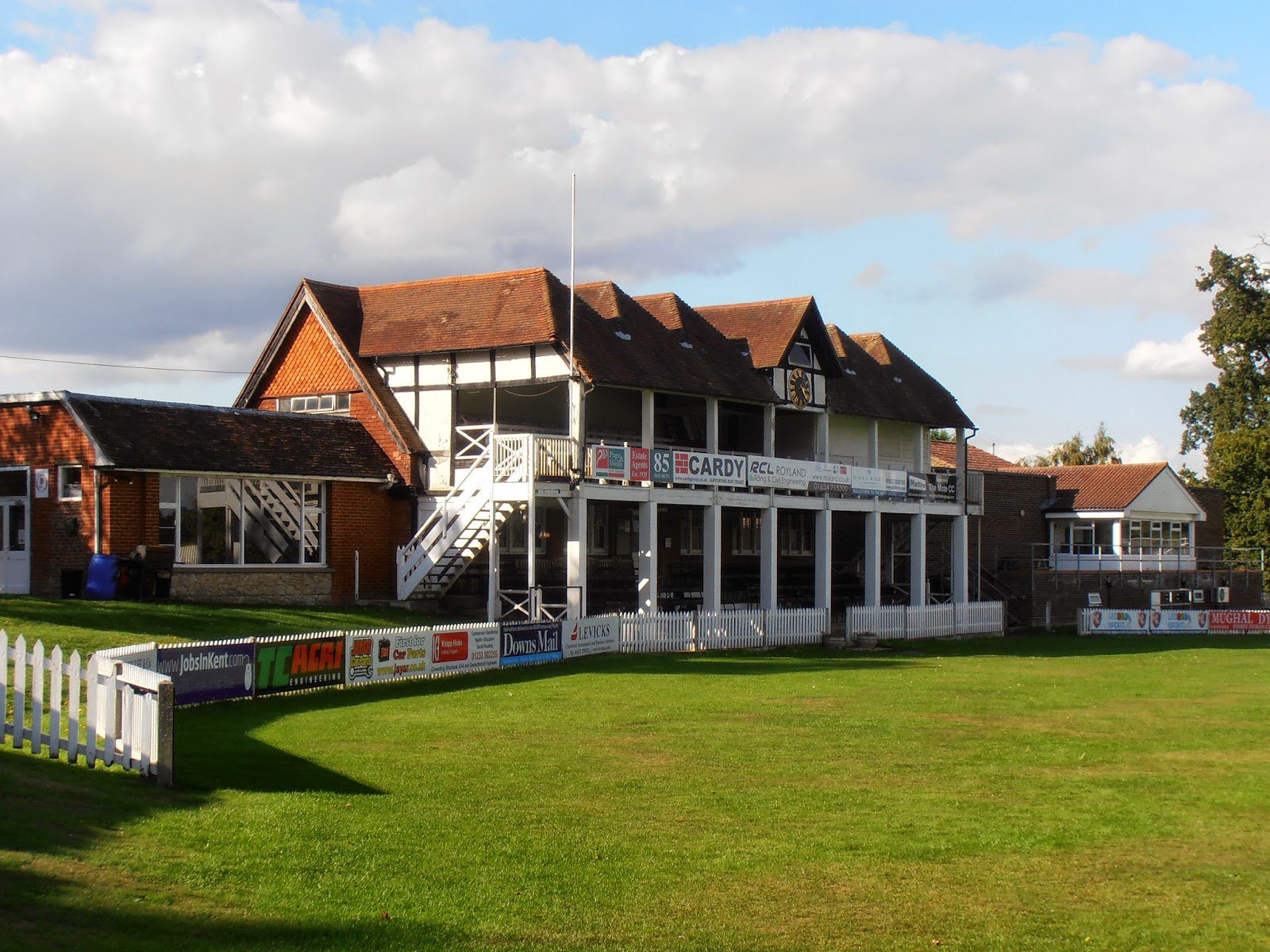
The sole interest of our visit was the north-west corner of the park, where one of the finest cricket grounds in Kent is to be found.

Maidstone Week, usually in the first week of July, sits in the memory as the best of summer. Sun baking a flat, fast pitch from a clear blue sky; the woods across the valley pulsing in a light breeze; Asif Iqbal shimmying down the pitch to send the ball rasping through the covers; the birdsong tempered only by the welcome purr of the ice cream van’s generator.
Of course, the memory tints the image. In 1980, for example, it began raining in the late afternoon on Sunday and there was not another ball bowled until five on Thursday.

The good news is that it is still a cricket ground, unlike the Crabble in Dover for one. It is home to the Mote CC, one of Kent’s most famous clubs, and staged two Kent Second XI Championship games last season. But there has been no county cricket there since 2005 when a dodgy pitch caused Kent to be docked eight Championship points.
Pitches can be put right. The expense of taking cricket to the outgrounds and the period-charm nature of the Mote’s facilities are why the county has not returned, and is not likely to.

So I was pleased to be able to introduce my correspondent the ground much as it was throughout the three decades that spans my watching cricket there.
Though located a walk away from the town centre (lunchtime food replenishment is possible—the Mote holds a three-egg rating*), the outlook from the ground is predominantly rural. From the bank on the southern side one looks across the valley to the scarp slope of the North Downs, on their way to Dover to form the white cliffs. So many shades of green.

The cricket field is located on the middle of three tiers. The top level is the home of Maidstone RFC and a car park. The grass slope down to boundary is the main spectator area. In this respect, the Mote is more like a New Zealand ground. Of course, in Kent we are not as outré as to come into actual contact with the grass. There must be seating. In the seventies, this was rusticity itself. Planks of four by two balanced precariously on upright logs. Most days were enlivened by a row of stout parties finding themselves on their backs, feet waving in the air.
The Northern End

For cricket week the marquees lined the boundary from the bank to the scoreboard at the Northern End. There’s a short expanse of concrete terracing, from which we would watch Sunday League games when the bank tended to get overfull.

The Pavilion
Square to the pitch is the mock Tudor pavilion, which I once saw Clive Lloyd clear with a six. Further along, the boundary bulges back into the field of play, making space for a square, terracotta-coloured building known as the Tabernacle. Originally the private pavilion of Viscount Bearsted, it was used as the club office on match days. Both buildings date from 1910.
The Tabernacle
I first went to the Mote in 1972, when I saw Alan Knott hit his second century of the match, against Surrey. I was last there in 2002, for a resounding defeat of Durham in the Sunday League.

From the end of school until a reluctant entry into the world of work I would be there throughout cricket week. After that, the Mote always drew me back to Kent for the weekend.
There was so much fine cricket, some of which was in my mind’s eye as I walked the boundary and rested on the bank in September:

·       The day in 1976 when a helicopter landed on the square with the Sunday League trophy, just as Colin Dredge was run out in Cardiff, meaning that Kent had won it.

·       Two wins in 1978, the last year Kent won the Championship, with 19 wickets for Derek Underwood.

·       Losing to Middlesex by one wicket in the rain in 1981.

·       A fluent double hundred by Graeme Fowler in 1984.

·       My reward for turning down tickets to Live Aid in 1985 to go to Mote Park instead: a run-a-ball century by Roger Harper.

·       Mark Ealham setting about Derbyshire in general and Dominic Cork in particular for a 44-ball century in 1995, the fastest ever in the Sunday League then.
I was surrounded by the ghosts of spectators long gone, on their backs, feet towards the sky.

*The My Life in Cricket Scorecards Scotch egg ratings rank cricket grounds according to ease with which food supplies can be replenished during the day.

Only Folkestone has ever held the prestigious five egg status, the only ground in my experience to have a supermarket close enough for the replenishment of Scotch eggs during a drinks interval without missing a ball. Challenging certainly, requiring speed, strategy, cunning and the ability to knock aside old people without feeling remorse, but it could, and has, been done.

Unfortunately, Folkestone was subsequently downgraded to four eggs after the supermarket was rebuilt with the entrance at the other end of the building. Why don’t these people stop and think?

Monday, October 27, 2014

Kent v Gloucestershire, County Championship, Canterbury, 23-26 September 2014: third day

http://www.espncricinfo.com/county-cricket-2014/engine/match/693007.html

In my absence on the second day Gloucestershire took control of the match. After skittling the rest of the Kent batting for a lead of 14, they finished the day on 208 for two. Will Tavaré was unbeaten having reached his century in 150 balls, putting them to the sword in the belligerent manner of his uncle, the great Kent player CJ Tavaré (who is not to be confused with the rather dour fellow of the same name who played for England).

Unfortunately for us nostalgists, Tavaré lost his off stump to Mitch Claydon early on. Darren Stevens opened from the Nackington Road End, despite the ball being 55 overs old. The Kent faithful suspect that Sam Northeast is agnostic towards the spinners. We did not see Riley until only ten overs before the new ball could be taken, and then from the Pavilion End, conventionally the wrong end for an off spinner because of the slope. Graham Johnson, looking on as chairman of the cricket committee, would hardly have bowled from that end in a 20-year career. 

James Tredwell got his first bowl of the day only three overs before the new ball was due (though it was not taken straight away), and had two catches dropped in his first over, including the key wicket of Alex Gidman.

Gidman, 46 not out overnight, dominated the morning. This was his last innings for Gloucestershire. He and his brother Will are following the road well-trodden by gifted sportsmen out of Bristol, Alex to Worcestershire and Will to Nottinghamshire. The younger brother was not playing here, but the captain was set upon making the most of his farewell. His century, reached with a straight-driven four off Riley, was warmly received by the Gloucestershire folk present, who appreciate that furthering a career and staying at the County Ground are mutually exclusive concepts.

Runs were easy to come by before and after lunch as Gidman and Cockbain put on 124 for the fifth wicket. Claydon removed both, Cockbain lbw and Gidman with a cracker that came back and removed the middle stump.

Claydon bowled well, finishing with four for 90 from 31 overs. But I was more taken with his fielding, or to be precise, the lack of it. It was as much as I could do not to stand and cheer when, at some point during the afternoon, he fielded a ball on the boundary by stopping it with his foot. This used to be the default method for the tall fast bowler (hence my comparison of Claydon with Norman Graham in the post on the first day’s play) but has become one of contemporary cricket’s great taboos. In my view it would be a better game if every XI had to contain one player incapable of touching his toes.

The afternoon gave us two things you don’t see very often. The first of these was three wickets in four balls by David Griffiths, a fast-medium bowler making his Kent first-class debut after spending most of his career on the fringe at Hampshire. Howell was the first victim, slashing at a wide one to be caught behind. After Miles lost his middle stump, Payne dug out the hat-trick ball, but had his leg stump removed by the next one. I have not seen a hat trick in person since 2000, (Simon Doull in Cricket Max and nobody realised it was a hat trick until after the game—long story), so this was the next-best thing.

Five wickets had fallen for ten runs and the lead was 370, probably enough but leaving Kent with a wisp of hope.  The second thing-you-don’t-see-very-often of the afternoon closed it down.

Tom Smith and Liam Norwell broke Gloucestershire’s tenth-wicket record against Kent, surpassing  CF Belcher and FG Roberts’ partnership of 74 at the Spa Ground, Gloucester in 1890. Belcher (I learn from Cricket Archive) had a seven-match first-class career of which his 60 not out contribution to the record partnership was almost certainly the highlight. It was 60 more than his captain, WG Grace, managed on that occasion. Fred Roberts was more distinguished. He took 970 wickets in 261 matches with his left-arm pace bowling over 19 seasons. His 35 that day was only three short of his career-best with the bat.

Smith took Belcher’s role as the all-rounder left to do as well as he could with only the last man to assist him. Norwell’s first-class average of 14 is double that of Roberts, and he swung the bat with some intelligence. Griffiths finished the partnership at 76 when he uprooted Norwell’s middle stump, finishing with a career-best six for 63.

I knew about the Belcher and Roberts because a programme came with the scorecard that, among other things, listed the main records in matches between the two counties, making the pound charge for the card good value. Thus I learned that this was the third Gloucestershire record that I had witnessed. First there was Sadiq Mohammad and Zaheer Abbas putting on 229 sumptuous runs at St Lawrence in the golden summer of 1976. Second was Paul “Human” Romaines and John Shepherd (who had a point to prove) compiling 221 for the fourth wicket at the County Ground in 1983. Though several of the Kent records were set in my era, I was not there for any of them.

Kent’s target was 448, right at the impossible end of the continuum, except for those of us who had been at St Lawrence the year before to watch Darren Stevens lead a laws-of-probability-defying  chase of 418 to beat Lancashire. In that context, the extra 30 seemed a trifle.

We were kidding ourselves, and we knew it. Bell-Drummond and Cowdrey were gone before the Byzantine light regulations brought play to an end for the day. I was not there for the fourth day, so missed Kent being bowled out for 203, a Gloucestershire win by 244 runs. Kent finished sixth in division two, Gloucestershire seventh.

A mediocre season then, for both my counties (I lived in Bristol for 19 years and was a member of Gloucestershire for much of that time). Kent, perhaps, have more cause for cautious optimism, having reached the semi-finals of the 50-over competition. What they need desperately is a decent fast bowler. Nobody is a greater admirer of Darren Stevens than me, but no side with a 39-year-old shuffling in to open the bowling is promotion material. Doug Bollinger was supposed to be the answer this year, but he has lost his fizz and played in only half the Championship games (I can’t resist the champagne metaphors with Bollinger, I know it’s a character flaw).

Gloucestershire appear to have more young talent where quick bowling is concerned. Both Miles and Norwell looked decently sharp here. But even if they find the talent, can they keep it? Kent have the same problem. Billings and Riley are both in the England development squad for the winter and will get good offers when their contracts are up. It is not simply a question of money, though neither county has cash to burn. Players aspiring to a test career these days think (probably with justification) that they must prove themselves in division one to be taken seriously. What began as a fissure between the two divisions has become a chasm. Last year’s promoted teams were both relegated.

I would like to think that on one of my end-of-season visits to the old country I will see Kent (preferably) or Gloucestershire win the Championship, but that may not be possible unless medical science doubles the human lifespan in the next thirty years or so.

But let us live in the present. I watched cricket at Canterbury, and it was good.

Saturday, October 25, 2014

Kent v Gloucestershire, County Championship, Canterbury, 23-26 September 2014: first day

http://www.espncricinfo.com/county-cricket-2014/engine/match/693007.html

First, the good news. Scotch eggs—the absence of which triggered the pork pie avalanche of 2013—were abundant on the shelves of the on-ground Sainsbury’s, and no doubt in anticipation of the presence of My Life in Cricket Scorecards, had been placed close to the ground to minimise the risk of slither among the processed meats.

There was a pleasing familiarity about the St Lawrence. For one thing, only a year had elapsed since my last visit. For another, Sky Sport New Zealand has shown almost all the English county cricket broadcast by BSkyB in the UK this season, including several games from Canterbury. Last year I could name fewer than half of the Kent XI as it first took the field; this year my recognition rate was 100%, thanks to technology’s ability to shrink the world.

Gloucestershire captain Alex Gidman won the toss, chose to bat, and would not have expected to be 29 for five after an hour’s play, routed by Darren Stevens and Mitch Claydon, sharing the new ball with a combined run up of 27 paces. Fifteen of these are Stevens’, and they get shorter as he tires passing the umpire. “Mince up” might be convey the experience more accurately. I can’t think of a regular opening pair with such an economy of sole use since John Shepherd and Norman Graham. Like Graham, Claydon uses his height to get lift and has had a good year, finishing with more than 50 wickets. He follows Graham’s admirable approach to the game in other ways, which we will come to.

Another novelty of this partnership is that Stevens stands at first slip for his partner. Opening bowlers in the slips are novelty enough, though there have been a few good ones, most obviously Ian Botham. Mike Hendrick also springs to mind. But I cannot recall any others at first slip. It was here that Stevens got the carnage under way, taking a straightforward catch to remove Dent in the third over.

A residue of damp in the autumn air might have been a factor; the ball appeared to stop a bit and it certainly moved around, as the new ball should. Also, it was one of those days when edges carried and fielders held them. The ball that Gloucestershire’s promising young keeper Roderick edged to second slip reared up too, but there was nothing here to induce any doubt that it is a thoroughly good idea to extend the English county season to the end of September.

Hamish Marshall came in at No 5. I wrote about Hamish often when I was CricInfo’s man in the Northern Districts so it was a pleasure to watch him again, not least because there was no risk of the unwary scribe mistaking him for his identical twin James (or vice versa). The joy was short-lived; Marshall was caught by Northeast at third slip of the back of the bat as tried to steer Stevens through the onside.

Gloucestershire’s pre-lunch recovery was merely relative; three more wickets fell by the interval. Sam Northeast, captain in Rob Key’s absence, kept the opening bowlers going for 22 overs. When Claydon finally got a rest, Tom Smith flailed away in relief at Calum Haggett’s first ball, to be well caught by Northeast in the gully. There was no rest for Stevens, who sauntered in from the Nackington Road End until lunch.

There’s always something new at the cricket. Today it was the sponsorship of the match by a firm of funeral directors, who positioned their limo (filled with balloons, bizarrely enough) on the bank on the hospital side. Given the demographic of the average County Championship crowd, the presence of a funeral car risked instigating unease, especially at the last game of the season when the minds of older spectators turn to whether they will be back next year. As a metaphor for the Gloucestershire innings thus far, it was compelling.

The interval found me carrying out a humanitarian act at the second-hand bookstall. Among the Wisdens sat a pristine 1966 edition. That sounds just what a collector wants, but consider. It was as-new because it had been neglected, for nigh half a century ignored on a shelf or in the back of a cupboard, unable to give out the good news about the second XI averages and Other Matches at Lord’s. Now it is free to shout all this out, sitting on the shelves at My Life in Cricket Scorecards Towers, alongside 52 yellow-jacketed friends.
 
The Gloucestershire batting was also in better spirits after lunch. The ninth-wicket partnership of Craig Miles and David Payne put on 90 in 24 overs, just on the polite side of tail-end slogging. Some felt that Northeast persisted with the quicker bowlers for too long as the ball became middle-aged.

When Adam Riley was brought on he had Miles caught at long on for 48 and was then hit for six by Payne, coming down the pitch to reach 50.  After more merriment from last man Liam Norwell, Gloucestershire were all out for 179, not as many as Gidman envisaged when he won the toss, but a total he would happily have settled for at lunchtime.

James Tredwell did not get a bowl. He has had an odd season, loaned to Sussex for first-class games, but a regular for England in the short forms. Kent rightly give Championship precedence to Adam Riley, already spoken of as a test player of the middle future, but would like to hold on to Tredwell for the limited-overs stuff. The fact that both are offies does not help, especially at Canterbury where the slope makes things difficult from the Pavilion End.

Kent’s top order did only marginally better than Gloucestershire’s, subsiding to 47 for four before Billings and the inevitable Stevens rallied towards the end of the day.

During the final session I watched under lights for the first time at St Lawrence, but only briefly. The lights were switched on at tea as the cloud thickened. They kept the players on for longer than would have been the case, but at the point when the artificial light became stronger than the natural light (which, one might have thought, was their purpose) the regulations demanded that the umpires called a halt. It is probably the case that the ball becomes a shade more difficult to see at this point, just as it was a shade more difficult to play first thing, but this should be regarded as one of the variables that makes the first-class game interesting.
It confounded my Blean correspondent who shelled out the full admission price for very little cricket.
 

Sunday, September 21, 2014

The 1956 Wisden Cricketers’ Almanack

My Khandallah correspondent is on form. For my recent birthday I was presented with a copy of the 1956 Wisden, the 52nd edition on the shelves of the library at My Life in Cricket Scorecards Towers. It is not the oldest there; the 1955 edition was an earlier gift from the same discerning source. As she says, if you’d told her two years ago that she’d spend her time hunting down the Almanack in second-hand bookshops and on websites she’d have thought that you had escaped from somewhere.  

Norman Preston had succeeded his father Hubert as Wisden editor in 1952; this was his fifth edition. Preston was a Derek Pringle among editors: solid, reliable, but unlikely to surprise or excite (I mean Pringle the cricketer; Pringle the writer would make a fine editor, I’m sure).

The format of the 1956 Wisden was that of every other of the 28 editions that Preston edited. It begins with a 63-page index. Nobody is keener on a well-honed index than My Life in Cricket Scorecards, but this is too much of a good thing. Yet there it stayed at the front of the Almanack until Matthew Engel came along. He shifted the index to the back in 1993 and did away with it altogether two years later, replacing it with detailed contents pages for the book as a whole and for the records. In his 1995 preface Engel anticipates complaints, but I doubt that there were any. He did more than anybody to make Wisden fit for the 21st century, not least by adding authority and panache to Notes by the Editor.

In 1955 the Notes were more by way of summing up with any opinions expressed meekly lest someone at Lord’s be offended. Preston does express concern that cricket in the mid-50s could often be dull. Even here, he was not sufficiently confident to say this in his own voice. Instead, he tugged his forelock and agreed with the views of MCC President Viscount Cobham (soon off to be Governor-General of New Zealand).

The main feature article takes up this issue. Bill Bowes—former Yorkshire and England bowler turned writer—leads, followed by a paragraph or two from leading players and administrators. The focus of the debate was the lbw law, which required the batsman to be struck in line with the stumps to be given out. This meant that batsmen could pad up outside the off stump at will. Some did so, for hour after hour in some cases.

Some contributors called for a return to the lbw law as it had been before a change in 1935 that allowed the bowler to obtain a dismissal from a ball that pitched outside the off stump. It might seem odd, in the pursuit of more positive play, to narrow the law, apparently in the batsman’s favour. The rationale was to encourage bowlers to bowl stump to stump, thus compelling batsmen to play shots.

Nothing happened of course, at least not until 1972 when the current law was introduced to allow a batsman playing no shot to be out when struck outside the off stump. Just seven years before the inauguration of the Gillette Cup, nobody proposes one-day cricket as a curative for English cricket’s torpor.

On the face of it, the progress of the test series between England and South Africa makes you wonder if the debate was necessary: South Africa pulled back a two-nil deficit only for England to take the decider at the Oval. But the run rate in that game was well below two an over, so they had a point.

Basil D’Oliveira would have brightened things up. On cricketing ability he should have been one of the first selected for the South African touring party, had it actually represented South Africa rather than only the minority white population. Wisden makes no mention of this.

The best writing in the 1956 edition comes from Neville Cardus, paying tribute to Len Hutton, who had retired. The article shows why Cardus is regarded as one of cricket’s greatest writers. Here he describes the young Hutton on one of first appearances for Yorkshire:

After a characteristically Yorkshire investigation of the state of the wicket, the state of the opposition bowling, the state of mind the umpires were in, the state of the weather and barometer, and probably the state of the Bank of England itself, Mitchell and Hutton began to score now and then.

Young Hutton was feeling in form, so after he had played himself in he decided to cut a rising ball outside the off-stump. Remember that he was fresh to the Yorkshire scene and policies. He actually lay back and cut hard and swiftly, with cavalier flourish. He cut under the ball by an inch, and it sped bang into the wicket-keeper's gloves. And Mitchell, from the other end of the pitch, looked hard at Hutton and said, "That's no ...... use!" This was probably Hutton's true baptism, cleansing him of all vanity and lusts for insubstantial pageantry and temporal glory.

This and other features are available on CricInfo:


The fifties were grim for Kent. The thirteenth place in 1955 was bettered only three times in the decade. With Colin Cowdrey on test duty for much of the season, forty-year-old Arthur Fagg was leading scorer. Kent’s first professional captain, Doug Wright (41) took most wickets.

My friends Allen Hunt and George Murrell would have suffered the season at eight home grounds: Gravesend, Blackheath, Tunbridge Wells, Gillingham, Maidstone, Canterbury (but not until the end of July), Dover and Folkestone. They probably took the train to some of the away venues long since disappeared from the schedule: Yeovil, Hull, Hastings and Clacton. George in particular would have taken a certain ascetic satisfaction from these proceedings.

The 1956 Wisden was primarily a publication of record, as Wisden remained until well into the nineties. It would be pleasing to report that it led debate on the issues of the day, rather than following rather breathlessly behind, but perhaps that is to expect more than readers did at the time. The great thing about any Wisden is that it becomes more fascinating as it gets older, each page a memory-lined tunnel to the past.

Note to my correspondent: Christmas is coming.

The Summer of ’66

  Everyone of my age remembers the summer of 1966, almost all of them for the same two hours or so on the afternoon of Saturday 30 July. The...