Monday, February 4, 2013

Wellington v Canterbury, Plunket Shield, fourth day of four, 3 February 2013

http://www.espncricinfo.com/new-zealand-domestic-2012/engine/current/match/580745.html

376 runs is plenty to score on the final day of any game, even with all ten wickets still standing. That was Wellington’s task at the start of another day so gorgeous that it had a modelling contract and was driving around in a sports car with its footballer boyfriend.

In the home team’s favour was a pitch that might have been prepared by Mary Poppins, perfect in every way as it was, from a batsman’s point of view at least. Wellington’s sole spinner, Luke Woodcock, had been little used on Saturday. Today, almost three-quarters of the overs were bowled by Canterbury’s three spinners. Neither approach was right or wrong. Whatever the style of the bowler, the surface offered no charity and wickets had to be mined for, using guile and accuracy as tools.

Of course, this means that the pitch was far from perfect. A cricket pitch for a first-class match should be in a state of constant evolution from first ball to last, presenting different challenges from day to day, even from session to session. This one had all the variety of Scottish cuisine.

Left-arm fast-medium bowler Ryan McCone made an early breakthrough when Josh Brodie edged an outswinger to keeper David Fulton, who came into the match through the revolving door installed at the Basin by the New Zealand selectors (see yesterday’s post). Fulton is the brother of Canterbury captain Peter Fulton (but no relation of his namesake the former Kent captain), and should he never play first-class cricket again, will become a quiz question as this one day will constitute his entire career.

Wellington skipper and first-innings centurion Stephen Murdoch soon followed, unaccountably leaving a straight one from trundler Brett Findlay that removed his off stump. Decent fellow as I am sure Murdoch is, nobody was sorry to see him go, as his departure brought in Jesse Ryder. This was the point of the day as far as everyone was concerned. If he was there for three hours he would win the game for Wellington, if dismissed cheaply the game was as good as Canterbury’s.

Ryder was soon away, swatting a six over mid wicket off Findlay, then cover driving a four in the same over. He was as harsh on Todd Astle, and it was a surprise that Fulton persisted with the leg spinner. Out of the blue, Astle tossed one right up and Ryder’s drive turned it into a yorker, which removed his leg stump. Some spectators were out of the gate before Ryder had left the field. I braced myself for an adjectival outburst and the thud of bat against dressing shed wall, but none came. Later that day it emerged that Ryder had been signed up by the Delhi Dilettantes (I may not have the name quite right) in the IPL for NZ$300,000 plus, which would bring equitability to the most combustible temperament.

The general feeling was that only the formalities remained and that by mid-afternoon we would be strolling around the harbour enjoying Wellington’s apparent relocation on the Mediterranean. Not for the last time today, the home team displayed fortitude and fought back to a point where the game was close to level pegging. Michael Papps and Grant Elliott added 52 by lunch, 236 short of the target.

McCone, switching to the southern end immediately after the interval, trapped Papps lbw with an inswinger in his first over. McCone’s ability to produce a fine delivery at the start of a spell was to be crucial later in the afternoon. Papps made 65, continuing his good form. Like Fulton, he is being touted as a Test opener, but the same doubts about his class apply.

Luke Woodcock edged an Astle googly to slip and thoughts turned once more to gelato on the waterfront. For the second time, Elliott formed half of a match-levelling partnership, this time with Harry Boam, returning to the game after a day off on Saturday (see “revolving door”, above). After a brief period of consolidation, they too went on the attack—a draw would end what little chance Wellington had in the Plunket Shield as much as a defeat would.

The biggest surprise was not that the sixth-wicket partnership proved so durable, but that a crowd of about 200 was there to enjoy it in the sun. It is not often that the word “crowd” can be reasonably deployed in a report on a Plunket Shield match, and while it was not exactly Woodstock, there was a hint of an atmosphere around the pickets during the afternoon.

Fulton placed strong reliance on Todd Astle, who bowled with only brief respites at the northern end. Astle played a Test during the recent tour of Sri Lanka and is often mentioned for the spinning all-rounder’s role against England in the absence of the injured Vettori. Despite his dismissal of Ryder, Astle was unimpressive. He bowled far too much loose stuff—three successive full tosses followed by a long hop in one over—which he largely got away with here, but that would be punished severely by competent Test batsmen.

However, Astle did break the Elliott/Boam partnership just as it appeared to be pushing Wellington ahead. Elliott top-edged a sweep for 91 with the stand worth exactly 100. Another 125 were needed with four wickets left.

For most of the first two sessions slow left-armer Roneel Hira was ignored by his captain, at one stage having bowled only four overs in contrast to 13 of the non-descript off spin of Tim Johnston. With Boam booming and Kuggeleijn making a confident start with four, four and six from the last three balls of an Astle over, Fulton turned to Hira almost in desperation. He struck almost at once, beating Kuggeleijn through the air and bowling him.

The ever-aggressive Mark Gillespie, who, whatever the situation, bats with the demeanour of a man who has been served a plate of bad oysters in an expensive restaurant[1], put on another 41 with Boam, taking Wellington to within 63 of their target. Hira then produced another clever delivery, one that went on with the arm to have Boam lbw. Boam departed and twenty seconds after disappearing from view treated us to the dressing room explosion that we had expected from Ryder. An oath measured on the Richter Scale and work for the plasterers today, I think.

Ili Tugaga continued the attack, but did so brainlessly, holing out off the impressive Hira for two. Last man Tipene Friday came out to join Gillespie with 57 still required. Unlike Tugaga, Friday focused on defence, at which he looked well-organised, and left the run scoring to Gillespie, who started turning down singles, a strategy that I usually deplore, but which was vindicated here.

A four and a six off Hira was followed by a maiden by Astle to Friday. Twenty came from Hira’s next over, including two sixes high over the head of the man on the mid-wicket boundary. Friday resisted another over from Astle, and with 21 needed Fulton brought back McCone from the southern end. His first delivery settled it. A slow yorker, audacious in conception and perfectly executed. It clipped Gillespie’s leg stump and gave Canterbury victory by 20 runs.

The cricket was not always top class, but as a match it was wonderful. There’s nothing like a well-contested game of first-class cricket and when it is staged at the Basin in the sun it is a glimpse of Paradise. Auckland visit next weekend, by which time we will all be growing olives and oranges in the capital.


[1] My Waikato correspondent points out that I use food images quite often, and she has a point.

Saturday, February 2, 2013

Wellington v Canterbury, Plunket Shield, third day of four, 2 February 2013

http://www.espncricinfo.com/new-zealand-domestic-2012/engine/current/match/580745.html

It is summer in Wellington. Proper, Cider With Rosie, lazy-hazy-crazy, eggs-frying-on-the-pavement summer. Day after day of blue skies and ice cream. A Test match of a summer, not the T20 substitutes we have had for the past couple of years. Where better to be than the Basin, and for a first-class game too?

Five others agreed with me. We half-dozen constituted the crowd when the first ball was bowled at 10.30 (though the possibility that a couple of the others had wandered in for a stroll, fallen asleep in the sun and awoke surprised to find a cricket match going on cannot be discounted).

Canterbury began 43 without loss in their second innings, a lead of 16. Peter Fulton and George Worker were the openers. Fulton is being touted for the troublesome opener’s spot in the Test side, along with most of the rest of the male population under 50. He is scoring runs: 94 in the first innings here, and has previous experience, of ten Tests. I was going to write “previous form” but this would be misleading as an average of 20 does not constitute form.

The problem with the New Zealand batting line up is that, Ross Taylor apart, it consists entirely of men who would be better off at No 5 or 6 on the order. I would move Taylor up to No 3, followed by Brownlie, Williamson, Guptill (who has not made it as an opener, but is too good to drop) and Watling. This would leave McCullum to open with whoever is in form and appears up for it when the first Test comes along.

Fulton moved smoothly enough to his second fifty of the match and, with some fluent striking, demonstrated why he is being spoken of as an answer to New Zealand’s opener question. However, he also showed why he is not the right answer. He favours the onside a little too much, almost giving Gillespie a caught-and-bowled as he tried to work one from too far outside off. Then he was out, loosely driving Tipene Friday to backward point when set. But is there anyone better?

Fulton’s dismissal apart, Canterbury were untroubled in the morning session, reaching 158 for one at lunch. Some spectators, looking at the card in the paper, might have asked “why don’t they put Harry Boam on? He took three wickets in the first innings.” Boam could not bowl because he is no longer playing in this game. But he will be playing tomorrow. This curious state of affairs is because of the regulations allowing the Black Caps management to take players in and out of matches at their whim (the regulations don’t actually say “whim” but it’s a fair summary). So here the two keepers, Luke Ronchi of Wellington and Tom Latham of Canterbury, are being withdrawn on the fourth day so that they can travel to Whangarei to play in the tour opener against an England XI (this is the correct term for a non-international fixture by the way). I can just about put up with that, albeit it sneeringly.

But Grant Elliott swanning in fashionably late on the third day (which is why Boam dropped out today) is intolerable. The powers that be seem to think that our international cricketers need to be rested as much as the average granny, and that Elliott could not stand four days under the harsh Wellington sun a mere week after returning from South Africa. At least Elliott gets two days’ play. James Franklin, present today, gets no game time at all.

Jeetan Patel was also at the Basin, but did not play, for different reasons. He has taken a lot of criticism for his less-than-steadfast approach to the South African quicks. In the First World War he would have been shot for cowardice. But so what? He is picked as a spinner. Patel is more highly valued in Warwickshire, for whom he was a key member of their Championship-winning side last year. With Vettori out for the Tests, New Zealand need all their spinners to be doing as much bowling as possible. In fact, the more all the international players can play the better, but this would be dismissed as laughably old-fashioned by John Buchanan and his acolytes, I have no doubt.

After lunch Mark Gillespie returned having bowled a long, tidy, if unthreatening spell in the morning. He was rewarded with the wicket of Stewart, bowled by an outswinger. On the boundary in front of me Gillespie explained to Wellington coach Jamie Siddons that he was swinging it both ways, possibly at the same time. He had an outstanding Test at the Basin against South Africa last year, but has not featured since, because of injury and the mysterious way in which the national selectors move at times. His day may have gone, though he would do a job if called upon against England.

Dean Brownlie, the best batsman in the recent Test debacle in South Africa, was next in. I had not seen much of Brownlie, so was looking forward to his innings. He proceeded tidily to 25, when he top-edged a hook off Tipene Friday and was caught at mid off.

At the other end, George Worker moved towards the second century of his career efficiently, if edgily at times. No doubt he will be propelled into the Test team by some pundits. His innings was not that compelling, but he may be a contender soon enough. At 107 he edged Friday to slip where Jesse Ryder—who else?—took a spectacular catch, the best bit of cricket of the day. My plan to seduce Ryder into an international return by way of fast food appears to have failed. His catches, as well as his runs, will be missed.

Tipene Friday removed Brent Findlay next ball, finishing with a career-best four for 67. Friday makes good use of a tall and solid frame. He bowls off a 20-pace run up, which only gets properly under way after ten paces. Sorting this out will add more pace, which, at a guess, stands around the 130 kph mark at the moment. There is plenty of promise here.

At tea Canterbury were 252 for five. This left the South Islanders with a tricky choice. These sides are the bottom of the table, and need a win to maintain an interest in the competition. Canterbury needed to push on in order to give themselves all day tomorrow to bowl Wellington out on a placid pitch, but in doing so could not afford to lose wickets and leave a target of under 300, or the game would be thrown away. In the final session they were rewarded for being positive. First Latham maintained momentum impressively with 57 from 72 deliveries before holing out to Tugaga on the mid-wicket boundary off Elliott. Astle followed for 37 leaving things evenly poised again. Enter Roneel Hira, who set about the Wellington attack to to the extent of a career-high 57, from just 44 balls, including the only three sixes hit all day. He put on an unbeaten 82 with Ryan McCone, enabling Fulton to declare to leave Wellington a target of 384 to win and a tricky 20 minutes to survive tonight.

Michael Papps and Josh Brodie were there at the end, but Matt McEwan struck Brodie with a short-pitched delivery and looked the most likely to take a wicket.

It was a hugely enjoyable day in the sun. There’s nothing as good as a well-contested first-class game. Wellington need 371 more tomorrow on a Mother Theresa of a pitch, so benign is it. Should be a cracking day.

Sunday, January 20, 2013

Wellington v Auckland, T20 Preliminary Final, Basin Reserve, 18 January 2013

http://www.espncricinfo.com/ci/engine/match/589241.html

In the city that is the home of The Hobbit the chirpy little local people overcame the evil force from the big bad world outside: Wellington beat Auckland in the preliminary final of the T20.
I have written before of the wisdom of getting to cricket matches in good time:
http://mylifeincricketscorecards.blogspot.co.nz/2010/12/random-thoughts-on-ashes-adelaide.html

The importance of this principle was manifest once more at the Basin on Friday. Indolent spectators lacking in moral backbone who wandered in late after the third over missed the best that this game had to offer: a 17-ball 46 by Jesse Ryder. Twenty came from the first over, bowled by the unfortunate Matt Quinn, with three fours, and a six kept in the ground at long on only by one of the pohutukawas. Giving the new ball to the inexperienced Quinn was to ask a boy bugler to lead the charge, particularly when the cunning and experienced Andre Adams was available.

At the other end, Ben Orton knew that his job was to get off strike as soon as possible, which he did with a single off the first ball, bowled by the experienced left-armer Michael Bates. In the rest of the over Ryder cover drove three boundaries, one off the back foot and two off the front, the second lofted over the infield. Three jewels of shots that would have looked shiny and beautiful in any game of cricket. Ryder did not play a stroke today that was predetermined; each was a response to the ball that was bowled.

Unbelievably, Auckland captain Gareth Hopkins persisted with Quinn from the Vance Stand End. Quinn looks very young and I seriously considered ringing the child protection people at this point. Two fours and a towering six onto the bank were the inevitable result, but from the last ball of the over Ryder was caught on the square-leg boundary; had it carried two metres further it would have been a 17-ball fifty (not the quickest I would have seen: that was Matthew Fleming’s 16-ball effort in a rain-reduced ten-over Sunday League game for Kent v Yorkshire in 1996). It was magnificent batting, with no qualification about it only being T20. Mike Hesson, the Black Caps coach, is shortly to have a conversation with Ryder about the possibility of a return to the national team for the forthcoming England tour of these islands. This is how Hesson should begin this exchange:

Hesson: Please Jesse (can I call you Jesse or would you prefer Mr Ryder?), you just name the terms, you don’t have to practise, just turn up and bat, you can have the house of whichever member of the New Zealand Cricket board you nominate and your own body weight in whatever fast food you choose delivered daily to the dressing room, but please play, I’m begging you.

A quietness overtook the ground for a while, punctuated only by the repentant sobbing of latecomers, as they learned what they had missed. Michael Papps began to build an innings that was perfect for the circumstances, busy, with enough big hits to keep the scoreboard moving at a good rate (by the way Basin Reserve authorities, if you have a scoreboard which shows the scores of team and batsmen by in the form of lit electric bulbs, wouldn’t it be an idea to check that enough of the bulbs are working to enable spectators to see what those scores actually are?). Papps was 70 not out from 48 balls at the end. He put on 79 for the third wicket with Cameron Borgas, who was no quicker about his work than he had been against Otago last week: 29 from 33 balls, not fast enough for the second half of a 20 innings on a good pitch. Borgas has a considerable repertoire of unorthodox shots, but fewer than desirable of the orthodox variety that have stood the test of time over the centuries as a means of moving things along. He was caught at fine third man from a dilscoop, which was just as well for Wellington as it brought in Luke Ronchi, who made 21 from just 11 balls.

Wellington finished with 182 for four, a formidable target, but one that Auckland had the firepower to chase down if they got a good start.

Tugaga removed Lou Vincent lbw from the first ball of the innings, and Gareth Hopkins followed in the second over, caught and bowled by slow left armer Mark Houghton. This left Aaron Finch as the bearer of Auckland’s hopes and dreams. Finch was signed just for the weekend, having been dropped from Australia’s ODI team, in which he featured last weekend (the biggest cheer of the day, incidentally, was raised not for a Ryder six, but for the news that Australia were 40 for nine against Sri Lanka at the Gabba). He was man of the series in this year’s Big Bash (as the Australian T20 is fashioned) and struck fluently from the start. Ryder put him down at backward point, one of five chances that Wellington spurned, something that has to be put right before the final.

Finch drove the Auckland innings along at a fair pace, well supported by Craig Cachopa. They were 84 for two in the tenth, and unease could be seen removing its hat and taking a seat among the home supporters. But at this point Finch was bowled as he made room to cut. From that point on wicket-taker Woodcock and Houghton (a combined three for 52 from eight overs) exercised sufficient control and guile to take the target over Auckland’s horizon. Ryder bowled with intelligence and accuracy towards the end, and Auckland finished 23 runs short, the width of the Sahara in T20 terms.

So it is off to the deep south for Wellington, who face Otago in the final on Sunday.


Tuesday, January 15, 2013

Tony Greig

I started a post about Tony Greig a while ago, but held it back when I discovered that David Tossell had written a biography of Greig that made my point at greater length: that people had forgotten what a top-class cricketer Tony Greig was. The intention was to get hold of the book and turn my piece into a review. News of Greig’s death – ever the showman, between the Melbourne and Sydney Tests – means that now is the time to finish it.

Many of the obituaries have – at last – set out the case for Greig the player, as well as giving him the kudos he deserves for his role in liberating the game from aristocratic cricket governance. Even so, Tony Greig is rarely mentioned when the great all-rounders are being discussed, even though he absolutely deserves to be. Why not?

His involvement in the creation World Series Cricket is central to the answer. Use of the language of the time to describe his role in the events that tore the cricket world asunder in May 1977 will illustrate the scale of the opprobrium that was heaped upon Greig then and suggest why its effects have continued to have an unjustly deleterious effect on his reputation ever since.

He was Kerry Packer’s “recruiting agent”, cricket’s “Quisling”, “tempting”, “seducing” even, his teammates into “disloyalty” and “desertion” in favour of Packer’s “pirates/rebels/circus”. John Woodcock wrote that Greig’s problem was that he was “not English through and through”, quite the silliest thing that great cricket writer ever wrote.

It may astonish those unfamiliar with these events that Greig’s role did not involve the secreting of barrels of gunpowder under the Long Room at Lord’s, nor the planning of the assassination of the President of MCC, but merely the promotion of an opportunity for under-rewarded cricketers to earn more for playing the game. Even though the traditionalists’ view of World Series Cricket has been the subject of revisionism that has exposed it to the ridicule it so clearly warrants, Tony Greig’s enduring association with it has continued to draw attention away from his fine playing record.

Then there was the fact that nobody ever said “when will there be another Tony Greig?” after he left international cricket in 1977, because as Greig exited, Ian Botham entered, a ready-made replacement, an improvement even. Yet comparison of Greig’s record with that of Botham is instructive. For a start, Greig’s Test batting average is 40.43, Botham’s 33.54. Greig scored 50 or more every 3.32 innings, Botham every 4.47 innings. Of course, Botham batted with wonderful panache and daring, but if he was Errol Flynn, Greig was at least Douglas Fairbanks Junior, as those of us who saw the highlights of him slicing Lillee and Thomson through gully and over the slips at the Gabba in 1974 will tell you (nobody in today’s sports-channel era could conceive of how exciting it was to watch those nightly half-hour highlights packages, a glimpse of the sharp light of the Australian summer bringing relief from the December drabness of the old country). Or, once more in adversity, at Headingley in 1976, centuries for Greig and Knott against Roberts, Holding and Daniel (and an unbeaten 76 leading an unsuccessful run chase in the second innings).

Greig the batsman relished the challenge of intimidating bowling and raised his game against the best, as great players do. In contrast, Botham’s batting average against the West Indies, the titans of his time, was 21.40.

This is not to denigrate Botham, a truly great player, first choice for All-time England XI (well, maybe second, after Alan Knott). Botham is a street ahead of Greig—and everybody else—as a bowler. But Greig was a fine bowler too with 141 Test wickets at 32.20, mostly from medium fast deliveries bowled from a loping, angular delivery, but with the ability to switch to off cutters, as he famously did to win a Test at Port-of-Spain in 1974.

Nor should it be forgotten that Greig was only 30 when he played his last Test, his best years, particularly as a batsman, still ahead of him. Had he continued into the the early eighties, he would have been bracketed with Botham, Hadlee, Imran Khan and Kapil Dev as a totem of the era of the all-rounders. We never saw the second half of his international career.

The third reason why Greig the cricketer has been overlooked is that he was, for more than three decades, one of cricket’s most irritating commentators: “Got ‘im!”, “Goodnight Charlie!”, “It went like a tracer bullet!” etc. He was always long on exuberance and short on analysis. Some would say that the same applied to his captaincy, but it should not be forgotten he was the first England captain since Jardine—and one of only four in total[i]—to lead his team to a Test series victory in India.

The case for the prosecution would conclude with his famous “I intend to make them grovel” remark in advance of the 1976 series against the West Indies. As I have written elsewhere[ii], for any England captain that would have been an unfortunate and poorly judged remark; for one with Greig’s harsh South African accent at the height of Apartheid it was inflammatory. Yet that apart, Greig’s record on racial issues is unblemished. Some of the obituaries say that Greig’s family was anti-Apartheid. It should be remembered that, unlike Allan Lamb, Chris and Robin Smith et al, Greig aligned himself with England before it became clear that South Africa was out of the international game long-term. He made his debut in the wonderful, neglected, series against the Rest of the World XI in which replaced the cancelled South Africa tour in 1970 (those games were regarded as Tests at the time, but are not so now; it was a fantastic series, and I must write about it).

One personal memory from 1976. Kent were drawn at home to Sussex in the second round of the Gillette Cup: http://cricketarchive.com/Archive/Scorecards/36/36340.html. We won the other two one-day trophies that season, but were bundled out of the 60-over competition by a brilliant all-round performance by Tony Greig, whose 62 and three for 45 were the best batting and bowling of the game (he took three catches too). This against the best side in the country. He was quite brilliant. Nobody who saw him that day could doubt that Tony Greig was a great cricketer.


[i] Gower and Cook are the other two.
[ii] http://mylifeincricketscorecards.blogspot.co.nz/2011/08/fire-in-babylon.html

Monday, January 14, 2013

Wellington v Otago, T20, Basin Reserve, 11 January 2013

http://www.espncricinfo.com/new-zealand-domestic-2012/engine/match/580778.html

To the Basin for the first time this season for an intriguing T20 match. With the league stage of the competition reaching its conclusion, Wellington, second in the table, hosted leaders Otago. On Sunday third-placed Northern Districts visit the Basin, so by the end of the weekend the line-up for the knock-out phase will be sorted out (the top-placed team hosts the final against the winners of playoff between the second and third-placed sides). No matter what the sporting code, Wellington teams have a long tradition of blowing it when this close to success, so the local mood going into this game was guarded at best.

Rumours that Chris Gayle had been signed for the two games this weekend proved unfounded, a pity as the prospect of Gayle peppering the rush-hour traffic around the Basin with sixes was alluring. Gales of a more familiar Wellingtonian kind were more happily absent on a beautiful late afternoon, though most of the pohutukawas had lost their scarlet bloom.

Otago won the toss and elected to bat. Hamish Rutherford and Neil Broom opened the batting, Ili Tugaga the bowling. Tugaga is the only No 10 batsman I have seen make a century in first-class cricket (http://cricketarchive.com/Archive/Scorecards/259/259070.html), and is a male model in his spare time (or possibly, is a cricketer in his spare time from being a male model). He took the first wicket when Broom hooked straight to long leg.

This brought in Derek de Boorder (Kiwi born-and-bred despite the South African-sounding name), who batted through until the penultimate ball of the innings for 67 without looking completely at ease until the last couple of overs, particularly when the blade of his bat separated from the handle during a straight drive. It hurtled towards the bowler, Jesse Ryder, who of all the Wellington team has a life experience that means he the least likely to be perturbed by a large piece of wood coming at him.

Rutherford’s 32 constituted precisely half of Otago’s total when he was brilliantly caught by Ryder at cover point. Ryder’s wonderful hand-eye co-ordination is worth any number of gym sessions; an athlete despite his girth.

Scott Kuggeleijn dropped de Boorder from a sharp diving chance at mid-wicket but atoned with a direct hit that ran out Nathan McCullum later the same over. This brought Ryan ten Doeschate of Essex and the Netherlands to the middle. He has the reputation of being one of the finest exponents of T20 in the world, a hitter, so I was keen to see him get going. But he had scored only nine when he fell to a fine catch by Tugaga, strutting the boundary catwalk.

A surfeit of boundaries through the middle of the innings meant that after 17 overs Otago had an unimpressive 132 for four. It was a dating website of an innings: singles only, though effective hitting at the death raised to 170, a par score but no more at the Basin.

As the Wellington innings began a spasm of anticipation ran round the crowd, for Jesse Ryder was at the wicket. Ryder is New Zealand’s only clear-the-bar batsman, someone who can generate excitement just by stepping onto the field. The appearance of the Black Caps Test batsmen sends supporters to the bar, drinking to forget. Ryder despatched the first ball of the third over to the long-off boundary with the insouciance of a restaurant critic sending  an overcooked turbot back to the kitchen. But he hit across the line of the next delivery and was bowled, to the sound of three thousand people emitting a wistful sigh.

At the other end was Bangladeshi batsman Tamim Iqbal. The appearance of the name of the scoreboard made me think what a fine T20 player Kent’s Asif Iqbal would have been,  full of movement and unorthodox shots, and a greyhound between the wickets. Tamim Iqbal has been quite successful in his spell for Wellington, but did not find the pace of the pitch today; much of his 41 was accrued from mistimed shots and he found scoring more difficult the longer his innings went on. Yet he was Jack Hobbs reincarnated compared with Australian import Cameron Borgas.

Borgas scored 50 in his last appearance for Wellington in November, but has scored only 26 in five innings for the Sydney Thunder since, and today had less touch than the Venus de Milo. His 35 came in 39 balls, a glacial pace of scoring in this form of the game. Had his innings been a dog it would have been mercifully euthanised at an early stage.

Luke Ronchi (another Aussie, but qualified for New Zealand) took just eight deliveries to overtake Borgas, who had been in for almost three-quarters of an hour, but was out for a nine-ball 20, by which point Wellington’s hopes faded away like an ageing starlet.

Some hitting in the last two overs reduced the final margin of Otago’s victory to 12 runs, which did not reflect the ease of the win. The local supporters retreated into the Wellington evening disappointed, but not in the least surprised.

Update: Wellington made a spirited attempt to lose Sunday’s game against Northern Districts by conceding 72 runs in the last six overs of the run chase, but won nevertheless and host Friday’s semi-final, probably against the same opponents.


Monday, November 19, 2012

Brian Cheal

Of the many people whose company I have enjoyed at cricket grounds in two hemispheres, only Brian Cheal shared my dual allegiance to Kent and Gloucestershire. Like me, he came from Kent and lived in Bristol.

I entered Brian’s name in Google the other day, to discover this:

12/04/2010
Gloucestershire County Cricket Club regret to report the death of life member Brian Cheal. Brian was a hugely popular member of the club and will be sadly missed by all those who knew him. He was also President of local football club Ashley FC.
There will be a service held on Monday 26th April at 12:30 at Canford Crematorium. Brian requested no flowers but if anyone would like to make a donation, then please do so to St Peter’s Hospice, Bristol. After the service, refreshments will be available in the Grace Room at the County Ground, Bristol.

Both Brian’s parents died at around 60, and Brian reasoned that genetics would probably account for him at about that age. He lived his life according to that expectation and it seems that he was correct to do so. This is not to say that he adopted a lavish or hedonistic lifestyle, far from it. Rather, he was determined to gain full enjoyment from simple pleasures, particularly jazz, non-league football, real ale and, above all, county cricket.
For many years, these activities took up so much of his time that he had none to spare to join the rest of us in the world of work. When his inheritance ran out, he became a postman. Brian’s round was in Ashley Down, where he lived, a short walk from the County Ground. I knew some people on his route, and they regarded him highly, an old-fashioned postie who kept an eye on those without anyone else to do so, though on days when the first ball was to be bowled at 11, they would wake to the sound of the mail falling on the mat at the crack of dawn.

Brian would return to Kent several times a summer, always to the Nevill for Tunbridge Wells week, and usually to the Mote for Maidstone week, where he would stay with Allen Hunt (it was through Allen that I got to know him).
As the years went on, Brian was more inclined than me to stay in the west when fixtures conflicted. He particularly enjoyed the Cheltenham Festival and was a leading light of the 88 Club, a group of Gloucestershire supporters united, for reasons that none of them could quite remember, by their fascination for the number eight. The second day of the Gloucestershire v Yorkshire match at Cheltenham in 1988 was to them as a total eclipse of the sun might be to an astronomer, for it took place on Monday, 8 August 1988: 8.8.88. They convened in one of the marquees lining the boundary at eight minutes past eight that auspicious morning and none could tell you the score when they left the ground some ten hours later.

Brian was a knowledgeable and fluent commentator on the Bristol hospitals radio service, which ran ball-by-ball commentaries on games at the County Ground. I made occasional appearances in the commentary box at his invitation. In 1991 we commentated together on the final overs of a NatWest Trophy game between Gloucestershire and Nottinghamshire that the Bristol weather had strung out into the third evening. Eddie Hemmings scrambled a last-ball single to give Nottinghamshire the game. Whether the effect of our description on our captive audience in the Bristol Royal Infirmary, Frenchay Hospital and elsewhere was restorative or otherwise, I don’t know.
Brian was a purist. When he joined Allen Hunt for weekend jaunts to Kent away games, he and George Morrell would find a country pub for Sunday lunch followed by an afternoon stroll instead of going to the 40-over Sunday League game. Allen would go to the game, believing the most inferior form of cricket to be superior to all other forms of human activity. Though I was never able to discuss it with him, I will say with certainty that Brian scorned T20.

I had always assumed that one day I would get back to the County Ground during the cricket season and catch up with Brian. I will watch cricket from the Hammond Room roof again, and when I do I will think of the Bristolian Kentish man for whom cricket was at the centre of a happy life.

Sunday, October 21, 2012

Letter to the editor of The Cricketer

I have just sent this to Andrew Miller, editor of The Cricketer, about the lamentable decline of his magazine.


Hello Andrew

I am writing to invite you to persuade me to change my decision not to renew my subscription to The Cricketer when it expires with the December issue.

When I was six I was given the April 1966 edition of Playfair Cricket Monthly, and have read at least one of that magazine, The Cricketer, Wisden Cricket Monthly, The Wisden Cricketer, or the new Cricketer every month since, even after I moved to New Zealand 15 years ago. The decision to break this sequence is not one I would take lightly.

Of the magazines listed, there is no question that The Wisden Cricketer was the best. Month after month it contained writing of an astonishingly high standard; a must-read for the informed cricket follower. Those parts of the magazine that were not exceptional were still sound and often interesting; from cover to cover it radiated quality and high editorial standards. It hardly ever annoyed me.

I don’t think that first-night reviews are fair, so I have left it until the fifth edition of the new-look Cricketer before commenting. But I can’t think of a sentence that describes the decline in standards since then that does not contain “plummet”.

A closer look at the October edition will illustrate what I mean. First, there is an interview with Alistair Cook, the first published since he was named Test skipper probably, a scoop. The first three questions are OK, but then we descend to boofheadery. “Do you give your sheep names…The Only Way is Essex…sweaty palms”. For God’s sake. A journalistic open goal missed.

Then what do we have on page 17? Everybody who opened the magazine even on the day of issue would already have known about Freddie Flintoff’s putative boxing career. At first glance, I thought that the photo of him in training just about justified it, but I read on to discover that the photo was six years old! To fill a page like that is simply insulting to the subscriber. A couple of years ago TWC would have taken the story and done something with it that was different. A few original quotes at least.

The XI was a feature that I used to look forward to. It always produced something that was quirky, or that I didn’t know. This one could have been entitled “The 11 most-repeated press conference stories you knew already”. Much of the magazine now comes across like this: a frantic attempt to fill the pages with the first thing that comes to hand.

There are also the desperate attempts at laddish humour. At its best Test Match Sofa can be very funny in its original audio medium. But you can’t just write that stuff down and expect it to work. Being funny on the page is difficult. It needs talent and hard work. If neither of those is available, better to give it a miss altogether. The same and more so is true of the Swannipedia. Graeme Swann is a breath of fresh air in the game, which makes this contrived drivel all the more difficult to bear.

Worst of all (we have reached the tipping point now) was the five pages of blokes in dinner suits gurning at the camera (no captions to identify them either, which is lazy) with more say-nothing writing around it. Playfair Cricket Monthly used to fill a few pages of one edition a year with photos of blokes in suits at its annual dinner. Even as a primary school kid I thought this was a rip off in a cricket magazine, and I see no reason to change that view now.

There are too many pages on which the writing is bite-sized; gobbets that tell us nothing. The county review devotes fewer than half the words to each county than the equivalent feature two years ago (and the three pages of would-you-believe it pieces that follow don’t count). The Test reports are shorter, so are many of the book reviews and obituaries. You need to give writers a bit of room.

Of course, not all is bad. Mike Selvey, Michael Henderson and Simon Hughes are always interesting (though I can read Selvey online on The Guardian’s website whenever I want). The piece on the 1954/55 tour was quite well done, but for outstanding writing, we had to wait until John Woodcock on Alan Ross. Benj Moorhead is talented too. Giving him space and his head in other parts of the publication would be a start. The Game section is OK of itself, but I don’t play any more, so am not interested in the fitness and equipment stuff. It effectively shortens the magazine by several pages for me.

So, what I would like to know is what readership is The Cricketer now after? Am I correct in concluding from its content that the future of the magazine been staked on uncovering a new market among twenty-something blokes who emerge from the pub on a Friday night with an unaccountable urge to buy a cricket magazine? If so, the rest of us will quietly collect our hats and depart.

Your thoughts would be appreciated.


Sunday, October 14, 2012

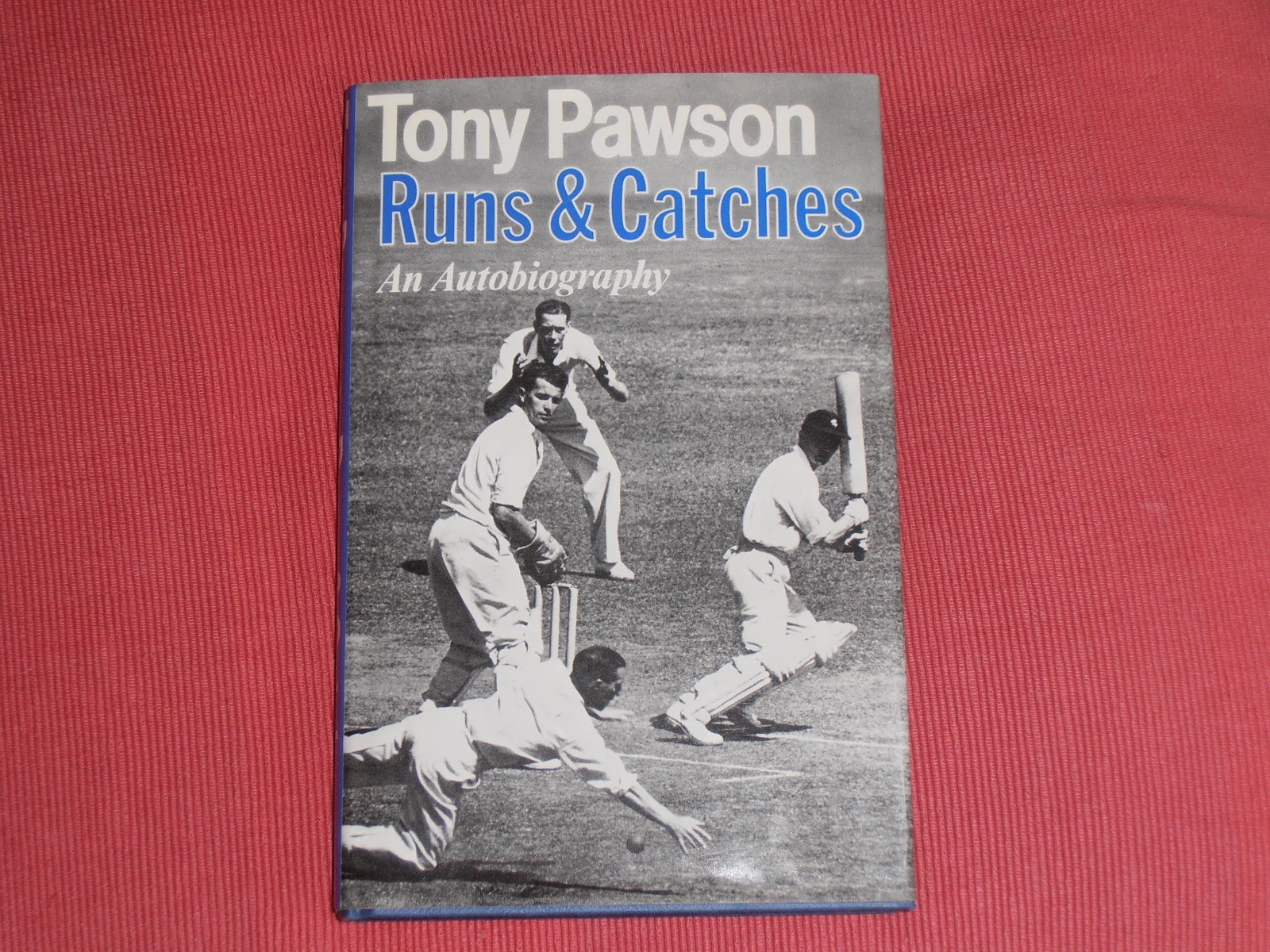
Tony Pawson: Kent v Glamorgan, Sunday League, St Lawrence Ground, 3 August 1980


Tony Pawson, cricketer, footballer, fisherman and journalist, died this week at the age of 91, too old even for me to have seen him play for Kent, which he did as a batsman in the late forties and early fifties. I have his autobiography, Runs and Catches, published in 1980.

He signed it for me at Canterbury one day, helpfully dating the signature: 3 August 1980.
I find that Kent played Glamorgan in the Sunday League that day, recording a rare victory in a wretched summer. The great CJ Tavaré scored a century, and Alan Ealham followed a rumbustious unbeaten 81 with the only List A wicket he took in a 16-year career. Classy though—an Alan Knott stumping. As far as I recall, Ealham bowled off spin (though he might even have been a leggie) so slow that the batsman had forgotten he was in by the time the ball reached the other end. The reference to “Old Caps Day” means that there was a reunion of former players (but only those sufficiently proficient to have received their county cap, apparently[1]).

I flicked through Runs and Catches again after hearing that Pawson had died, and very entertaining it is. He was an amateur in the best sense; good enough to have played as a professional had he chosen to do so, not a dilettante taking a better player’s place in the holidays. He averaged 33 in 43 matches across eight seasons (on uncovered pitches, remember; add ten for comparison with modern players). Until his death he was one of the last left to have played against Bradman, which he did for Kent at Canterbury in 1948.

My friend Allen Hunt, an irrefutable source of information about the four decades of Kent cricket before I started watching, spoke of Pawson as an attacking batsman, part of a team that was fun to watch, if not that successful. Allen also said that in the field Pawson was as good as Ealham, Asif Iqbal and the other outstanding fielders in the great side of the seventies.

That he was one of Kent’s more athletic fielders is not surprising; he was one of the country’s leading amateur footballers in the immediate post-war years, an era when that meant something. He won an FA Amateur Cup winner’s medal playing for Pegasus (there’s a great name for a sports team) in front of 100,000 people at Wembley in 1951 and was good enough to play a few games for Charlton Athletic in the old First Division. He scored on debut against Tottenham Hotspur and the Charlton directors showed their appreciation by standing, turning to Mrs Pawson and doffing their bowler hats. Roman Abramovich ought to try that with the Chelsea wags. Pawson was selected for the Great Britain team in the Stockholm Olympics of 1952 (they lost to Luxembourg).

The “catches” in the title is a pun; it is a rule of publishing that all sports books must contain a pun in the title and this one is less excruciating than most. It refers to Pawson’s later career as a fly fisherman, which had not reached its apogee when the book was published. In 1983 he was a member of the England team that won the World Championship. There is also a chapter on his military career, fighting the Germans across north Africa and Italy.

After he finished playing he became a journalist, reporting on cricket and football for the Observer, combining the writing with a full-time career in industrial relations, one of post-war Britain’s more challenging vocations. He was still reporting on one sport or the other every weekend when I met him. Though more recent than his playing career, his description of the world of journalism would seem Dickensian to readers younger than 30.

Copy had to be dictated down the phone from the ground. The first problem was to find a phone. There was usually just one line to the press box, invariably guarded by the most bad-tempered of the local reporters. At Canterbury there was often a harassed reporter in the queue for the public phone box beside the pavilion; I was profusely thanked by Rex Alston, freelancing for the Daily Telegraph, when I let him in ahead of me one day in the late sixties.[2]

Reporting on a Northern Ireland v England international at Windsor Park, Belfast, Pawson had identified a post office near the ground and paid the postmistress to keep a phone booth free for him at full-time. He had not allowed for the line of policemen present at the end of the game to prevent anybody from going down the road in which the post office was located. Deploying the bodyswerve and turn of pace that had served him so well on the wing for Pegasus, he darted through the thin blue line and his report made the early editions.

Tony Pawson was very friendly that August day 32 years ago, and chatted for some time about the book and the Observer, the future of which was under threat. What a life he seems to have had, unBritish in the way that he showed that it is possible to do several things well.  He was given the OBE for services to angling. It could have been cricket, football, business or journalism.

I doubt that there is anybody left alive who played for Kent in the forties.


[1] The awarding of county caps, a somewhat arcane system undermined by the frequent of movement of players  around the counties but retained by Kent, should be the subject of a post at some point.
[2] Rex Alston was the only man whose marriage was announced in The Times after his death, but that’s another story.

Sunday, October 7, 2012

A present from India

My Island Bay correspondent has been to India, and she returned with this intriguing gift for me.  
 
It is a group portrait of the Baroda College XI of 1936/37.
Baroda was a self-governing city in Gujarat, in the north-west of India, ruled by its Maharajah, the head of the Gaekwad family. At the centre of the front row of this group is Shri Yuvaraj Pratapainbrao Gaekwar.  So kingly does he look, that the single-letter difference in name must be a typo. Alone of those photographed, he holds a hat (possibly a homburg). Besides Gaekwar, only the College’s principal, SG Burrow, and the Hon General Secretary, Professor SV Shevade, wear ties, though several cravats are sported. White shoes are worn only by Gaekwar and the equally regal looking Sirdar WN Ghorade. All this must mean something.
Curiously, Gaekwar is described as “Capt. Randle Cup”, while PK Pandit, three along on the front row, is simply “Capt”. This, and Gaekwar’s rotund appearance, suggests that his centre-front-row status is down more to his aristocratic lineage than to cricketing ability. This was common in higher levels of Indian cricket at this time. The Indian team that had toured England a few months before this photograph was taken had been led – nominally, at least – by the Maharajah of Vizianagram,  who scored 33 runs in six Test innings and did not bowl. He is always mentioned when nominations are sought for the title of worst player ever to play Test cricket, though it would be hasty to dismiss the claims of Geoff “Thriller” Miller in this regard.
There are further signs of the complex stratification at all levels of Indian society at this time. Those seated are each accorded an individual “Mr” in their title (obviously excepting the two titled fellows already mentioned). Those standing share the collective honorific “Messrs”.
Photographs like this would have been hanging on the walls of every public school in England at this time, and no doubt the ethos of Baroda College in the 1930s was to create Indian copies of the young Englishmen whose mission it was to keep as much of the map as possible coloured red.  Yet ten years later, India was independent and the Maharajah of Baroda’s feudal backwater was swallowed up in the new Republic.
A later Maharajah of Baroda (the old titles were retained, but not the power that went with them) was guest summariser on Test Match Special during India’s 1974 tour of England. The other commentators called him “Prince”, which was no doubt meant respectfully, but rather created the impression that somebody’s pet labrador had wandered in.
What happened to these young men? Did they spend the rest of their lives as anachronistic relics of the imperial past, or did they adapt, as Indians seem so able to do, becoming leaders in the new democracy? There is no clue on the internet; searches for Baroda College and a sample of the names on the photograph draw blanks. Baroda itself has been renamed Vadodara, though the old name lingers on in various contexts.
The Central College Cricket Ground is in regular use still, according to Cricket Archive, though it has not seen a first-class fixture since the Ranji Trophy final of 1947. It would be nice to think that one of those young men, at least, has survived into their mid-nineties and sits on the boundary’s edge, thinking of the time when he was in the XI, and put on his blazer and his cravat to have his photograph taken with the rest of the team.

Monday, August 27, 2012

Kent v Leicestershire, Gillette Cup quarter-final, Canterbury, 31 July 1974

http://cricketarchive.com/Archive/Scorecards/34/34529.html

It is always cheering to wake up in the Wellington chill to news that the old county has won overnight. This has happened pleasingly often recently, particularly in the Sunday League (as my Blean Correspondent and I still choose to refer to 40-over cricket).  Six wins in a row have taken Kent to the top of their group with one match to play. That will be against Sussex, who are just a point behind. So it will, almost, amount to a quarter-final at the St Lawrence Ground on Bank Holiday Monday. Almost, because the best second-placed team will join the three group winners in the semi-final draw, and my calculations (not always a reliable guide) suggest that the defeat would have to be huge for Kent to be pushed out of this position.

I hope that the ground will be full, just as it was in the glory days. Let us select a scorecard from July 1974 by way of illustration. Harold Wilson was Prime Minister, Richard Nixon was about to resign from the White House, George Macrae’s Rock Your Baby was No 1, and Kent played Leicestershire in the quarter-final of the Gillette Cup.

The two counties had already contested a quarter-final at Canterbury that year, in the 55-over competition. Leicestershire won that one. They batted first and reached 238 for six, a reasonable score for the time. Barry Dudleston’s 79 was the top score, his partnership with Brian Davison of 98 from 18 overs the heart of the innings. Dudleston was to become my personal ski instructor a decade or so later, but that’s a story for another day.

It was a school day, so I saw none of that, arriving hotfoot down the Nackington Road in mid-afternoon to be told by a collective groan that things were not going well. You can read the noise of a cricket crowd quite easily if you have been in enough of them and there was no mistaking that this was a “God there’s another one gone” groan: Kent were 12 for three.

Brian Luckhurst was steadfast at one end, but wickets kept falling at the other. Some hope was retrieved when Bernard Julien was promoted to No 7 and shared a partnership of 87 with Luckhurst at a reasonable pace. It was the only time I can remember Julien being given any responsibility with the bat and the result suggests that it might have been done more often. He had scored a quick hundred in a Test at Lord’s the previous year, after all. But there was talent everywhere in the Kent order in those days, and Julien at No 7 meant that Bob Woolmer, who was to score a Test hundred against Australia the following year, was down at No 9.

Luckhurst was out for 111 trying to hit the penultimate ball of the innings for six when ten were needed. He won the man-of-the-match award despite Graham McKenzie having taken five for 34, winning the game with decisive spells at either end of the innings. It’s a batsman’s game.

So seven weeks later the teams met again to contest another quarter-final, this time with 60 overs a side. That year, these two counties were the best in the country, at one-day cricket, at least. Just to make it even more interesting, there was the sub-text of Denness v Illingworth, the incumbent England captain against his predecessor. Raymond Illingworth had not been pleased by this turn of events and – I was to learn during the après-ski at a later date – was particularly keen to put one over on Kent. As we will see, it was not to be his day.

I was there by nine o’clock, but the cars would have been lining up down the Old Dover Road from daybreak, the first in observing the tradition of what John Arlott called “the Canterbury breakfast” by getting out the camping stoves and starting the sausages sizzling. By the time McKenzie bowled the first ball to Luckhurst at 11 o’clock the ground was full; Wisden gives the attendance as 12,000. It was the best day of a wet summer.

All day, there were echoes of the match a few weeks earlier. Again, Kent lost early wickets, starting with Graham Johnson. Colin Cowdrey came in at three. Cowdrey’s reputation as a fine batsman, but a cautious one led opposition supporters to expect him to block all day. In the 55-over final the previous year, there were jeers and laughter from some Worcestershire folk as he came to the middle with only a couple of overs to go. But he increased the scoring rate with shots so deft and well-weighted that he scored two from almost every ball he faced, even with the field back in those pre-circle restriction days. He was puffed at the end though.

By the way, guess where Cowdrey often fielded in one-day cricket. At backward point. So did Norman Graham. It was where the captain hid his slow fielders. A generation later and it had become the place from where Jonty Rhodes, Paul Collingwood and the other guns leapt, dived and threw the stumps down.

This day was not Colin Cowdrey’s. He was out for a duck and Kent were 22 for two. That was where our anxiety peaked for the day, as Mike Denness joined Luckhurst for a partnership of 149. One of the great pleasures for Kent supporters was to watch these two bat together. They complimented each other so well, Luckhurst strong on the onside, Denness on the off. Almost a decade of opening the batting together had given them the trust and understanding that made them thieves of a quick single, two baseball batters stealing base at the same time. There was no calling to alert the opposition to their mischief either; no need when both knew what the other was thinking.

When Denness went for 72, Alan Ealham came in to rev things up. When people look at the Kent line-up in the seventies they might wonder how Ealham came to have a regular place in a team that otherwise comprised international players, and how he went in above Knott, Shepherd, Woolmer and Julien for many years. His career figures – an average of 28 with only seven centuries in 16 seasons – are ordinary. They tell not a quarter of the story. Besides being the finest boundary fielder I have seen, he made his runs when they were most needed. Look through the scorecards and count how often his 50 or sixty was highest score in a low total, or, like today, when quickfire 40 was the difference between a gettable total and one that was beyond reach.

Ealham added 57 with Luckhurst (who finished with 125) then 42 in four overs with Knott. Illingworth drew much of the fire, conceding 23 from one over and finishing with the figures of 12 overs, no maidens, 76 runs and no wickets. Mention Illingworth (and it should be made clear that he was a fine cricketer and one of England’s best captains) to my Blean correspondent or myself to this day and we will intone these figures with the seriousness of a Buddhist monk teaching the eightfold path.

Kent’s total of 295 disappeared over Leicestershire’s horizon thanks to parsimonious use of the new ball by Graham and Shepherd. Brian Davison gave them hope with a splendidly aggressive 82. He hit Derek Underwood for 18 in one over, as many as the great man ever went for I would think. It was good to see Davison featured on the Tasmanian avenue of fame at the Bellerive Oval a few weeks ago. He had a few years at Bristol when he was past his best, as so many did. When he was out, that was effectively it, and the final margin of victory was 66 runs.

I hope that the modern Kent team go into their big match with something of the confidence of their predecessors from 40 years ago. They could do with a Luckhurst or an Underwood of course, but Rob Key would have had a place in that great team, there is exciting young talent (I’d love to see young Sam Billings bat) and a few Alan Ealham types who can make a difference on the day. I’ll be up early to see how they get on.

Update: I said that only a huge defeat could exclude Kent from the semi-final, and so it was, by 9 wickets with ten overs to spare.


Sunday, August 12, 2012

Cricket Grounds in Winter: the Bellerive Oval, Hobart

I recently spent a week in Hobart, Tasmania, and what a delight it was. I believe that, millennia ago, Tasmania nestled happily alongside its brother and sister, the North and South Islands of New Zealand. Then, in a Dickensian rearrangement of the geological timeline, it was snatched away from its siblings and sold into servitude under the Mr Gradgrind of continents, Australia.  It waits, in lonely exile, for the day when it is reunited with its siblings on the other side of the Tasman Sea, where its landscape, climate and equability would be at home.

Hobart spreads itself out either side of the estuary of the River Derwent, with the Bellerive Oval (I eschew its rebranded name) on the opposite side to the city centre. The ground shares the virtues of the town of which it is a part, being proportioned, intimate, open and attractive.

Though it has been nestled into the hillside since 1914, the Bellerive Oval only became the first-class venue for cricket on the island 25 years or so ago, developed so that Tasmania would have an international venue. The first ODI here was played (between New Zealand and Pakistan) in 1988. The first Test followed the next year.

Tasmania is unrepresented in national competitions in any of the winter sports – though Aussie Rules is followed passionately – so, as in Kent, the cricket team is the focus of aspirations for top-level sporting success (hush, Gillingham fans, I said top level). Cricket is also the only sport played at international level on the island, which is why the Bellerive Oval still looks like at a cricket ground.
The northern half of the ground houses is a collection of stands along with facilities for players, members, sponsors and the media. Clearly, this arrangement is not the result of a master plan, but has emerged over the years, which is how cricket grounds should develop, and how they carry their history with them. At the river end there is a large, single-storey stand that provides excellent viewing. Between these areas is a grass bank, always a welcome feature. The Bellerive Oval occupies an area no bigger than the Basin Reserve, and there are some good ideas here when a refresh of the Basin takes place.
For too long Tasmania was shunned by the Australian cricketing establishment (something else the island has in common with New Zealand); it was not allowed to participate in the Sheffield Shield until 1977.  Like Wellington’s Clarrie Grimmett, some of Tasmania’s early cricketing heroes had to decamp to the Australian mainland to further their careers. Fast bowler Ted Macdonald, who terrorised the English along with Jack Gregory in the years after the First World War, and Max Walker, the under-estimated support act to Lillee and Thomson, were two such players.

The ground’s relatively newness does not prevent it from displaying a pleasing awareness of Tasmania’s cricketing history. A roller and a pair of turnstiles (imported from Britain) from the old Tasmanian Cricket Association ground are garden features. Then there is this lawn, saluting Tasmania’s cricketing heroes.


The statue, despite its Edwardian appearance, is of David Boon, the island’s greatest cricketer, pre-Punter, obviously. You will observe that he is represented with a somewhat smaller trouser size than we remember. Presumably the cost of the extra bronze necessary for a true likeness was prohibitive.

And who’s this at the top of the list of famous players? It can’t be. But it is. Jack Simmons, of Lancashire…and Tasmania. Flat Jack spent seven winters here as captain, and during a memorable fortnight in 1979 led the side to its first trophy – the one-day Gillette Cup ­– and to their first win in a Sheffield Shield match. I found a 1988 article from The Age that suggested that Simmons was so popular in Tasmania that he could have led a successful coup d’etat. As the island contains the finest fish-and-chip shops I have encountered in the southern hemisphere, it was clearly a match made in heaven.

Brian Davison succeeded Simmons and is also commemorated. Rohan Kanhai, Khalid Ibadulla, Jack Hampshire and even the young Alan Knott also spent time here.

In recent years, Tasmania has kept the national team well supplied with talent. Aside from the obvious, there has been Boon, and Colin “Funky” Miller, best remembered for turning up to a Test match with blue hair, and the only bowler I have seen switch between fastish medium off a long run, and off spin, and back in the same over, depending on whether a right or left-hander was facing. Today, Ben Hilfenhaus has often looked the most consistent of the fast bowlers, Tim Paine contends to be Brad Haddin’s successor, and Xavier Docherty is one of the legion of spinners tried in the post-Warne era.

And, of course, there’s Ricky Ponting, who contends with Errol Flynn and Mary Donaldson, now better known as Crown Princess Mary of Denmark, as the most famous Tasmanian (on the Tasmania Top 10 website, Boon and Walker also make the list, so the competition is not hot). Though circumstances have meant that he has played little domestic cricket for the past decade or so, he has remained loyal to the island, and is now turning out for them more often If they really want a different name for the Bellerive Oval, the Ponting Oval would be the one. Unless they plan to rename Hobart after him, that is.

A feast of 50 over finals at the Basin Reserve

  Men’s eliminator final, Wellington v Central Districts Women’s final, Wellington v Northern Districts Men’s final, Canterbury v Centra...