Monday, January 16, 2012

Cricket grounds in winter: St Lawrence Ground, Canterbury

Unlike my visits to Bath and Bristol, this was not a return after a long absence. I have had a wander around the St Lawrence Ground on almost every occasion on which I have been back to the UK, and have watched cricket there several times, most recently in April 2010:


This time, I was looking forward, not back. My purpose was to inspect the redevelopment, which, after some delay, has got under way in the 18 months since I was last here. We are promised that it is Kent's financial salvation, but at what other cost? On a glorious November afternoon, quite nice enough for there to be play, I went to find out.
Continuity is what I was looking for. That it would remain recognisably the same ground as that on which I first watched cricket on in the sixties, or that on which Les Ames and Frank Woolley batted and Tich Freeman bowled, come to that. It is pleasing to report that, so far at least, impressions are favourable.

The old practice area, an attractive part of the ground backed by a converted oast house, has disappeared under housing. Alec Stewart will be pleased. In a recent edition of The Cricketer, he blamed the St Lawrence practice pitches for England's early exit from the 1999 World Cup. It was not clear where they have been relocated. Nor did I work out how the new owners get to and from their homes. Will they have to pay admission on matchdays?
There is more building going on off the main driveway, consisting of a new administration block and other facilities including, it was announced this week, a small Sainsbury's. This is very good, though they had better lay in extra supplies of Scotch eggs next time I'm there. Every ground should have a supermarket close by. Folkestone had one right outside, one of the reasons why it was such a great place to watch cricket. Here in New Zealand, Seddon Park in Hamilton has a shopping centre just across the road. I once had a haircut and a sit-down lunch and was still back in my seat by the time the first ball of the afternoon session was bowled. More building, including a hotel on the Old Dover Road side of the ground, is to follow.
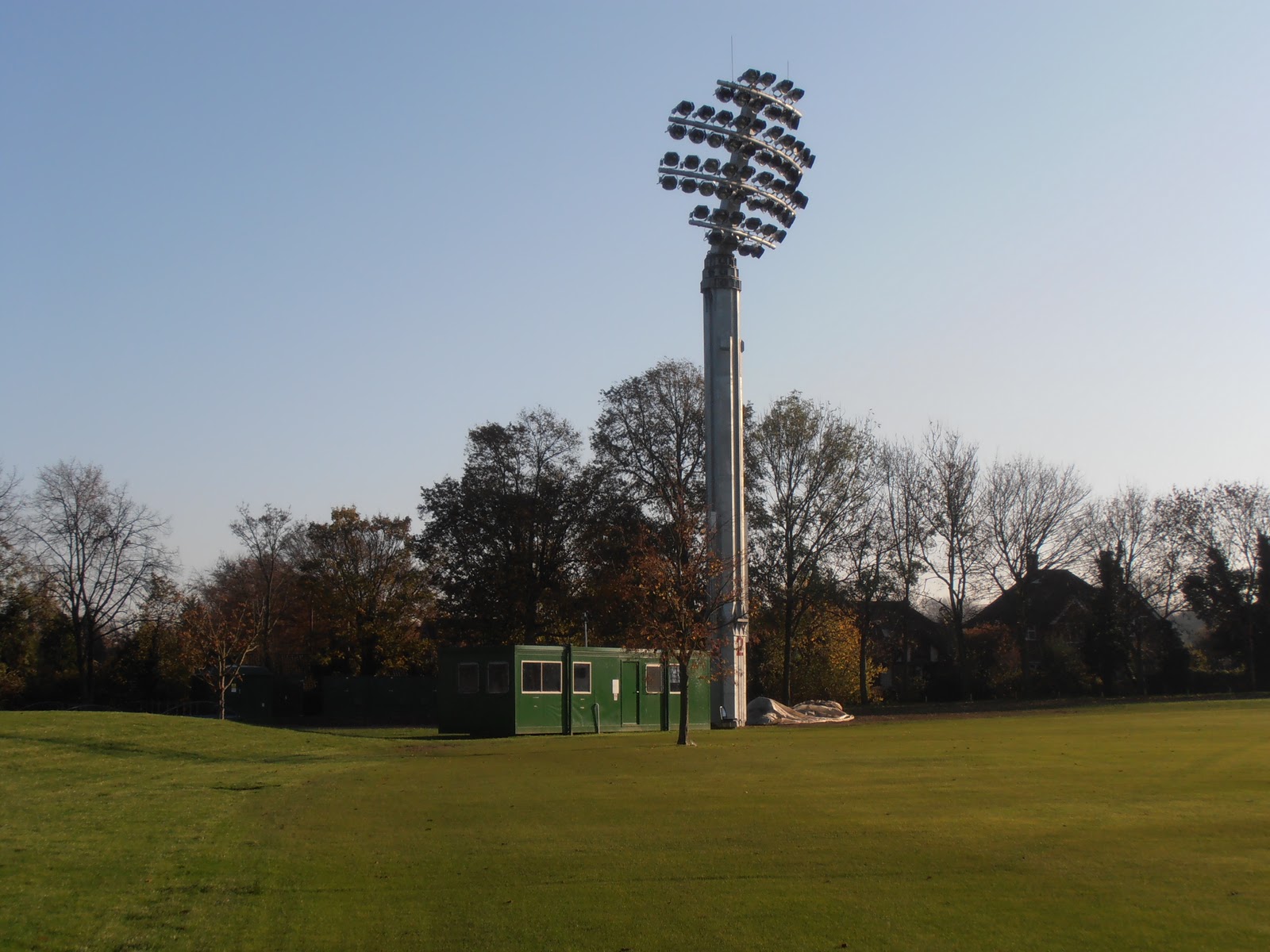
Five floodlight towers have been installed (all telescopic so as not offend to the sensibilities of the residents in this well-heeled part of town): next to the Leslie Ames Stand, beside the indoor school, next to the Frank Woolley Stand, behind where the white scoreboard used to be and near the site of the old lime tree. I disapprove of course, but not on aesthetic grounds. Floodlights, lit or not, add a certain grandeur to sports grounds. It is simply that conditions in England are not suited to floodlit cricket. I have long thought that English cricket should make more use of long summer evenings with matches in June and July starting later and finishing at 8 or 8.30 pm. It would be perfectly possible to begin T20 games at 6 pm, or even 6.30 pm in the north. Outside the height of summer, conditions are rarely conducive to after-dark viewing, spectacular though it can be.

The good news is this: far from being ruined as some of us feared, the stands that define the playing arena have been entrenched and enhanced. I worried that they might do away with the wooden stand, or pavilion annexe as it was officially known. But it has been given a proper name at last, and what a good one: the Underwood and Knott Stand. The very place from which I used to watch the two great heroes of my youth now named after them. Splendid.

Best of all, the regretable late-sixties brick dressing rooms have been extended and transformed so as to fit in perfectly with the wooden, red-tiled buildings on either side. They look as though they might have been there since 1906, when the Underwood and Knott Stand was built.
The shop was open and I was sufficiently relieved and impressed by what I had seen to buy a club polo shirt, so the white horse will be seen at the Basin this summer. The redevelopment seems to be having the desired financial benefits too; the club has just announced a six-figure profit for the past year. Too late to keep Joe Denly on the premises, but a sign that things will soon be on the up, we hope.

Thursday, January 12, 2012

Wellington v Northern Districts, T20, Basin Reserve, 11 January 2012

http://www.espncricinfo.com/new-zealand-domestic-2011/engine/current/match/526638.html

The pohutukawas are out so the Basin is wrapped in cardinal's scarlet, even if more fitting attire for today's match – a bottom-of-the-table affair with neither side having a realistic chance of qualifying for the final – might be the rough-hewn vestments of a country priest.

The shorter format has the cricket world in its grip as the year begins. Two games from the West Indies T20 competition were on offer on the telly earlier in the day. The first was Sussex v the Netherlands in Antigua. Only a decade ago such a contest in such a place would have seemed the stuff of fantasy. Later, there was a game from the Big Bash competition. Who knew that the Australians could do onomatopoeia?

Before the game began the teams lined up for a minute's silence in memory of the eleven victims of the ballooning accident that took place last weekend 40 miles or so from Wellington. The home players wore black armbands. With our small population, tragedies of this kind are more deeply felt in New Zealand than they are in more populous countries. But these memorial moments at sports fixtures now happen so often that they are in danger of becoming mere tokenism (“who is it today then?” I have heard people say as we rise to make solemn observance). The Australians, it sometimes appears, rarely take the field these days without their armbands. It cannot be long before the marketing people bring their characteristic soullessness to this, mark my words: “Granny dead?The Woolongong Wombats have a space on their armband for her and, in return for a large sum, will stand around looking non-specifically sad for several seconds before play (unless it rains in which case Duckworth-Lewis applies)”.

Northern Districts won the toss and chose to bat. Kane Williamson opened and anchored the innings with 53 from 41 balls. He continues to look a class above almost everybody else at this level. When he was out the innings lost momentum. Scott Styris scored 23 without looking convincing. He was dropped off a towering top edge, wicket keeper Brendon Taylor waiting under it for an age before the Wellington wind made a fool of him, as it will. He barely touched it. Andy McKay was outstanding with one for 16.

The last over started with Northern Districts on 138. Wellington appeared to have every chance of restricting the total to below 150, which would leave the home team in the box seat. Vettori (hirsuiteness update: short hair, big beard, a look of the ayatollah about him) took a single from the first ball leaving Peter McGlashan to face Mark Gillespie. My mind went back to a 50-over game three years ago when the same combination faced each other at the climax. McGlashan then needed nine from the last two balls for a one-wicket win. He dealt with the matter straightforwardly by twice hitting Gillespie past the scoreboard and out of the ground for wind-assisted sixes. Today it seemed that McGlashan had remembered those events while Gillespie had forgotten. The second ball of the over was lifted onto the roof of the JR Reid Gate, the third clearing the boundary squarer. A third successive six enabled McGlashan to demonstrate that he is New Zealand's most proficient reverse hitter, as he pulled the ball over the cover boundary. A four in the same manner with a single to finish took Northern Districts to a formidable 162.

Three wickets fell in the first four overs of the reply, and that was more or less it. One of T20's main weaknesses is that there is no coming back from a bad start. Rory Hamilton-Brown, the Surrey captain brought in for the second half of the T20 competition in the manner of a pilot coming on board the Titanic just as it hits the iceberg, hung around for seven overs as opener, but scored only seven runs, a Boycottian rate of progress in this context.

The whole Northern Districts attack was proficient, with Vettori applying a mid-innings strangle as Derek Underwood used to do of a Sunday afternoon, and Tim Southee outstanding. The wonder is how a side so full of talent could find itself superior to Wellington only on run rate at the start of the game. Another of T20's issues is that it is too great a leveller.

It will be a month before I can watch more live cricket, but then it will be the South Africans, in town in all three forms, so it will be worth the wait.

Friday, January 6, 2012

Cricket grounds in winter: the County Ground, Bristol

Not even its best friends would call the County Ground attractive. On one side there is the grey stone and narrow windows of what used to be the orphanage. Jack Fingleton noted the sad faces of the orphans peering over the fence when the Australians visited in 1948. Opposite is a back view of the terraced houses of Kennington Avenue. The pavilion is an asymetrical arrangement, again in trademark grey, that still looks a bit of a hotchpotch despite the redevelopment of the mid-nineties. There are no views of note. The fathers of Gloucestershire cricket might have had more foresight and located their headquarters in Clifton, or on the Downs, rather than in artisan Horfield.

Yet, if I had to to nominate the place from which I would watch cricket for the rest of eternity the roof of the Hammond Room at the County Ground would be in serious contention.

I lived in Bristol for 19 years, from 1978, when I went to Bristol University, to 1997, when I left for New Zealand. I must have watched more cricket at the County Ground than anywhere else, apart of course from the St Lawrence Ground, Canterbury.

Though I have been back to Bristol several times over the past 15 years, I had not returned to the County Ground until last November. I found it largely unchanged, apart from the pleasing addition of the Jessop Stand on the site of the old Jessop Tavern. This might be thought surprising, given that the ground is now a regular international venue, with an ODI or a T20 international most summers, but on those occasions the majority of spectators are accommodated in temporary stands.

Watching international games on television being played before a full house, it has sometimes occurred to me that there were more spectators present than there had been in whole seasons, possibly several added together, in my time at the ground.

Alone of the county headquarters, Bristol has always been something of a poor relation. The season would begin there (it was a dank, drizzly day when I visited, but up on the Hammond Room roof it was warmer than was usually the case in April or early May) but when summer got into its stride the county would decamp north, first to Gloucester and then to Cheltenham for the festival. It was common for there to be little of no cricket for six weeks or more at the height of the season. Then, with autumn's chill in the air, it was back to Bristol (this pattern has been reinforced by the modern obsession with T20: in 2011 there was no Championship cricket at Bristol between 2 June and 30 August).

So why, when the evidence presented so far would suggest otherwise, do I nominate the Hammond Room roof as a likely location for eternal spectating?

Good humour and conviviality have much to do with it. The Bristol faithful went to the cricket to enjoy themselves, whereas too many in Kent seemed to prefer any opportunity to disapprove of something. The roof was an open-necked sort of place, whereas ties – many attached to stuffed shirts – predominated on the top of the pavilion at Canterbury.

In part, the different attitudes were the result of recent history. The seventies was Kent's great era: nine trophies in as many years. Success was expected and there was disgruntlement when it did not arrive. Gloucestershire had won the Gillette Cup in 1973 and the B&H Cup in 1977 (beating Kent in the final), but winning was neither habit nor addiction. During my period in Bristol, Kent won only one trophy – the Sunday League in 1995 – and Gloucestershire nothing (though a golden period followed my departure, with seven one-day trophies in six seasons from 1999). In Kent the apoplexy increased with each year, but in Bristol it was accepted as the natural state of things, and we roof dwellers continued to enjoy the cricket whatever the result.

A look at a Gloucestershire line-up in the mid-eighties suggests that expectations might have been a bit higher. For a start, there was Courtney Walsh, with 869 wickets at an average of 20 over as distinguished and dedicated a career as any overseas player has had in county cricket. Gloucestershire chose their overseas players wisely; Walsh followed the equally committed Mike Procter, and Zaheer Abbas and Sadiq Mohammad are remembered fondly too. The classy Bill Athey, who might have won many more England caps, led the batting, supported by some good county players, such as Andy Stovold, Phil Bainbridge, Jeremy Lloyds and Paul “Human” Romaines. The peerless Jack Russell chattered away behind the stumps, while David “Syd” Lawrence joined Walsh in county cricket's most fearsome attack. David Graveney led intelligently, bowled good left-arm spin and rolled over in the gully just too late to stop the ball several hundred times a season (this was not a great fielding side). There was a third place in 1985, and a second the following year (but well behind Essex, the champions) and that was as close as the team came to winning something in my time.

Incidentally, Syd Lawrence's career was cut short in 1992 at the Basin Reserve of all places, when his kneecap split. He made a forlorn comeback five years later, by which time his second career as a bar/restaurant owner had contributed to his growing to the size of a small bus. In his first game back, against Hampshire at the County Ground, he set out off to the boundary in pursuit of the ball but was slow to get steam up and was overtaken by one of the young guns, who collected the ball and turned ready to throw it to the keeper, only to find Syd, whose stopping distance now crossed postcodes, bearing down on him. Player and ball were wiped out as Syd passed through, and all parties ended in a heap over the boundary. It was several minutes before play resumed, not because anybody was hurt, but because it took that long for everybody on the ground to stop laughing.

There was also the day when the sightscreen blew over, sending the bike that was tethered to it flying through the air. This sort of thing was always happening at Bristol, which was why it was fun to watch cricket there.

It was also the scene of the zenith of my own playing career, one Sunday afternoon in August 1988. I got a call-up from a friend inviting me to play for a team representing whichever insurance company owned the ground at that time. It was the holiday season and they were clearly desperate. I did not enquire how many people they had been turned down by, but suspect that a figure in the low eighties would be adjacent. The team was of a standard well above my usual village-green level, and was playing a Welsh side at least a couple of grades above them. I batted at ten, making three with a couple of late cuts so subtle that they were mistaken by the undiscriminating for edges.

It was in the field that the difference between recreation or school field cricket and that on a first-class ground became clear. Several times I turned from mid on to chase a ball on its way to the boundary. I found that the bumps and hollows that would slow the ball down more than I slowed down were absent, so I stayed two or three yards behind it all the way to the rope.

Towards the end of the game my moment of glory came. The ball was top edged and it soon became clear that it was coming down straight at me, I did not have to move. What disappointed me was not that I failed to catch it, but that I failed to touch it. I was never asked again.

Tuesday, December 27, 2011

Cricket grounds in winter: the Recreation Ground, Bath

As well as my expedition to the Crabble Ground in Dover (http://mylifeincricketscorecards.blogspot.com/2011/11/in-search-of-crabble.html) I returned to three other old haunts during my recent trip to the old country. This post and two to follow will record these visits, and the memories that I took with me.

You would not think it on a drizzly November day like that on which I was there, but the Rec in Bath is one of the five most attractive grounds on which I have watched cricket. Seeing as you ask, Pukekura Park, New Plymouth tops the list without question. Bath would certainly be on it. The other three might be subject to change according to mood, but today they are the Crabble; New Road, Worcester (before they knocked the old pavilion down); and Mote Park, Maidstone (Disgusted of Tunbridge Wells is filling his pen with green ink having read that, but the rhododendrons are not out all summer).

The Bath Festival – consisting of two three-day matches and a Sunday League game or two when I first attended in the eighties – was usually held in mid-June, with the sun shining from a cloudless sky, the hills that surround the city collecting the heat in a bowl, marquees around the boundary, the Abbey looking on over mid-wicket and the sound of the Avon gushing over Pulteney Weir. On such a day all these grounds share a timeless quality, regardless of whatever modern-day commercial ephemera are on view. Catherine Morland could pass through the Rec on her way to the Pump Rooms without looking at all out of place.

In those conditions it is unsurprising that big scores are at the forefront of the memory rather than match-winning bowling performances, or that IVA Richards features prominently, particularly when Kent were the visitors. In 1986, on a day just like that described above, his forceful, fluent 128 set up Somerset to score 433 for six declared in just 98 overs, this against a Kent attack that, on paper at least, was as good as the county has fielded: Dilley, Alderman, Ellison and Underwood. Brian Rose and Vic Marks (who could be an entertaining batsman in an anarchic sort of way) put on 167 for the sixth wicket to set up an innings victory, Joel Garner taking nine wickets.
http://cricketarchive.com/Archive/Scorecards/47/47337.html

There is often poignancy in a scorecard. We could not have known as we enjoyed the spectacle that this would be the last time when the West Indian duo would combine to win a match for the county; the great Somerset schism took place later that summer, and then they were gone.

It also occurs to me that early that sparkling Saturday morning Graham Dilley would have bowled to Peter Roebuck. Both have died these past few weeks. As I write, I am watching Australia taking on India in the Boxing Day Test, and missing Roebuck's judgment and wit, on the radio and in print. Bath was his home town.

Things did not always go Richards' way against Kent at the Rec. In a Sunday League match in 1981 the Antiguan all-rounder Eldine Baptiste, making his competitive county debut, found himself bowling at his legendary compatriot. And he got his man, lbw for a duck. I never saw a bowler happier to take a wicket. Somerset were shot out for 136. Laurie Potter (one of many whose talents were squandered by Kent in the eighties), also on debut, took four for 27, while Derek Underwood, a Scrooge on Sundays, conceded only eight runs from eight overs.

The finest innings I saw at Bath was not by Viv Richards, or any other Somerset player. It was Mike Gatting's 196 in 1987. Gatting was one of the best players I have seen at county level. That day his runs came from only 269 balls (though the report in Wisden is more excited by Martin Crowe's final-day 102 from 109 balls on a drying pitch, which unfortunately I did not see).

The Rec was also the place where I came as close to death as I ever have at a cricket ground. It was in 1985, Gloucestershire were the visitors and had made 300 for nine when Courtney Walsh took a fancy to Vic Marks' off spin, hitting him high, long and often into the very seats at long on where I was in residence. It was like being under Howitzer fire down there. Twice I had to take last-second avoiding action (What's that? Why did I not try to catch it? You clearly have no idea who you are talking to).

The last Championship match at the Rec was played five years ago. Last season it staged only a measly T20 fixture, which is like hiring an opera house for a shove ha'penny contest. The fact that Bath RFC (which shares the ground, the rugby pitch taking up the area next to the river, while the cricket field is on the eastern side of the field) has risen above its proper station to become one of the country's leading teams does not help. What used to be a temporary stand on the cricket side of the rugby pitch has now become a grander, permanent structure, which precludes the use of the rugby pitch as a car park (the use for which we Bristol supporters think it best suited). The pavilion is obviously in need of attention; perhaps they use the rugby facilities these days.


So blissful, lazy Championship days in the sun belong in the past as much as the Roman Baths and the Jane Austen Museum, which is a shame. The next two posts will feature visits to grounds where the real thing can still be seen.

Thursday, December 8, 2011

Wellington v Otago, 50 overs (reduced to 40), Basin Reserve, 4 December 2011

http://cricketarchive.com/Archive/Scorecards/349/349234.html

New Wellington coach Jamie Siddons has all the qualifications you would want for the job. The scorer of most runs in the Sheffield Shield until overtaken by Darren Lehman and Jamie Cox, he made an appearance in Australia's one day side before embarking on a coaching career that has taken him from South Australia and the national set-up under John Buchanan to being head coach of Bangladesh for four years.

But his most important attribute is that he has no hair. This means that there is no danger of him being injured in attempting to pull it out as he watched Wellington once more pick defeat from the pocket of victory with the expertise of a Victorian scallywag, as occurred on Sunday at the Basin. Several times his team was within a couple of proficient overs of taking the game away from Otago, only to go down by six runs in the evening gloom.

For most of a rainy morning it appeared unlikely that there would be any cricket, but play began with sufficient time for a 40-over game on a Sunday afternoon, just like the old days. It was thoroughly pleasant, warm despite the heavy cloud cover and – here's a word used to describe the Basin no more than once a decade – still. The pohutukawas could barely restrain themselves from bursting into a cascade of scarlet.

I arrived in time to see Otago succumb to the waft-aimlessly-outside-the-off-stump epidemic that is ravaging cricket here; New Zealand's finest had gone down to a particularly virulent strain in Brisbane an hour or so before. Aaron Redmond was first, followed by Craig Cumming and Nathan McCullum. Neil Broom, with 38 from 44 balls, played well before skying Woodcock to Rhodes, coming in from the cover boundary.

There was also a Bracewell, as there is in most New Zealand teams; the name is now as common as Jones in the valleys. An understanding of the Bracewell family tree is as essential as is that of the Tudors to a student of sixteenth century England. This was Michael, nephew of John and Brendon and cousin of Doug. By the time I had worked that out he was gone, lbw to Jeetan Patel for a duck.

When Wells swept Woodcock to deep square leg Otago were 97 for six with more than half their overs gone. That they accrued a final total of 219 was largely due to an intelligent and determined 55 from Jimmy Neesham, a 21-year-old Aucklander in his first season with Otago. He was well-supported in seventh and eighth-wicket partnerships by Derek de Boorder and Neil Wagner. The Otago dressing room applauded every run as if each were the product of a Jack Hobbs cover drive, a surfeit of enthusiasm filling the gap left by the departure of discrimination.

But they were helped by some poor cricket from Wellington. There were too many loose deliveries. Two chances were missed in Woodcock's seventh over: a difficult catch to Pollard in the covers and as simple a stumping chance as debutant wicket-keeper Craig Cachopa could have wished for. Barry Rhodes spilled a straightforward boundary catch two overs later.

Wellington skipper Grant Elliott had impressed earlier in the innings, maintaining close catchers longer than is usual, but later he changed the bowling as often as a super model changes her shoes. There is merit in allowing bowlers (especially spinners) to build up pressure. Bringing himself on late in the innings did not work either: Neesham hit him over the scoreboard.

Even so, in good batting conditions 220 in 40 overs was eminently attainable.

Michael Papps dominated in the first part of Wellington's reply with a robust fifty, full of trademark pulls and cuts. Papps has moved north after ten seasons with Canterbury. He will be an asset, but whether keeping in the game a 32-year-old whose international days are several years behind him is in the wider interests of New Zealand cricket is open to question. Ten years ago, when there was less cash around, he would have retired, leaving a space for a young player.

Meanwhile, Neesham was proving as potent with the ball as he had been with the bat. He accounted for Boam and Elliott with slower deliveries. When Woodcock was bowled by Ian Butler in the 28th over Wellington needed 94 to win, having let the rate required drift over the previous half dozen overs. Nick Beard bowled a tight spell of slow left arm from the northern end.

Everything now depended on James Franklin, who batted with assurance and some style throughout. He was well supported by Cachopa, until the little keeper attempted a dilscoop, and ended up flat on his back, stumps spreadeagled. The Otago bowlers did their bit: both Neesham and Wagner bowled wides that went to the boundary (I was looking forward to seeing Wagner, the great hope of New Zealand bowling when he finally qualifies next year, but today he had a bad day, as anyone can).

We waited for Franklin to produce the big over that would swing the game. Perhaps T20, in which Franklin has been very successful as a batsman, has created a false sense of empowerment, the feeling that the the big hit can be rolled out at will. Here, thanks in part to more good bowling from Beard, the moment never came, and Wellington began the final over needing 12.

Neesham was brought on to replace Beard, which I still think was a mistake, so well was the spinner bowling. The outcome vindicated Redmond's choice, but it was a close run thing. Scott Kuggeleijn (son of Chris, who used to coach Northern Districts and gave short answers to long questions from CricInfo's man) pulled the first ball, a long hop, to the boundary. A leg bye gave Franklin the strike. He sent the ball high in the direction of long off. It seemed at first that it would clear the boundary by some way, but Nathan McCullum had his eagle eye on it, and knew that it was heading straight into his hands. An ounce more power and the game would have been won. Kuggeleijn was also caught at long off, this time some way in from the rope, and that was that.

A fine start to my season of spectating, and it was free. As with four-day games, it seems that the money taken at the gate would not have paid those who collect it. There was no food on sale, and the game was not advertised. The weather meant that the game was not expected to start, so it is unfair to draw too many conclusions from the sparse crowd. But there is something of the self-fullfilling prophesy about this approach, and that domestic cricket appears to bestaking everything on T20, which has the prime holiday period to itself, worries me.

But I was not as downcast as Jamie Siddons, who stormed into the rooms leaving the air blue behind him.


Tuesday, November 1, 2011

In Search of the Crabble

Kent v Essex, County Championship, the Crabble Ground, Dover, 30 and 31 August 1967


I first went to the Crabble Ground in Dover 44 years ago, for the second (and, as it turned out, final) day of the Championship match between Kent and Essex. It was the first time I had watched cricket anywhere other than at the St Lawrence Ground.

Kent wrapped up a victory that took them to the top of the table, though everybody knew that it was too late; Yorkshire were in a strong position in a game in progress and had another fixture to come, wheras Kent's programme was now concluded, and Yorkshire duly became champions the next week. By that time, Kent held the Gillette Cup having defeated Somerset in the final on the Saturday following this game.

I still have the autograph book in which I collected signatures after the game had ended. Among compliant signers that day were Peter West, for four decades the face of BBC TV's cricket coverage but reporting for The Times that day, and Kent's match winner Norman Graham.

1967 was Graham's breakthrough season. A fringe player up to that point, his pinpoint medium-fast bowling, making full use of his six feet seven inches, took him to third place in the national bowling averages (Derek Underwood was top) with 104 wickets at 13.90. He remained a key member of the Kent attack for a further decade, his accuracy and extra bounce contributing significantly to the one-day glory years, even if his batting and fielding did not; he challenges Kevin Jarvis for the title of worst batsman that I have seen, but Jarvis takes it out.

Norman Graham was hugely popular with Kent supporters and was richly rewarded in his benefit season. Benefits have fallen into deserved disrepute now that county cricketers are well paid, but in the seventies they were justified reward for long-serving professionals. Graham, who was said to have visited a thousand pubs during his year, earned enough to buy several houses and, I hope, a nice car. He left the Crabble that day folded into a Triumph Herald, adopting a driving position not usually seen outside a dodgem track, but he had taken 12 for 80, so was smiling.

Of course, the Crabble pitch was not so much helpful to Graham and his colleagues as enslaved to them. There have not been too many unabbreviated matches which one team has one won comfortably having scored fewer than 200, as was the case in 1967. Pitch quality remained an issue there. Things came to a head in 1976 when Charles Rowe, batsman and occasional off spinner, took 11 for 71 against Derbyshire, almost a fifth of his total career haul for Kent. That was that. It was the last time county cricket was played at the ground, a shame because it was the most attractive of all the Kent grounds, though supporters of the Nevill at Tunbridge Wells will disagree.

Accompanied by my Blean correspondent, I went back there last week (I am in the old country for a month). The ground was hard to find, though this was more because of navigational issues than anything to do with the ground itself. I am always confused as to where the sun is when I change hemispheres and, except when I resume duties as his chauffeur, my correspondent relies on public transport to get him where he wants to go, so is untroubled by such concerns. We hit upon the idea of following a bus, as my correspondent had passed the ground while on such a conveyance at some unspecified point in the past. I recommend this as an aid to navigation, though we added the refinement of establishing where the bus was going later than we might have done. But Dover is on the coast, so we reasoned that we could only explore half the compass, and came upon the ground well before nightfall, a success by our own standards.
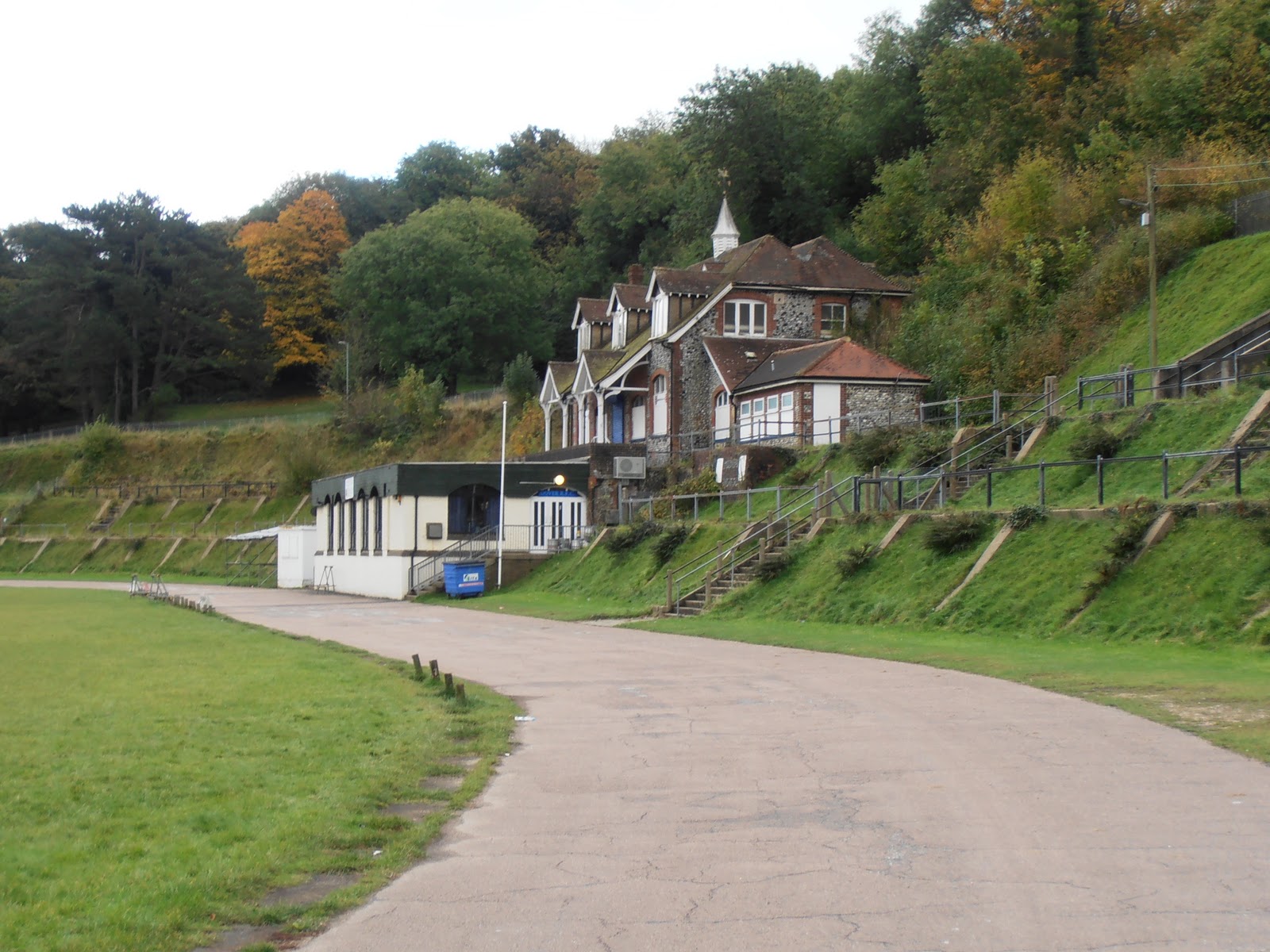
We were pleased with what we found. The Crabble is no longer a cricket ground, but has escaped the developers' grasp. It is home to Dover Rugby Club and instantly recognisable as the splendid venue it once was.

 It is situated in a valley at River (not all Kentish names are imaginative), with tall trees marking the extremity of the ground on three sides. Cut into the hill is a series of terraces, which used to accommodate seating, covered on the higher levels, with more trees above them. This is slightly reminiscent of the majestic Pukekura Park in New Plymouth, though on a much smaller scale. In the middle is the stone pavilion, run down and boarded up now, but stately in its day, brightly painted and decorated with flower baskets.
I have watched cricket from few better places than the higher terraces at the Crabble. It is to hoped that cricket can return to the ground one day; there is room enough, despite the floodlights around one of the two rugby pitches. New Zealand expertise in using the same piece of turf for a rugby pitch and cricket square would be useful.

We took a couple of turns around the ground and thought of the players who had batted and bowled with grace and style to match the surroundings. Ames and Leyland scored double hundreds here; Ames seven more centuries, Woolley the same number. Sobers scored a quickfire, match-winning hundred in 1968 described with awe by those who saw it, and he'd taken seven for 69 earlier in the same game. Yorkshiremen liked bowling here. Illingworth took 14 in a game in 1964, Verity nine in an innings in 1933, Trueman eight for 28 in 1954. And Kent's Freeman took seven or more on ten occasions.

The rustling of the trees is leftover applause for them all.

Sunday, October 2, 2011

Forty Years On: Kent v Lancashire, Gillette Cup Final, Lord's, 4 September 1971

http://cricketarchive.com/Archive/Scorecards/32/32020.html

Lancashire are the county champions.

There is a sentence that has not been written since 1934 (Lancashire shared the Championship with Surrey in 1950, but Lancashire supporters do not count that, just as Kent people are reluctant to acknowledge the shared Championship of 1977).

Congratulations to the men of the red rose. It is good when Championship pennant flies over unfamiliar pavilions. One feels particular pleasure for the players such as Glen Chapple and Gary Keedy who have played little or no international cricket, but have been proud to call themselves county cricketers, a term that has an obsolete solidity about it, like “milkman” or “haberdasher”. I think also of those Lancashire folk of my age and older who have waited all their lives for the day the Championship was won, and who will go to their graves a little happier.

Lancashire's victory is all the more relishable for having been achieved on outgrounds while Old Trafford is renovated and rotated, bringing Liverpool, Blackpool and Southport back to the first-class schedule from another age. One half expects Cardus to be filing for the Manchester Guardian. Ideally, championship cricket would never be played on the bigger Test grounds, where it rattles about like an old person in a large house with the children long-gone.

From this distance, it appears the County Championship appears in good health. There have been last-day resolutions in several recent seasons, and the introduction of promotion and relegation means that there are few meaningless games, even in September. There is less coverage in the broadsheets than a decade ago, but digital media have compensated, with plenty of good reporting on the blogs and commentary on about half the games online from the BBC.

The domestic one-day game (I mean the longer form, rather than the T20) has, relatively speaking, gone backwards.

As I write, I am watching a recording of the Somerset v Surrey one-day final at Lord's. This is the first opportunity I have had to watch one of these events since leaving the old country in 1997. Sky New Zealand has added English domestic cricket to its schedules in the last month, starting with the T20 final followed by Surrey v Durham from the last round of the league phase, the semi-finals from Taunton and the Oval, and now the final. What has brought this on, I don't know, but it is wonderful for a county cricket castaway.

Players that I had heard or read about – Maynard, Hildreth and Hamilton-Brown to name but three – have acquired a form and style. I have been struck by how many good young players Surrey and Somerset have. Jos Buttler, for example, has just reached a hallmarked fifty in adverse circumstances (speaking of youthful brilliance, I must mention Jonny Bairstow on international debut in the final ODI against India; he began as if seventy not out with ten years' experience, an innings which brought a tear to the eye of those of us who remember his late father David, who always looked as if he was enjoying himself when playing cricket, a considerable achievement when playing for Boycott's Yorkshire).

It was good to see Taunton again. Though plenty of building has taken place it appears to have retained its character, with the Quantocks on the horizon one way, the Mendips the other, and the two churches a six hit away. The southern end retains its pleasing confusion of old stands, I hope still with old leather armchairs with the stuffing coming out. It was an intimidating place to visit when Botham and Richards were in their pomp, and the locals (the Taunton Macoute) were cidered up. The end of Kent's glorious era can be dated precisely to the day in August 1979 when they were Garnered for 60 in the Gillette Cup quarter-final (it is still too soon to write more about that game).

There was not a seat to be had that day. There were plenty visible at this year's semi-final, and Lord's was little more than half full for the final. I attended twenty-five one-day finals, all of them before a capacity crowd. Why the difference? For one thing, the MCC website tells me that a ticket to the final cost between £40 and £50. More significant is that 50-over cricket has been squeezed between a surfeit of ODIs and the shaken-up bottle of Pepsi that is T20.

So, in tribute to Lancashire, let us go back forty years to a time when, the Tests done with and ODIs barely thought of, the first Saturday in September was the county game's big day: the Gillette Cup final of 1971 between Kent and Lancashire, a fine game most remembered for a single moment of athleticism from an unlikely source.

Kent were there having beaten Warwickshire soundly at Canterbury, while the BBC delayed the Nine O'Clock News to cover the climax of the other semi-final at Old Trafford, David Hughes smashing John Mortimore for 24 in one over in the dark. The famously irascible umpire Arthur Jepson replied to an appeal to go off for bad light with “You can see the moon, how far do you want to see?”.

Though Kent were the 1970 county champions, Lancashire were the dominant one-day team of the time having won the first two Sunday Leagues and the previous season's Gillette Cup.

We took our seats on the lower level of the Lord's Grandstand on a beautiful morning. Mike Denness (standing in for Colin Cowdrey who missed much of that season through illness) won the toss and put Lancashire in. Kent, against the orthodoxy of the time, usually chose to bat, but presumably Denness wanted to make the most of the September dew that was such an influence on the September final.

An early blow was the news that Norman Graham was injured and would not play. Graham, who bowled penetrating fast-medium from a great height, was very popular with the Kent faithful despite being a poor fielder and a worse batsman. But his replacement, the burly left-armer John Dye, removed Barry Wood lbw for a duck in the first over.

For much of the rest of the innings it was a good battle, each side fighting back just as the other looked to be gaining the advantage. Class told. The best innings was 66 from Clive Lloyd, and we'd have given him that at the start. Derek Underwood tied up the middle of the innings, conceding just 26 from 12 overs. John Shepherd and Asif Iqbal were almost as abstemious, but Bob Woolmer was unusually expensive, going for five an over, a fair return these days, but as profligate as a footballer's wife then.

At 179 for seven things were turning our way, but Hughes again, in partnership with his spinning colleague “Flat” Jack Simmons (who I was to sit next to on a memorable evening in a Sydney restaurant twenty-eight years later), put on an unbroken 45 in the last few overs to take Lancashire to an above-average score in the era before fielding circles, powerplays, and special rules for legside wides. In the end, it was the difference.

Kent started badly, losing England opener Brian Luckhurst for a duck. It was a struggle to 105 for five, the uncomfortable feeling that another wicket would bring the curtain down. But Asif Iqbal was in, and that changed everything. Asif was in his fourth of fifteen seasons as a Kent player, already as Kentish as hops and the Medway. The same could be said of John Shepherd. Both still live in Kent, just as Clive Lloyd and Farokh Engineer remain Mancunians to this day (it would have been at about this time that Lancashire chairman Cedric Rhoades, worried that the Indo-Pakistani War would deprive him of his wicketkeeper, asked Engineer if he might be called upon to fight, to which Engineer replied that he would have to go when the fighting reached his home village; “where's that?” asked the chairman; “Oswaldtwistle” [which is just outside Blackburn] replied the keeper).

How things have changed where overseas players are concerned. I hear that Martin van Jaarsveld is leaving for Leicestershire, an odd choice given that they are almost as short of cash at Grace Road as Kent are, and that it was only Leicestershire's ineptitude that kept Kent off the bottom of the Championship. And Marcus North has just signed for Glamorgan, his sixth (sixth!) county.

Asif was at his best that day, dancing down the pitch like Jessop and moving across the crease in a way many batsmen do now but few did then. He was also whippet-quick between the wickets – Tony Greig says the fastest of the players he has seen. Cowdrey apart, no Kent batsman of that time made his runs in a way that was so aesthetically pleasing.

For almost an hour the Lancashire bowlers were driven (and pulled and cut, but mostly driven) to distraction by him. He had reached 89, and looked odds-on for an unbeaten, victorious century when he came down the pitch once more to Simmons. Jack Bond, the dumpy 39-year-old Lancashire captain fell to his right at mid off, but our eyes passed him to follow the ball on its way to the pavilion fence. But where was it? The ball was still red then, of course, so harder to spot in the September gloaming. Asif must have timed it so sweetly that it had passed outside the spectrum of human visibility.

Bond had it. His fall had been a full-length dive to seize from the air the ball, which had never got more than a couple of feet off the ground. It was one of the famous Lord's final catches, and it won his side the game, the last three wickets falling for just three runs.

Kent were to return to Lord's for finals five more times in the seventies, winning all but one. I hope that Somerset shake off their second successive defeat at Lord's (as well as two more in the T20 elsewhere) and return as successfully, following their loss to Surrey. They still have some way to go to challenge Kent's record of successive losses in finals at headquarters though: seven (and counting).

Sunday, August 21, 2011

Fire in Babylon

Snow is falling and laying outside as I write, the first time such a thing has been seen around here since 1976. It's been as cold as the County Ground in Bristol in May. What better way to escape the chill than by going to see Fire in Babylon, the documentary film about the rise of West Indies team that dominated world cricket from that year until the early nineties? I saw it in a full theatre at Te Papa, our wonderful national museum here in Wellington.

1976 was identified as the year that the West Indians stopped being calypso cricketers and turned into a hardnosed team founded on ruthless pace bowling. As the year began the team was in the middle of a drubbing, going down 5–1 to Australia. The players were confronted with the pace of Lillee and Thomson and shameful racism, from both from the Aussie players and the crowds.

The way the film told it, this humiliation made West Indies captain Clive Lloyd go out and find some fast bowlers, which enabled him to lead his side to victory against India at home, and England away, later that year. Well, not really. The only addition for the England tour, compared to the attack that had gone to Australia, was Wayne Daniel, who was certainly quick, but very much the tyro, threatening to life, limb and wicket only in short spells. The fourth member of the attack on the England tour was the workmanlike Vanburn Holder of Worcestershire, who had been playing international cricket for seven years by that time.

So the idea that Lloyd simply applied water to a pack of instant fast-bowler mix is wrong. West Indies won that series 3-0 because Andy Roberts (a wonderfully lugubrious witness throughout the film) and Michael Holding were very quick learners, and because Richards batted as well as anybody – Bradman included – has ever done that long hot summer, with 829 runs in just four Tests. And, they were playing England, not Australia. The England selectors took a preference for experience a little far that summer. Their chosen top four for the first Test was Brearley, Edrich, Steele and Close whose combined average age was just under 38 (if only their combined batting average had been as high).

Close and Edrich both finished their Test careers – or rather had them finished for them – at the third Test at Old Trafford where they received a fearful battering on the third evening at the hands of Holding, Roberts and Daniel, one which had the movie audience wincing in sympathy with each blow replayed on the screen (remember that in 1976 cricket was still helmet-free). Much pompous nonsense was written about that passage of play in the days, months and even years that followed. It came to be exhibit A in the case against an approach that was said to be, well, not quite cricket. Fire in Babylon featured an extract from a contemporary interview with Robin Marler, former Sussex captain and then cricket correspondent of the Sunday Times as an example of this attitude. To adapt a Penelope Gilliatt's famous remark about that organ's theatre critic Harold Hobson, the characteristic sound of an English Sunday morning in the seventies was Robin Marler barking up the wrong tree.

One person who did not complain was Brian Close himself. The film missed a trick by failing to point out that Close had been Viv Richards' county captain at Somerset, and that Richards credits Close with being a great influence in the development of his uncompromising approach to the game.

Incidentally, the photo of Close covered in bruises that followed the Old Trafford sequence – and which had the audience gasping at the screening I saw – was not taken then, but thirteen years earlier, after Close had put himself in the way of another West Indian pace onslaught, from Wes Hall and Charlie Griffith at Lord's in 1963.

And then there was Greig's gaffe. Before the start of the 1976 series England captain Tony Greig, then as now not a man given to understatement, announced that it was his intention to make the West Indians grovel. Such a statement delivered in, say, the Yorkshire tones of Ray Illingworth or the Scottish lilt of Mike Denness would have been provocative enough. But Greig spoke with the voice of a white South African at the time of apartheid, and might as well have been sitting under a neon sign saying “oppressor”. Like the rest of the audience I winced as Grieg spoke, just as I did when I first heard him utter those ill-considered words on Sportsnight all those years ago.

For the purposes of the film Greig became symbolic of the political sub-text of the rise of the West Indies, one that was partly historical: the descendents of slaves striving to overcome their recent colonisers; and partly comtemporary: black men playing against the representatives of countries in which black people experienced racism as a part of their daily lives. This came across strongly in the testimony of Gordon Greenidge, who moved from Barbados to Reading as a 14-year-old in the mid-sixties. Greenidge deserves to rank among the batting greats, but has been neglected, probably because he stood in the shadow of the Richards, Barry at Hampshire and Viv for the West Indies.

Of course, a fast bowler with a ball in his hand does not require political motivation; the scent of blood and wickets is enough. But there is no doubt that many of the West Indian players of that era had an awareness of a political dimension to their cricket that was almost entirely absent among white players. That was why the recruiters of players for sanctions-breaking tours of South Africa found it so much harder to tempt West Indians with their large cheques than they did the English. Only Colin Croft of the first-line players signed, and he admitted that he had to quit the Caribbean for Florida to escape the resulting opprobium. Others ended up on Skid Row.

It was not that the likes of Gooch, Gatting and the rest of those who at some time pocketed the tainted rand held consciously racist attitudes; English cricket in the seventies (except in the Ridings) was well ahead of most other facets of British life in its embracing of multiculturalism. It was that they were naïve, so failed to join the dots.

Two things in defence of Tony Greig. First, he dealt with the pace of both the Australians and the West Indians better than any other English batsman. He played the innings of the series at the Gabba in 1974 and at Headingley in 1976. (Who was the only other player to score centuries in both series? Alan Knott, of course).

Second, I was at the Oval on the fourth day of the final Test in 1976 and witnessed a public act of contrition by Greig. Despite having a lead of 252, Clive Lloyd did not enforce the follow on. Instead he sent out Fredericks and Greenidge to lash the England bowlers around the Oval's parched expanses to the tune of 182 in 32 overs. During the carnage Greig pursued a ball towards the boundary on the western side of the ground, where the greatest concentration of West Indian supporters was located. They greeted him with deserved and vocal hostility. Twenty-five yards or so short of the boundary he fell to his knees and grovelled his the way to the fence to collect the ball. By the time he got there every boo had turned to a cheer.

Though the premise of Fire in Babylon is that Lloyd's side resolved to move away from the calypso cricketers image, it also makes clear that it played with joyous exuberance, which was why I for one couldn't have cared less how often they beat England; it was such fun to watch.

A somewhat cavalier approach to the deployment of archive material was irritating. Several times a bowler ran into bowl at, say, Lord's, only for the resulting wicket to be taken at Sydney or similar. Brian Luckhurst was shown batting left-handed at one point. Footage used to illustrate the Lord's Test in 1984 was from 1987 or later (the new Mound Stand roof was apparent).

A criticism in these parts was that the bad-tempered defeat that the West Indies suffered in these islands in 1980 was all but ignored, represented only by the famous photograph of Mikey Holding kicking a stump out of the ground at Carisbrook. As Mike Brearley said, only Holding could have made such a violent act look so graceful. The matter was raised again in the Sky commentary box the other day when a bowler accidentally removed the bails. Holding, invited to compare this with his own efforts, commented in those wonderful bass Jamaican tones that “if you're going to do something, you might as well do it properly”. I would like somebody to analyse the footage of that game (which New Zealand won by one wicket) to test my supposition that, to have produced such a reaction from a team that prided itself on controlling its emotions, the umpiring must have been atrocious. In the greater scheme of things it was insignificant, which is why it was left out.

A more substantial criticism is that the film ignored the fact that Lloyd's team was not the first from the islands to dominate international cricket. Those of Sobers and Worrell had done so for much of the sixties. Though defeated 2-1 in Australia in 1960/1 – Colin Croft scornfully dismissed the famous tickertape farewell as being for a losing team – the Australians were beaten at home as were England away in both 1963 and 1966. Then as later the team was founded on pace, then that of Wes Hall and Charlie Griffith, along with Sobers, and batting of class: Hunte, Kanhai, Butcher, Nurse et al. That there was no victory in Australia was because tours there took place at such long intervals, not because they were not capable.

But these points did not reduce my enjoyment of the film one bit. The interviews with players, historians and spectators (particularly with Bunny Wailer, as in Bob Marley and the) were fascinating, and the archive material full of memories. There is plenty of potential for intelligent documentary in cricket and it is to be hoped that that the success of Fire in Babylon will inspire others to emulate it.

Sunday, July 24, 2011

The Greatest Test of All

The BBC Radio iPlayer has some interesting cricket material available at the moment, inspired by the happy confluence of the thirtieth anniversary of Headingley '81 with the 2,000th Test, currently in progress at Lord's.

Two programmes are devoted to the considerable task of choosing which of the 2,000 Tests was the best. The first is a 90-minute discussion between Jonathan Agnew, Simon Hughes and Chris Broad (with a contribution from Tony Cozier) with the aim of selecting a shortlist of three (they settled on four in the end). Such a format depends on the panel's knowledge being deep enough to do the subject justice. This group did a reasonable job, though their lack of awareness of Test cricket's early days was exposed. The Oval Test of 1882 and the Sydney match of 1894 were mentioned only because a listener emailed suggesting that they should be, though both are clearly worthy of consideration. A cricket historian such as David Frith or Gideon Haigh would have filled the gap well.

The Oval game was the one that gave rise to the Ashes legend, with the publication of an obituary for English cricket being published in the Sporting Times (“...and the Ashes will be taken to Australia”). Fred “The Demon” Spofforth, the first great fast bowler, took 14 wickets for Australia, who won by 7 runs. At least Simon Hughes knew the story about the spectator so caught up in the tension that he chewed through the handle of his umbrella, though he wasn't sure whether it was supposed to have occurred in 1882 or 1953.

Hughes also suggested that Headingley 1981 was the first occasion on which a side had won a Test after following on. Not so. That was the significance of Sydney 1894, a game that had everything that a great game should have. Besides England's great rearguard, Syd Gregory hit Test cricket's first double century and slow left-armer Peel bowled a match-winning spell. It should have been seriously discussed, at least.

Old Trafford 1902 was not mentioned at all. Australia won a classic by three runs. Victor Trumper and FS Jackson both scored hundreds, and Hugh Trumble and England's less well-known Bill Lockwood took ten and eleven wickets respectively. Debutant Fred Tate of Sussex had a nightmare in his only Test match. He dropped Joe Darling in the deep and was last man out with four still needed. Legend has it that he as he left the ground he said something along the lines of “I've got a boy at home who will make up for this for me”, the boy being Maurice, who lived up to his father's promise by becoming the best fast-medium bowler of his time and taking 38 Test wickets in the 1924-5 Ashes series.

A winner was chosen from the shortlist by a different panel during lunch on the second day of the Lord's Test. Agnew again, but this time accompanied by Geoffrey Boycott, Michael Vaughan and Steve Waugh, who ruefully noted that the choice appeared to consist of games that Australia had thrown away. They went for the Calcutta Test of 2001, another won after following on:


VVS Laxman's monumental 281 led the way, supported by Rahul Dravid's 180, which was no doubt as silky as yesterday's century at Lord's.

These programmes are best accessed through the podcast pages of the BBC website, where they will available indefinitely.


There is some interesting archive commentary in the first programme, including Alan Gibson on the final over at Lord's in 1963, with Colin Cowdrey, arm in a plaster cast, at the non-striker's end, and some vintage John Arlott.

And the Archive on 4 series featured an hour on the 1981 series, presented by the Great Alchemist himself, Mike Brearley. I will write a more detailed post on this series soon, but this is a treat, with a revelation thrown in: the selectors almost went along with the wishes of most of the cricketing public, myself included, and omitted Bob Willis before the game. Fortunately for posterity, they changed their minds at the last moment.

This programme will only be available for a week or so, so get in quick:


Monday, July 4, 2011

The third World Cup Final: India v West Indies, Lord's, 25 June 1983

http://cricketarchive.com/Archive/Scorecards/43/43681.html

There are two things that should be recorded about the third World Cup final. First, it was the most important game of cricket ever played, and second, it was quite dull.

As expected, the West Indies reached the final for the third time. The team was at its formidable peak by now, enhanced by the addition of Malcolm Marshall, perhaps the greatest of their fast bowlers, and Jeff Dujon, a good wicketkeeper and a batsman of international class. It had won all its group matches, and the semi-final against Pakistan, by resounding margins. Except one. We might have paid more attention to that exception, as it was against India in the first group match, the West Indies falling 34 short of India's 262, Roger Binny's wobbly seamers accounting for Lloyd, Richards and Dujon.

India almost went down to Zimbabwe in the improbable surroundings of the Nevil Ground, Tunbridge Wells (why Kent chose to stage its first ODI there, rather than at Canterbury, is a mystery). At 17 for five all seemed lost, but captain Kapil Dev came to the rescue with 175 not out, six sixes re-arranging the rhododendrons. It remains the highest one-day score made in Kent. His team went on to beat a strong England side in the semi-final.

Even so, as we gathered at Lord's on the morning of the final there was a feeling of inevitability about proceedings, and disappointment when Clive Lloyd put India in, a decision that seemed likely to deprive us of a repeat of the Caribbean run fest that we had so enjoyed in the first two finals.

Indeed, the Indian innings proceeded as we expected. Andy Roberts, with three for 32, was the most expensive of the quicks, though Larry Gomes went for 49 from 11 overs, but also took two wickets. Kris Srikkanth (a prototype Sehwag in his approach to batting) was top scorer with 38, and the last wicket partnership of 22 between Kirmani and Sandhu was the fourth-highest of the innings.

The result being certain, the main interest between innings was on whether Viv Richards would get in early enough to complete his usual Lord's final century (two more had followed that in the 1979 final). Sure enough, Greenidge went early and in strode the Great Man, nobody more certain than himself that he was about to rescue our day with something wonderful.

Richards attacked from the start, and we got ready to relish the next 90 minutes or so. Of his first 33 runs, 28 came in boundaries, to all corners of the ground. In his Guardian report, Matthew Engel described Richards as playing “a sophisticated form of clock golf”. Madan Lal, from the Pavilion End, had the temerity to attempt a bouncer. Richards hooked, and as it came off bat the question was would it land in the Mound or Tavern Stand, or perhaps even the St John's Wood Road?

But it had come not from the middle of the bat but from the top edge, and the trajectory was steep. The ball was still heading in the direction of the mid-wicket boundary, but would it reach? Kapil Dev was the nearest fielder and for a moment was as uncertain as most of us as to the ball's flight path. He began to move towards the boundary with eyes fixed upwards. Then his hands moved up to his eye level, which told us what we needed to know. The catch was a good one, taken over the shoulder, and Richards turned away, towards the pavilion.

Nobody at the ground saw it as a match-winning catch though. Gomes was next in, but we did not want his brand of cautious accumulation to take the West Indies home. The hope was for a reprise of Clive Lloyd's 1975 innings, in so far as the target of 184 would allow. But both fell with the score at 66, and Faoud Bacchus followed ten runs later.

Dujon and Marshall (a capable batsman) steadied things and looked very comfortable against India's trundlers, who were less threatening than half the county attacks of the time. With the required run rate low enough not to be a factor it appeared at 119 for six that, though excitement that we hoped for was absent, sensible batting would bring the West Indies home.

So certain were we of the invincibility of the West Indies that there was curiously little tension. I have never been in a crowd which so misread what was happening in front of it, me as much as anybody. It would have been much more exciting to have been following the game on the radio on the streets of Calcutta and Bombay (as they then were), where people knew exactly what was going on, that every wicket was taking India nearer to a famous victory. At Lord's only when Dujon, Marshall and Roberts were out in quick succession to leave the last pair, Garner and Holding, to chase the 58 still needed did the penny finally drop. Holding was lbw to Mohinder Armanath to give India a 40-run victory.

So why was it the most important game ever played? Because it was the day that South Asia in general and India in particular awoke to the possibilities of one-day cricket, a form of the game that had been scorned in that part of the world up to that point. I have written before about the time on the same turf just eight years before when Sunil Gavaskar disdained a target of 334, the compromises to his art that it would necessitate being too much for him to bear.


Test matches, even torpid ones on flat, slow pitches were everything. From September 1979 to February 1980 13 Test matches were played in India, not an ODI in sight. By 1986/7 there were 17 ODIs in an Indian season, and in the next the hosting of World Cup was shared with Pakistan. In a sense the IPL, or at least the mindset that spawned it, was born that June day at Lord's, of all places.

Even so, it was a poor game of cricket. The World Cup final has usually been a stage for a memorable performance from a great player. Lloyd, Richards, Wasim Akram, da Silva ( a Kent player, by the way), Warne, Ponting, Gilchrist, and a brilliant losing century by Jayawardene this year. The Man of the Match that day? Mohinder Armanath, not even a proper bowler, for little seamers so modest that they wore a veil. India did not even pick a proper spinner.

That was my third, and probably last World Cup final, the prices being what they are these days, though we look forward to 2015 when the event returns to New Zealand and the West Island. We are staging a World Cup in another code as practice for it here this year, so everything will be ready.

NB. Birthday today. Got a card from Stephen Fleming.


Sunday, June 19, 2011

In the Footsteps of Giants

Author's note: apologies for the small font size, which it is beyond my technical ability to enlarge. I advise readers having difficulty reading this post to buy a bigger screen.

As part of the desecration redevelopment of the St Lawrence Ground a walkway is to be built honouring twelve of the county's great players, chosen by a panel comprising Kent's long-serving statistician Howard Milton; Derek Carlaw, who has been contributing erudite and interesting features to the Kent annual for many years; and Tony Rickson, a journalist unknown in this part of New Zealand. A shortlist of forty was published in local papers and Kent followers were invited to nominate their chosen dozen, but this was purely advisory, and rightly so. A comprehensive knowledge of two centuries of cricket was needed to do justice to the task.

And justice to it they have done, selecting a twelve that tells the story of cricket in Kent as well as celebrating some of our finest. Of course, this task is easier than picking an all-time Kent XI, because so many of the county's great names were wicketkeepers or slow bowlers. Eleven of the names are the same as my selection, and I have no great quarrel with the twelfth.

But I do have a couple of small gripes about the shortlist of forty:
http://www.thisiskent.co.uk/Kent-Legends-Walkway-choose-favourite-cricket/story-12002825-detail/story.html
First, Richard Ellison (11 Tests) or Mark Ealham, (eight Tests and 64 ODIs) would be a better representative of the 80s and 90s than Steve Marsh, who was, by our high Kentish standards, a mediocre keeper. What about Neil Taylor, who scored more centuries for Kent than Bob Wilson, Brian Luckhurst or Mike Denness? Or Dean Headley?

And what's this? No CJ Tavaré? David Gower was good on Tavaré during the recent Lord's Test, describing how the batsman who would block to order for England was known to the Kent membership only as a carefree shot player (Gower should be on the list too, having been educated in Canterbury, but he was allowed to slip away to Leicestershire).

Of the twelve, nine are obvious choices. Taking them chronologically:

Alfred Mynn

When John Woodcock (editor of Wisden and cricket correspondent of The Times for more than three decades; known to Alan Gibson's readers as the Sage of Longparish) ranked his hundred greatest cricketers in the mid-nineties he placed Mynn third, below only Bradman and Grace, who was seen as the new Mynn early in his career. As well as being the greatest all-rounder of his day, Mynn – three times bankrupt and over-fond of his ale – was just the sort of dissolute character that the public likes to have as a hero. It is as well that he had finished before the county club was formally constituted. The sort of people who have run it for most of its existence would never have approved of him.

Colin Blythe

It is Blythe who is bowling in the Chevallier Taylor painting of the Kent v Lancashire game of 1906 that captivated Duncan Hamilton when he visited Canterbury at the end of his journey around England in 2009.
http://mylifeincricketscorecards.blogspot.com/2011/04/harold-larwood-and-last-english-summer.html
It would not have been right for another bowler to have been its focus. Blythe's slow left-arm was Kent's paramount advantage in the first golden era of four championships between 1906 and 1913. At Northampton in 1907 he took 17 wickets in a day, match figures beaten only by Laker at Old Trafford, and he was as lethal on drying pitches as Derek Underwood. Like Freeman, he did not not transfer his county prowess to Tests, and was said to have suffered from epilepsy, brought on by stress. He lost his life at Passchendale in 1917, and a memorial stands to him at the St Lawrence Ground, untouched, I trust, by the developers.

Frank Woolley

In the late sixties and early seventies there were still plenty of people around the grounds who had watched Woolley and they would go all misty-eyed as they told you that they had never seen better. As well as the sheer weight of runs – he is Kent's top aggregate scorer with 15,000 more than next-best Wally Hardinge – he batted with sublime elegance. Allen Hunt said that the young Gower reminded him of Woolley, also a left-hander. There is also the small matter of 1,680 wickets (mostly as a slow left-armer, though he was quicker as a young player) and 773 catches, another county record. I saw him when he visited during Canterbury Week one year, a tall agile figure, even in his eighties. Kent's best.

Tich Freeman

Freeman's bowling record tests credulity. With his leg spin he took more than 200 first-class wickets in eight successive seasons, 304 in 1928, more than any bowler before or since. Even in an age when hapless amateurs filled places in most county sides, ready for harvest by Freeman assisted by Les Ames behind the stumps, these figures are unmatched. His career aggregate is second only to Wilfred Rhodes, whose career was more than ten years longer. But Freeman was the Graeme Hick of his time: superlative domestic figures, but little impact in Tests, something I have never heard explained satisfactorily.

Les Ames

Ames was a cricketer eighty years ahead of his time, a top-class wicketkeeper who was a Test-class batsman, the best until Gilchrist. With Woolley and Cowdrey he was one of Kent's trio of scorers of a hundred hundreds. But his contribution to the county was as significant after retirement as it had been on the field of play. As secretary-manager (about 27 people are now employed to do what he did alone) he was more responsible than anyone else for building the great team of the seventies. A professional cricketer (in the best sense), he commanded total respect in a county where amateurs (often not in the best sense) dominated.

Godfrey Evans

January 1999, 5th Ashes Test, Sydney Cricket Ground. I am sitting next to two sisters and the husband of one of them (it is impossible to tell which, as he is largely silent, through habit). They all in their seventies and straight out of The Sullivans. They are up from the country for a day at the Test, an excursion they have made since the forties. The talk turns to favourite players. “Godfrey Evans” says one of the sisters, the name echoed by the other at once, “he was our favourite”. Ten minutes later I point out a familiar side-whiskered figure who has appeared a few rows in front of us and for a moment their smiles make them young again. I saw him play for the Cavaliers, and for Old England at the Oval in 1980 when, aged sixty, he executed a stumping so quickly that the ground announcer thought it was bowled, and in a first-class match, against Yorkshire at Canterbury in 1967 when Fred Trueman dusted the crease with his cap as Evans came into bat (Alan Knott had been picked for England and Kent was without a keeper). Godfrey Evans enjoyed playing cricket and liked people to enjoy watching him.

Colin Cowdrey, Derek Underwood and Alan Knott

I take these three together because their places in the chosen twelve need little justification, and because each warrant more detailed attention at another time, so important were they to my cricketing education. Suffice to mention that it was not so much the runs that Cowdrey scored, but the way in which he scored them that made him special to a generation of cricket supporters, and not only in Kent, or England.

To the Kentish, Knott and Underwood belong together like Astaire and Rogers for the way in which their talents combined to produce something beautiful. To opposition batsmen a more lethal pairing – Smith and Wesson say – would be a more appropriate comparison. Neither ever gave less than their all for the county, even at the peak of their international careers.

Those nine names would be on the lists of all informed Kent followers. What about the other three? The two names that my selection have in common with the official choice both come from the glory days of my youth, and those of at least two of the selectors, I suspect. I don't think that this is sentimentality; simply a reflection that this was the county's high summer.

Brian Luckhurst and John Shepherd

Mike Denness could fill a spot, as a fine batsman and winner of six one-day titles as captain; but no championships. Bob Woolmer described Denness as the best one-day captain he played under, but insufficiently imaginative in first-class cricket. Woolmer himself warrants consideration for his contributions with both bat and ball to the winning teams of the seventies. He should have been captain at some stage. But somehow he appealed to minds, not hearts (and I've never forgiven him for denying me the autograph that would have completed my collection in the souvenir Gillette Cup final brochure in 1971). I'd a hankering to pick Alan Ealham, our last Championship-winning captain, and the best outfielder I've seen, but that would have been sentiment.

But the choice of Brian Luckhurst will produce collective nodding of heads from those who saw him play. He scored 39 centuries and almost 20,000 runs and was of those who became a better batsman because of the need to adapt to one-day cricket. Luckhurst was a key member of the Ashes-winning team of 1970-71 and deserved a longer international career than he had. But his record on the field is only part of the story. After his (premature) retirement in 1976, he held a variety of posts at Canterbury, from coach to indoor school bar manager. At one time he sold scorecards around the ground on Sundays, and did so with the same dignity and good humour that he brought to every other role. Of the professionals, only Les Ames and Claude Lewis gave the county longer service.

John Shepherd is the current president of the club. When he joined the staff in 1965 the idea of a black president would have triggered mass coronaries in the Band of Brothers tent. That nobody thinks it now worth mentioning is a pleasing reflection of how far we have come, and of the contribution made by the overseas players who have played such an important part in Kent's history over the past half century, John Shepherd first among them. It seemed to me that Kent captains had an easier job than those of other counties. They simply put Shepherd on at one end in April and took him off in September. He was a genuine all-rounder and would have batted much higher for any other county. Runs were made when the top order had failed (a century against Middlesex in the Gillette Cup in 1977 a prime example) and often spectacularly (24 off an over from fellow Bajan Hallam Moseley one sunny Sunday in 1973). He could throw the ball from fine leg to the bowler's end with a flick of the wrist. Shepherd has also served as captain of Herne Bay Golf Club, which would have seemed an even more unlikely prospect in 1965.

And so to the last place. The selectors have given it to Doug Wright, who kept a poor side going in the fifties with his quickish leg spin, which was good enough to take a world record seven hat-tricks. There is no disputing Wright's status among Kent's finest. My issue is that, while the great era of the seventies has been given due recognition, this is not the case for the other period in which the county was the country's best: the years before the First World War, during which Championships were won in 1906, 1909, 1910 and 1913. So a representative of these years besides Woolley and Blythe is needed.

But who? Having looked at the season-by-season records two candidates are pre-eminent: Kenneth Hutchings and Arthur Fielder. Hutchings was an attacking batsman, whose driving was particularly strong. His best three seasons were all Championship-winning years, though he had finished by 1913. Like Blythe, Hutchings died on the Western Front.

Fielder was a fast bowler. According to his obituary in Wisden, he could swing the ball away and bring it back off the pitch, which might explain how he took 1,150 wickets for Kent in not much more than a decade as a regular player. He contributed strongly to all for Championships, particularly the first in 1906, when he took 172 wickets. Fielder gets my nomination, if only because Kent is not known for its fast bowlers, but I'll celebrate Doug Wright quite happily.

I look forward to walking the walkway, even if it is likely to be a dull day in November when I next visit the frozen north. It is good to know that the desperate measures that the club's financial crisis requires have not meant that its history or heroes have been forgotten.

A feast of 50 over finals at the Basin Reserve

  Men’s eliminator final, Wellington v Central Districts Women’s final, Wellington v Northern Districts Men’s final, Canterbury v Centra...